SOLAR GEOENGINEERING WEEKLY SUMMARY (08 APRIL - 14 APRIL 2024)

Subscribe to our newsletter to receive monthly updates on Solar
Geoengineering:
Solar Geoengineering Updates
<https://solargeoengineeringupdates.substack.com?utm_source=substack&utm_campaign=publication_embed&utm_medium=email>
Monthly news summaries about solar geoengineering. Links to scientific
papers, news articles, jobs, podcasts, and videos.
<https://solargeoengineeringupdates.substack.com?utm_source=substack&utm_campaign=publication_embed&utm_medium=email>
By Andrew Lockley
<https://solargeoengineeringupdates.substack.com?utm_source=substack&utm_campaign=publication_embed&utm_medium=email>
------------------------------
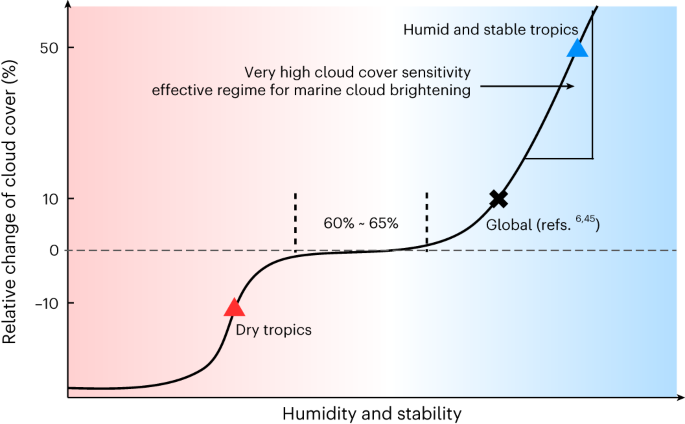
RESEARCH PAPERSSubstantial cooling effect from aerosol-induced increase in
tropical marine cloud cover
<https://www.nature.com/articles/s41561-024-01427-z>
Chen, Y., Haywood, J., Wang, Y., Malavelle, F., Jordan, G., Peace, A., ...
& Lohmann, U. (2024). Substantial cooling effect from aerosol-induced
increase in tropical marine cloud cover. *Nature Geoscience*, 1-7.

*Abstract*

With global warming currently standing at approximately +1.2 °C since
pre-industrial times, climate change is a pressing global issue. Marine
cloud brightening is one proposed method to tackle warming through
injecting aerosols into marine clouds to enhance their reflectivity and
thereby planetary albedo. However, because it is unclear how aerosols
influence clouds, especially cloud cover, both climate projections and the
effectiveness of marine cloud brightening remain uncertain. Here we use
satellite observations of volcanic eruptions in Hawaii to quantify the
aerosol fingerprint on tropical marine clouds. We observe a large
enhancement in reflected sunlight, mainly due to an aerosol-induced
increase in cloud cover. This observed strong negative aerosol forcing
suggests that the current level of global warming is driven by a weaker net
radiative forcing than previously thought, arising from the competing
effects of greenhouse gases and aerosols. This implies a greater
sensitivity of Earth’s climate to radiative forcing and therefore a larger
warming response to both rising greenhouse gas concentrations and
reductions in atmospheric aerosols due to air quality measures. However,
our findings also indicate that mitigation of global warming via marine
cloud brightening is plausible and is most effective in humid and stable
conditions in the tropics where solar radiation is strong.

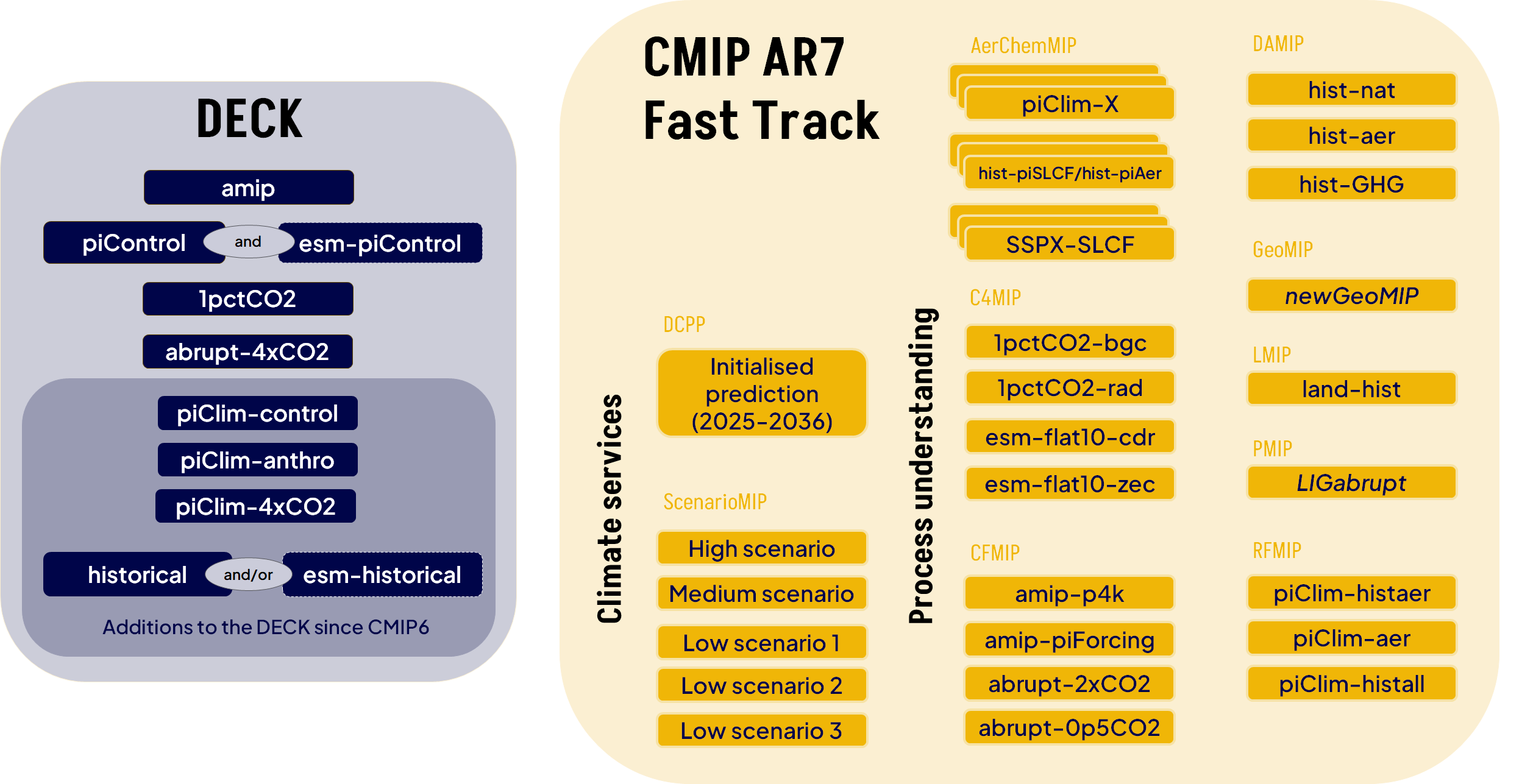
G6-1.5K-SAI: a new Geoengineering Model Intercomparison Project (GeoMIP)
experiment integrating recent advances in solar radiation modification
studies <https://gmd.copernicus.org/articles/17/2583/2024/>

Visioni, D., Robock, A., Haywood, J., Henry, M., Tilmes, S., MacMartin, D.
G., ... & Egbebiyi, T. S. (2023). G6-1.5 K-SAI: a new Geoengineering Model
Intercomparison Project (GeoMIP) experiment integrating recent advances in
solar radiation modification studies. *EGUsphere*, *2023*, 1-21.

*Abstract*

The Geoengineering Model Intercomparison Project (GeoMIP) has proposed
multiple model experiments during phases 5 and 6 of the Climate Model
Intercomparison Project (CMIP), with the latest set of model experiments
proposed in 2015. With phase 7 of CMIP in preparation and with multiple
efforts ongoing to better explore the potential space of outcomes for
different solar radiation modifications (SRMs) both in terms of deployment
strategies and scenarios and in terms of potential impacts, the GeoMIP
community has identified the need to propose and conduct a new experiment
that could serve as a bridge between past iterations and future CMIP7
experiments. Here we report the details of such a proposed experiment,
named G6-1.5K-SAI, to be conducted with the current generation of scenarios
and models from CMIP6 and clarify the reasoning behind many of the new
choices introduced. Namely, compared to the CMIP6 GeoMIP scenario G6sulfur,
we decided on (1) an intermediate emission scenario as a baseline (the
Shared Socioeconomic Pathway 2-4.5), (2) a start date set in the future
that includes both considerations for the likelihood of exceeding 1.5 °C
above preindustrial levels and some considerations for a likely start date
for an SRM implementation, and (3) a deployment strategy for stratospheric
aerosol injection that does not inject in the tropical pipe in order to
obtain a more latitudinally uniform aerosol distribution. We also offer
more details regarding the preferred experiment length and number of
ensemble members and include potential options for second-tier experiments
that some modeling groups might want to run. The specifics of the proposed
experiment will further allow for a more direct comparison between results
obtained from CMIP6 models and those obtained from future.

Climate engineering by Passive daytime radiative cooling: Moving beyond
materials towards real-world applications
<https://doi.org/10.1016/j.nxener.2024.100121>

Aili, A., Jiang, T., Chen, J., Wen, Y., Yang, R., Yin, X., & Tan, G.
(2024). Passive daytime radiative cooling: Moving beyond materials towards
real-world applications. *Next Energy*, *3*, 100121.

*Abstract*

Passive daytime radiative cooling has emerged as a promising sustainable
technique for meeting ever-growing demand for cooling across multiple
sectors. Although a number of review articles have reported fundamental
mechanisms and materials developments of daytime radiative cooling, reviews
on its current and potential applications have been limited to specific
scenarios such as building energy saving. Thus, to the best of our
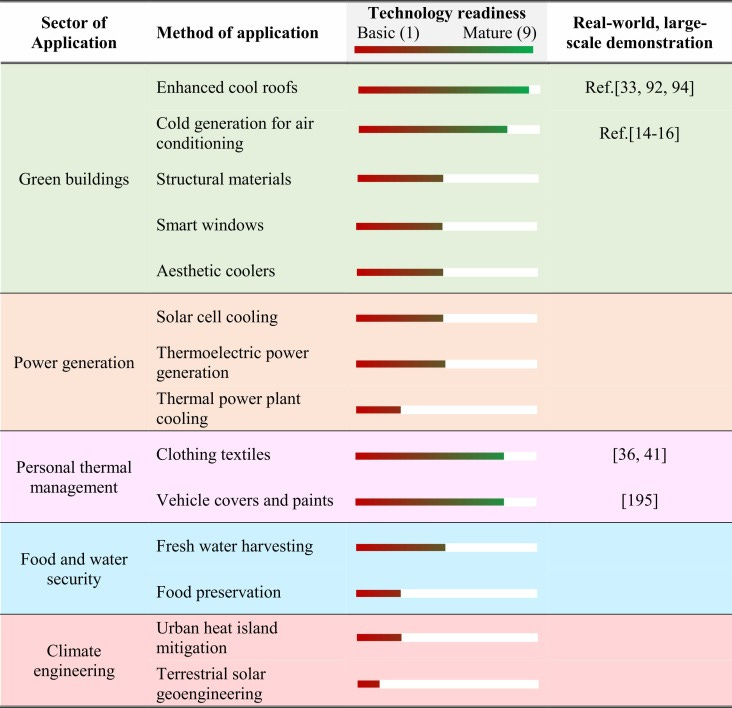
knowledge, here we summarize and discuss a comprehensive list of most
current and potential applications of passive daytime radiative cooling to
broaden horizons in this technology. First, from a materials perspective,
we briefly summarize approaches to creating high solar reflectance and high
emissivity in the atmospheric window of 8–13 µm. We then present
applications in five major categories, each with several sub-categories,
and discus each application with selective articles. Based on the
availability of real-world demonstrations and developments in
commercialization, we qualitatively assess the technology readiness levels
of these applications, highlighting future directions that need more
attention. This review offers one-stop access to a comprehensive summary of
passive radiative cooling applications along with recent progress and
future opportunities.

Rethinking the susceptibility-based strategy for marine cloud brightening
climate intervention: experiment with CESM2 and its implications
<https://essopenarchive.org/doi/full/10.22541/essoar.171201044.45268441/v1>

Chen, C. C., Richter, J. H., Lee, W., MacMartin, D. G., & Kravitz, B.
(2024). Rethinking the susceptibility-based strategy for marine cloud
brightening climate intervention: experiment with CESM2 and its
implications. *Authorea Preprints*.

*Abstract*

Previous modeling studies indicate that even though marine cloud
brightening under a susceptibility-based strategy is effective in reducing
the global average surface temperature, it triggers a La Niña-like
sea-surface temperature response with cooling mostly confined within lower
latitudes. Here we explore a different cloud seeding strategy involving
seeding of regions with low susceptibility. Simulations with the Community
Earth System Model, version 2 (CESM2) reveal that because the regional
forcing is weaker and more widespread, cooling is more evenly distributed
over the globe. This new strategy also does not result in the La Niña-like
state seen in the other strategies.

Moral hazards and solar radiation management: Evidence from a large-scale
online experiment
<https://www.sciencedirect.com/science/article/pii/S0272494424000616>

Schoenegger, P., & Mintz-Woo, K. (2024). Moral hazards and solar radiation
management: Evidence from a large-scale online experiment. *Journal of
Environmental Psychology*, 102288.

*Abstract*

Solar radiation management (SRM) may help to reduce the negative outcomes
of climate change by minimising or reversing global warming. However, many
express the worry that SRM may pose a moral hazard, i.e., that information
about SRM may lead to a reduction in climate change mitigation efforts. In
this paper, we report a large-scale preregistered, money-incentivised,
online experiment with a representative US sample (N = 2284). We compare
actual behaviour (donations to climate change charities and clicks on
climate change petition links) as well as stated preferences (support for a
carbon tax and self-reported intentions to reduce emissions) between
participants who receive information about SRM with two control groups (a
salience control that includes information about climate change generally
and a content control that includes information about a different topic).
Behavioural choices are made with an earned real-money endowment, and
stated preference responses are incentivised via the Bayesian Truth Serum.
We fail to find a significant impact of receiving information about SRM
and, based on equivalence tests, we provide evidence in favour of the
absence of a meaningfully large effect. Our results thus provide evidence
for the claim that there is no detectable moral hazard with respect to SRM.

Australia, we need to talk about solar geoengineering
<https://www.tandfonline.com/doi/full/10.1080/10357718.2024.2333811>

Symons, J., Fung, C., Jayaram, D., Kabbej, S., & McDonald, M. (2024).
Australia, we need to talk about solar geoengineering. *Australian Journal
of International Affairs*, 1-6.

*Abstract*

Solar geoengineering is a deeply controversial idea. It is now well
understood that growing atmospheric concentrations of greenhouse gases have
placed the global climate in a perilous and unprecedented situation. Solar
geoengineering is either a dangerous distraction from the urgent work of
decarbonising economic process, or possibly a flawed, imperfect and partial
response that might limit climate harms while the international community
gets serious about urgent mitigation action.

While Australia and its neighbours are among the most climate-vulnerable
countries, they are currently among the least informed about the possible
consequences of solar geoengineering. Australian climate scientists are
well represented among scholars modelling solar geoengineering scenarios.
However, to date there has been no effort to detail implications for
Australia. Regardless of whether Australia and its Pacific neighbours
ultimately support or oppose climate interventions, Australian
policy-makers and researchers need to start taking the potential
implications and governance of solar geoengineering seriously.

Side Effects of Sulfur-Based Geoengineering Due To Absorptivity of Sulfate
Aerosols <https://agupubs.onlinelibrary.wiley.com/doi/10.1029/2023GL107285>

Wunderlin, E., Chiodo, G., Sukhodolov, T., Vattioni, S., Visioni, D., &
Tilmes, S. (2024). Side effects of sulfur‐based geoengineering due to
absorptivity of sulfate aerosols. *Geophysical Research Letters*, *51*(4),
e2023GL107285.

*Abstract*

Sulfur-based stratospheric aerosol intervention (SAI) can cool the climate,
but also heats the tropical lower stratosphere if done with injections at
low latitudes. We explore the role of this heating in the climate response
to SAI, by using mechanistic experiments that remove the effects of
longwave absorption of sulfate aerosols above the tropopause. If longwave
absorption by stratospheric aerosols is disabled, the heating of the
tropical tropopause and most of the related side effects are strongly
alleviated and the cooling per Tg-S injected is 40% bigger. Such
side-effects include the poleward expansion of eddy-driven jets,
acceleration of the stratospheric residual circulation, and delay of
Antarctic ozone recovery. Our results add to other recent findings on SAI
side effects and demonstrate that SAI scenarios with low-latitude
injections of absorptive materials may result in atmospheric effects and
regional climate changes that are comparable to those produced by the CO2
warming signal.

Solar Geoengineering, Free-Driving and Conflict: An Experimental
Investigation <https://link.springer.com/article/10.1007/s10640-024-00854-1>

Cherry, T. L., Kroll, S., McEvoy, D. M., & Campoverde, D. (2024). Solar
Geoengineering, Free-Driving and Conflict: An Experimental
Investigation. *Environmental
and Resource Economics*, 1-16.

*Abstract*

As the international community continues to fall short on reducing
emissions to avoid disastrous impacts of climate change, some scientists
have called for more research into solar geoengineering (SGE) as a
potential temporary fix. Others, however, have adamantly rejected the
notion of considering SGE in climate policy discussions. One prominent
concern with considering SGE technologies to help manage climate change is
the so-called “free driver” conjecture. The prediction is that among
countries with different preferences for the level of SGE, the country that
prefers the most will deploy levels higher than the global optimum. This
paper tests the free-driver hypothesis experimentally under different
conditions and institutions. We find that aggregate deployment of SGE is
inefficiently high in all settings, but slightly less so when players are
heterogeneous in endowments or when aggregate deployment is determined by a
best-shot technology. Despite persistent inefficiencies in SGE deployment,
free-driver behavior, on average, is less extreme than the theoretical
predictions.

<https://substackcdn.com/image/fetch/f_auto,q_auto:good,fl_progressive:steep/https%3A%2F%2Fsubstack-post-media.s3.amazonaws.com%2Fpublic%2Fimages%2F3eae9bd3-b0cb-45d9-97e3-7ba6d29c1940_2497x1287.png>
Visioni,
D., Robock, A., Haywood, J., Henry, M., Tilmes, S., MacMartin, D. G., ... &
Egbebiyi, T. S. (2023). G6-1.5 K-SAI: a new Geoengineering Model
Intercomparison Project (GeoMIP) experiment integrating recent advances in
solar radiation modification studies.
<https://gmd.copernicus.org/articles/17/2583/2024/>*EGUsphere
<https://gmd.copernicus.org/articles/17/2583/2024/>*,
<https://gmd.copernicus.org/articles/17/2583/2024/>*2023
<https://gmd.copernicus.org/articles/17/2583/2024/>*, 1-21.
<https://gmd.copernicus.org/articles/17/2583/2024/>
[image: figure 4]
<https://substackcdn.com/image/fetch/f_auto,q_auto:good,fl_progressive:steep/https%3A%2F%2Fsubstack-post-media.s3.amazonaws.com%2Fpublic%2Fimages%2Fe38c9c41-6565-41f8-98c8-5744833b2414_685x424.png>
Chen,
Y., Haywood, J., Wang, Y., Malavelle, F., Jordan, G., Peace, A., ... &
Lohmann, U. (2024). Substantial cooling effect from aerosol-induced
increase in tropical marine cloud cover.
<https://www.nature.com/articles/s41561-024-01427-z>*Nature Geoscience
<https://www.nature.com/articles/s41561-024-01427-z>*, 1-7.
<https://www.nature.com/articles/s41561-024-01427-z>
<https://www.sciencedirect.com/science/article/pii/S2949821X24000267?via%3Dihub#fig0010>
[image: Image 1]
<https://substackcdn.com/image/fetch/f_auto,q_auto:good,fl_progressive:steep/https%3A%2F%2Fsubstack-post-media.s3.amazonaws.com%2Fpublic%2Fimages%2F79a27398-b7a7-424e-9743-4f8a81126078_732x708.jpeg>
Aili,
A., Jiang, T., Chen, J., Wen, Y., Yang, R., Yin, X., & Tan, G. (2024).
Passive daytime radiative cooling: Moving beyond materials towards
real-world applications.
<https://www.sciencedirect.com/science/article/pii/S2949821X24000267?via%3Dihub#fig0010>*Next
Energy
<https://www.sciencedirect.com/science/article/pii/S2949821X24000267?via%3Dihub#fig0010>*,
<https://www.sciencedirect.com/science/article/pii/S2949821X24000267?via%3Dihub#fig0010>*3
<https://www.sciencedirect.com/science/article/pii/S2949821X24000267?via%3Dihub#fig0010>*,
100121.
<https://www.sciencedirect.com/science/article/pii/S2949821X24000267?via%3Dihub#fig0010>
------------------------------
WEB POSTSThe inadvertent geoengineering experiment that the world is now
shutting off
<https://www.technologyreview.com/2024/04/11/1091087/the-inadvertent-geoengineering-experiment-that-the-world-is-now-shutting-off/>
(MIT Technology Review)What values do SRM researchers share? (Plan A+)
Plan A+
What values do SRM researchers share?
<https://peteirvine.substack.com/p/what-values-do-srm-researchers-share?utm_source=substack&utm_campaign=post_embed&utm_medium=email>
What motivates researchers studying SRM and what values do they bring to
their work? There are different kinds of researchers with different kinds
of motivations working on SRM, but here I’ll focus on what I consider to be
mainstream SRM scientists. These are researchers, like myself, who are
working to develop an evidence base on which future decisions…
Read more
<https://peteirvine.substack.com/p/what-values-do-srm-researchers-share?utm_source=substack&utm_campaign=post_embed&utm_medium=email>
5 days ago · 2 likes · 1 comment · Pete Irvine
Staring at the Sun
<https://www.epfl.ch/schools/cdh/alice-bucknell-staring-at-the-sun/> (EPFL)

"Staring at the Sun is a research project and multimedia “sci-fi
documentary” that’s rooted within an urgent unfolding dialogue around
planetary-scale climate modification projects. Toggling across scales,
political agendas, technologies, and temporalities, it aims to critically
examine contemporary solar geoengineering proposals including stratospheric
aerosol injection (SAI) that are currently undergoing research development
in both the United States and the European Union."

------------------------------
*UPCOMING EVENTS*(NEW) Dr Alan Gadian on Marine Cloud Brightening by HPAC
<https://groups.google.com/g/geoengineering/c/G8Q1jYlj7d0> | 18 April
2024*Solar
Radiation Modification, Clouds, Aerosols, and their Impacts on the
Biosphere and Earth System | EGU General Assembly
<https://meetingorganizer.copernicus.org/EGU24/session/49142> | 18 April
2024**Fourteenth GeoMIP Workshop | Ithaca, USA
<https://climate.envsci.rutgers.edu/GeoMIP/2024.html> | 10-12 July 2024*

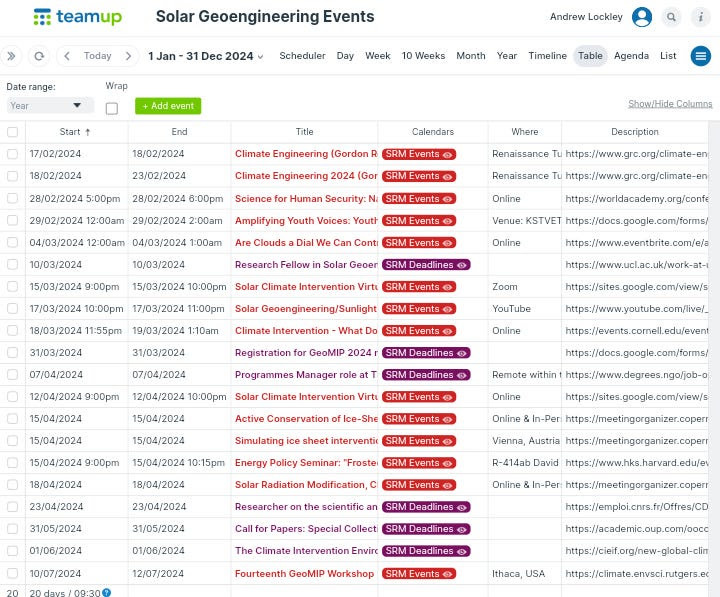
Solar Geoengineering Events Calendar <https://teamup.com/ks64mmvtit583eitxx>

*GUIDELINES:**Sync selected events to your default calendar in these simple
steps:**1) Click on the event you want to sync.**2) Tap the menu icon
(three vertical lines) at the top left.**3) Choose 'Share.'**4) Pick your
default calendar.**5) Save the event.*

*Sync the entire Teamup Calendar to your default calendar with these simple
steps:**1) Tap the menu icon (three vertical lines) at the top right.**2)
Choose 'Preferences.'**3) Click 'iCalendar Feeds.'**4) Copy the URL shown
for 'Solar Geoengineering Events / SRM Deadlines.'’**5) Paste the URL into
your default calendar settings (Open Google Calendar in your web browser if
you are using Gcal).**6) Click 'Subscribe' or 'Add Calendar.'*

*For more detailed instructions,
visit: https://calendar.teamup.com/kb/subscribe-to-teamup-icalendar-feeds/
<https://calendar.teamup.com/kb/subscribe-to-teamup-icalendar-feeds/>*

*You can directly sync all Solar Geoengineering events to your default
calendars by pressing the link below:*

Sync SG Events to your Default Calendar
<https://ics.teamup.com/feed/ks64mmvtit583eitxx/0.ics>
<https://substackcdn.com/image/fetch/f_auto,q_auto:good,fl_progressive:steep/https%3A%2F%2Fsubstack-post-media.s3.amazonaws.com%2Fpublic%2Fimages%2Fd7600ecb-75e0-42fd-9fb0-b3e9614a6b08_720x597.jpeg>
Solar
Geoengineering Events Calendar <https://teamup.com/ks64mmvtit583eitxx>
------------------------------
*DEADLINES*(NEW) DSG's Early Career Researchers Network
<https://docs.google.com/forms/d/e/1FAIpQLSfrW3sFDl7XjJ3jB6oMEMj2CBTfAPHQSklnAbnDeU_1quwYHQ/viewform>
| Survey Closes on 19 April 2024

"DSG’s Youth Engagement program seeks to provide young people, especially
those from climate-vulnerable regions, with access to diverse and
science-based information to enable constructive engagement in deliberation
about solar geoengineering.
Their first step in building the Early Career Researchers Network is to
understand how it would be most useful to young researchers. To that end,
they’ve developed a survey to gather information on ideas and needs."

------------------------------
YOUTUBE VIDEOSSandro Vattioni: Risks and benefits of climate intervention
via stratospheric aerosol injection | NCAR Atmospheric Chemistry
Observations & Modeling <https://www.youtube.com/watch?v=GaPhaqsqGrw>

"Abstract: Recent studies have suggested that injection of solid particles
such as alumina and calcite instead of SO2 for climate intervention via
stratospheric aerosol injection (SAI) could reduce some of the adverse side
effects of SAI such as ozone depletion and stratospheric heating. However,
the expected improvements are subject to large uncertainties. We constrain
some of these uncertainties by experimental work on calcite particles using
elastic recoil detection analysis and in-situ X-ray photoelectron
spectroscopy. Subsequently, we use a global aerosol-chemistry-climate model
that, for the first time, interactively couples microphysical and chemical
processes of solid particles as well as sulfuric acid aerosols with model
radiation and transport. Notably, SAI by solid particles only leads to more
effective radiative forcing per aerosol burden compared to sulfur-based
SAI, not per injected mass. However, reduced stratospheric warming remains
a major advantage of solid particles. Furthermore, different assumptions on
the heterogeneous chemistry of solid particles, based on the available
experimental data, result in drastically different impacts on stratospheric
ozone layer. For alumina particles, which are thought to not undergo
chemical aging in the stratosphere we present a sensitivity analysis of the
ozone response to quantify uncertainty. For the alkaline calcite particles,
which are thought to undergo chemical aging in the stratosphere via
reaction with acids we find even larger uncertainties due to unknown
reaction pathways and highly uncertain rates under stratospheric
conditions. Uncertainty in predicted stratospheric ozone changes can only
be reduced via additional laboratory experiments under stratospheric
conditions."

The USA's first solar geo-engineering test | The Laughington Post
<https://www.youtube.com/watch?v=W6wvHo0M3c4>

"The first outdoor test to limit global warming by increasing #cloud cover.
The experiment, which organizers did not widely announce to avoid public
backlash, marks the acceleration of a contentious field of research known
as “solar radiation modification”. The concept involves shooting substances
such as aerosols into the sky to reflect sunlight away from the Earth."

Marine Cloud Brightening - Tribute to Stephen Salter | Climate Emergency
Forum <https://www.youtube.com/watch?v=clYtK2tuCmU>

"The Climate Emergency Forum hosts a discussion about the late Stephen
Salter, a pioneering professor of engineering at the University of
Edinburgh, and his work on marine cloud brightening (MCB) as a potential
solution for mitigating global warming.

This video was recorded on March 27th, 2024, and published on April 14th,
2024.

The participants reflect on Salter's innovative ideas and creative mindset.
A key focus is Salter's proposal to use a fleet of unmanned ships to spray
fine sea water droplets into marine clouds to increase their reflectivity
and albedo, thereby reflecting more sunlight back into space and cooling
the planet. Salter provided calculations on the number of ships needed for
different cooling goals, such as reversing sea level rise or preserving
Arctic ice. The dialogue highlights the relatively low cost and scalability
of this approach versus other geoengineering methods.

The participants emphasize the need for solutions like MCB, given the
rapidly worsening climate crisis. However, they also acknowledge the public
opposition and lack of media coverage around such unconventional
approaches. They stress the importance of engaging in broader
conversations, good governance, and bringing the public on board through
strategic communication efforts to explain the vision and overcome the code
of silence around these topics in mainstream discourse.

Overall, the dialogue serves as a tribute to Salter's innovative work while
underscoring the potential of marine cloud brightening as a viable,
affordable, and environmentally-friendly way to help mitigate global
warming, if implemented responsibly and with proper public support."

Can Mirrors on the Ground Cool the Earth? w/ Dr. Ye Tao, Founder of
MEER.org | Climate Chat <https://www.youtube.com/watch?v=39kBw4UiN0o>

"In this Climate Chat episode, we interview Dr. Ye Tao, the founder and
Executive Director of MEER.org. MEER stands for "Mirrors for Earth's Energy
Rebalancing." Dr. Tao proposes deploying mirrors on the ground (or oceans)
to reflect sunlight back into space in order to reduce Earth's Energy
Imbalance and cool the Earth. We will discuss the scale of mirrors needed
to reverse the impacts of greenhouse gas warming as well as feasibility,
cost, and side effects of implementing MEER. Besides full-scale deployment,
Dr. Tao believes there are benefits to deploying smaller scale mirror
systems.

Dr. Tao also has interesting takes on other climate-related issues such as
the side effects of renewable energy systems, low cost ways to implement
Carbon Dioxide Removal (CDR), and the climate path we are on if we do not
implement MEER or some other form of Sunlight Reflection Methods (SRM)."

<https://carbonremovalupdates.substack.com/account>

--
You received this message because you are subscribed to the Google Groups
"geoengineering" group.
To unsubscribe from this group and stop receiving emails from it, send an email
to [email protected].
To view this discussion on the web visit
https://groups.google.com/d/msgid/geoengineering/CAHJsh9-1qoA_-jgyotd8TMR%3D5iE%3DmUSS%2BnWP3BqpKndNOPsT4Q%40mail.gmail.com.