SOLAR GEOENGINEERING WEEKLY SUMMARY (20 MAY - 26 MAY 2024)

Subscribe to our newsletter to receive monthly updates on Solar
Geoengineering:
Solar Geoengineering Updates
<https://solargeoengineeringupdates.substack.com?utm_source=substack&utm_campaign=publication_embed&utm_medium=email>
Monthly news summaries about solar geoengineering. Links to scientific
papers, news articles, jobs, podcasts, and videos.
<https://solargeoengineeringupdates.substack.com?utm_source=substack&utm_campaign=publication_embed&utm_medium=email>
By Andrew Lockley
<https://solargeoengineeringupdates.substack.com?utm_source=substack&utm_campaign=publication_embed&utm_medium=email>
------------------------------
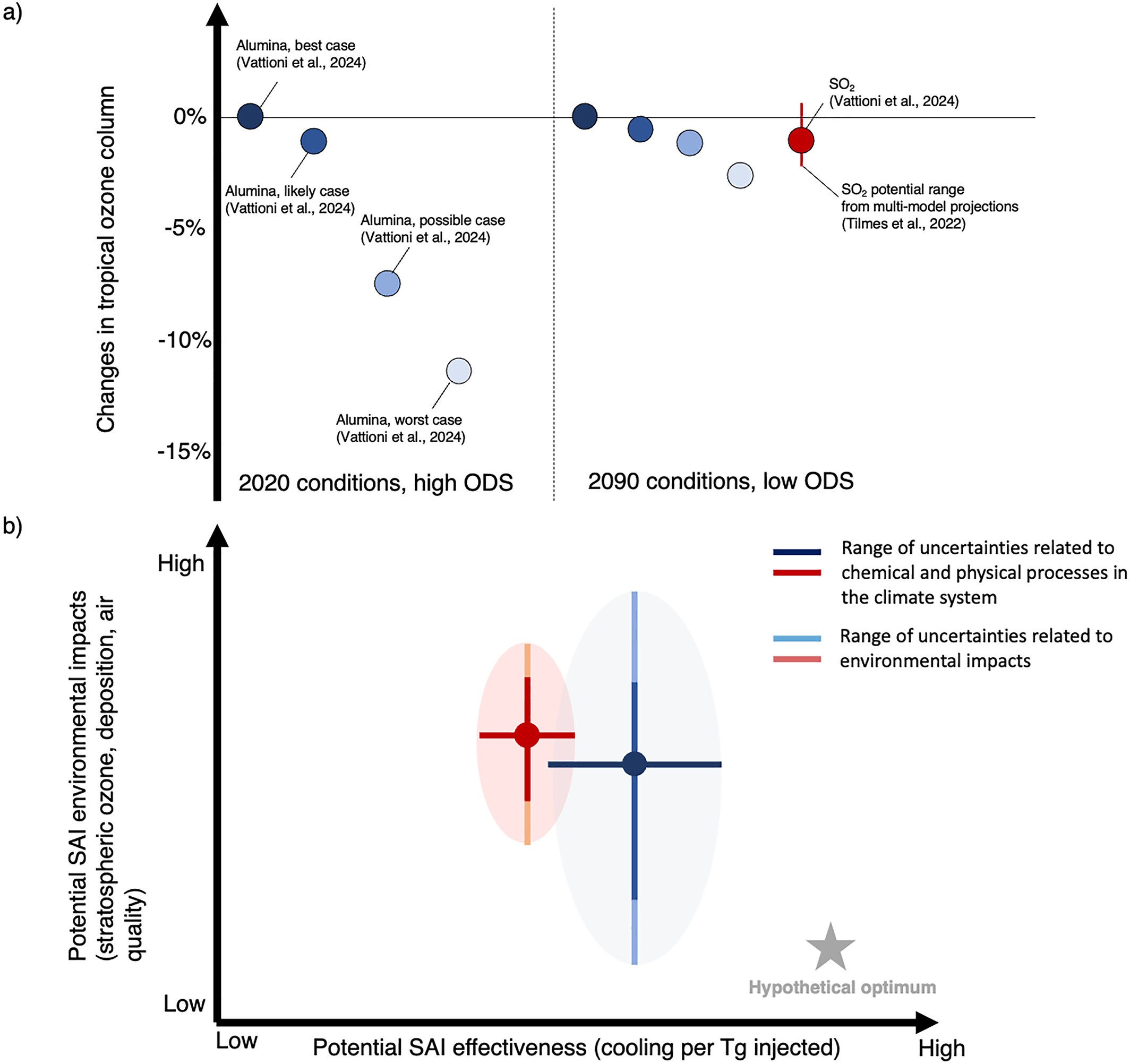
RESEARCH PAPERSA Living Assessment of Different Materials for Stratospheric
Aerosol Injection—Building Bridges Between Model World and the Messiness of
Reality
<https://agupubs.onlinelibrary.wiley.com/doi/full/10.1029/2024GL108314>
Visioni, D., Quaglia, I., & Steinke, I. (2024). A living assessment of
different materials for stratospheric aerosol injection—Building bridges
between model world and the messiness of reality. *Geophysical Research
Letters*, *51*(10), e2024GL108314.

*Abstract*

There are obstacles in better understanding the climate impacts associated
with new materials that could be used for Stratospheric Aerosol Injections
(SAI), like the lack of an integrated framework that combines climate
modeling across scales, laboratory studies and small-scale field
experiments. Vattioni et al. (2023, https://doi.org/10.1029/2023gl105889)
explored one aspect of using alternative, non-sulfate materials for SAI.
They investigated how uncertain the response of stratospheric ozone would
be to alumina injections for SAI. In their study, they quantify chlorine
activation rates in the presence of alumina, and then cascade these
uncertainties into estimates of ozone depletion, concluding that alumina
might have less detrimental impacts on stratospheric chemistry than
sulfate, but with large uncertainties. Their results provide a useful basis
upon which future research endeavors combining indoor and outdoor
experiments and modeling may be structured to produce robust assessments of
SAI impacts, benefits and uncertainties, together with clarifying what kind
of research needs to be prioritized.

Dependency of the impacts of geoengineering on the stratospheric sulfur
injection strategy – Part 2: How changes in the hydrological cycle depend
on the injection rate and model used
<https://helda.helsinki.fi/items/b1ada402-ac01-413b-bc5b-80faac462218>

Laakso, A., Visioni, D., Niemeier, U., Tilmes, S., & Kokkola, H. (2024).
Dependency of the impacts of geoengineering on the stratospheric sulfur
injection strategy–Part 2: How changes in the hydrological cycle depend on
the injection rate and model used. *Earth System Dynamics*, *15*(2),
405-427.

*Abstract*

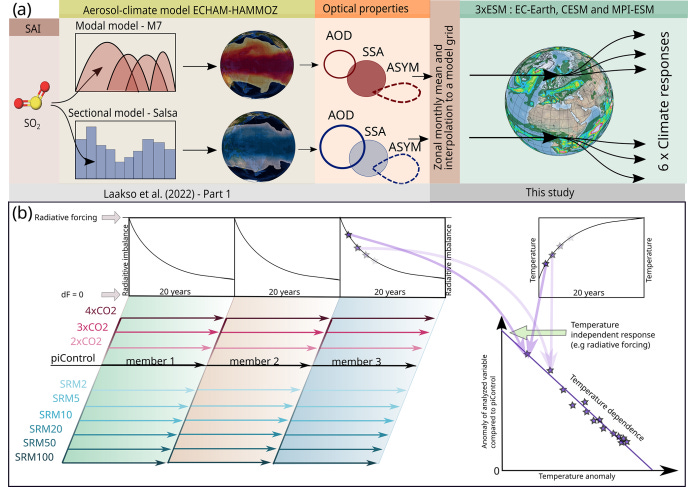
This is the second of two papers in which we study the dependency of the
impacts of stratospheric sulfur injections on the model and injection
strategy used. Here, aerosol optical properties from simulated
stratospheric aerosol injections using two aerosol models (modal scheme M7
and sectional scheme SALSA), as described in Part 1 (Laakso et al., 2022),
are implemented consistently into the EC-Earth, MPI-ESM and CESM Earth
system models (ESMs) to simulate the climate impacts of different injection
rates ranging from 2 to 100 Tg(S) yr−1. Two sets of simulations were run
with the three ESMs: (1) regression simulations, in which an abrupt change
in CO2 concentration or stratospheric aerosols over pre-industrial
conditions was applied to quantify global mean fast temperature-independent
climate responses and quasi-linear dependence on temperature, and (2)
equilibrium simulations, in which radiative forcing of aerosol injections
with various magnitudes compensated for the corresponding radiative forcing
of CO2 enhancement to study the dependence of precipitation on the
injection magnitude. The latter also allow one to explore the regional
climatic responses. Large differences in SALSA- and M7-simulated radiative
forcing in Part 1 translated into large differences in the estimated
surface temperature and precipitation changes in ESM simulations; for
example, an injection rate of 20 Tg(S) yr−1 in CESM using M7-simulated
aerosols led to only 2.2 K global mean cooling, while EC-Earth–SALSA
combination produced a 5.2 K change. In equilibrium simulations, where
aerosol injections were utilized to offset the radiative forcing caused by
an atmospheric CO2 concentration of 500 ppm, the decrease in global mean
precipitation varied among models, ranging from −0.7% to −2.4% compared
with the pre-industrial climate. These precipitation changes can be
explained by the fast precipitation response due to radiation changes
caused by the stratospheric aerosols and CO2, as the global mean fast
precipitation response is shown to be negatively correlated with global
mean atmospheric absorption. Our study shows that estimating the impact of
stratospheric aerosol injection on climate is not straightforward. This is
because the simulated capability of the sulfate layer to reflect solar
radiation and absorb long-wave radiation is sensitive to the injection rate
as well as the aerosol model used to simulate the aerosol field. These
findings emphasize the necessity for precise simulation of aerosol
microphysics to accurately estimate the climate impacts of stratospheric
sulfur intervention. This study also reveals gaps in our understanding and
uncertainties that still exist related to these controversial techniques.

High-resolution stratospheric volcanic SO2 injections in WACCM
<https://egusphere.copernicus.org/preprints/2024/egusphere-2024-1448/>

Axebrink, E., Sporre, M. K., & Friberg, J. (2024). High-resolution
stratospheric volcanic SO 2 injections in WACCM. *EGUsphere*, *2024*, 1-19.

*Abstract*

Aerosols from volcanic eruptions impact our climate by influencing the
Earth’s radiative balance. The degree of their climate impact is determined
by the location and injection altitude of the volcanic SO2. To investigate
the importance of utilizing correct injection altitudes we ran climate
simulations of the June 2009 Sarychev eruptions with three SO2 datasets, in
the Community Earth System Model Version 2 (CESM2) Whole Atmosphere
Community Climate Model Version 6 (WACCM6). We have compared simulations
with WACCM’s default 1 km vertically resolved dataset M16 with our two 200
m vertically resolved datasets, S21-3D and S21-1D. The S21-3D is
distributed over a large area (30 latitudes and 120 longitudes), whereas
S21-1D releases all SO2 in one latitude and longitude grid-box, mimicking
the default dataset M16.

For S21-1D and S21-3D, 95 % of the SO2 was injected into the stratosphere,
whereas M16 injected only 75 % to the stratosphere. This difference is due
to the different vertical distribution and resolution of SO2 in the
datasets. The larger portion of SO2 injected into the stratosphere for the
S21 datasets leads to more than twice as high sulfate aerosol load in the
stratosphere for the S21-3D simulation compared to the M16 simulation
during more than 8 months. The temporal evolution in AOD from two of our
simulations, S21-3D and S21-1D, follows the observations from the
space-borne lidar instrument CALIOP closely, while the AOD in the M16
simulation is substantially lower. This indicates that the injection
altitude and vertical resolution of the injected volcanic SO2 substantially
impact the model’s ability to correctly simulate the climate impact from
volcanic eruptions.

The S21-3D dataset with the high vertical and horizontal resolution
resulted in global volcanic forcing of -0.24 W/m2 during the first year
after the eruptions, compared with only -0.11 W/m2 for M16. Hence, our
study high-lights the importance of using high-vertically resolved SO2 data
in simulations of volcanic climate impact, and calls for a re-evaluation of
further volcanic eruptions.

Sensitivities of Marine Cloud Brightening Studied with a Lagrangian Cloud
Model <https://meetingorganizer.copernicus.org/EGU24/EGU24-4114.html>

Rowland, Z. C., Hoffmann, F., Glassmeier, F., Steinke, I., & Russchenberg,
H. (2024). *Sensitivities of Marine Cloud Brightening Studied with a
Lagrangian Cloud Model* (No. EGU24-4114). Copernicus Meetings.

*Abstract*

Marine cloud brightening (MCB) is a proposed climate engineering technique
in which shallow liquid clouds are deliberately seeded with aerosol
particles to increase their albedo and lifetime. Development of accurate
models is essential to assess the feasibility of MCB; however, this is
complicated by the large number of interacting microphysical processes that
occur during cloud formation and the many environmental parameters that
influence them. To simulate these microphysical processes in the required
detail, a Lagrangian cloud model has been coupled to a simple adiabatic
parcel model for this study.

Using this modelling framework, a sensitivity analysis is performed to
determine the susceptibility of MCB to the aerosol particle size
distribution, meteorological conditions, and several cloud microphysical
choices. Attention is paid to the effect of varying the number of giant
cloud condensation nuclei (GCCN) in the aerosol distribution, as these are
known to enhance precipitation, with potentially deleterious effects to
MCB. The results of this analysis provide insight for understanding the
susceptibility of cloud formation to environmental conditions and practical
considerations for any possible future MCB implementation.

Climate impact of marine cloud brightening solar climate intervention under
a susceptibility based strategy simulated by CESM2
<https://essopenarchive.org/doi/full/10.22541/essoar.171322700.02512514>

Chen, C. C., Richter, J. H., Lee, W. R., Tye, M. R., MacMartin, D. G., &
Kravitz, B. (2024). Climate impact of marine cloud brightening solar
climate intervention under a susceptibility based strategy simulated by
CESM2. *Authorea Preprints*.

*Abstract*

The efficiency of marine cloud brightening in cooling Earth’s surface
temperature is investigated by using a medium ensemble of simulations with
the Community Earth System Model version 2 (CESM2). Various cloud seeding
schemes based on susceptibility are examined to determine what area extent
will be required to induce 1oC cooling under SSP2-4.5. The results indicate
that cloud seeding over 5% of the ocean area is capable of achieving this
goal. Under this seeding scheme, cloud seeding is mainly deployed over
lower latitudes where strong surface temperature and precipitation
responses are induced. The simulations also reveal that the 5% cloud
seeding scheme induces an overall reduction in global precipitation, with
an increase over land and a decrease over the ocean.

<https://substackcdn.com/image/fetch/f_auto,q_auto:good,fl_progressive:steep/https%3A%2F%2Fsubstack-post-media.s3.amazonaws.com%2Fpublic%2Fimages%2F53893e18-7a40-4551-a0f5-2b5ed65605cc_2128x2004.jpeg>
Visioni,
D., Quaglia, I., & Steinke, I. (2024). A living assessment of different
materials for stratospheric aerosol injection—Building bridges between
model world and the messiness of reality.
<https://agupubs.onlinelibrary.wiley.com/doi/full/10.1029/2024GL108314>*Geophysical
Research Letters
<https://agupubs.onlinelibrary.wiley.com/doi/full/10.1029/2024GL108314>*,
<https://agupubs.onlinelibrary.wiley.com/doi/full/10.1029/2024GL108314>*51
<https://agupubs.onlinelibrary.wiley.com/doi/full/10.1029/2024GL108314>*(10),
e2024GL108314.
<https://agupubs.onlinelibrary.wiley.com/doi/full/10.1029/2024GL108314>
<https://substackcdn.com/image/fetch/f_auto,q_auto:good,fl_progressive:steep/https%3A%2F%2Fsubstack-post-media.s3.amazonaws.com%2Fpublic%2Fimages%2F016d7c21-7dea-43ac-af6c-3ce2f8abc5c2_690x491.png>
Laakso,
A., Visioni, D., Niemeier, U., Tilmes, S., & Kokkola, H. (2024). Dependency
of the impacts of geoengineering on the stratospheric sulfur injection
strategy–Part 2: How changes in the hydrological cycle depend on the
injection rate and model used.
<https://helda.helsinki.fi/items/b1ada402-ac01-413b-bc5b-80faac462218>*Earth
System Dynamics
<https://helda.helsinki.fi/items/b1ada402-ac01-413b-bc5b-80faac462218>*,
<https://helda.helsinki.fi/items/b1ada402-ac01-413b-bc5b-80faac462218>*15
<https://helda.helsinki.fi/items/b1ada402-ac01-413b-bc5b-80faac462218>*(2),
405-427.
<https://helda.helsinki.fi/items/b1ada402-ac01-413b-bc5b-80faac462218>
------------------------------
WEB POSTSA trial of cloud-brightening technology sparks controversy in a
California city
<https://www.nbcnews.com/science/environment/trial-cloud-brightening-controversy-california-rcna153092>
(NBC News)A Test of Cloud-Brightening Machines Poses No Health Risk,
Officials Say
<https://www.nytimes.com/2024/05/23/climate/cloud-brightening-geoengineering.html>
(The New York Times)From Pollution to Solution (Cremieux Recueil)
Cremieux Recueil
>From Pollution to Solution
<https://www.cremieux.xyz/p/from-pollution-to-solution?utm_source=substack&utm_campaign=post_embed&utm_medium=email>
Crémieux recently tweeted that peak pollution might have been reached.
Among the jubilant voices in the comments, there were a few casting a keen
eye towards the lack of sulfur dioxide (SO₂), a compound notorious for its
role in acid rain. Beyond its infamous reputation, SO₂ holds a lesser-known
potential as a powerful tool to combat global warming w…
Read more
<https://www.cremieux.xyz/p/from-pollution-to-solution?utm_source=substack&utm_campaign=post_embed&utm_medium=email>
3 days ago · 16 likes · 2 comments · Andrew Song
------------------------------
*UPCOMING EVENTS*(NEW) Healthy Planet Action Coalition meeting with Wouter
van Dieren and Hans van der Loo in conversation on International Climate
Cooling Coalition
<https://groups.google.com/g/healthy-planet-action-coalition/c/YQTQ-lpjfuk>
| 30 May 2024 | Online*Collaborative Futures of Climate Repair in the
Arctic by The Alliance for Just Deliberation on Solar Geoengineering
<https://docs.google.com/forms/d/e/1FAIpQLSfBrU9gN-sOz2FGSAzuk8jJGJO-Jcx6yaL11HhdFLfI31v77A/viewform>
| 31 May 2024 | Norway**RFF 2024 SRM Social Science Workshop: Cooperative
vs. Non-Cooperative Interventions
<https://docs.google.com/forms/d/1zE6Eo625cpEKZVbKwzDQSL4gxmnArmPsxtePJM-1SY0/viewform?edit_requested=true&gxid=-8203366>
| 19-20 September 2024 | Washington, DC.*

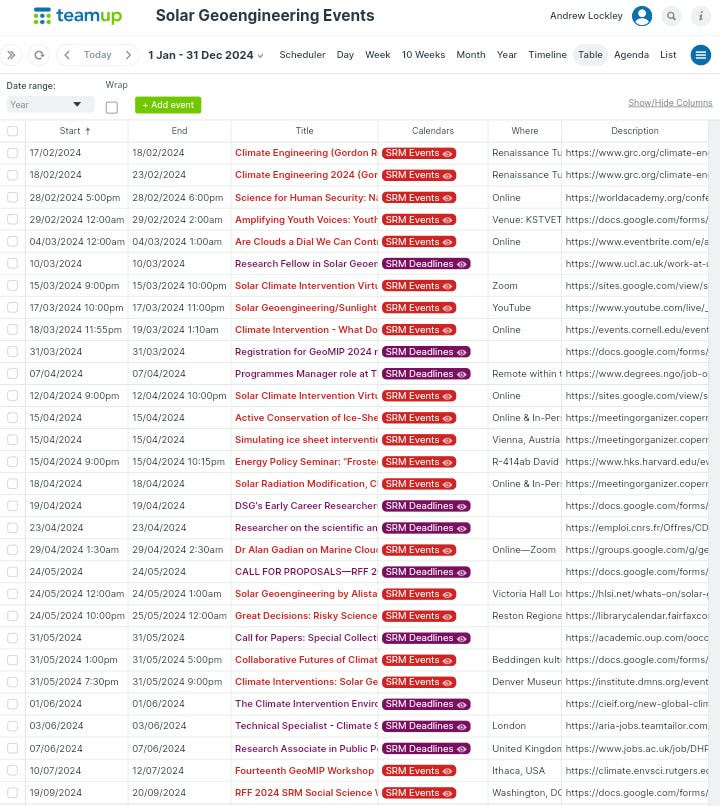
Solar Geoengineering Events Calendar <https://teamup.com/ks64mmvtit583eitxx>

*GUIDELINES:**Sync selected events to your default calendar in these simple
steps:**1) Click on the event you want to sync.**2) Tap the menu icon
(three vertical lines) at the top left.**3) Choose 'Share.'**4) Pick your
default calendar.**5) Save the event.*

*Sync the entire Teamup Calendar to your default calendar with these simple
steps:**1) Tap the menu icon (three vertical lines) at the top right.**2)
Choose 'Preferences.'**3) Click 'iCalendar Feeds.'**4) Copy the URL shown
for 'Solar Geoengineering Events / SRM Deadlines.'’**5) Paste the URL into
your default calendar settings (Open Google Calendar in your web browser if
you are using Gcal).**6) Click 'Subscribe' or 'Add Calendar.'*

*For more detailed instructions,
visit: https://calendar.teamup.com/kb/subscribe-to-teamup-icalendar-feeds/
<https://calendar.teamup.com/kb/subscribe-to-teamup-icalendar-feeds/>*

*You can directly sync all Solar Geoengineering events to your default
calendars by pressing the link below:*

Sync SG Events to your Default Calendar
<https://ics.teamup.com/feed/ks64mmvtit583eitxx/0.ics>
<https://substackcdn.com/image/fetch/f_auto,q_auto:good,fl_progressive:steep/https%3A%2F%2Fsubstack-post-media.s3.amazonaws.com%2Fpublic%2Fimages%2Fbfb8b20f-2c8f-42f7-b66f-9cfe58d95f2e_720x806.jpeg>
Solar
Geoengineering Events Calendar <https://teamup.com/ks64mmvtit583eitxx>
------------------------------
YOUTUBE VIDEOSClimate Interventions: Solar Geoengineering | The Institute
for Science & Policy <https://www.youtube.com/watch?v=8jHslQ1GFG0>

"In our three-part Climate Interventions series, we look at the scientific
understanding and uncertainties around a range of interventions to reduce
greenhouse gas emissions and cool the planet, along with a robust
discussion on ethics, risks, and governance.

In this session, we are exploring solar geoengineering approaches, also
known as solar radiation modification/management (SRM), which seek to cool
the planet by reflecting some of the incoming energy back to space. To
date, most of the research approaches have been restricted to computer
modeling. Some proponents, however, are looking to field experiments, and
perhaps ultimately, wide-scale deployment. While some options might help
ameliorate the impacts of climate change, they also might pose serious
risks. Join a panel of experts for breakfast at the Denver Museum of Nature
and Science exploring the latest deliberations around research, governance,
impacts, and more."

Can geoengineering help us solve climate change? | The Excerpt | USA TODAY
<https://www.youtube.com/watch?v=b05U8fBjtE8>

"As the world warms and aspirations to reach net-zero carbon emissions
slide further and further away, climate scientists and engineers are
looking at solutions, that to some, might sound like they’re straight out
of science fiction. By taking on climate control with technology, experts
say geoengineering can be a tool to help mitigate and remove greenhouse
gases from the climate system and may be essential to reducing global
temperatures. Wake Smith, author of “Pandora’s Toolbox: The Hopes and
Hazards of Climate Intervention,” and a lecturer at the Yale School of the
Environment, joins The Excerpt to discuss these developments in climate
intervention."

------------------------------
*DEADLINES**Call for Papers: Towards a Risk-Risk-Assessment of Solar
Radiation Modification: Effectiveness, Feasibility, Side effects,
Governance
<https://substack.com/redirect/8984e2ab-dd2f-4b65-ad88-be835e6efe5f?j=eyJ1IjoiMjJrMHl3In0.wQQsFypG52typ8FI2nhnJ8eUoUIIkdCkuhmzxNYKtgE>
|
Deadline for manuscript submissions: 31 May 2024**Climate Intervention
Environmental Impact Fund
<https://substack.com/redirect/8cd6566c-1d02-4bf1-9a81-04fc425e074f?j=eyJ1IjoiMjJrMHl3In0.wQQsFypG52typ8FI2nhnJ8eUoUIIkdCkuhmzxNYKtgE>
| Deadline
for applying: 01 June 2024*

--
You received this message because you are subscribed to the Google Groups
"geoengineering" group.
To unsubscribe from this group and stop receiving emails from it, send an email
to [email protected].
To view this discussion on the web visit
https://groups.google.com/d/msgid/geoengineering/CAHJsh9_Gkbi4DroOL0hAgETThk7rDw3X6nzgKN0wZ-zbCypAjQ%40mail.gmail.com.