*SOLAR GEOENGINEERING WEEKLY SUMMARY (27 MAY - 2 JUNE 2024)*

Subscribe to our newsletter to receive monthly updates on Solar
Geoengineering:
Solar Geoengineering Updates
<https://solargeoengineeringupdates.substack.com?utm_source=substack&utm_campaign=publication_embed&utm_medium=email>
Monthly news summaries about solar geoengineering. Links to scientific
papers, news articles, jobs, podcasts, and videos.
<https://solargeoengineeringupdates.substack.com?utm_source=substack&utm_campaign=publication_embed&utm_medium=email>
By Andrew Lockley
<https://solargeoengineeringupdates.substack.com?utm_source=substack&utm_campaign=publication_embed&utm_medium=email>
------------------------------
RESEARCH PAPERSStratospheric transport and tropospheric sink of solar
geoengineering aerosol: a Lagrangian analysis
<https://www.nature.com/articles/s41612-024-00664-8>
Sun, H., Bourguet, S., Luan, L., & Keith, D. (2024). Stratospheric
transport and tropospheric sink of solar geoengineering aerosol: a
Lagrangian analysis. *npj Climate and Atmospheric Science*, *7*(1), 115.

*Abstract*

Stratospheric aerosol injection (SAI) aims to reflect solar radiation by
increasing the stratospheric aerosol burden. To understand how the
background circulation influences stratospheric transport of injected
particles, we use a Lagrangian trajectory model (lacking numerical
diffusion) to quantify particles’ number, flux, lifetime, and tropospheric
sinks from a SAI injection strategy under present-day conditions. While
particles are being injected, stratospheric particle number increases until
reaching a steady-state. During the steady-state, the time series of
particle number shows a dominant period of ~2 years (rather than a 1-year
cycle), suggesting modulation by the quasi-biannual oscillation. More than
half of particles, injected in the tropical lower stratosphere (15° S to
15° N, 65 hPa), undergo quasi-horizontal transport to the midlatitude. We
find a zonal asymmetry of particles’ tropospheric sinks that are co-located
with tropopause folding beneath the midlatitude jet stream, which can help
predict tropospheric impacts of SAI (e.g., cirrus cloud thinning).

Abrupt reduction in shipping emission as an inadvertent geoengineering
termination shock produces substantial radiative warming
<https://www.nature.com/articles/s43247-024-01442-3>

Yuan, T., Song, H., Oreopoulos, L., Wood, R., Bian, H., Breen, K., ... &
Platnick, S. (2024). Abrupt reduction in shipping emission as an
inadvertent geoengineering termination shock produces substantial radiative
warming. *Communications Earth & Environment*, *5*(1), 281.

*Abstract*

Human activities affect the Earth’s climate through modifying the
composition of the atmosphere, which then creates radiative forcing that
drives climate change. The warming effect of anthropogenic greenhouse gases
has been partially balanced by the cooling effect of anthropogenic
aerosols. In 2020, fuel regulations abruptly reduced the emission of sulfur
dioxide from international shipping by about 80% and created an inadvertent
geoengineering termination shock with global impact. Here we estimate the
regulation leads to a radiative forcing of Wm−2 averaged over the global
ocean. The amount of radiative forcing could lead to a doubling (or more)
of the warming rate in the 2020 s compared with the rate since 1980 with
strong spatiotemporal heterogeneity. The warming effect is consistent with
the recent observed strong warming in 2023 and expected to make the 2020 s
anomalously warm. The forcing is equivalent in magnitude to 80% of the
measured increase in planetary heat uptake since 2020. The radiative
forcing also has strong hemispheric contrast, which has important
implications for precipitation pattern changes. Our result suggests marine
cloud brightening may be a viable geoengineering method in temporarily
cooling the climate that has its unique challenges due to inherent
spatiotemporal heterogeneity.

Response of the Southern Hemisphere extratropical cyclone climatology to
climate intervention with stratospheric aerosol injection
<https://iopscience.iop.org/article/10.1088/2752-5295/ad519e/meta>

Reboita, M. S., Gabriel Martins Ribeiro, J., Machado Crespo, N., da Rocha,
R. P., Odoulami, R. C., Sawadogo, W., & Moore, J. C. (2024). Response of
the Southern Hemisphere extratropical cyclone climatology to climate
intervention with stratospheric aerosol injection. *Environmental Research:
Climate*.

*Abstract*

Little is known about how climate intervention through stratospheric
aerosol injection (SAI) may affect the climatology of the Southern
Hemisphere extratropical cyclones under warming scenarios. To address this
knowledge gap, we tracked extratropical cyclones from 2015 to 2099 in a set
of projections of three international projects: the Assessing Responses and
Impacts of Solar Climate Intervention on the Earth System with
Stratospheric Aerosol Injection (ARISE), the Stratospheric Aerosol
Geoengineering Large Ensemble (GLENS), and the Geoengineering Model
Intercomparison Project (GeoMIP/G6sulfur). Comparisons were performed
between no-SAI and SAI scenarios as well as between different timeslices
and their reference period (2015-2024). Among the findings, both no-SAI and
SAI project a decrease in cyclone frequency towards the end of the century
although weaker under SAI scenarios. On the other hand, cyclones tend to be
stronger under no-SAI scenarios while keeping their intensity more similar
to the reference period under SAI scenarios. This means that under SAI
scenarios the climatology of cyclones is less affected by global warming
than under no-SAI. Other features of these systems, such as travelling
distance, lifetime, and mean velocity show small differences between no-SAI
and SAI scenarios and between reference and future periods.

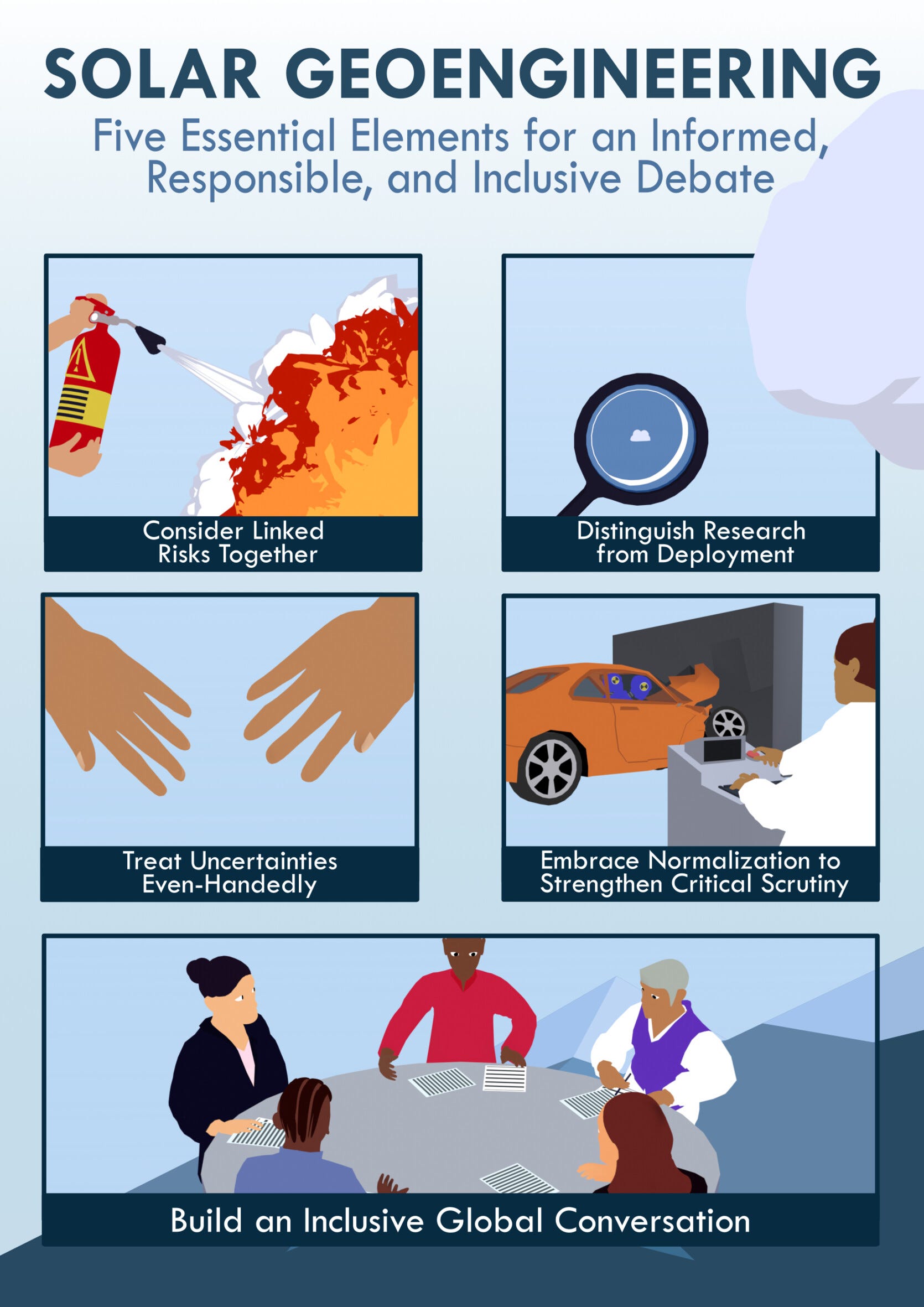
Toward an evidence-informed, responsible, and inclusive debate on solar
geoengineering: A response to the proposed non-use agreement
<https://wires.onlinelibrary.wiley.com/doi/10.1002/wcc.903>

Parson, E. A., Buck, H. J., Jinnah, S., Moreno‐Cruz, J., & Nicholson, S.
(2024). Toward an evidence‐informed, responsible, and inclusive debate on
solar geoengineering: A response to the proposed non‐use agreement. *Wiley
Interdisciplinary Reviews: Climate Change*, e903.

*Abstract*

A prominent recent perspective article in this journal and accompanying
open letter propose a broad international “non-use agreement” (NUA) on
activities related to solar geoengineering (SG). The NUA calls on
governments to renounce large-scale use of SG, and also to refuse to fund
SG research, ban outdoor experiments, decline to grant IP rights, and
reject discussions of SG in international organizations. We argue that such
pre-emptive rejection of public research and consultation would deprive
future policy-makers of knowledge and capability that would support
informed decisions to safely and equitably limit climate risk, sustain
human welfare, and protect threatened ecosystems. In contrast to the broad
prohibitions of the NUA, we propose an alternative near-term pathway with
five elements: assess SG risks and benefits in the context of related
climate risks and responses; distinguish the risks and governance needs of
SG research and deployment; pursue research that treats uncertainties and
divergent results even-handedly; harness normalization of SG as a path to
effective assessment and governance; and build a more globally inclusive
conversation on SG and its governance. These principles would support a
more informed, responsible, and inclusive approach to limiting climate
risks, including judgments on the potential role or rejection of SG, than
the prohibitory approach of the NUA.

Chinese public’s perceptions and understanding of the potential roles of
solar climate engineering for reducing climate change risks
<https://link.springer.com/article/10.1007/s10668-024-05054-x>

Zhang, Z., Huisingh, D., & Crabbe, M. J. C. (2024). Chinese public’s
perceptions and understanding of the potential roles of solar climate
engineering for reducing climate change risks. *Environment, Development
and Sustainability*, 1-20.

*Abstract*

Limiting global temperature increases appear to be an exceedingly
challenging task due to great difficulty in advancing carbon reduction
emission negotiation. Solar climate engineering is emerging as an emergency
shield for climate risks. Except for its technical feasibility and
reasonable costs, public understanding is essential for future
implementation. Compared with wide studies in Europe and North America, our
study was the first large-scale survey to comprehensively investigate the
Chinese public’s attitude toward solar climate engineering. Moreover, our
study was the first to focus on combined solar climate engineering schemes
and investigate Public attitude toward international governance and
regulatory structures. Our survey revealed that: The surveyed Chinese
participants perceived a high level of its deployment costs and a middle
level of its effectiveness, technical readiness and side effects. A
majority of surveyed participants supported China’s active role in
international governance and regulatory structures for solar climate
engineering. About a half of the surveyed participants were willing to pay
taxes to support related research and possible future deployment. However,
when solar climate engineering was compared with seven mainstream climate
change mitigation schemes, Chinese participants favored less priority and
less funding for solar climate engineering. This means that Chinese
participants viewed it as only a backup option in climate strategies.

Africa's Climate Response to Marine Cloud Brightening
<https://meetingorganizer.copernicus.org/EGU24/EGU24-6419.html>

Odoulami, R. C., Hirasawa, H., Kouadio, K., Patel, T. D., Quagraine, K. A.,
Pinto, I., ... & New, M. G. (2024). *Africa's Climate Response to Marine
Cloud Brightening* (No. EGU24-6419). Copernicus Meetings.

*Abstract*

Climate intervention through solar radiation modification is one proposed
method for reducing climate risks from anthropogenic warming. Marine Cloud
Brightening (MCB), one such approach, proposes to inject sea salt aerosol
into a regional marine boundary layer to increase marine clouds'
reflectivity. This study assessed the potential influence of four MCB
experiments on the climate in Africa using simulations from the Community
Earth System Model (CESM2) with the Community Atmospheric Model (CAM6).
Four idealised MCB experiments were performed with the CESM2(CAM6) model
under a medium-range background forcing scenario (SSP2-4.5) by setting
cloud droplet number concentrations to 600 cm-3 over three subtropical
ocean regions: (a) Northeast Pacific (MCBNEP); (b) Southeast Pacific
(MCBSEP); (c) Southeast Atlantic (MCBSEA); and (d) the combination of these
three regions (MCBALL). The CESM2(CAM6) model reproduces the observed
spatial distribution and seasonal cycle of precipitation and minimum and
maximum temperatures over Africa and its climatic zones well. The results
suggest that MCBSEP would induce the strongest global cooling effect and
thus could be the most effective in decreasing (increasing) temperatures
(precipitation) and associated extremes across most parts of the continent,
especially over West Africa, in the future (2035-2054) while other regions
could remain warmer or dryer compared to the historical climate
(1995-2014). While the projected changes under MCBALL are similar to those
of MCBSEP, MCBNEP and MCBSEA could result in more warming and, in some
regions of Africa, create a warmer future than under SSP2-4.5. Also, all
MCB experiments are more effective in cooling maximum temperature and
related extremes than minimum temperature and related extremes. These
findings further suggest that the climate impacts of MCB in Africa are
highly sensitive to the deployment region.

A Living Assessment of Different Materials for Stratospheric Aerosol
Injection—Building Bridges Between Model World and the Messiness of Reality
<https://agupubs.onlinelibrary.wiley.com/doi/full/10.1029/2024GL108314>

Visioni, D., Quaglia, I., & Steinke, I. (2024). A living assessment of
different materials for stratospheric aerosol injection—Building bridges
between model world and the messiness of reality. *Geophysical Research
Letters*, *51*(10), e2024GL108314.

*Abstract*

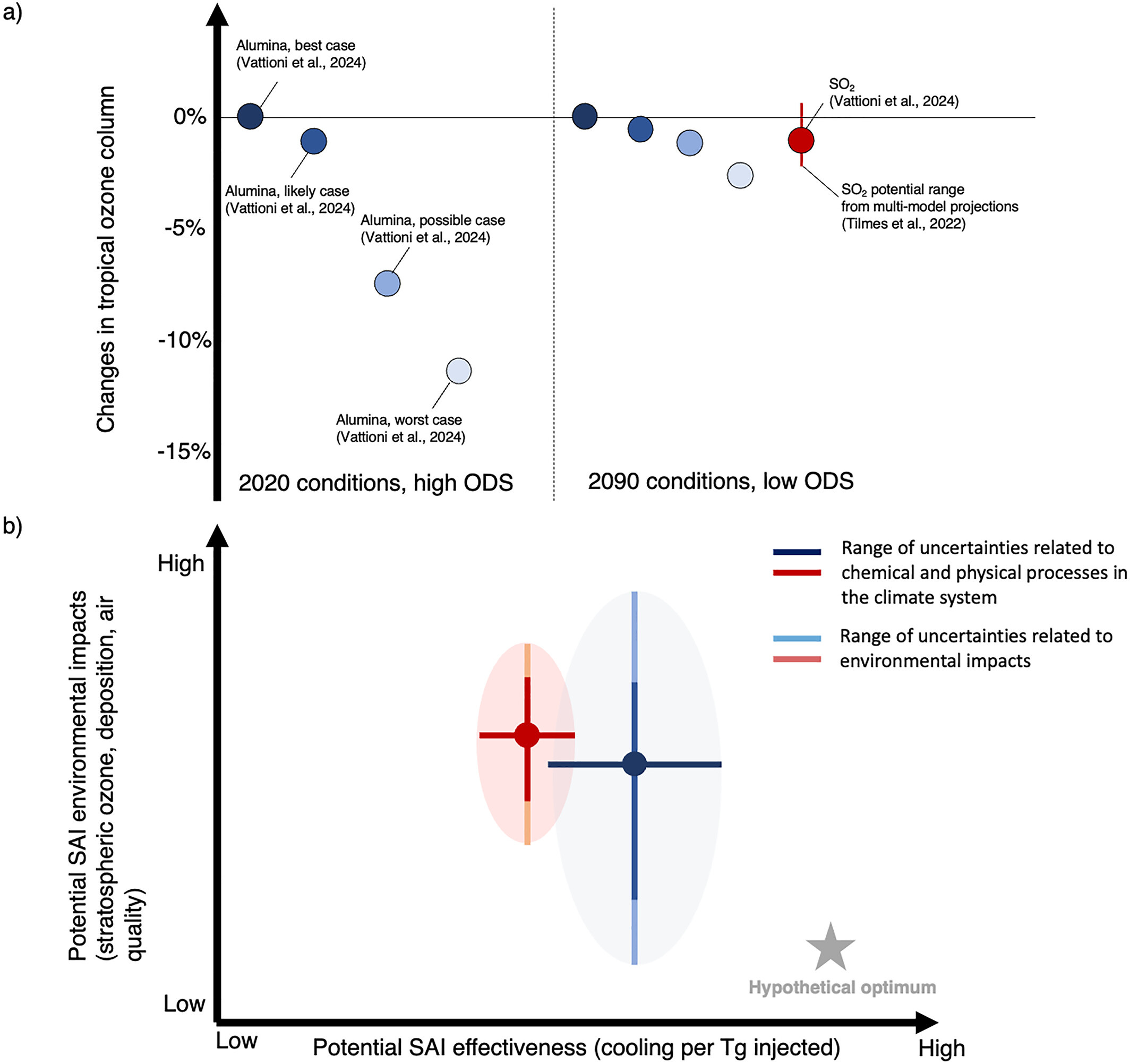
There are obstacles in better understanding the climate impacts associated
with new materials that could be used for Stratospheric Aerosol Injections
(SAI), like the lack of an integrated framework that combines climate
modeling across scales, laboratory studies and small-scale field
experiments. Vattioni et al. (2023, https://doi.org/10.1029/2023gl105889)
explored one aspect of using alternative, non-sulfate materials for SAI.
They investigated how uncertain the response of stratospheric ozone would
be to alumina injections for SAI. In their study, they quantify chlorine
activation rates in the presence of alumina, and then cascade these
uncertainties into estimates of ozone depletion, concluding that alumina
might have less detrimental impacts on stratospheric chemistry than
sulfate, but with large uncertainties. Their results provide a useful basis
upon which future research endeavors combining indoor and outdoor
experiments and modeling may be structured to produce robust assessments of
SAI impacts, benefits and uncertainties, together with clarifying what kind
of research needs to be prioritized.

<https://substackcdn.com/image/fetch/f_auto,q_auto:good,fl_progressive:steep/https%3A%2F%2Fsubstack-post-media.s3.amazonaws.com%2Fpublic%2Fimages%2F459fc627-1098-4895-807e-4c9e462d2715_1670x2362.jpeg>
Parson,
E. A., Buck, H. J., Jinnah, S., Moreno‐Cruz, J., & Nicholson, S. (2024).
Toward an evidence‐informed, responsible, and inclusive debate on solar
geoengineering: A response to the proposed non‐use agreement.
<https://wires.onlinelibrary.wiley.com/doi/10.1002/wcc.903>*Wiley
Interdisciplinary Reviews: Climate Change
<https://wires.onlinelibrary.wiley.com/doi/10.1002/wcc.903>*, e903.
<https://wires.onlinelibrary.wiley.com/doi/10.1002/wcc.903>
<https://substackcdn.com/image/fetch/f_auto,q_auto:good,fl_progressive:steep/https%3A%2F%2Fsubstack-post-media.s3.amazonaws.com%2Fpublic%2Fimages%2Fac357647-e041-4aca-aa56-c771549273ec_2128x2004.jpeg>
Visioni,
D., Quaglia, I., & Steinke, I. (2024). A living assessment of different
materials for stratospheric aerosol injection—Building bridges between
model world and the messiness of reality.
<https://agupubs.onlinelibrary.wiley.com/doi/full/10.1029/2024GL108314>*Geophysical
Research Letters
<https://agupubs.onlinelibrary.wiley.com/doi/full/10.1029/2024GL108314>*,
<https://agupubs.onlinelibrary.wiley.com/doi/full/10.1029/2024GL108314>*51
<https://agupubs.onlinelibrary.wiley.com/doi/full/10.1029/2024GL108314>*(10),
e2024GL108314.
<https://agupubs.onlinelibrary.wiley.com/doi/full/10.1029/2024GL108314>
------------------------------
WEB POSTSThe Need for Geoengineering
<https://groups.google.com/g/healthy-planet-action-coalition/c/3Xgh79YFs8A>
(HPAC)Honest dialogue is needed to help build consensus around solar
radiation modification technology
<https://theconversation.com/honest-dialogue-is-needed-to-help-build-consensus-around-solar-radiation-modification-technology-226697>
(The Conversation)
------------------------------
JOB OPPORTUNITYPostdoc High-fidelity Computations of Aerosol Dynamics in
Stratospheric Aircraft Wakes at TU Delft University of Technology
<https://www.iamexpat.nl/career/jobs-netherlands/delft/research-academic/postdoc-high-fidelity-computations-aerosol-dynamics>

"In this postdoc position, you will form part of a consortium of
researchers at ETH Zurich, the Paul Scherrer institute, the Physical
Meteorological Observatory, the University of West Indies and ITS Indonesia
with the goal of accurately quantifying the physics and effects of SAI.
Your role will be to combine large-eddy simulations with particle evolution
models to initially examine near-wake aerosol dynamics, then to study
long-term aerosol wake evolution. This will provide input to predictions of
large-scale aerosol properties which will be employed in global climate
simulations. The results of these simulations will be used in case studies
quantifying local impacts, with detailed studies to be performed for the
West Indies and Indonesia. The anticipated outputs of this consortium are
crucial for decision makers, who should have realistic assessments of the
risks associated with SAI techniques before considering their incorporation
into global warming management strategies."

------------------------------
YOUTUBE VIDEOSre:publica 2024: Thomas Ramge - Solar Geoengineering – Why we
must dim the sun before | re:publica
<https://www.youtube.com/watch?v=hLt5G0blEFQ>

"Solar Geoengineering – Why we must dim the sun before entering the
post-fossil age

Humanity is not decarbonizing decisively enough. In a few decades from now,
we will likely live on a planet with 2 degrees of global warming. Without
solar geoengineering, billions of people will suffer unbearable
consequences. Reflecting sunlight into space will be our best option to
gain time."

Is this the cheapest Solar Radiation Modification method? | Neofizix
<https://www.youtube.com/watch?v=8HyxXwaJN2I>

"Solar radiation modification is one of the prominent ideas considered for
reducing global warming. Injecting aerosol particles into the atmosphere is
thought to be the cheapest radiation modification approach. It costs about
$18 billion/yr over 66 years to reduce the global mean temperature by 1
degree Celsius. We describe a method which could cost as low as $1.6
billion/yr to reduce the global mean temperature by 1 degree Celsius.
Perhaps we can engineer a better Earth together using this approach."

NOAC meeting - 13th May 2024 | Clive Elsworth
<https://www.youtube.com/watch?v=Oi7LkZSTSJY>

"Agenda:

•Greg – Gwyne Dyer’s book

John M – MCB study put on hold – Alameda

•Greg – how much SO2 is needed for SAI to cool Earth by 0.1C?

•Sev – Theses e.g.:- Mitigation – oil/gas good for future"

HPAC Meeting with Hans Van Der Loo and Wouter von Dieren 30 May 2024 |
Robbie Tulip <https://www.youtube.com/watch?v=Cp0zrREvFI8>

"The Healthy Planet Action Coalition in conversation with two very special
guests. Wouter van Dieren and Hans van der Loo are long time highly
accomplished change-makers and climate advocates from the Netherlands. They
cofounded the Blue Cooling Initiative, BlueCooling.org, an NGO committed to
“buying time for survival of humanity by temporarily cooling the planet.”
They are now actively engaged in establishing the International Climate
Cooling Coalition, an NGO whose goal is to advance the need for DCC -
Direct Climate Cooling - or Active Cooling as they call it."

--
You received this message because you are subscribed to the Google Groups
"geoengineering" group.
To unsubscribe from this group and stop receiving emails from it, send an email
to [email protected].
To view this discussion on the web visit
https://groups.google.com/d/msgid/geoengineering/CAHJsh9-wPoCWf%2BEV0NVGHKFEpov-T7Bp%3D%2B2JGoxqtenFH3z7_A%40mail.gmail.com.