*SOLAR GEOENGINEERING WEEKLY SUMMARY (24 JUNE - 30 JUNE 2024)*

Subscribe to our newsletter to receive monthly updates on Solar
Geoengineering:
Solar Geoengineering Updates
<https://solargeoengineeringupdates.substack.com?utm_source=substack&utm_campaign=publication_embed&utm_medium=email>
Monthly news summaries about solar geoengineering. Links to scientific
papers, news articles, jobs, podcasts, and videos.
<https://solargeoengineeringupdates.substack.com?utm_source=substack&utm_campaign=publication_embed&utm_medium=email>
By Andrew Lockley
<https://solargeoengineeringupdates.substack.com?utm_source=substack&utm_campaign=publication_embed&utm_medium=email>
------------------------------
DEADLINES*Call for Abstracts—AGU Conference | Submissions are open until 31
July 2024 <https://www.agu.org/annual-meeting>*
*SRM Sessions at AGU2024:**GC009-Advances in Climate Engineering Science
<https://agu.confex.com/agu/agu24/prelim.cgi/Session/227097>**A081-Exploring
the Interplay of Weather Modification and Climate Intervention: Modeling,
Observations, and Field Campaigns
<https://agu.confex.com/agu/agu24/prelim.cgi/Session/230051>**GC004-Advancements
in Climate Intervention Research Technologies, Policies and Practices:
Opportunities and Issues
<https://agu.confex.com/agu/agu24/prelim.cgi/Session/226893>**GC048-Climate
Intervention, Mitigation, Adaptation, and Restoration: Assessing the Risks
and Benefits of Using Earth System Models for Guidance on Climate Action
<https://agu.confex.com/agu/agu24/prelim.cgi/Session/227971>*

*Call for Abstract—Cloud and precipitation responses to aerosol pollution,
weather modification and climate intervention
<https://annual.ametsoc.org/index.cfm/2025/> | Deadline to apply: 15 August
2024*(NEW) Funding opportunity: Modelling environmental responses to solar
radiation management by Natural Environment Research Council (NERC) |
Deadline to apply: 08 October 2024
<https://www.ukri.org/opportunity/modelling-environmental-responses-to-solar-radiation-management/>
------------------------------
RESEARCH PAPERSAn assessment of the infrastructural and temporal barriers
constraining a near-term implementation of a global stratospheric aerosol
injection program
<https://iopscience.iop.org/article/10.1088/2515-7620/ad4f5c/meta>

Smith, W. (2024). An assessment of the infrastructural and temporal
barriers constraining a near-term implementation of a global stratospheric
aerosol injection program. *Environmental Research Communications*.

*Abstract*

Models of stratospheric aerosol injection deployment scenarios have often
assumed that a global sunscreen could be applied to the Earth on relatively
short notice, perhaps in response to a climate emergency. This emergency
response framing confuses the timescales associated with the commencement
of such a program. Once deployed, stratospheric aerosols could cool the
Earth quite quickly, but the most commonly assumed deployment scenarios
would require aircraft and other infrastructure that does not currently
exist. Given the span required to develop and certify a novel aircraft
program and to subsequently build a fleet numbering in the hundreds,
scenario builders should assume a roughly two-decade interval between a
funded launch decision and the attainment of a target level of cooling.

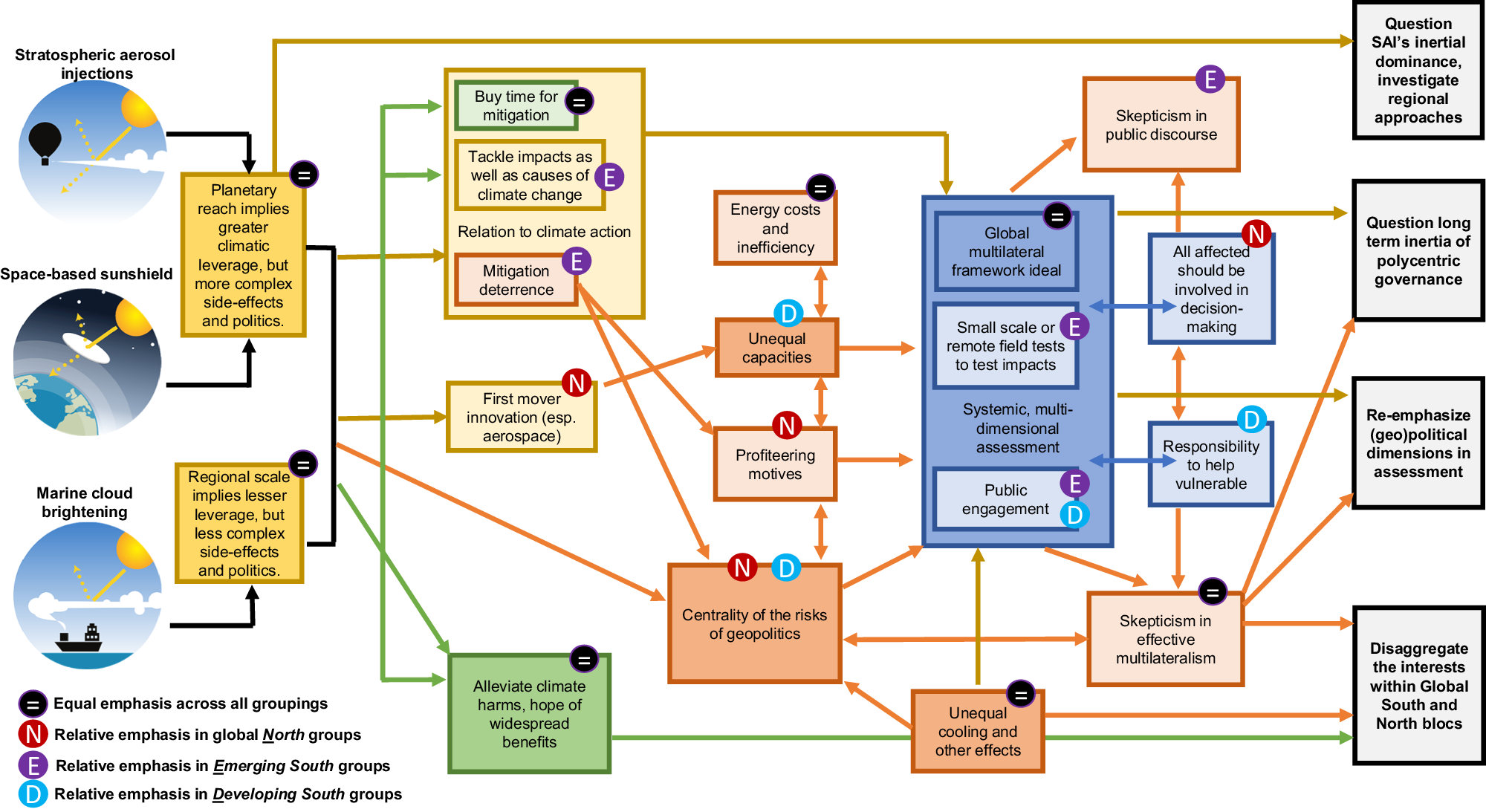
Public perceptions on solar geoengineering from focus groups in 22 countries
<https://www.nature.com/articles/s43247-024-01518-0>

Low, S., Fritz, L., Baum, C. M., & Sovacool, B. K. (2024). Public
perceptions on solar geoengineering from focus groups in 22 countries.
*Communications
Earth & Environment*, *5*(1), 1-19.

*Abstract*

Solar geoengineering maintains a vocal presence as a stop-gap measure in
assessments of climate and sustainability action. In this paper, we map
prospective benefits and risks, and corresponding governance approaches,
regarding three major proposals for solar geoengineering (stratospheric
aerosol injection, marine cloud brightening, and a space-based sunshield).
We do so by engaging with 44 focus groups conducted in 22 countries split
between the global North and South. We compare results against previous
research on the public perceptions of solar geoengineering as well as wider
activities in assessment, innovation, and decision-making. We find that
global South groups exhibit greater hope but an arguably richer range of
concerns for solar geoengineering, in the context of observable inequities
in climate action and potential geopolitical conflict. Meanwhile, a strong,
global preference for multilateral coordination and public engagement from
the conduct of research onwards is offset by skepticism of effective
multilateralism and public discourse.

Microphysical interactions determine the effectiveness of Solar Radiation
Modification via Stratospheric Solid Particle Injection
<https://essopenarchive.org/doi/full/10.22541/essoar.171926549.92645374/v1>

Sandro V., Sina K K., John A D., et al. Microphysical interactions
determine the effectiveness of Solar Radiation Modification via
Stratospheric Solid Particle Injection. *ESS Open Archive*.

*Abstract*

Recent studies have suggested that stratospheric aerosol injection (SAI) of
solid particles for climate intervention could reduce stratospheric warming
compared to injection of SO2. However, interactions of microphysical
processes, such as settling and coagulation of solid particles, with
stratospheric dynamics have not been considered. Using a global
chemistry-climate model with interactive solid particle microphysics, we
show that agglomeration significantly reduces the backscatter efficiency
per unit of burden compared to mono-disperse particles, partly due to
faster settling of the agglomerates, but mainly due to increased forward-
over backscattering with increasing agglomerate size. Compared to injection
of SO2, injection of 150\,nm radius diamond particles still substantially
reduces required injection rates as well as perturbation of stratospheric
winds, age of air and water vapor concentrations due to the small
stratospheric warming per radiative forcing. Uncertainties remain as to
whether stratospheric dispersion of solid particles is feasible without
formation of agglomerates.

Different Strategies of Stratospheric Aerosol Injection Would Significantly
Affect Climate Extreme Mitigation
<https://www.osti.gov/pages/biblio/2370147>

Jiang, J., Xia, Y., Cao, L., Kravitz, B., MacMartin, D. G., Fu, J., &
Jiang, G. (2024). Different strategies of stratospheric aerosol injection
would significantly affect climate extreme mitigation. *Earth's Future*,
*12*(6), e2023EF004364.

*Abstract*

Stratospheric aerosol injection (SAI) has been proposed as a potential
supplement to mitigate some climate impacts of anthropogenic warming. Using
Community Earth System Model ensemble simulation results, we analyze the
response of temperature and precipitation extremes to two different SAI
strategies: one injects SO 2 at the equator to stabilize global mean
temperature and the other injects SO 2 at multiple locations to stabilize
global mean temperature as well as the interhemispheric and equator‐to‐pole
temperature gradients. Our analysis shows that in the late 21st century,
compared with the present‐day climate, both equatorial and multi‐location
injection lead to reduced hot extremes in the tropics, corresponding to
overcooling of the mean climate state. In mid‐to‐high latitude regions, in
comparison to the present‐day climate, substantial decreases in cold
extremes are observed under both equatorial and multi‐location injection,
corresponding to residual winter warming of the mean climate state. Both
equatorial and multi‐location injection reduce precipitation extremes in
the tropics below the present‐day level, associated with the decrease in
mean precipitation. Overall, for most regions, temperature and
precipitation extremes show reduced change in response to multi‐location
injection than to equatorial injection, corresponding to reduced mean
climate change for multi‐location injection. In comparison with equatorial
injection, in response to multi‐location injection, most land regions
experience fewer years with significant change in cold extremes from the
present‐day level, and most tropical regions experience fewer years with
significant change in hot extremes. The design of SAI strategies to
mitigate anthropogenic climate extremes merits further study.

[image: Fig. 1]
<https://substackcdn.com/image/fetch/f_auto,q_auto:best,fl_progressive:steep/https%3A%2F%2Fsubstack-post-media.s3.amazonaws.com%2Fpublic%2Fimages%2F62c26c40-b21a-4523-9306-f8a6aa3af7d2_2000x1093.png>
Low,
S., Fritz, L., Baum, C. M., & Sovacool, B. K. (2024). Public perceptions on
solar geoengineering from focus groups in 22 countries.
<https://www.nature.com/articles/s43247-024-01518-0>*Communications Earth &
Environment <https://www.nature.com/articles/s43247-024-01518-0>*,
<https://www.nature.com/articles/s43247-024-01518-0>*5
<https://www.nature.com/articles/s43247-024-01518-0>*(1), 1-19.
<https://www.nature.com/articles/s43247-024-01518-0>
------------------------------
WEB POSTSThe great geo-engineering gamble
<https://www.ft.com/content/710259b4-6a16-4755-939a-14f05d18c821?accessToken=zwAGG8njbw_4kc9xAlm0ahZHVdOTmhTwXRjIIQ.MEQCIEjnbMQ9SMKOV9Hlx46dy2NyGB2ywwI4WydoTTUFnAKaAiACUU1KnnDCnXa6VC8JPa7bp1cVwrjAympDxJK1_gqNWA&sharetype=gift&token=ff983e28-d804-4d8f-9ed1-dc373e09fe81>
(Financial Times)
------------------------------
THESISStratospheric sulfate aerosols and their impact on climate: from
volcanoes to proposed human interventions
<https://ricerca.univaq.it/bitstream/11697/208519/2/PhD_Thesis-5.pdf>
------------------------------
UPCOMING EVENTS*Fourteenth GeoMIP Workshop
<https://climate.envsci.rutgers.edu/GeoMIP/2024.html> | 10-12 July 2024 |
Ithaca, USA**RFF 2024 SRM Social Science Workshop: Cooperative vs.
Non-Cooperative Interventions
<https://docs.google.com/forms/d/1zE6Eo625cpEKZVbKwzDQSL4gxmnArmPsxtePJM-1SY0/viewform?edit_requested=true&gxid=-8203366>
| 19-20 September 2024 | Washington, DC.*(NEW) The 2025 Degrees Global Forum
<https://www.degrees.ngo/globalforum/> | 12-16 May 2025 | Cape Town, South
Africa(NEW) Artic Repair Conference 2025 by University of Cambridge &
Center for Climate Repair
<https://www.climaterepair.cam.ac.uk/events/artic-repair-conference-2025> |
26-28 June 2025 | Cambridge UK
------------------------------
JOB OPPORTUNITIESClimate Engineering Researcher (CDR/SRM) at CMCC | Milano,
Italy
<https://cmccfoundation.applytojob.com/apply/EfyLJUg3Mg/12591-Climate-Engineering-Researcher-CDRSRM?referrer=20240627110432HDNHKC2JYLYH29JK>
| Deadline to apply: 12 July 2024

"Our Institute (European Institute on Economics and the Environment) is
always looking for bright researchers motivated to work on the defining
issue of climate change. For this position we are encouraging applications
by researchers interested in modelling and assessing the implications of
climate engineering interventions, specifically either Carbon Dioxide
Removal (CDR) or Solar Radiation Management (SRM), as possible additional
strategies to conventional mitigation ones.
We have a portfolio of international research projects on both removing CO2
and CH4 (e.g. UPTAKE <https://www.cdr-uptake.eu/>, REPAIR
<https://repair-eu.com/>), and on assessing solar radiation modification
(e.g. CO-CREATE <https://co-create-project.eu/>, RFF
<https://www.rff.org/events/conferences/solar-geoengineering-futures-current-research-and-uncertainties/>).
We are looking from one to two candidates to work on either research
strand, or possibly combine them. We are interested in the integration of
all key aspects of climate engineering, from the technical side to its
socio-economic repercussion and its governance."

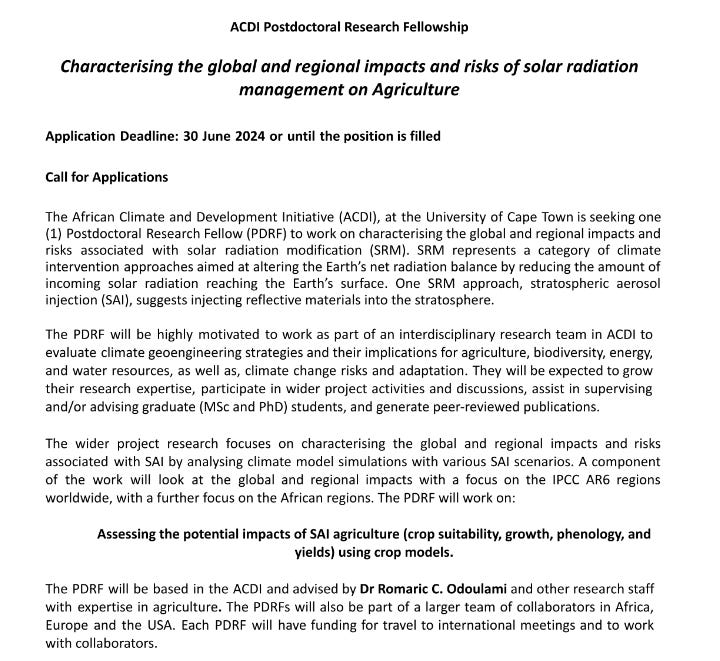
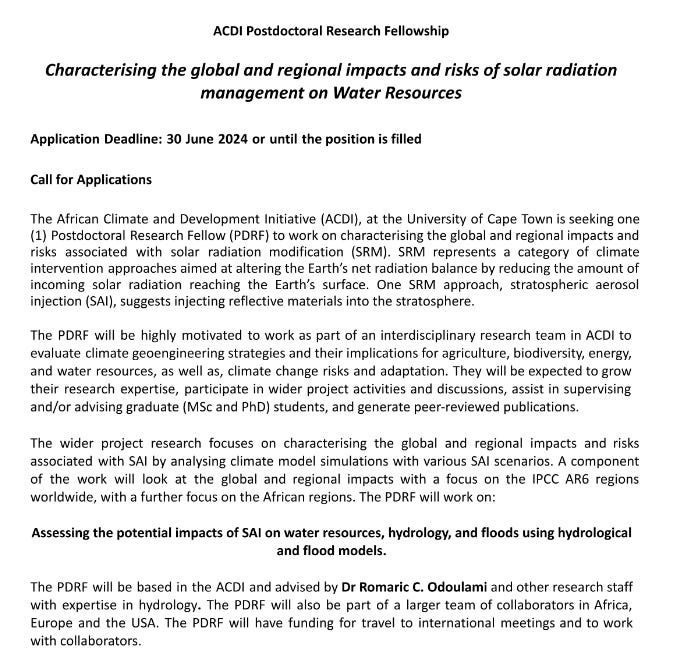
*African Climate and Development Initiative* *- University of Cape Town *in
South Africa have opened two 3-year postdoc positions to characterise the
global and regional impacts and risks of SRM on *agriculture
<https://ngo.us17.list-manage.com/track/click?u=4ec4191d31f894c0e3eab90bb&id=05eac2c190&e=7cbc351041>*
 and *water resources
<https://ngo.us17.list-manage.com/track/click?u=4ec4191d31f894c0e3eab90bb&id=0e025d6fdc&e=7cbc351041>:*
<https://substackcdn.com/image/fetch/f_auto,q_auto:good,fl_progressive:steep/https%3A%2F%2Fsubstack-post-media.s3.amazonaws.com%2Fpublic%2Fimages%2Fa12d72f8-59b6-421c-a5ec-d9cf1c09db58_720x661.png>
<https://substackcdn.com/image/fetch/f_auto,q_auto:good,fl_progressive:steep/https%3A%2F%2Fsubstack-post-media.s3.amazonaws.com%2Fpublic%2Fimages%2F7ce9f6d9-cf43-4c6c-bed5-a703b30793bc_680x670.png>
------------------------------
YOUTUBE VIDEOSWalker Lee on Marine Cloud Brightening Global Impact Modeling
- HPAC | Robbie Tulip <https://www.youtube.com/watch?v=BscdfZqz2Pk>

"Walker Raymond Lee is a postdoctoral research associate at the National
Center for Atmospheric Research in Boulder, Colorado. Walker's research
explores the design space of climate intervention: what can climate models
tell us about how different climate intervention strategies might affect
the Earth system in different ways? In this talk he applies this research
to Marine Cloud Brightening. From 2018-2023, Walker studied at Cornell
University, where he compared simulations of stratospheric aerosol
injection at various latitudes, altitudes, and seasons and used feedback
control algorithms to determine whether and how different strategies could
be used to prevent certain impacts from global warming. After completing
his doctorate in 2023, Walker began as a postdoc at NCAR, where he is
working to apply the same analysis to simulations of marine cloud
brightening interventions."

Making sense of solar engineering | Latitude Media
<https://www.youtube.com/watch?v=RGnQQ6mesPA>

"In this episode, Shayle talks to Dan Visioni (
https://dan-visioni.github.io/) , a climate modeler who studies solar
geoengineering at Cornell University’s Sibley School of Mechanical and
Aerospace Engineering. They discuss what solar geoengineering might look
like in the real world."

Can technology stop a hurricane? | YaleClimateConnections
<https://www.youtube.com/watch?v=0mj_hBTqtfw>

"Climate change is fueling more intense and frequent hurricanes, posing
greater risks to lives and communities. But could cutting-edge technology
offer a solution? In this video, meteorologist Alexandra Steele talks with
former hurricane hunter Jeff Masters and other experts about whether
geoengineering or artificial intelligence could one day enable us to
control hurricanes."

A rogue geoengineering startup sparks worry | Latitude Media
<https://www.youtube.com/watch?v=Qv8g26-0QXk>

"Luke Iseman and Andrew Song are the co-founders of Make Sunsets, a startup
claiming to be implementing solar geoengineering by launching weather
balloons filled with SO2 into the stratosphere.

Their first experimental launch in the Mexican state of Baja resulted in a
swift regulatory response from the Mexican government. But when they ran
another test launch a few weeks ago just outside of Reno, Nevada, Luke
invited Alejandro to meet them."

Solar Geoengineering: Ethics and Science | Harvard Climate Action Week 2024
| The Salata Institute at Harvard University
<https://www.youtube.com/watch?v=jJZnr2FGcmg>

"Solar geoengineering refers to a strategy for reducing the impacts of
climate change by reflecting some of the incoming solar radiation. Long
considered too controversial to discuss in public, it has been getting more
and more attention both within the scientific community and from the public
at large, perhaps due to the growing awareness of climate change impacts as
well as the scale of the challenge of decarbonizing the global energy
system.

For nearly 20 years, Harvard has played a leading role in convening
conversations surrounding this approach to managing climate change, as well
as contributing important scholarship on new technological approaches,
better understanding of the impacts, and debates surrounding its
governance.

In this panel, leading scholars from atmospheric chemistry, climate physics
and philosophy discussed the current state of our understanding of solar
geoengineering, highlighting the main areas of uncertainty, and identified
ways to move forward on solar geoengineering research while the debate
intensifies on its possible deployment."

Board member Jackie Kado explains why she volunteers her time with Degrees
| The Degrees Initiative  <https://www.youtube.com/watch?v=wpjhBuM1TW0>

"Dr Jackie Kado is the Executive Director of the Network of African Science
Academies (NASAC) and volunteers her time as a member of Degrees’ board of
trustees. In this short interview she discuss her the work of the Degrees
Initiative and what motivates her to work with the Degrees Initiative."

--
You received this message because you are subscribed to the Google Groups
"geoengineering" group.
To unsubscribe from this group and stop receiving emails from it, send an email
to [email protected].
To view this discussion on the web visit
https://groups.google.com/d/msgid/geoengineering/CAHJsh99cjxapaE0ucEUgtz0r9tpq4eBN9uN%2BphXMSPjS0jvk5Q%40mail.gmail.com.