SOLAR GEOENGINEERING WEEKLY SUMMARY (19 AUGUST - 25 AUGUST 2024)
<https://substack.com/app-link/publications/1346479/drafts/8bcfb7c8-85e9-40ff-ad32-e67794f22657?publication_id=1346479&post_id=148155939&utm_source=post-email-title&utm_campaign=email-post-title&isFreemail=false>
Subscribe to our newsletter to receive monthly updates on Solar
Geoengineering:
Solar Geoengineering Updates
<https://solargeoengineeringupdates.substack.com?utm_source=substack&utm_campaign=publication_embed&utm_medium=email>
Monthly news summaries about solar geoengineering. Links to scientific
papers, news articles, jobs, podcasts, and videos.
<https://solargeoengineeringupdates.substack.com?utm_source=substack&utm_campaign=publication_embed&utm_medium=email>
By Andrew Lockley
<https://solargeoengineeringupdates.substack.com?utm_source=substack&utm_campaign=publication_embed&utm_medium=email>
------------------------------
RESEARCH PAPERSSolar Geoengineering: History, Methods, Governance, Prospects
<https://www.annualreviews.org/content/journals/10.1146/annurev-environ-112321-081911>

Parson, E. A., & Keith, D. W. (2024). Solar Geoengineering: History,
Methods, Governance, Prospects. *Annual Review of Environment and Resources*,
*49*.

*Abstract*

Solar geoengineering, also called sunlight reflection or solar radiation
modification (SRM), is a potential climate response that would cool the
Earth's surface and reduce many other climate changes by scattering on
order 1% of incoming sunlight back to space. SRM can only imperfectly
correct for elevated greenhouse gases, but it might complement other
climate responses to reduce risks, while also bringing new risks and new
challenges to global governance. As climate alarm and calls for effective
near-term action mount, SRM is attracting sharply increased attention and
controversy, with many calls for expanded research and governance
consultations along with ongoing concerns about risks, misuse, or
overreliance. We review SRM's history, methods, potential uses and impacts,
and governance needs, prioritizing the approach that is most prominent and
promising, stratospheric aerosol injection. We identify several
policy-relevant characteristics of SRM interventions and identify four
narratives that capture current arguments over how SRM might be developed
or used in socio-political context to either beneficial or destructive
effect, with implications for near-term research, assessment, and
governance activity.

Baseline Climate Variables for Earth System Modelling
<https://egusphere.copernicus.org/preprints/2024/egusphere-2024-2363/>

Juckes, M., Taylor, K. E., Antonio, F., Brayshaw, D., Buontempo, C., Cao,
J., ... & Dingley, B. (2024). Baseline Climate Variables for Earth System
Modelling. *EGUsphere*, *2024*, 1-37.

*Abstract*

The Baseline Climate Variables for Earth System Modelling (ESM-BCVs) are
defined as a list of 132 variables which have high utility for the
evaluation and exploitation of climate simulations. The list reflects the
most heavily used elements of the Coupled Model Intercomparison Project
phase 6 (CMIP6) archive. Successive phases of CMIP have supported strong
results in science and substantial influence in international climate
policy formulation. This paper responds both to interest in exploiting CMIP
data standards in a broader range of climate modelling activities and a
need to achieve greater clarity about the significance and intention of
variables in the CMIP Data Request. As Earth System Modelling (ESM)
archives grow in scale and complexity there are emerging problems
associated with weak standardisation at the variable collection level. That
is, there are good standards covering how specific variables should be
archived, but this paper fills a gap in the standardisation of which
variables should be archived. The ESM-BCV list is intended as a resource
for ESM Model INtercomparison Projects (MIPs) developing requests to enable
greater consistency among MIPs, and as a reference for modelling centres to
enhance consistency within MIPs. Provisional planning for the CMIP7 Data
Request exploits the ESM-BCVs as a core element. The baseline variables
list includes 98 variables which have modest or minor data volume
footprints and could be generated systematically when simulations are
produced and archived for exploitation by the WCRP community. A further 34
variables are classed as high volume and are only suitable for production
when the resource implications are justified.

Securing the ‘great white shield’? Climate change, Arctic security and the
geopolitics of solar geoengineering
<https://journals.sagepub.com/doi/abs/10.1177/00108367241269629>

Kornbech, N., Corry, O., & McLaren, D. (2024). Securing the ‘great white
shield’? Climate change, Arctic security and the geopolitics of solar
geoengineering. *Cooperation and Conflict*, 00108367241269629.

*Abstract*

The Arctic has been identified by scientists as a relatively promising
venue for controversial ‘solar geoengineering’ – technical schemes to
reflect more sunlight to counteract global warming. Yet contemporary
regional security dynamics and the relative (in)significance of climate
concerns among the key Arctic states suggest a different conclusion. By
systematically juxtaposing recently published schemes for Arctic
geoengineering with Arctic security strategies published by the littoral
Arctic states and China, we reveal and detail two conflicting security
imaginaries. Geoengineering schemes scientifically securitise (and seek to
maintain) the Arctic’s ‘great white shield’ to protect ‘global’ humanity
against climate tipping points and invoke a past era of Arctic
‘exceptionality’ to suggest greater political feasibility for research
interventions here. Meanwhile, state security imaginaries understand the
contemporary Arctic as an increasingly contested region of considerable
geopolitical peril and economic opportunity as temperatures rise. Alongside
the entangled history of science with geopolitics in the region, this
suggests that geoengineering schemes in the Arctic are unlikely to follow
scientific visions, and unless co-opted into competitive, extractivist
state security imaginaries, may prove entirely infeasible. Moreover, if the
Arctic is the ‘best-case’ for geoengineering politics, this places a huge
question mark over the feasibility of other, more global prospects.

Quantifying the Direct Radiative Effect of Stratospheric Aerosols Using
Radiative Kernels
<https://essopenarchive.org/doi/pdf/10.22541/essoar.172374105.56686934>

Yu, Q., & Huang, Y. (2024). Quantifying the Direct Radiative Effect of
Stratospheric Aerosols Using Radiative Kernels. *Authorea Preprints*.

*Abstract*

To facilitate the quantification of the stratospheric aerosol radiative
effect, this study generates a set of aerosol direct radiative effect
(ADRE) kernels based on MERRA-2 reanalysis data. These radiative kernels
measure the sensitivities of ADRE to perturbations in scattering and
absorbing aerosol optical depth (AOD), respectively. Both broadband and
band-by-band radiative kernels are developed to account for the wavelength
dependency of ADRE. The broadband kernels are then emulated by a
multivariate regression model, which predicts the kernel values from a
handful of predictors, including the top-of-atmosphere (TOA) insolation,
TOA reflectance, and stratospheric AOD. These kernels offer an efficient
and versatile way to assess the ADRE of stratospheric aerosols. The ADREs
of the 2022 Hunga volcano eruption and the 2020 Australia wildfire are
estimated from the kernels and validated against radiative transfer
model-calculated results. The Hunga eruption induced a global mean cooling
forcing of -0.46 W/m² throughout 2022, while the Australia wildfire caused
a warming forcing of +0.28 W/m² from January to August. The kernel
estimation can capture over 90% of the ADRE variance with relative error
within 10%, in these assessments. The results demonstrate the spectral
dependencies of stratospheric ADRE and highlight the distinct radiative
sensitivity of stratospheric aerosols, which differs significantly from
that of tropospheric aerosols.

------------------------------
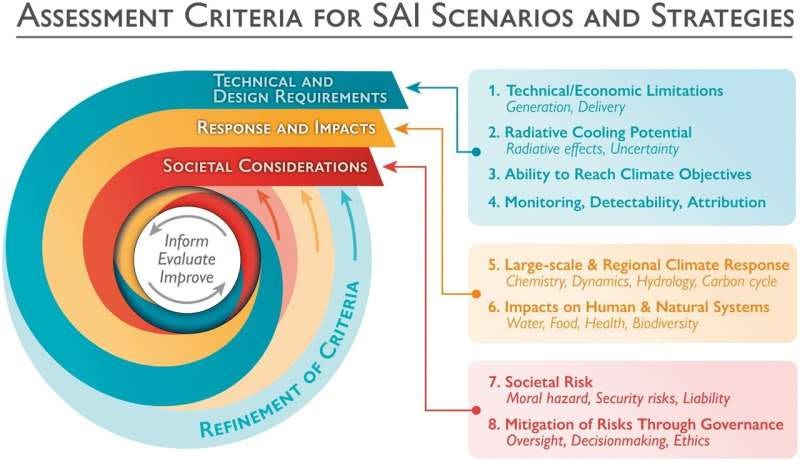
WEB POSTSScientists propose guidelines for solar geoengineering research
<https://phys.org/news/2024-08-scientists-guidelines-solar-geoengineering.html>
(Phys.Org)Record number of Global South scientists attend GeoMIP 2024
<https://www.degrees.ngo/record-number-of-global-south-scientists-attend-geomip-2024/>
(The Degrees Initiative)The Promise of Geoengineering
<https://www.aei.org/articles/the-promise-of-geoengineering/> (AEI)Andrew
Ng’s new model lets you play around with solar geoengineering to see what
would happen
<https://www.technologyreview.com/2024/08/23/1097292/andrew-ngs-new-model-lets-you-play-around-with-solar-geoengineering-to-see-what-would-happen/>
(MIT Technology Review)Marine Geoengineering Will Not Save the Oceans or
the Climate
<https://www.project-syndicate.org/commentary/marine-geoengineering-is-just-another-form-of-pollution-by-lili-fuhr-and-james-kerry-2024-08>
(Project Syndicate)The overshoot myth: you can’t keep burning fossil fuels
and expect scientists of the future to get us back to 1.5°C
<https://theconversation.com/the-overshoot-myth-you-cant-keep-burning-fossil-fuels-and-expect-scientists-of-the-future-to-get-us-back-to-1-5-c-230814>
(The Conversation)
[image: Scientists propose guidelines for solar geoengineering research]
<https://substackcdn.com/image/fetch/f_auto,q_auto:good,fl_progressive:steep/https%3A%2F%2Fsubstack-post-media.s3.amazonaws.com%2Fpublic%2Fimages%2F554bd5eb-3cf6-4106-8972-c1710dd14443_800x461.jpeg>
Scientists
propose guidelines for solar geoengineering research
<https://phys.org/news/2024-08-scientists-guidelines-solar-geoengineering.html>
(Phys.Org)
------------------------------
JOB OPPORTUNITIESPostdoctoral Scholar Opportunity in Aerosol Microphysics
Modeling at UChicago
<https://geosci.uchicago.edu/postdoctoral-scholar-opportunity-in-aerosol-microphysics-modeling-at-uchicago/>

"Wang Aerosol Lab (PI: Mingyi Wang) at the University of Chicago is seeking
a highly motivated postdoctoral scholar to join our interdisciplinary
research team in a position supported by the University of Chicago’s
Climate Systems Engineering initiative (Director: David Keith). Our focus
is on aerosol microphysics modeling for solar geoengineering, with the aim
of understanding two key areas: (1) the near-field aerosol number size
distribution and efficacy of stratospheric aerosol injection (SAI) methods,
and (2) the impact of SAI aerosols on tropospheric aerosol-cloud
interactions.

Despite ongoing climate mitigation efforts, achieving the 1.5 °C target
remains a significant challenge. In addition to CO2 reduction strategies,
solar geoengineering, particularly the methods that involve injecting
particles or inducing particle formation in the stratosphere, is being
studied as a potential last resort to prevent global warming from exceeding
critical climate tipping points. However, this form of human intervention
comes with substantial risks: we have limited knowledge about the evolution
of particles in the upper atmosphere and even less about their long-term
climate impacts. Therefore, it is crucial to thoroughly study and constrain
aerosol dynamics before considering any actual climate interventions to
avoid unintended and potentially adverse consequences."

Research Assistant/Associate in Arctic climate dynamics at University of
Cambridge | Deadline to apply: 28 August 2024
<https://www.climaterepair.cam.ac.uk/job-opportunities>

"The Arctic region has warmed at least twice as rapidly as the global
warming trend. Arctic sea-ice has declined dramatically over the past few
decades and an ostensibly ice-free summer Arctic in the near future seems
like a real possibility. This would have significant global and regional
implications and could trigger undesirable feedbacks (e.g. albedo feedback,
ocean circulation disruptions). The goal of this project is to explore
possible interventions that can hinder the decline trend or help regenerate
sea-ice more effectively. The postdoctoral work will focus on
high-resolution realistic modelling of the Arctic region, with a focus on
ice-ocean interactions. The project will focus on I) enhancing scientific
understandings of the physics of sea-ice and its interaction with the
density stratified ocean beneath, II) use such knowledge to inform their
representation in state-of-art models, and III) use the models to inform
possible intervention design and quantify their potentials and hazards.

The post-holder will help develop a state-of-the-art model of the Arctic
region in collaboration with multiple UK research centres through CANARI.
The model will resolve important processes that govern ocean interaction
with sea-ice and Greenland ice shelves. The post-holder will also work with
industry on implementing optimised algorithms for sampling of data in the
Arctic for the purpose of improving the parameterization of various
quantities in the model, which in turn will be used to inform potential
interventions with the goal of protecting Arctic ice. Sensitivity analysis
of model parameterizations will be used to help establish the range of
uncertainties of impacts following different potential interventions."

Research Associate - Mechanical Engineering at Southern Cross University |
Deadline to apply: 15 September 2025
<https://www.timeshighereducation.com/unijobs/listing/378620/research-associate-mechanical-engineering/>

"Southern Cross University’s Faculty of Science and Engineering is seeking
a highly motivated Research Associate in Mechanical Engineering to join the
Cooling and Shading sub-program of the Reef Restoration and Adaptation
Program (RRAP). This position offers an exciting opportunity to work
closely with senior scientists across multiple research organizations on
ground-breaking climate interventions.

As a Research Associate, you will play a critical role in advancing Marine
Cloud Brightening (MCB) interventions through innovative engineering
solutions. Your core responsibilities will include:

-Designing and optimizing bespoke infrastructure for seawater atomization,
including pump systems, piping networks and nozzle assemblies.

-Collaborating with interdisciplinary teams to create functional prototypes
of seawater atomization systems.

-Ensuring compliance with environmental and safety regulations in the
design and operation of these systems.

-Contributing to the University's research profile through publications in
high-quality journals."

------------------------------
*UPCOMING EVENTS**Virtual Workshop II: State of SRM Governance and Future
Frameworks by DSG
<https://substack.com/redirect/428d3066-094c-4e7c-b140-4442a8d17a82?j=eyJ1IjoiMjJrMHl3In0.wQQsFypG52typ8FI2nhnJ8eUoUIIkdCkuhmzxNYKtgE>
|
28 August 2024 | Online**In-Person Workshop: Building South African
Perspectives on SRM by DSG
<https://substack.com/redirect/c20a5bb5-baab-4748-a2d1-e74db8cf3065?j=eyJ1IjoiMjJrMHl3In0.wQQsFypG52typ8FI2nhnJ8eUoUIIkdCkuhmzxNYKtgE>
|
30 August 2024 | Cape Town, South Africa*(NEW) Co-CREATE Seminar: The role
of public engagement and participation in SRM research
<https://docs.google.com/forms/d/e/1FAIpQLScRAVUmKSZsMB0ZVn1v6Zl0xlkMuwTHxlYJOEIgoOnQA564WQ/viewform>
| 05 September 2024 | Online*(NEW) Panel Discussion: ‘Climate overshoot:
devastating risks and possible responses’ by University of Oxford
<https://www.oxfordmartin.ox.ac.uk/events/climate-overshoot> | 10 September
2024 | Oxford, London**RFF 2024 SRM Social Science Workshop: Cooperative
vs. Non-Cooperative Interventions
<https://substack.com/redirect/0f59b1a3-dd46-45e7-b897-2f755c264754?j=eyJ1IjoiMjJrMHl3In0.wQQsFypG52typ8FI2nhnJ8eUoUIIkdCkuhmzxNYKtgE>
|
19-20 September 2024 | Washington, DC.**(NEW) Freetown: Cooling a City at
the NYC Climate Film Festival | 22 September 2024
<https://x.com/MEERsrm/status/1821855407863668864?t=hZSd4MefHlA18bOYxw3u1A&s=19>
| NYC **Solar Geoengineering: Perspectives on Risks, Governance
Implications and Political Challenges at New York Climate Action Week
<https://sciencesummitunga.vfairs.com/en/#agendamain> | 23 September 2024 |
New York**Exploring the Ethics and Societal Interactions of Climate
Intervention by the U.S. National Science Foundation
<https://app.smartsheet.com/b/form/9fb8234e1b8c49a885eb1c5a4a7aa39f>*

Discovery workshop focussing on atmospheric science (SRM) | 18 October 2024
| Online

Integrative synthesis workshop focusing on identifying gaps in current
governance & ethics | 18 November 2024 | Online

*The 2025 Degrees Global Forum
<https://substack.com/redirect/8521c00b-652a-4d78-822f-7ae393c57068?j=eyJ1IjoiMjJrMHl3In0.wQQsFypG52typ8FI2nhnJ8eUoUIIkdCkuhmzxNYKtgE>
|
12-16 May 2025 | Cape Town, South Africa**Artic Repair Conference 2025 by
University of Cambridge & Center for Climate Repair
<https://substack.com/redirect/90f81f14-d09c-4418-8d97-c6621d753433?j=eyJ1IjoiMjJrMHl3In0.wQQsFypG52typ8FI2nhnJ8eUoUIIkdCkuhmzxNYKtgE>
|
26-28 June 2025 | Cambridge UK*

Solar Geoengineering Events Calendar <https://teamup.com/ks64mmvtit583eitxx>
------------------------------
YOUTUBE VIDEOSStanford Panel on Stratospheric Aerosol Injection | Planet
Parasol <https://www.youtube.com/watch?v=m3Nz5FR3mCI>

“A Stanford-hosted virtual panel discussing stratospheric aerosol
injection, a potential key tool for managing global temperatures. Held on
Thursday, August 15th 2024.”

HPAC Discussion with Operaatio Arktis Finland | Robbie Tulip
<https://www.youtube.com/watch?v=OQBGv2Yuge0>

“Conversation with Anni Pokela and Viktor Jaakkola of Operaatio Arktis. The
mission of OA is ‘to preserve the polar ice caps and prevent global tipping
points by updating societies' climate strategies by integrating research
and development of climate interventions’. They note on their website that
‘Solar radiation reflection technologies, together with emission reductions
and carbon sequestration, may have the potential to secure a stable society
and a thriving habitat for younger generations’. Anni and Viktor will
briefly present the work that they are doing and their plans for the
future. This will be followed by an open Q&A.”

------------------------------

--
You received this message because you are subscribed to the Google Groups
"geoengineering" group.
To unsubscribe from this group and stop receiving emails from it, send an email
to [email protected].
To view this discussion on the web visit
https://groups.google.com/d/msgid/geoengineering/CAHJsh9_RK9YXWdtg2hgvi%2BZd_2rvrPzOOaA7Zj4bkrTquZY4jw%40mail.gmail.com.