SOLAR GEOENGINEERING WEEKLY SUMMARY (03 FEBRUARY 2024 - 09 FEBRUARY 2025)

Subscribe to receive the monthly updates:
Solar Geoengineering Updates
<https://solargeoengineeringupdates.substack.com/?utm_source=substack&utm_campaign=publication_embed&utm_medium=email>
Monthly news summaries about solar geoengineering. Links to scientific
papers, news articles, jobs, podcasts, and videos.
<https://solargeoengineeringupdates.substack.com/?utm_source=substack&utm_campaign=publication_embed&utm_medium=email>
By Andrew Lockley
<https://solargeoengineeringupdates.substack.com/?utm_source=substack&utm_campaign=publication_embed&utm_medium=email>
------------------------------
*TABLE OF CONTENTS*
*1. Research Papers**2. Web Posts**3. Reports*4. Resources*5. Upcoming
Events**6. Podcasts**7. YouTube Videos*

------------------------------
RESEARCH PAPERSGoverning marine cloud brightening for ecosystem
conservation under a warming climate
<https://www.sciencedirect.com/science/article/pii/S2589811625000060>

Foster, R., Shumway, N., Harrison, D., & Fidelman, P. (2025). Governing
marine cloud brightening for ecosystem conservation under a warming
climate. *Earth System Governance*, *23*, 100240.Abstract: Marine Cloud
Brightening (MCB) is an emerging technology designed to mitigate the
impacts of climate change by increasing the reflectivity of low-lying
marine clouds. As research into this technology advances, the question of
how to govern its trials and deployment becomes increasingly important.
This paper identifies 12 challenges and 13 recommendations for governance
of MCB, based on a systematic review of 27 publications. These findings are
explored in relation to the design of effective MCB governance, with a
particular focus on potential small-scale applications for ecosystem
conservation purposes, like coral bleaching mitigation. The paper
underscores the existing knowledge gaps and potential avenues for future
MCB governance research, contributing to the burgeoning literature on the
governance of innovative technologies aimed at addressing global
environmental challenges. To manage potential risks and maximise potential
benefits, it is crucial to understand the governance challenges MCB
presents and explore options to address these challenges.

Global Warming Has Accelerated: Are the United Nations and the Public
Well-Informed?
<https://www.tandfonline.com/doi/full/10.1080/00139157.2025.2434494#abstract>

Hansen, J. E., Kharecha, P., Sato, M., Tselioudis, G., Kelly, J., Bauer, S.
E., ... & Pokela, A. (2025). Global Warming Has Accelerated: Are the United
Nations and the Public Well-Informed?. *Environment: Science and Policy for
Sustainable Development*, *67*(1), 6-44.*Abstract: *Global temperature
leaped more than 0.4°C (0.7°F) during the past two years, the 12-month
average peaking in August 2024 at +1.6°C relative to the temperature at the
beginning of last century (the 1880-1920 average). This temperature jump
was spurred by one of the periodic tropical El Niño warming events, but
many Earth scientists were baffled by the magnitude of the global warming,
which was twice as large as expected for the weak 2023-2024 El Niño. We
find that most of the other half of the warming was caused by a restriction
on aerosol emissions by ships, which was imposed in 2020 by the
International Maritime Organization to combat the effect of aerosol
pollutants on human health. Aerosols are small particles that serve as
cloud formation nuclei. Their most important effect is to increase the
extent and brightness of clouds, which reflect sunlight and have a cooling
effect on Earth. When aerosols – and thus clouds – are reduced, Earth is
darker and absorbs more sunlight, thus enhancing global warming. Ships are
the main aerosol source in the North Pacific and North Atlantic Oceans. We
quantify the aerosol effect from the geographical distribution of sunlight
reflected by Earth as measured by satellites, with the largest expected and
observed effects in the North Pacific and North Atlantic Oceans. We find
that aerosol cooling, and thus climate sensitivity, are understated in the
best estimate of the United Nations Intergovernmental Panel on Climate
Change (IPCC).Global warming caused by reduced ship aerosols will not go
away as tropical climate moves into its cool La Niña phase. Therefore, we
expect that global temperature will not fall much below +1.5°C level,
instead oscillating near or above that level for the next few years, which
will help confirm our interpretation of the sudden global warming. High sea
surface temperatures and increasing ocean hotspots will continue, with
harmful effects on coral reefs and other ocean life. The largest practical
effect on humans today is increase of the frequency and severity of climate
extremes. More powerful tropical storms, tornadoes, and thunderstorms, and
thus more extreme floods, are driven by high sea surface temperature and a
warmer atmosphere that holds more water vapor. Higher global temperature
also increases the intensity of heat waves and – at the times and places of
dry weather – high temperature increases drought intensity, including
“flash droughts” that develop rapidly, even in regions with adequate
average rainfall.Polar climate change has the greatest long-term effect on
humanity, with impacts accelerated by the jump in global temperature. We
find that polar ice melt and freshwater injection onto the North Atlantic
Ocean exceed prior estimates and, because of accelerated global warming,
the melt will increase. As a result, shutdown of the Atlantic Meridional
Overturning Circulation (AMOC) is likely within the next 20-30 years,
unless actions are taken to reduce global warming – in contradiction to
conclusions of IPCC. If AMOC is allowed to shut down, it will lock in major
problems including sea level rise of several meters – thus, we describe
AMOC shutdown as the “point of no return.”We suggest that an alternative
perspective – a complement to the IPCC approach – is needed to assess these
issues and actions that are needed to avoid handing young people a dire
situation that is out of their control. This alternative approach will make
more use of ongoing observations to drive modeling and more use of
paleoclimate to test modeling and test our understanding. As of today, the
threats of AMOC shutdown and sea level rise are poorly understood, but
better observations of polar ocean and ice changes in response to the
present accelerated global warming have the potential to greatly improve
our understanding.

Under a not so white sky: visual impacts of stratospheric aerosol injection
<https://iopscience.iop.org/article/10.1088/1748-9326/ada2ae>

Lemon, A., Keith, D. W., & Albers, S. C. (2024). Under a not so white sky:
visual impacts of stratospheric aerosol injection. *Environmental Research
Letters*.Abstract: Stratospheric aerosol injection (SAI) could change the
sky's appearance. This could play a role in shaping public perception of
SAI. Noticeability depends strongly on tropospheric aerosol optical depth
(AOD) and the amount of SAI used. We aim to quantify the noticeability of
changes in sky color and brightness due to SAI. We use a 3D visible light
radiative transfer package to generate cloudless sky images during high
sun, sunset, and twilight under SAI from the reference point of a ground
observer. We consider three aerosol types: H2SO4, CaCO3, and diamond. We
consider stratospheric aerosol loadings required to produce radiative
forcings of −1, −2, and −4 W m−2. We use population density and AOD data to
compute the distribution of AODs people experience and then simulate sky
images for the 10th, 50th, and 90th percentiles of that distribution. We
compare the simulated changes in color and brightness to experimental
measurements of minimum thresholds humans can detect. The three aerosol
types cause similar changes, except most notably the diamond aerosol
increases brightness of the solar aureole by roughly three to five times
less than do H2SO4 or CaCO3. During high sun, sky whitening from sulfate
SAI at −2 W m−2 is undetectable for roughly half of observers chosen
randomly from the global population. For the remainder of the population,
we expect whitening to still be unnoticeable for all but perhaps the most
astute observers aided by color samples. Brightening and enlargement of the
solar aureole is the most visible feature during high sun for H2SO4 and CaCO
3, while changes near twilight would be the most noticeable impact of SAI.
We cannot evaluate the fraction of the population who would notice these
changes.

“It's Not the Climate, Stupid”: Exploring Nonideal Scenarios for Solar
Geoengineering Development
<https://www.cambridge.org/core/journals/ethics-and-international-affairs/article/its-not-the-climate-stupid-exploring-nonideal-scenarios-for-solar-geoengineering-development/5C1BF840C9B7120F24AB5338DE5E9386>

McLaren, D. (2024). “It's Not the Climate, Stupid”: Exploring Nonideal
Scenarios for Solar Geoengineering Development. *Ethics & International
Affairs*, *38*(3), 255-274.*Abstract: *As part of the “Solar
Geoengineering: Ethics, Governance, and International Politics” roundtable,
this essay examines dilemmas arising in exploring nonideal scenarios of
solar geoengineering deployment. Model-based knowledge about solar
geoengineering tells us little about possible climatic responses to
malicious, self-interested, or competing deployments, and even less about
political or cultural responses outside of the climate system. The essay
argues that policy for governing solar geoengineering in a world of
multiple states and uneven power relations requires a broader base for
solar geoengineering knowledge, beyond that offered by modeling, and a
better understanding of nonideal scenarios, especially those motivated by
logics beyond reducing climate impacts. It highlights the interests of
military and security actors in such knowledge, and the potential for it to
facilitate securitization and further reduce the prospect of multilateral
collaborative governance of geoengineering in the public interest. The
essay concludes that further research can be ethically justified but must
be comprehensively governed.

Carbonation of BaSO4 NPs Modified Alkali-Activated GGBS for Passive Daytime
Radiative Cooling
<https://pubs.acs.org/doi/full/10.1021/acssuschemeng.4c08889>

Yan, X., Peng, S., Yang, M., Duan, W., & Cui, H. (2025). Carbonation of
BaSO4 NPs Modified Alkali-Activated GGBS for Passive Daytime Radiative
Cooling. *ACS Sustainable Chemistry & Engineering*.*Abstract: *In this
study, alkali-activated granulated blast furnace slag (AAS) was selected as
a low-carbon precursor for fabricating an inorganic radiative cooler via
accelerated carbonation and BaSO4 nanoparticles (NPs) modification. The
influence of the accelerated carbonation and BaSO4 dosages on the solar
reflectance and thermal emittance were experimentally investigated, along
with multiple analytical characterizations that provide insights into the
correlation between phase/microstructure transformation and optical
properties. Additionally, small-scale field tests were conducted to
validate the cooling performance of the as-fabricated sample in outdoor
environments. An energy balance analysis was subsequently performed to
calculate the corresponding net cooling power. The results revealed that
the synergy of carbonation and BaSO4 NPs significantly improved the solar
reflectance from 10.3 to 83.9% while having negligible impact on the
thermal emittance. Mechanism analysis indicated that the whitening effect
of BaSO4 NPs and its capability to promote the formation of calcite and
capillary pore were responsible for the improved solar reflectance. Outdoor
measurements demonstrated an excellent passive cooling performance compared
to the plain sample, with an average temperature drop of ∼10 °C in the
midday, corresponding to a net cooling power of 59 W/m2. This work paves
the way for upcycling waste slag into a high-performance passive cooling
material while also capturing CO2 for energy-efficient buildings.

Idealized modeling of stratospheric aerosol injection deployment scenarios
with two uncooperative actors
<https://essopenarchive.org/doi/full/10.22541/essoar.173884462.21136288/v1> -
Preprint

Määttänen, A., Ravetta, F., Lurton, T., & Boucher, O. (2025). Idealized
modeling of stratospheric aerosol injection deployment scenarios with two
uncooperative actors.*Abstract: *We have coupled multiple
Proportional-Integral-Derivative (PID) controllers to a simple climate
model to investigate solar radiation management scenarios using
stratospheric aerosol injection (SAI). The climate model describes the
evolution of hemispheric temperatures and an Indian monsoon index in
response to annual SAI at a range of locations. The stratospheric aerosol
optical depth evolution after sulfur injections and the monsoon response
are parameterized based on simulations with a global climate model. The
controller models the behavior of an actor that deploys SAI to reach a
certain climatic goal, such as an average temperature or a monsoon
precipitation target. We have implemented different deployment scenarios
with two actors. Continuous deployment by two actors that do not cooperate
sometimes leads to the actors not fully reaching their targets. An
experiment where one of the actors stops for a while and then resumes SAI
leads to a free-riding situation with one actor doing most of the work.
Intermittent SAI experiments, where actors halt deployment for a period due
to perceived failure or decision-makers changing their minds, bring about
oscillations of hemispheric and global mean temperatures, and the targets
are missed. These results emphasize the need for global SRM governance.
More complex experiments, including multi-target controllers and coalitions
of actors, will be possible with a future version of the model.

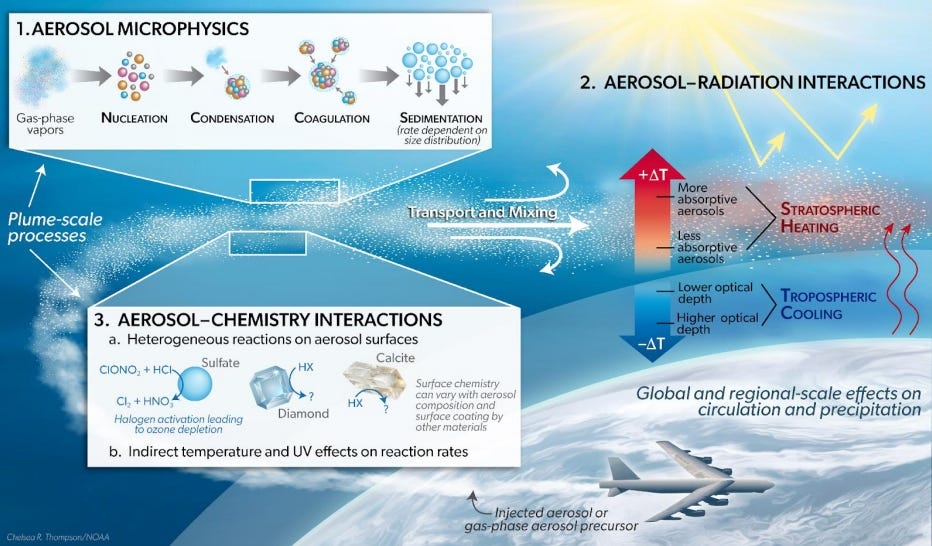
Addressing Gaps in Scientific Knowledge Could Improve Accuracy of Climate
Intervention Assessments
<https://essopenarchive.org/doi/pdf/10.22541/essoar.173884395.59264515> -
Preprint

Eastham, S. D., Butler, A. H., Doherty, S. J., Gasparini, B., Tilmes, S.,
Bednarz, E. M., ... & Yu21, P. (2025). Addressing Gaps in Scientific
Knowledge Could Improve Accuracy of Climate Intervention Assessments.
*Abstract: *Solar radiation modification (SRM) is increasingly discussed as
a potential method to ameliorate some negative effects of climate change.
However, unquantified uncertainties in the physical and environmental
impacts of SRM impede informed debate and decision making. Some
uncertainties are due to a lack of understanding of processes determining
the atmospheric effects of SRM and/or a lag in development of their
representation in models, meaning that even high-quality model
intercomparisons will not necessarily reveal or address them. Although
climate models at multiple scales are advancing in complexity, there are
specific areas of uncertainty where additional model development – often
requiring new observational data - could significantly advance our
understanding of SRM’s likely effects, and therefore improve our ability to
assess and weigh its potential risks against those of choosing to not use
SRM. We convene expert panels in the areas of atmospheric science most
critical to understanding the three most widely-discussed forms of SRM.
Each identifies three key modeling gap relevant to either stratospheric
aerosols, cirrus clouds, or low-altitude marine clouds. In addition to
arguing for more observations, the panels argue that model development work
to either leverage different capabilities of existing models, bridge the
scales across which relevant processes operate, or address specific, known
modeling gaps could yield benefits in understanding. By focusing effort on
addressing these knowledge gaps, we believe that themodeling community
could advance our understanding of SRM’s physical risks as well as its
potential benefits, allowing better-informed decision-making about whether
and how to use SRM.

<https://substackcdn.com/image/fetch/f_auto,q_auto:good,fl_progressive:steep/https%3A%2F%2Fsubstack-post-media.s3.amazonaws.com%2Fpublic%2Fimages%2F1dddb7ba-4a95-4146-b234-da107c172570_932x546.jpeg>
Addressing
Gaps in Scientific Knowledge Could Improve Accuracy of Climate Intervention
Assessments
<https://essopenarchive.org/doi/pdf/10.22541/essoar.173884395.59264515>
------------------------------
WEB POSTSThe Solar Geoengineering Updates Monthly Newsletter (January'2025)
<https://solargeoengineeringupdates.substack.com/p/the-solar-geoengineering-updates-e72>
[image: The Solar Geoengineering Updates Newsletter (January'2025)]
<https://solargeoengineeringupdates.substack.com/p/the-solar-geoengineering-updates-e72>
The Solar Geoengineering Updates Newsletter (January'2025)
<https://solargeoengineeringupdates.substack.com/p/the-solar-geoengineering-updates-e72>

Andrew Lockley <https://substack.com/profile/168530251-andrew-lockley>
·
Feb 5
Read full story
<https://solargeoengineeringupdates.substack.com/p/the-solar-geoengineering-updates-e72>
2024 Dubai Future Forum: “Will Humans Control the Atmosphere?
<https://medium.com/@honegger.matthias/2024-dubai-future-forum-will-humans-control-the-atmosphere-9fa03491bf45>
 (Medium)‘They see the streaks in the skies:’ Kentucky bill would ban
theoretical ‘geoengineering’
<https://www.lpm.org/news/2025-02-05/they-see-the-streaks-in-the-skies-kentucky-bill-would-ban-theoretical-geoengineering>
 (LPM)Given the Political Landscape, Arctic SRM Is Neither Feasible nor
Desirable
<https://srm360.org/perspective/arctic-srm-neither-feasible-nor-desirable/>
 (SRM360)Letter: Time is ripe to begin polar geoengineering trials
<https://www.newscientist.com/letter/mg26535290-700-time-is-ripe-to-begin-polar-geoengineering-trials-2/>
(New
Scientist)Solar geoengineering as a legitimate strategy? Interview with
Orri Stefánsson on Swedish radio
<https://mimircenter.org/news/kwpu5g5foun4nrt0ippz5nb8cayksl> (Mimir Center)Can
geoengineering plans save glaciers and slow sea level rise?
<https://www.sciencenews.org/article/glacier-engineering-to-slow-rising-sea>
(Science
News)SRM may moderate weather extremes in tropical river basin, report
Malaysia team <https://www.degrees.ngo/muda-river-malaysia-srm/> (The
Degrees Initiative)Could geoengineering strategies be effective in
preventing glaciers from subsiding and halting the increase in sea levels?
<https://list23.com/3913063-could-geoengineering-strategies-be-effective-in-preventing-glaciers-from-subsiding-and-halting-the-i/>
(List
23)The Arctic Ice Project Shuts Down
<https://srm360.org/perspective/arctic-ice-project-shuts-down/> (SRM360)
------------------------------
REPORTSIs studying climate interventions the same as deploying them?
<https://lnkd.in/etjZRmCi> (Center for future generations)
------------------------------
*RESOURCE*The full GENIE survey dataset—covering public perceptions of
climate change, CDR, and solar geoengineering across 30 countries & 19
languages—is now available open access via the Knowledge Hub
<https://cdr.apps.ece.iiasa.ac.at/story/2025_02_global_survey> (GENIE)
------------------------------
UPCOMING EVENTS*Clear Skies, Clear Minds: Harnessing Open Research to Find
Climate Solutions by Climate Systems Engineering Initiativ
<https://climateengineering.uchicago.edu/events/event/clear-skies-clear-minds-harnessing-open-research-to-find-climate-solutions/>e
| 13 February 2025 | University of Chicago**What if we could make more ice
by Centre for Climate Repair
<https://www.climaterepair.cam.ac.uk/events/spring-seminars-engineering-climate>
|
13 February 2025 | University of Cambridge**Towards a European Blueprint
for Responsible Solar Radiation Modification Research by Co-Create
<https://docs.google.com/forms/d/1zFN8QFO_ssQvztGYn3WmSbcj7nxQ1cyOziq-wcR7v1k/viewform?edit_requested=true>
|
14 February 2025 | Online**Science Revealed - Dean's Lecture Series
featuring Gwynne Dyer (lecture on geoengineering and climate change) by TRU
Faculty of Science
<https://www.castanetkamloops.net/news/Kamloops/529125/Well-known-author-journalist-to-give-free-lecture-on-geoengineering-and-climate-change>
|
19 February 2025 | Canada**What if clouds could be more reflective by
Centre for Climate Repair
<https://www.climaterepair.cam.ac.uk/events/spring-seminars-engineering-climate>
|
27 February 2025 | University of Cambridge**Solar radiation modification:
What are the technologies, and what are the risks? by Scientific Advice
Mechanism to the European Commission
<https://us02web.zoom.us/webinar/register/WN_ZuE3jfmuRNuY5OkztjYvhw#/registration>
|
11 March 2025 | Online**International Conference on Arctic Research
Planning IV Summit and Arctic Science Summit Week IASC
<https://assw.info/> | 20-28 March 2025 | Boulder, Colorado, USA**Climate
Intervention: Distraction or Necessity? by Center for Climate Repair
<https://www.climaterepair.cam.ac.uk/events/climate-intervention-distraction-or-necessity>
|
21 March 2025**2025 Solar Radiation Management Annual Meeting by Simons
Foundation
<https://www.simonsfoundation.org/event/solar-radiation-management-annual-meeting-2025/>
|
24-25 April 2025 | New York**The 2025 Degrees Global Forum
<https://substack.com/redirect/8521c00b-652a-4d78-822f-7ae393c57068?j=eyJ1IjoiMjJrMHl3In0.wQQsFypG52typ8FI2nhnJ8eUoUIIkdCkuhmzxNYKtgE>
|
12-16 May 2025 | Cape Town, South Africa**Consultative Workshop and
Science-Policy Dialogue on Solar Radiation Modification by UNEP
<https://www.unep.org/events/workshop/consultative-workshop-and-science-policy-dialogue-solar-radiation-modification>
|
19-20 May 2025 | Switzerland**Artic Repair Conference 2025 by University of
Cambridge & Center for Climate Repair
<https://substack.com/redirect/90f81f14-d09c-4418-8d97-c6621d753433?j=eyJ1IjoiMjJrMHl3In0.wQQsFypG52typ8FI2nhnJ8eUoUIIkdCkuhmzxNYKtgE>
|
26-28 June 2025 | Cambridge UK*

Solar Geoengineering Events Calendar <https://teamup.com/ks64mmvtit583eitxx>
------------------------------
PODCASTSSky whitening - Lemon | Reviewer 2 does geoengineering

Sky whitening - Lemon

Reviewer 2 does geoengineering

1:13:09
<https://podcasts.apple.com/us/podcast/sky-whitening-lemon/id1529459393?i=1000690380746&uo=4>

"Would a whiter sky be noticeable, under SAI geoengineering? Ansar Lemon
discusses what humans and animals could see. Paper: Under a not so white
sky: visual impacts of stratospheric aerosol injection - Ansar Lemon et al
2025 Environ. Res. Lett. 20 024060 DOI 10.1088/1748-9326/ada2ae A link to
his music is here <https://youtu.be/EpQ7rnQTDDU?si=ubVwa7p45uZ9mw_q>"

The Geopolitics of SRM | Climate Reflections: The SRM360 Podcast

The Geopolitics of SRM

Climate Reflections: The SRM360 Podcast

18:36
<https://podcasts.apple.com/us/podcast/the-geopolitics-of-srm/id1779965690?i=1000688713815&uo=4>

"Climate change will disrupt the geopolitical landscape. So will Sunlight
Reflection Methods (SRM). But might SRM help reduce international tensions
by reducing the impacts of climate change? Or will these methods cause more
or worse disruptions? For this episode of Climate Reflections, host Pete
Irvine speaks with geopolitical experts to explore the current geopolitical
landscape and how SRM might interact with it to impact international
relations."

We have to talk about solar geoengineering, part 1 with Kelly Wasner |
Wicked Problems
Wicked Problems
We have to talk about solar geoengineering, part 1
<https://news.wickedproblems.uk/p/we-have-to-talk-about-solar-geoengineering?utm_source=substack&utm_campaign=post_embed&utm_medium=email>
I’m not sleeping too well at the moment. My current wine/blood/caffeine
ratio is not sustainable. Yeats’ over-quoted “Second Coming” feels like a
cheery pep talk. The “Doomsday Clock” of the Bulletin of Atomic Scientists
has been set at 89 seconds to midnight. But I was raised to believe despair
is a sin, so while I’m going to just do what it takes to get through this
week, and the next one, and the next one, I also reserve the right to just
take a moment to appreciate the absurdity of this horror show…
Listen now
<https://news.wickedproblems.uk/p/we-have-to-talk-about-solar-geoengineering?utm_source=substack&utm_campaign=post_embed&utm_medium=email>
6 days ago · 1 like · Richard Delevan and Kelly Wanser
Degrees Initiative, Centering the Global South - interview with Andy Parker
| Wicked Problems
Wicked Problems
Degrees Initiative, Centering the Global South
<https://news.wickedproblems.uk/p/degrees-initiative-centering-the?utm_source=substack&utm_campaign=post_embed&utm_medium=email>
It’s the best of times, it’s the worst of times. I don't know about you,
but the whipsaw between good news, bad news and really, really dire news
is…a lot. And it’s not going to get any better any time soon…
Listen now
<https://news.wickedproblems.uk/p/degrees-initiative-centering-the?utm_source=substack&utm_campaign=post_embed&utm_medium=email>
3 hours ago · 1 like · Richard Delevan
------------------------------
YOUTUBE VIDEOSSAM webinar - Solar Radiation Modification: What’s at stake
for society? | Academia Europaea Cardiff Knowledge Hub
<https://www.youtube.com/watch?v=XlKaKTgo9H8>

"Solar Radiation Modification (SRM) covers a range of technologies that
have the potential to cool the Earth’s climate. SRM is therefore the
subject of intense and controversial debate around whether it might provide
a means to tackle global warming and the devastating impacts of climate
change."

Global Warming Has Accelerated: An Intimate Conversation with Leading
Climate Scientists | SDSN <https://www.youtube.com/watch?v=d6wOjk2OCZQ>

"An engaging discussion on groundbreaking research that reveals the
unexpected drivers behind the recent unprecedented rise in global
temperatures. Moderated by SDSN President Professor Jeffrey Sachs, this
virtual event explored Dr. James Hansen and colleagues' findings in the
latest publication, “Global Warming Has Accelerated,” their implications
for climate sensitivity, and the urgent need for alternative approaches to
mitigate the looming "point of no return."

--
You received this message because you are subscribed to the Google Groups
"geoengineering" group.
To unsubscribe from this group and stop receiving emails from it, send an email
to [email protected].
To view this discussion visit
https://groups.google.com/d/msgid/geoengineering/CAHJsh98Uc6fw_b9JmM6HxjA0F-gYKocvH3a9w%2B9bDwrkbBW1tA%40mail.gmail.com.