https://www.mdpi.com/2225-1154/13/3/43
*Authors*
Alec Feinberg

https://doi.org/10.3390/cli13030043

*Published: 21 February 2025*

*Simple Summary*
Global warming (GW) occurs when we add greenhouse gasses (GHGs) like CO2
and darken the Earth with black roads and roofs. This is called “forcing”
in climatology. Warming due to forcing is increased by nature’s feedback
problems like snow and ice melting which makes the planet hotter as we lose
reflectivity. But as the planet loses reflectivity and warms, more snow and
ice melt, and this is called a feedback loop. Most of the feedback and
feedback loop problems are due to atmospheric water vapor, which is
increasing as the planet becomes hotter. This is because warmer air holds
more water vapor. More water vapor in the atmosphere is a problem because
water vapor is a strong GHG. This study estimates that water vapor GHG
increase is 83% of the total feedback problem. In short, global warming is
the sum of forcing and feedback problems. Most people are concerned about
CO2 forcing problems from emissions (from cars, power plants, etc.).
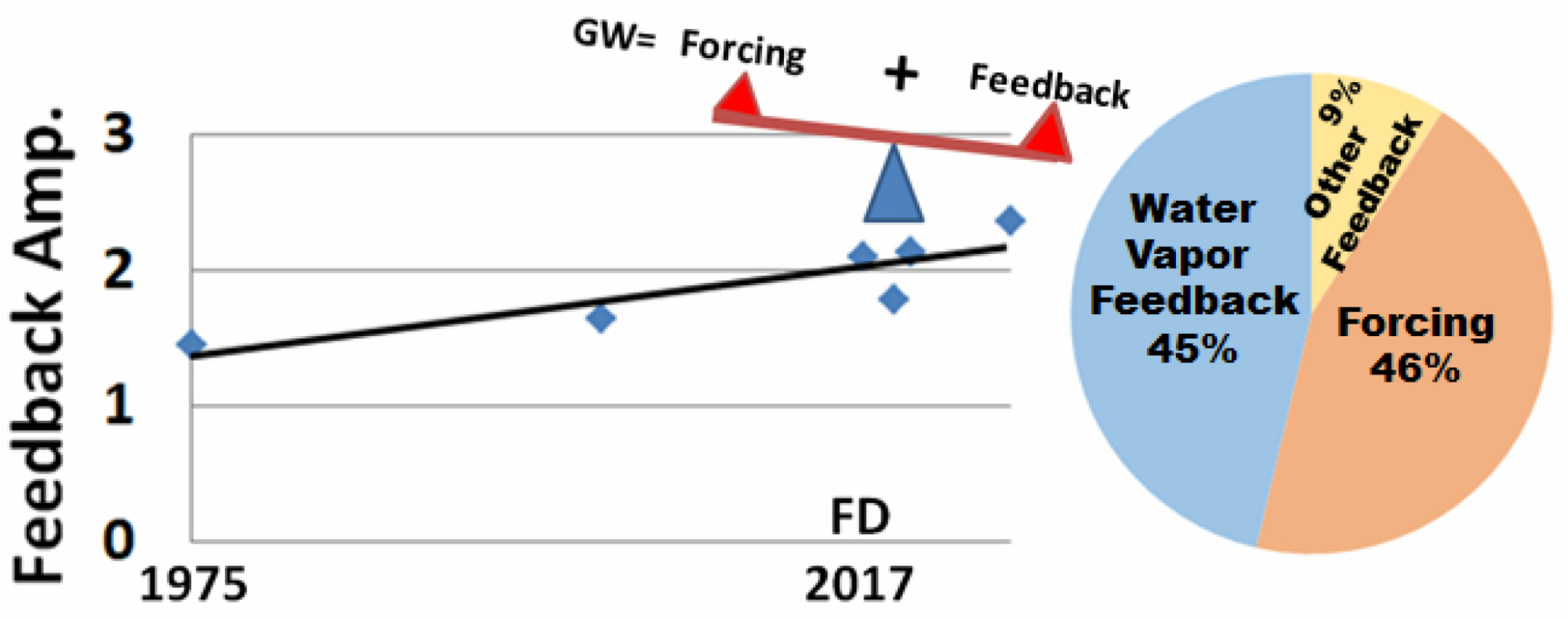
However, this study estimates that GW due to feedback in 2024 has become
larger than forcing with about 54% due to feedback and 46% due to forcing.
Although forcing causes feedback, it is unlikely that if we could remove
all the forcing (CO2, etc.) that feedback would also fully reverse since we
are over the 50% point. This adds to our global warming risks. This study
estimates feedback trends over time with simple graphs which helps us
better understand our global warming root causes. Calculations for these
are based on simple data manipulation on how much faster global warming
occurs, compared to energy consumption. This is shown to provide feedback
estimates. Results show that, in 2024, forcing, what man does, like adding
CO2, is now less of a problem than what nature’s feedback warming is doing,
like adding water vapor and the snow and ice melting. Because GW due to
feedback is larger now than forcing, this study highly recommends that we
should try and mitigate feedback as well. There are two methods to mitigate
global warming: reducing manmade GHGs (a secondary warming source) and/or
using solar geoengineering (SG). SG is 62% more efficient than CO2
reduction as it uses methods to reduce the Sun’s energy (the primary
warming source) absorbed by the Earth, to help cool it. For example, we
could brighten our streets and roofs to reflect the sunlight away, to
reduce the amount of heat absorbed. However, we will need stronger solar
geoengineering methods, which likely will include ways to reflect sunlight
away in the stratosphere and/or in outer space. GHG current mitigation
methods are likely far too slow to keep up with the rate of aggressive
feedback increases and CO2 lingers in the atmosphere for 100’s of years.
Furthermore, GHG reduction efforts have been disappointing, with many
obstacles other than emission problems, like wildfires, and lack of
worldwide unification with the U.S. again pulling out of the Paris
Agreement. Therefore, given the current circumstances including
feasibility, it is unfortunate, but we should not expect that we can
mitigate GW using only GHG reduction methods according to a risk assessment
provided here. There are currently no strong SG efforts, which can take
years to develop and implement. There are no guidelines in the Paris
Agreement to stop even the opposite problem of worldwide abuse of dark
roads, roofs, cars, and buildings, a form of negative SG. Candidates for SG
besides urbanization include the Arctic and Antarctic to help cool the
planet. In this paper, the method called annual SG, which can help stop
yearly GW increases to stabilize temperature increase problems, is
recommended while GHG reduction methods can improve. SG implementation will
take years to develop and urgently requires the help of organizations like
NASA, Space X, and the Canadian, Chinese, and European space agencies.

*Abstract*
This paper provides climate feedback trends, quantifies the
feedback-doubling (FD) period, considers urbanization influences, and
provides related equilibrium climate sensitivity (ECS) estimates using data
from 1880 to 2024. Data modeling is accomplished by focusing on
statistically significant stable normalized correlated rates (NCRs, i.e.,
normalized related slopes). Estimates indicate that the global warming NCR
is increasing by a factor of 1.65 to 2.33 times faster than the energy
consumption NCR, from 1975 to 2024. The reason is feedback amplification.
This is supported by the fact that the NCR for forcing and energy
consumption shows approximate equivalency in the period studied. Results
provide feedback yearly trend estimates at the 95% confidence level that
key results will fall within the IPCC AR6 likely range. The projected
2017–2024 feedback amplification estimates, using the EC approach, range
from 2.0 to 2.16, respectively. A feedback amplification of 2.0
(approximately equal to −2.74 Wm−2 K−1) doubles the forcing, indicating
that in 2024, more than half of global warming (53.7%) is likely due to
feedback. Relative to the feedback-doubling (FD) threshold (i.e., the point
where feedback exceeds forcing), the FD overage is 3.7% in 2024. This is
the amount of feedback exceeding the forcing portion found to have a
surprisingly aggressive 3.1% to 3.9% estimated overage growth rate per
decade. We now ask, shouldn’t we try to mitigate feedback as well as GHG
forcing, and if forcing could be removed, would global warming fully
“self-mitigate”? Additionally, CO2 yearly increases are complex, with poor
reduction progress. Therefore, this study’s risk assessment urgently
recommends that supplementary “mild” annual solar geoengineering is
necessary, to reduce the dominant aggressive feedback. SG reduces the
primary solar warming source creating 62% higher mitigation efficiency than
CDR. Urgency is enhanced since solar geoengineering must be timely and can
take years to develop. This study also estimates that 75% to 90.5% (83%
average) of the feedback problem is due to water vapor feedback (WVF). High
WVF also plagues many cities needing local SG. Trend analysis indicates
that by 2047, the earliest we may reach 10 billion people, feedback
amplification could reach a value of 2.4 to 2.8. Furthermore, by 2082, the
year estimated for 2× CO2, at the current rate, feedback amplification
could range from 2.88 to 3.71. This yields an ECS range from 2.4 °C to 3.07
°C, in reasonable agreement with the reported estimated range in AR6. An
overview of recent urbanization forcing attribution indicates the ECS value
may be lower by 10.7% if this forcing is considered. For numerous reasons,
the lack of albedo urbanization Earth brightening requirements in the Paris
Agreement, is unsettling. In addition, a model assesses effective forced
feedback (EFF) temperature characteristics of up to 1.9 °C, providing
interesting feedback insights that may relate to high GW land and pipeline
temperature estimates. Lastly in addition to urbanization, solar
geoengineering in the Arctic and Antarctic is advised. Worldwide efforts in
GHG mitigation, with no significant work in SG, appears highly misdirected.
<https://www.mdpi.com/2225-1154/13/3/43#>
<https://pub.mdpi-res.com/climate/climate-13-00043/article_deploy/html/images/climate-13-00043-ag.png?1740457641>
Graphical Abstract

*Source: MDPI*

--
You received this message because you are subscribed to the Google Groups
"geoengineering" group.
To unsubscribe from this group and stop receiving emails from it, send an email
to [email protected].
To view this discussion visit
https://groups.google.com/d/msgid/geoengineering/CAHJsh9960dkfq2cmqZfWFL4qDgEBvye-a9rZfKZT1%3DnxkYOq9Q%40mail.gmail.com.