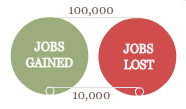
There's a pretty good literature history on this very subject. One
important thing noted by JJ Flannery as early as 1956 was that if you
scale your circle areas directly proportional to your variable, map
viewers underestimate the values. You have to scale the the circle
areas by a particular factor.
For example, see:

Flannery, J.J. (1971) "The relative effectiveness of some common
graduated point symbols
in the presentation of quantitative data." Canadian Cartographer 8,
no. 2:96-109.

What's funny is that very few GISes incorporate these psychographic techniques.

-Eric

-=--=---=----=----=---=--=-=--=---=----=---=--=-=-
Eric B. Wolf                          720-209-6818
USGS Geographer
Center of Excellence in GIScience
PhD Student
CU-Boulder - Geography


On Fri, May 8, 2009 at 10:30 AM, Michal Migurski <[email protected]> wrote:
>>> On May 7, 2009, at 3:48 PM, Catherine Burton wrote:
>>>
>>>> Nothing says well-conveyed information like a good map:
>>>>
>>>> http://tipstrategies.com/archive/geography-of-jobs/
>>>
>>>
>>>
>>> Ruh-roh:
>>>        http://mike.teczno.com/img/jobs-gained-jobs-lost.png
>>
>> you're pointing out it seems to be radius rather than area based?
>
>
> Yeah, it really blows the 100k jobs circles way out of proportion. The time
> browsing is well done, but I think that using the radius as a measure was
> probably a mistake. The view at the very end of the map, March 2009, is a
> serious exaggeration.
>
> On the plus side, Hurricane Katrina in 2005 and Detroit in 2006 particularly
> stand out. It would be nice if it were possible to scrub time back & forth.
>
> -mike.
>
> ----------------------------------------------------------------
> michal migurski- [email protected]
>                 415.558.1610
>
>
>
>
> _______________________________________________
> Geowanking mailing list
> [email protected]
> http://geowanking.org/mailman/listinfo/geowanking_geowanking.org
>

_______________________________________________
Geowanking mailing list
[email protected]
http://geowanking.org/mailman/listinfo/geowanking_geowanking.org