Hello Jon, thanks for taking the time to write and comment.  I'll write you
separately as I suspect most members of the list won't enjoy seeing a flurry of
emails between us, but I did want to point out that I do not believe you are
reading the piece closely or carefully.  As you can see here, on p. 192, I am
very, very careful to indicate that the piece is not about rejecting
adaptation, but making it better:
Lastly, the existence of enclosure, exclusion, encroachment, and entrenchment
in some Bangladeshi adaptation measures does not mean that they are always
present or even frequently present. Nor does it imply that Bangladesh should
abandon its adaptation efforts. There are many adaptation projects that seem to
be producing a net social benefit despite the complex Bangladeshi political
ecology surrounding them (Ahammad, Nandy, & Husnain, 2013; Chowdhury, 2008;
Rawlani & Sovacool, 2011). So, not every adaptation project need perpetuate
inequality, exclude others, or enclose and encroach upon people's property or
livelihood.  Although political ecology processes can at times distort or mold
adaptation projects and processes to the interests of dominant stakeholders,
they do not necessarily or completely undermine or obfuscate all of the
benefits of adaptation. Even the specific critiques raised, some of them quite
sobering, are aimed at a target: improving and learning from adaptation's
political ecology so that the least vulnerable are helped, and so that benefits
and burdens are made visible, and distributed fairly and according to
representative processes. Planners and practitioners of adaptation projects
need to become more cognizant of the potential for projects to harm others, or
admit complicity in the processes of enclosure, exclusion, encroachment, and
entrenchment.


So you're critique isn't mutually exclusive to my suggestion - make adaptation
more attuned to justice and vulnerability themes. While I am less familiar with
those scholars writing the development cooperation literature, I suspect they
wouldn't disagree?


-----Original Message-----

From: Jon Marco CHURCH [mailto:[email protected]]

Sent: 21 January 2018 09:08

To: Benjamin Sovacool <[email protected]<mailto:[email protected]>>

Cc: 'Ecopolitics'
<[email protected]<mailto:[email protected]>>;
[email protected]<mailto:[email protected]>;
[email protected]<mailto:[email protected]>; 'Karolina
Kluczewska' <[email protected]<mailto:[email protected]>>; 'Alice
Baillat' <[email protected]<mailto:[email protected]>>

Subject: RE: [Ecopolitics] When Climate Change Adaptation Goes Wrong


Dear Prof. Sovacool,


I am at the same time a scholar of sustainable development and a practitioner
of development cooperation. I read with much interest your article. I think
however that the focus of your research question is misplaced. Your research
findings have little to do with adaptation to climate change. Most of them are
common throughout development cooperation.

The fact that there is a lot of funding available for projects on adaptation to
climate change compared to other environmental issues exacerbates well-known
problems with development cooperation.


I am afraid that your article and its press release send a very wrong and
dangerous message. Adaptation to climate change and in general resilience to
exogenous shocks is very important in vulnerable countries like Bangladesh.

The problem is not adaptation to climate change but development cooperation,
which needs radical improvement.


I would like to thank Professor Takei for sharing your work.


Kind regards,


J.M.Church


--

Jon Marco CHURCH

Associate Professor

University of Reims

IATEUR - BP 30 - 57 rue Pierre Taittinger - 51571 Reims Cedex - France Tel. :
+33 (0)3 26 91 37 45 - www.univ-reims.fr<http://www.univ-reims.fr> New
publication : < Soft power of Tajikistan on the water agenda >, in Water
Resources in Central Asia, S.S. Zhiltsov et al. (ed.), Cham, Springer.


-----Original Message-----

From: Ecopolitics [mailto:[email protected]] On Behalf Of
Milton Takei

Sent: Friday, January 19, 2018 2:57 AM

To: Ecopolitics <[email protected]<mailto:[email protected]>>

Subject: [Ecopolitics] When Climate Change Adaptation Goes Wrong


To ecopolitics subscribers:


       The following is from:


[email protected]<mailto:[email protected]>

                                    --Milton Takei


Good morning from Europe everyone,


As many of you know, much work in the community focuses on climate change
mitigation, namely technologies, practices, and policies that can prevent
emissions from escaping into the atmosphere.  But equally important is
adaptation, building resilience to the impacts of climate change. In that vein,
drawing from two sets of interviews in Bangladesh, I was able to get the
attached study into World Development by connecting it to concepts in political
geography, political ecology, justice, and development studies:


https://www.sciencedirect.com/science/article/pii/S0305750X17303285


Sovacool, BK. "Bamboo beating bandits: Conflict, inequality, and vulnerability
in the political ecology of climate change adaptation in Bangladesh," World
Development 102 (February, 2018), pp. 183-194.


It's a bit dense and theoretical, but also troubling in its findings. To help
try and spread some of its lessons, we've translated some of its findings into
the blog below. Hopefully planners will start to design more equitable
adaptation programs and policies going forward.


Feedback most welcome on the conceptual framework as future work is applying it
to disaster recovery, renewable energy, and low-carbon transitions.


Benjamin


http://www.sussex.ac.uk/spru/newsandevents/2017/findings/bangladesh


[http://www.sussex.ac.uk/wcm/assets/media/25/banner/51585.jpg]

When Climate Change Adaptation Goes Wrong in Bangladesh


New research by Prof Benjamin Sovacool highlights the urgent need for climate
change adaption policies in Bangladesh to be rethought.


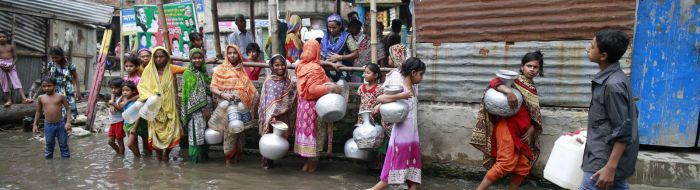
Bangladesh contributes little to global greenhouse gas emissions, yet is one of
the most climate vulnerable countries in the world, prone to a multitude of
climate-related disasters such as floods, droughts, tropical cyclones and storm
surges, which are being worsened due to global warming.

In addition to this, Bangladesh also has an extremely high population density
with one of the worst rates of poverty in the world.


Since May 2010, international donors have spent more than US$170m on climate
change adaption efforts such as altering infrastructure, institutions and
ecosystems in Bangladesh, bringing some success environmentally. Yet, research
by Prof Sovacool <http://www.sussex.ac.uk/profiles/373957> examines and
highlights how on the flip side of these efforts, existing social and political
injustices within Bangladesh have been re-affirmed and exacerbated.


In his paper 'Bamboo Beating Bandits: Conflict, Inequality, and Vulnerability
in the Political Ecology of Climate Change Adaptation in

Bangladesh'<http://www.sciencedirect.com/science/article/pii/S0305750X173032

85>

Prof Sovacool reveals that climate change policies implemented under the
country's National Adaptation Program of Action have ended up enabling elites
to capture land through public servants, the military, and even gangs carrying
bamboo sticks. Climate protection measures have also encroached upon village
property, char (public) land, forests, farms, and other public commons. More
shockingly, community coping strategies for climate change have actually
entrenched class and ethnic hierarchies in some communities, trapping the poor,
powerless and displaced in a patronage system, leading to increased human
insecurity and intensified violent conflict.


Using a mix of original interviews and a literature review, Prof Sovacool
examined the processes of:


  *   Enclosure - when adaptation projects transfer public assets into

private hands or expand the roles of private actors into the public sphere

  *   Exclusion - when adaptation projects limit access to resources or

marginalize particular stakeholders in decision-making activities

  *   Encroachment - when adaptation projects intrude on biodiversity

areas or contribute to other forms of environmental degradation

  *   Entrenchment - when adaptation projects aggravate the disempowerment

of women and minorities, or worsen concentrations of wealth and income
inequality within a community


_______________________________________________

Ecopolitics mailing list

[email protected]<mailto:[email protected]>

http://lists.opn.org/mailman/listinfo/ecopolitics_lists.opn.org


--
You received this message because you are subscribed to the Google Groups
"gep-ed" group.
To unsubscribe from this group and stop receiving emails from it, send an email
to [email protected].
For more options, visit https://groups.google.com/d/optout.