To be fair James, the "wibble" on Grist that humans (and most life on
earth) tends to be well-adapted to current climates, and that rapid
climate change would severely damage natural systems and impose
potentially large costs on the economy, has fairly strong support in
the literature. We can quibble over the term "optimal", but it seems
clear that under most scenarios anthropogenic warming will have
widespread negative effects vis-a-vis the status quo.
>From my perspective as an economist, your article seems somewhat
uncontroversial. It is a basic explanation of an environmental
externality, and an argument that correcting the externality would be
more socially-optimal than allowing it to continue. I have yet to meet
an economist who would seriously disagree with this broad statement
(and for a list of eminent economists spanning the political spectrum
who have explicitely supported such a position, see Greg Mankiw's
Pigou Club: http://gregmankiw.blogspot.com/2006/09/rogoff-joins-pigou-club.html
). The more interesting argument, from an economic perspective, is
what the costs of abatement will be, what the costs of climate change
will be, what type of mechanism is best for catalyzing abatement (e.g.
taxes, tradable permits, or hybrid systems), and what discount rate
should be used in calculating future costs of climate change.

Measures taken to reduce greenhouse gas emissions will reduce
consumption (and thus "hurt" the economy). However, if the cost of
abatement is less than the damages associated with unmitigated climate
change, abatement would have a net positive effect on the economy.
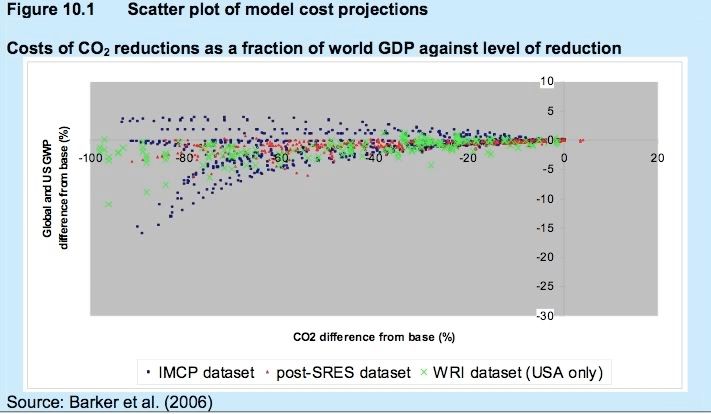
There are a wide range of estimates of the cost of abatement, ranging
from bottom-up optimistic estimates that investments in abatement
would effectively cost nothing due to efficiency opportunities
currently ignored (primarily models developed by engineers) to more
pessimistic top-down macroeconomic models (usually developed by
economists) that show a wide range of potential costs (from 0.5% of
annual GWP to over 10% of GWP). See, for example, this assembly of
different models from chapter three of the Stern Review:
http://i81.photobucket.com/albums/j237/hausfath/CostofAbatement.jpg .

Estimates of the costs of climate change also differ widely, with
economists such as Robert Mendelsohn and Bill Nordhaus estimating
relatively low damages and Nicholas Stern estimating high damages (~12
percent of GWP). Here many issues come into play, such as the
calculation of non-use values (the existance of species, for example)
and the value of ecosystem services. Similarly, equity weighting
becomes an important issue, so that the damages to the most vulnerable
countries are not marginalized simply because those countries have a
low GDP. The decision on how much to discount the future will
fundamentally shape any estimates of the future cost of climate
change, to the point where the choice of discount rate matters more
than any other factor. There is a robust debate among economists and
philosophers on the correct way to discount the future, and you can
see the appendix at the end of chapter two of the Stern Review for a
good overview:
http://www.hm-treasury.gov.uk/media/9/A/Chapter_2_Technical_Annex.pdf
.

Finally, the choice of economic mechanisms matters quite a bit.
Tradable permit systems with a fixed cap risk unacceptably high costs
if abatement proves more expensive than anticipated over the short
term. Similarly, taxes can allow unacceptably high climate damages if
the marginal damage curve for climate change is highly convex. For
good background on the relative merits of each of these systems, see
Billy Pizer's Prices vs. Quantities: The Case of Climate Change,
http://search.rff.org/custom/cs.html?charset=iso-8859-1&url=http%3A//www.rff.org/Documents/RFF-DP-98-02.pdf

In reality, the only way that measures to tackle climate change could
hurt the economy would be if the abatement measures were too ambitious
(and thus more costly than the damages of unabated emissions) or if
the cost of climate change proves lower than expected. There is a
healthy ongoing debate in the economics community about the damages of
climate change, the cost of abatement, and the best mechanisms to
achieve abatement.


--~--~---------~--~----~------------~-------~--~----~
You received this message because you are subscribed to the Google Groups
Global Change ("globalchange") newsgroup. Global Change is a public, moderated
venue for discussion of science, technology, economics and policy dimensions of
global environmental change.

Posts will be admitted to the list if and only if any moderator finds the
submission to be constructive and/or interesting, on topic, and not
gratuitously rude.

To post to this group, send email to [email protected]

To unsubscribe from this group, send email to [EMAIL PROTECTED]

For more options, visit this group at
http://groups.google.com/group/globalchange
-~----------~----~----~----~------~----~------~--~---