Though one could argue that the main barrier to economic nuclear power
is the cost of safety regulations (which have effectively doubled the
cost of a plant since 1970). These safety requirements have been
instituted for a good reason, but it does skew the economics a bit.
Also, small-scale power can work up to a point. Given our current
energy grid, I could foresee small-scale distributed generation
providing 30, maybe 40 percent of total power, assuming you find a
good way to regulate intermittent fluctuations in generation (say,
through hydrogen production or efficient battery systems). However,
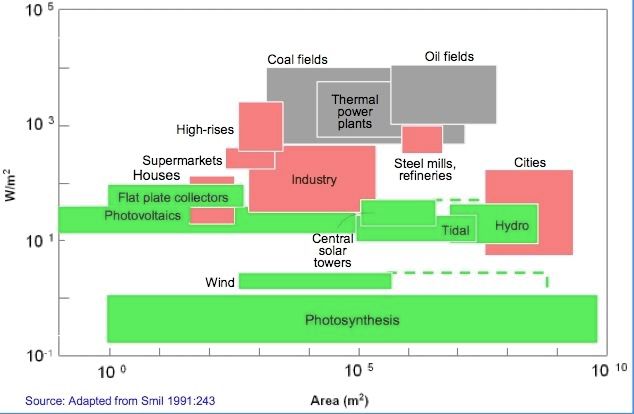
you soon start to run into the spacial power density issues, that tend
to require small power plants capable of producing large amounts of
power (see http://i81.photobucket.com/albums/j237/hausfath/Powerdensity.jpg
). For example, even if you covered every inch of downtown Tokyo with
100% efficient solar panels, it  would not produce sufficient
electricity to meet the area's energy needs.

Now, if you are willing to invest in a superefficient superconducting
electricity grid, it would be perfectly viable to power New York using
massive wind farms in Iowa or solar plants in Nevada. However, that
would not be cheap.

Also, ignoring what congress is doing is not always the best idea,
when its congress who has the ultimate power to change the economic
logic of the system (e.g. by pricing the climate externality via an
emissions tax on carbon).

On Jul 27, 7:35 am, Jim Torson <[EMAIL PROTECTED]> wrote:
> http://www.grist.org/news/maindish/2007/07/26/lovins/
> A conversation with energy guru Amory Lovins
> This covers a variety of issues, e.g., Big Coal, liquid coal,
> biofuels, etc.  Here is an excerpt:
> ------------
> <snip>
> So I would not pay too much attention to what Congress is doing. I'm not
> saying it doesn't matter, but ultimately economic fundamentals govern what
> will happen -- things that don't make sense, that don't make money, cannot
> attract investment capital.
> We see this now in the electricity business. A fifth of the world's
> electricity and a quarter of the world's new electricity comes from
> micropower -- that is, combined heat and power (also called cogeneration) and
> distributed renewables. Micropower provides anywhere from a sixth to over
> half of all electricity in most of the industrial countries. This is not a
> minor activity anymore; it's well over $100 billion a year in assets. And
> it's essentially all private risk capital.
> So in 2005, micropower added 11 times as much capacity and four times as much
> output as nuclear worldwide, and not a single new nuclear project on the
> planet is funded by private risk capital. What does this tell you? I think it
> tells you that nuclear, and indeed other central power stations, have
> associated costs and financial risks that make them unattractive to private
> investors. Even when our governmentapproved new subsidies on top of the old
> onesin August 2005 -- roughly equal to the entire capital costs of the
> next-gen nuclear plants -- Standard & Poor's reaction in two reports was that
> it wouldn't materially improve the builders' credit ratings, because the
> risks private capital markets are concerned about are still there.
> <snip>


--~--~---------~--~----~------------~-------~--~----~
You received this message because you are subscribed to the Google Groups
Global Change ("globalchange") newsgroup. Global Change is a public, moderated
venue for discussion of science, technology, economics and policy dimensions of
global environmental change.

Posts will be admitted to the list if and only if any moderator finds the
submission to be constructive and/or interesting, on topic, and not
gratuitously rude.

To post to this group, send email to [email protected]

To unsubscribe from this group, send email to [EMAIL PROTECTED]

For more options, visit this group at
http://groups.google.com/group/globalchange
-~----------~----~----~----~------~----~------~--~---