Though one could argue that the main barrier to economic nuclear power
is the cost of safety regulations (which have effectively doubled the
cost of a plant since 1970). These safety requirements have been
instituted for a good reason, but it does skew the economics a bit.
Yes, if we gave up our silly concern about safety and nuclear
proliferation, the economics of nuclear power would no doubt improve
Also, small-scale power can work up to a point. Given our current
energy grid, I could foresee small-scale distributed generation
providing 30, maybe 40 percent of total power, assuming you find a
good way to regulate intermittent fluctuations in generation (say,
through hydrogen production or efficient battery systems). However,
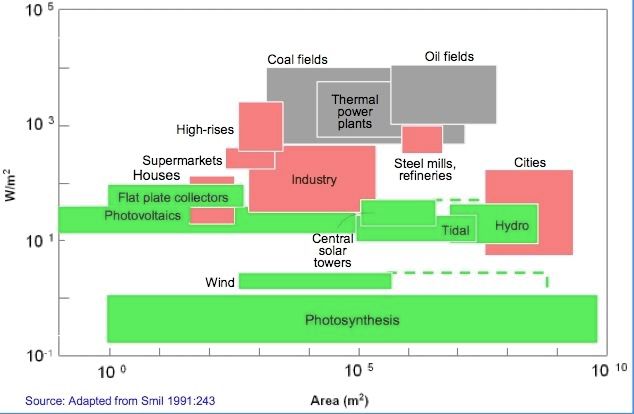
you soon start to run into the spacial power density issues, that tend
to require small power plants capable of producing large amounts of
power (see http://i81.photobucket.com/albums/j237/hausfath/Powerdensity.jpg
). For example, even if you covered every inch of downtown Tokyo with
100% efficient solar panels, it would not produce sufficient
electricity to meet the area's energy needs.
The following is an excerpt from part four of Joe Romm's blog reporting
on a long email from James Hansen:
http://climateprogress.org/2007/07/27/hansen-on-who-killed-the-electric-car/
Hansen on "Who Killed the Electric Car?"
<snip>
- Of course it is sensible to allow a trial power plant to be built of the sort intended to eventually include carbon capture and sequestration. But there is no way that anything more than a trial should be allowed. These plants are gargantuan. There is no guarantee that they will even make sense, once carbon is properly priced. Scandinavia provides a good example (B.E. Johansen, The Progressive, July 2007): Denmark, e.g., has remade its energy infrastructure. While in the 1980s it had 15 large power plants, it now has several hundred smaller ones, thus closer to homes and offices with reduced power loss during transmission. Much of the energy is renewable. Energy efficiency has been promoted, so the average Dane uses less than half the electricity used in the U.S. In the process, their economy has become strong.
--~--~---------~--~----~------------~-------~--~----~
You received this message because you are subscribed to the Google Groups Global Change ("globalchange") newsgroup. Global Change is a public, moderated venue for discussion of science, technology, economics and policy dimensions of global environmental change.
Posts will be admitted to the list if and only if any moderator finds the submission to be constructive and/or interesting, on topic, and not gratuitously rude.
To post to this group, send email to [email protected]
To unsubscribe from this group, send email to [EMAIL PROTECTED]
For more options, visit this group at http://groups.google.com/group/globalchange
-~----------~----~----~----~------~----~------~--~---