Eric,

Here's an article about the monitoring of the THC:
http://www.nerc.ac.uk/publications/planetearth/2008/summer/sum08-rapid.pdf
from the UK government organisation NERC. They produce a magazine
which reports some of their work each quarter, which can be found
here.
http://www.nerc.ac.uk/publications/planetearth/
The articles can be interesting and not too heavy :-)

Cheers, Alastair.

On Jun 22, 2:29 pm, Eric Swanson <[EMAIL PROTECTED]> wrote:
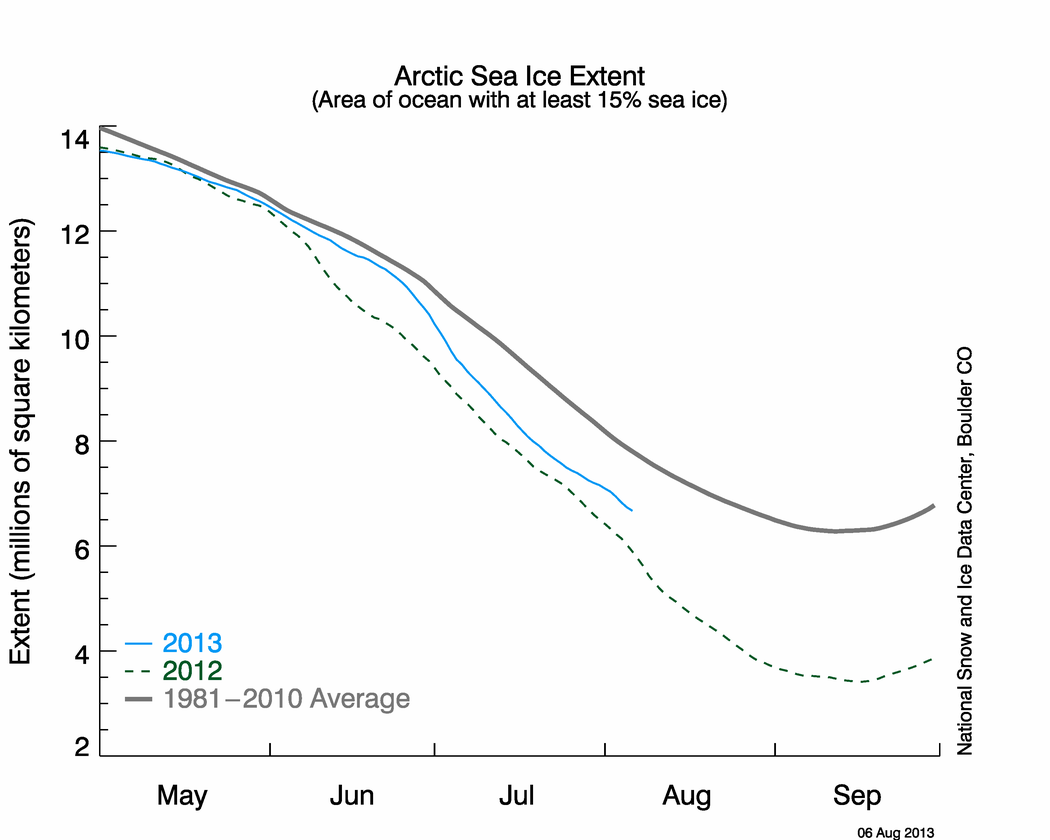
> It looks like the Arctic sea-ice is following last year's melt, with
> extent being just about the same lately as was seen last year in this
> time period.  Last year, there was a rather sharp decline seen during
> June and July, which may have been related to last year's wind
> patterns.  Time will tell.
>
> Here's a recent story from the BBC about the situation.
>
> http://news.bbc.co.uk/2/hi/science/nature/7461707.stm
>
> With all that sea-ice flooding out thru the Fram Strait, I wouldn't be
> surprised to learn that there's another "Great Salinity Anomaly" in
> the works.
>
> E. S.
> ----------------------------------------------------
>
> Eric Swanson wrote:
> > A great animation of sea-ice coverage over the Arctic was posted on a
> > web site by Thomas Homer-Dixon.
>
> >http://www.homerdixon.com/download/arctic_flushing.html
>
> > After last summer's record low sea-ice extent, the winds this winter
> > forced a considerable amount of sea-ice thru the Fram Strait into the
> > Greenland Sea.  Looking at the animation, the Fram strait is at the
> > top of the view, at about 1 o'clock.  As I looked at the the
> > animation, I had the feeling that what I was looking at was a living,
> > breathing critter, not cold, solid ice.  We have also recently learned
> > that there has been a large reduction in the multi-year ice, that is,
> > sea-ice which has survived more than 1 year and which tends to be
> > thicker than the new ice which forms each winter.  With less multi-
> > year ice, the resulting ice cap is thinner and thus weaker.  As wind
> > forces push across the sea-ice,  there is thus a stronger tendency for
> > the sea-ice to break apart and then move around.   As one watches the
> > animation, there appears to be a breakup due to the passage of a
> > strong winter storm in the lower RH corner, which would be north of
> > Alaska.
>
> > There’s information that the sea-ice extent at present is rapidly
> > declining towards the amounts seen last year at this time.  There has
> > been a sudden downward turn in the trend after the March maximum which
> > was somewhat above last year’s maximum.
>
> >http://nsidc.org/data/seaice_index/images/daily_images/N_timeseries.png

--~--~---------~--~----~------------~-------~--~----~
You received this message because you are subscribed to the Google Groups
Global Change ("globalchange") newsgroup. Global Change is a public, moderated
venue for discussion of science, technology, economics and policy dimensions of
global environmental change.

Posts will be admitted to the list if and only if any moderator finds the
submission to be constructive and/or interesting, on topic, and not
gratuitously rude.

To post to this group, send email to [email protected]

To unsubscribe from this group, send email to [EMAIL PROTECTED]

For more options, visit this group at
http://groups.google.com/group/globalchange
-~----------~----~----~----~------~----~------~--~---