A great animation of sea-ice coverage over the Arctic was posted on a
web site by Thomas Homer-Dixon.
http://www.homerdixon.com/download/arctic_flushing.html

After last summer's record low sea-ice extent, the winds this winter
forced a considerable amount of sea-ice thru the Fram Strait into the
Greenland Sea.  Looking at the animation, the Fram strait is at the
top of the view, at about 1 o'clock.  As I looked at the the
animation, I had the feeling that what I was looking at was a living,
breathing critter, not cold, solid ice.  We have also recently learned
that there has been a large reduction in the multi-year ice, that is,
sea-ice which has survived more than 1 year and which tends to be
thicker than the new ice which forms each winter.  With less multi-
year ice, the resulting ice cap is thinner and thus weaker.  As wind
forces push across the sea-ice,  there is thus a stronger tendency for
the sea-ice to break apart and then move around.   As one watches the
animation, there appears to be a breakup due to the passage of a
strong winter storm in the lower RH corner, which would be north of
Alaska.

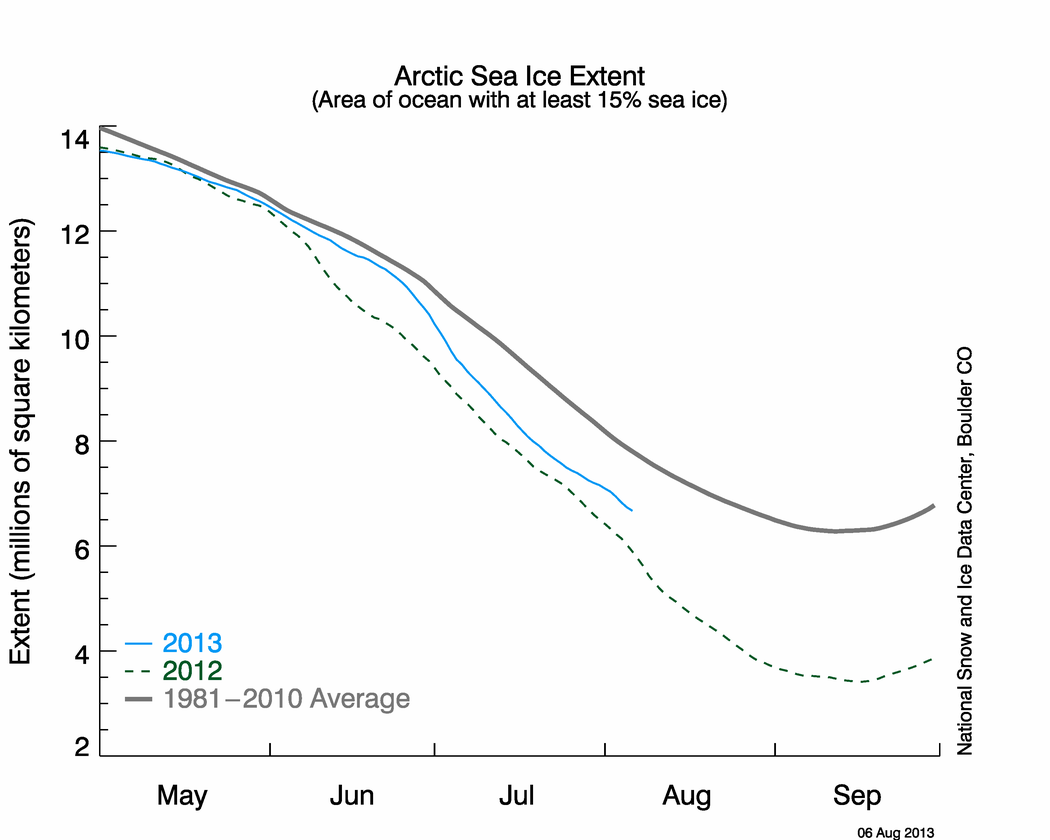
There's information that the sea-ice extent at present is rapidly
declining towards the amounts seen last year at this time.  There has
been a sudden downward turn in the trend after the March maximum which
was somewhat above last year's maximum.

http://nsidc.org/data/seaice_index/images/daily_images/N_timeseries.png

The sea-ice area indexes from U. Chicago is showing that present area
is just where it was at this time last year.  One should note that the
area index is computed differently than the extent index  from NSIDC.
I notice that the slope of the curve is much steeper this year than
last, which indicates a strong rate of melting.

http://arctic.atmos.uiuc.edu/cryosphere/IMAGES/current.365.jpg

If these trends continue, we may see even less sea-ice this year after
the end of the melt season than the record low which occurred last
year.

The flow of fresh water thru the Fram Strait in the form of sea-ice
may have dramatic consequences for the THC in the Greenland Sea and
also in the Ingmar and Labrador Seas, as the East Greenland current
can carry the ice/water all the way around the southern tip of
Greenland.  I suspect that there is already a reduced THC in the
Greenland Sea, although my supporting data is weak.  I would hope that
we will soon see reports of THC strength as the latest measurements
are collected and analyzed.

E. S.


--~--~---------~--~----~------------~-------~--~----~
You received this message because you are subscribed to the Google Groups
Global Change ("globalchange") newsgroup. Global Change is a public, moderated
venue for discussion of science, technology, economics and policy dimensions of
global environmental change.

Posts will be admitted to the list if and only if any moderator finds the
submission to be constructive and/or interesting, on topic, and not
gratuitously rude.

To post to this group, send email to [email protected]

To unsubscribe from this group, send email to [EMAIL PROTECTED]

For more options, visit this group at
http://groups.google.com/group/globalchange
-~----------~----~----~----~------~----~------~--~---