http://www.outlookindia.com/article.aspx?266789
<http://www.outlookindia.com/article.aspx?266789>
ENVIRONMENT: POLICY
The Butterfly Effect <http://www.outlookindia.com/article.aspx?266789>
A proactive minister puts Paryavaran Bhavan in focus. The development
dauphins are aflutter.
LOLA
NAYAR<http://www.outlookindia.com/peoplefnl.aspx?pid=1182&author=Lola+Nayar>
 ,  ANURADHA
RAMAN<http://www.outlookindia.com/peoplefnl.aspx?pid=3901&author=Anuradha+Raman>
 ,  SMRUTI
KOPPIKAR<http://www.outlookindia.com/peoplefnl.aspx?pid=3884&author=Smruti+Koppikar>

When did you last hear of an Indian cabinet minister being compared to
Muhammad Ali? Well, that’s how a retired bureaucrat described Jairam Ramesh:
float like a butterfly, sting like a bee. Over the past 15 months, UPA-II’s
environment minister has done just that, taking on many a ministerial
colleague in public while simultaneously landing on the hit-list of numerous
chief ministers. Even if Jairam is at the heart of the raging environmental
controversies of the day—approvals for mega projects from Vedanta and Posco,
the battle over Mumbai’s new airport, and last year’s spat over GM foods—his
plate never seems full. The man still takes time out to launch other battles
elsewhere.

It’s definitely making an impact. Today, a shared perception among
environmentalists and fellow politicians alike is that Jairam has
transformed Paryavaran Bhavan into a happening place. But by doing so, he’s
also changing the rules in the development vs environment applecart. This
makes for some powerful enemies in a fast-growing economy, where states—in
collusion with the central authorities—chase big money and bigger headlines.
Not to forget the ministries in a desperate race to meet development
targets. Is Jairam’s green charge all for the good then?

<http://cms.outlookindia.com/Uploads/outlookindia/2010/20100830/page46_20100830.jpg>

K. Ullas Karanth, head of the India chapter of Wildlife Conservation Society
and a member of the in-the-news Forest Advisory Committee (FAC), is one of
those pleased with the change. “Jairam Ramesh has brought back a lot of
integrity to the ministry and cleaned it up,” he says. His only complaint is
that the minister has not kept “his promise of making the ministry more
scientific-oriented (possibly due to his being a technocrat). There is lot
of room for improvement.”

Despite having crossed words with many ministers in public, it’s intriguing
that few in the Congress and the government have any criticism to offer. At
the most, there is unease at the minister’s tendency to veer towards
“flamboyance and playing to the gallery in many cases”. Similarly, everyone
glosses over the usual questions—is Jairam as clean as the white khadi
churidar kurta he favours? Is he above power politics? Is he a lone ranger
or is there a bigger design behind the UPA’s green politics?

In fact, a cabinet colleague, who in the past has aired major differences of
opinion with Jairam in public, defends him saying, “He is implementing laws
in letter and spirit...which previous environment ministers had never done.”
The minister, who declined to be identified, points out that all the
requisite laws to protect the environment without hampering development
already exist—it’s just that powerful vested interests continue to flout
them.


“If investing 10% can buy the system, would an erring industry spend money
to meet its legal obligations?”N.C. Saxena, NAC Member


Many point out that in the decade prior to Jairam taking charge, barring
Suresh Prabhu’s tenure during the nda regime, the ministry suffered during
the eight years when DMK ministers were in charge. It had virtually
abdicated its regulatory role and had become a clearing-house for
uncontrolled development. “The minister is only trying to observe the laws
passed by the cabinet and Parliament,” says N.C. Saxena, an NAC member who
heads numerous panels on development. Stating that often the bureaucracy is
also under pressure when politicians try to please companies, Saxena
caustically observes, “If investing 10 per cent can buy the system, why
would an erring industry want to spend money on meeting obligations under
the law?”

On the face of it, support for Jairam comes from consistent political
backing from Sonia Gandhi. The PMO is also letting him be—apart from the
time when Manmohan Singh pulled him up for his statements criticising home
minister P. Chidambaram’s policies on Chinese investments. Clearly, Jairam’s
mandate comes from its consonance with the principle of development with a
human face, which UPA-II is seeking to espouse in times of volatile
Naxalism. “There is pressure to strike a balance between development and the
environment. Unless we focus more on equity and distribution of profits, we
will have more Vedantas,” says Zoya Hasan, professor of political science at
JNU.

It helps that Jairam has played his cards well—thus far. He is quick to keep
everyone in the loop on developments, dashing off a flurry of letters.
Tactically, he has withheld environment clearance only after careful
deliberations, whether based on an expert team’s report (like with Vedanta)
or by engaging with civil society (like in the case of GM foods). But while
he has been using existing laws (the latest weapon is the Forest Rights
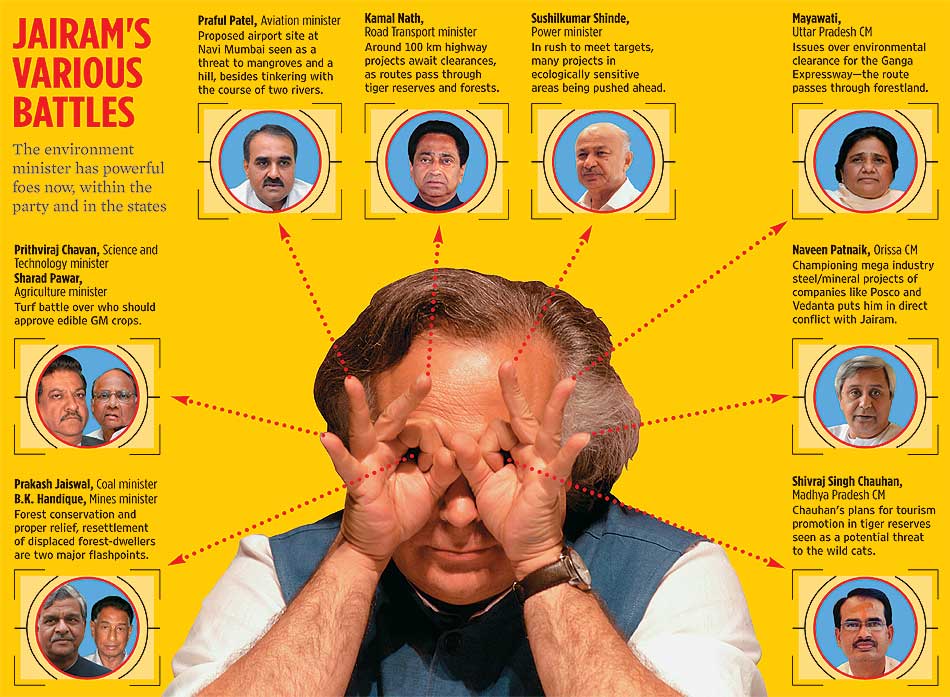
Act), the pressures are mounting. A look at Jairam’s many battles.


Site for the new airport in Navi Mumbai (Photograph by AFP, From Outlook,
August 30, 2010)

*Navi Mumbai Airport*

In Mumbai, they say the true test of Jairam’s calibre will lie in how the
city’s second airport project is decided. No one, including the minister
himself, questions the need for a second airport. For close to a decade, the
site was near Panvel in Navi Mumbai, about 75 minutes’ drive from the
existing airport. Clearances were given subject to several environmental
conditions. Jairam, sources in Mumbai say, took a different view when the
file came to him for final clearances. For one, he listened to all those
people and groups which had not been heard before; and they raised
ecological and land acquisition issues that apparently rattled him.

The Navi Mumbai airport project, which called for between 2,500-4000 acres
of land, would displace nearly 12 thriving villages, and inflict long-term
ecological damage in the region. How? Because the project calls for
exemption from certain provisions of crz rules, destruction of 400 acres of
mangroves, ‘training’ of the Gadhi river and diversion of the Ulwe river
which together might end up in a “Mithi-like disaster”, as Jairam put it
recently in Mumbai. (The Mithi river was diverted for the existing airport,
which contributed in large measure to the 2005 Mumbai floods). Jairam
directed the Bombay Natural History Society to submit a report in a month’s
time, based on which the final decision will be taken.

Jairam is now pitted against a most powerful confluence of interests: the
PMO itself, civil aviation minister Praful Patel, the Maharashtra
government, its City Industrial and Development Corp (CIDCO) which is to
construct the airport in a public-private partnership, 10 MPs from the city
who met the PM last week to demand that the airport project go ahead as
scheduled, construction giants who smell large-scale profit, and even the
Maharashtra governor, who last week made a strong pitch for the airport at
that site. Opposition to an alternative site in Kalyan is also rising—as is
the political pressure on Jairam.


Niyamgiri hills, Vedanta’s proposed site for bauxite mining (Photograph by
Sandipan Chatterjee)

*Vedanta*

What is it about mining projects that even wealthy private entrepreneurs
cannot do without cohabiting with psus? The answer is simple. The
public-funded body acts as the “facilitator”, opening government doors. This
is euphemistically called public-private partnership. The Orissa Mining
Corporation, a state body, is technically the licence-holder to mine the
Niyamgiri hills for bauxite—but the proceeds go to Sterlite (a subsidiary of
Vedanta).


“So far small power projects backed by the locals have been kept pending
while mega ones were fast-tracked.”Chandi Prasad Bhatt, Environmentalist


Therein hangs the tale of how the executive, the legislature and the
judiciary let the people of Niyamgiri down. So when Congress MP from Orissa
Bhakta Charan Das got up in Parliament last week to talk about how the
state’s BJD government had violated laws in giving approval to Vedanta,
perhaps he should have checked with the central party first. The first
go-ahead for the alumina refinery and captive power plant was actually given
in 2004, by a PMO-controlled environment ministry. The Supreme Court  then
gave the green signal for the project in 2008, subject to clearances from
several authorities. In ’09, the PMO gave an approval for the bauxite
mining.

Complicating matters further are contradictions within the Congress
itself—party spokesperson Abhishek Manu Singhvi is the lawyer for the Orissa
Mining Corporation before the National Environment Appellate Authority (a
quasi-judicial body). But after party heir apparent Rahul Gandhi lent a
sympathetic ear to the Dongria and Kutia Kondhs, Jairam set up a committee
to look into what was wrong with the project.

It’s hardly surprising that this four-member panel found that every single
law of the land was bent to facilitate the great mining expedition. Though a
final decision is pending, the project looks doomed. P.V. Jayakrishnan,
chairman of an SC committee on forests and wildlife, is happy that the
government “is for the first time concerned about illegal mining...and in
the process the forests are also getting the deserved focus”.


*Got your back* Sonia, Manmohan and Jairam during a meeting at her residence
in Delhi (Photograph by AP)

*Posco*

South Korean steel major Posco’s dream of setting up an integrated 12 mtpa
plant and captive port project near Paradip seems to have run into a fresh
set of hurdles. Two fact-finding teams, sent courtesy Jairam, have nullified
the Orissa government claim that there are no forest-dwellers on the
designated plant site. Taking a serious view of non-compliance of the
FRA—which empowers a community to ensure their habitat is preserved—the
ministry has clashed again with the Naveen Patnaik government.

Jairam has withdrawn an approval given in December 2009 for diversion of
1,253.23 hectares of forestland for the project. The minister has so far
refused to bow down to the Orissa government stand that since the FRA
implementation began after the approval was granted, Posco should not be
penalised. Protesting that the Union environment minister was not being
impartial, the Orissa government has pointed out that the Polavaram dam in
Congress-ruled Andhra Pradesh has been given the green signal though a large
number of tribals (estimated at 2 lakh) will be displaced. Jairam’s response
that no natural forest would be affected by the Rs 9,000-crore dam project
has so far cut no ice with Orissa. Watch this space.
------------------------------

*Charge Of The Green Brigade*

Large development projects that have been cancelled or stalled in the past
one year due to denial of environment clearances

*1. Project:* Posco's 12 mtpa greenfield steel plant and port facility near
Paradip, Orissa
*Status:* Denied environment clearance unless forest rights issues are
settled

*2. Project:* Vedanta's bauxite mining and refinery project in Kalahandi,
Orissa
*Status:* Denied environment clearance pending decision on Saxena probe team
report.

*3. Project:* Navi Mumbai airport project
*Status:* Stalemate as selected site near mangroves, would damage hill and
involve diversion of two rivers.

*4. Project:* Nagarjuna's 2,640 MW coal-based  power plant project at
Srikakulam, AP
*Status:* Clearance cancelled for falsifying information that project land
is barren.

*5. Project:* East Coast Energy's 2,640 MW thermal project in Srikakulam, AP
*Status:* No clearance; suppression of facts about possible damage to area’s
wetlands.

*6. Project:* Jindal's 2,400 MW power project at Tamnar, Chhattisgarh
*Status:* State asked to stop work (started without permission) and initiate
action.

*7. Project:* Reliance Cementation's proposed plant in Maharashtra
*Status:* No clearance as site not selected, environment impact not known

*8. Project:* Ultra Tech's limestone mining project in Amreli district of
Gujarat
*Status:* Fresh proposal sought as large portion of the mine lease falls
within CRZ

*9. Project:* Tehri Hydro's Sankosh-Teesta Canal project in West Bengal
*Status:* Alignment of canal is passing through Buxa Tiger Reserve
------------------------------

*Power Projects*

Over the past year, among the key decisions taken by Jairam is putting a
stop to giving “provisional approval” to projects, which many companies
(including Vedanta) took as the final approval to push ahead without
fulfilling legal commitments. Recently, Congress MP Naveen Jindal’s Jindal
Power Ltd was found to have commenced implementation of a 2,400 MW power
plant in Chhattisgarh without getting environment approval. A more diligent
approach by expert panels is now unearthing several other cases of fraud or
companies seeking approvals without furnishing correct information (*see
list of stalled projects*).


“Jairam gets to the nuts and bolts of issues unlike predecessors... pity the
cabinet has no unity of purpose.”Valmik Thapar, Nat’l Tiger Conservation
Authority


In many cases, as the recent landslides in Uttarakhand reveal, the collusion
of politicians and contractors has led to many power plants being set up in
ecologically sensitive regions with destructive consequences.
Environmentalist Chandi Prasad Bhatt, based in Badrinath, is happy that
“Jairam is trying to understand the issues”. Emphasising that development
should improve living conditions and not further worsen their situation,
Bhatt says, “So far the tendency has been to keep small power projects
proposed by locals pending while mega projects are given quick clearances.”

The saga of protests against many of the mega power projects continues
unabated. Anil Razdan, consultant to the government on energy technology,
stresses the need for a clear policy on “may go” and “no go” areas for
open-cast mining. Urging site-specific regulations and time-bound clearance
to help planners, Razdan favours making “project-affected families and areas
stakeholders in the benefits and earning of projects”. That’s an approach
similar to what has been mooted by the ministry of mines.

In conclusion, Jairam hasn’t won all his battles. Take the bitter debate
over whether India should go in for genetically modified food production.
The environment minister had won the first round. But now, though the debate
remains alive, Jairam will no longer have the final word. The cabinet has
recently approved a proposal for setting up a Biotechnology Regulatory
Authority. Once it comes into play, the scientific community will have the
final say, while the environment ministry’s panel will only have an advisory
role. This is not a happy state of affairs, fear environmentalists.

Meanwhile, Jairam’s plate is brimming over—promoting the “polluter pays”
principle, pushing for clean energy  fuels, protecting coastal zones. The
fight from now on is not going to be easy, nor will it get over soon. In
fact, many say “it’s a lonely seat” he occupies, with pressure lobbies at
play from all sides. For now, though, the man with “the luck of the devil”
is boxing away.
------------------------------

*By Lola Nayar with Anuradha Raman and Smruti Koppikar*

--
Peace Is Doable

--
You received this message because you are subscribed to the Google Groups
"Green Youth Movement" group.
To post to this group, send an email to [email protected].
To unsubscribe from this group, send email to
[email protected].
For more options, visit this group at
http://groups.google.com/group/greenyouth?hl=en-GB.