Ok its fixed... I tried everything and it didn't fix the problem.... So I
changed the string and added more rosin to the wheel and it sound's great like
it did when I first got it... I'm guessing from the ocean-side climate of
Seattle to the dry climate of Texas the instrument has made some changes.....
It took me a while to get it right but It sure is great that I got it working
right again and I learned a lot about the adjustments too...  Thanks for all
the help I'm sure I'll need more the next time the sun goes behind the
clouds... :):)    Seth..
Seth Hamon <[EMAIL PROTECTED]> wrote:  Ok I think I got it to sound cleaner
expecially in the higher notes after shimming the bridge to bring the string
higher... I still cannot keep the lower keys, A and B from jumping to the
higher octave, If I turn the wheel slowly the stay put but If I go fast to get
the dog buzzing those notes A & B jump 1 or 2 octaves very high pitched ......
Seth
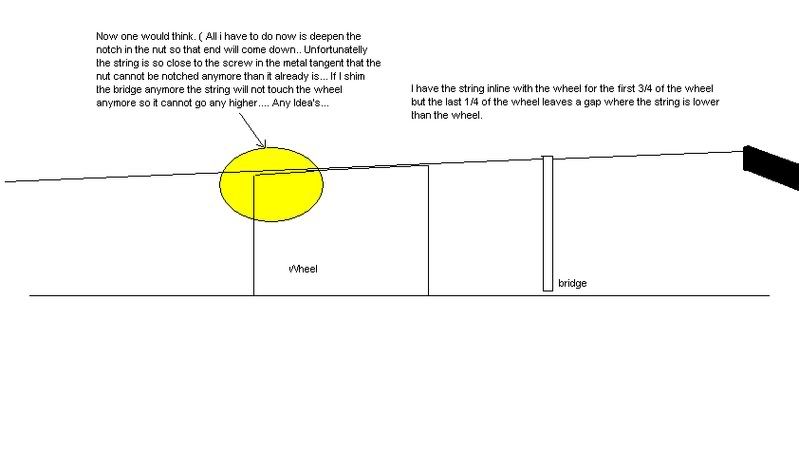
Seth Hamon <[EMAIL PROTECTED]> wrote: Ok, I was told that before you put the cotton on the string that the string should be one cigarette papers diameter from the wheel... Does that mean that the string shouldn't touch the wheel at all before you cotton but be as close as a cig papers lenth from it... I'm trying to get my Orca sounding its best... Any Ideas.. I added a picture I drew showing the problem I'm trying to solve to see if it will fix my vibrating problem on the lower A key and the problem with the A and B key jumping an octave...... click on the picture when you pull it up to blow it up.. http://i3.photobucket.com/albums/y59/texasbagpiper/gurdystring.jpg Thanks, Seth Here's what it looked like before I shimmed the bridge..The string was pressing super hard on the wheel... and the other string is not being used and it's not touching the wheel as the picture may seem to show.. http://s3.photobucket.com/albums/y59/texasbagpiper/?action=view¤t=DSCI0001.jpg Ulrich Joosten <[EMAIL PROTECTED]> wrote: v\:* {behavior:url(#default#VML);} o\:* {behavior:url(#default#VML);} w\:* {behavior:url(#default#VML);} .shape {behavior:url(#default#VML);} Dear folks on the Hurdy-gurdy list, Im a newbie to the list and I follow this interesting discussion. Since Im from Europe (Cologne) I am not familiar with the so called orca I guess its a nickname for a specific gurdy-type. Maybe one of you could send me some information on this instrument. A link probably where I could see some photos? Myself I am playing hurdy-gurdy since 1984. I play a lute-shaped Auvergnat by Jean-Noel Grandchamp and since 2 years I revived my interest in the instrument (after putting it for some years on a lower practising level) by getting a Weichselbaumer Alto. Im looking forward to follow some interesting dicussions on the list. Thank you for letting me participate. Best wishes, Ulrich --------------------------------- Von: [EMAIL PROTECTED] [mailto:[EMAIL PROTECTED] Im Auftrag von Chris Nogy Gesendet: Mittwoch, 9. Mai 2007 18:02 An: [email protected] Betreff: Re[2]: [HG] Bizarre Orca problem/ Remember, an instrument set up perfectly from the factory will not remain perfectly set up for long without maintenance and adjustment. Shimming, cottoning, adjusting, these are part of life for almost every instrument (mostly acoustic, but even solid body). Learning to make the necessary adjustments on an instrument, especially a hurdy gurdy, is part of owning one, and without that knowledge the experience will be less than stellar. Roy will, I am sure, be able to teach you the whys and hows of adjusting strings, shimming, tirant tension, wheel surface and rosin, etc. Doesn't matter how good your hands are at cranking and pressing, without being able to make the instrument perform mechanically correctly in a wide range of environmental situations, the art is not very impressive. I would suggest simply trying some shimming to get the contact area between the wheel and string more even and consistent. A pack of Tops cigarette papers is cheap, but you don't even need that - I have good luck with Trident gum wrapper paper (the thin stuff around each piece, not the foil stuff). And you get to chew the gum. You are not going to mess up the instrument with a little bit of shimming, just be careful to put in small shims that cover the entire notch in the bridge or nut. Chris *********** REPLY SEPARATOR *********** On 5/9/2007 at 7:58 AM Seth Hamon wrote: Sorry to hear about the Orca.. I just got an Orca made early this year and I'm not sure if it's the humidity change or weather or something but mine won't play the lowest A "last key on bottom" very well. If I turn the wheel very slowly and play the A it sounds ok.. If I turn the wheel at a normal speed it jumps the octave and sometimes makes a vibrating sound throughout the instrument... It only seems to happen on the A note.. Its very discouraging and I really haven't had a chance to get it right since I got it.. I don't know what I should do. Just about every song I try to play has that note in it and it makes me not even want to play at all with the awful sound I get on that lower A. I do have a local guy nearby "Roy" and I'm going to see if he can help me get it squared away. It may just be a climate issue. Only thing I noticed is where the string touches the wheel it seems to press more on the inside of the wheel (side closer to the keys) than on the outside. Roy told me something about using cigarette papers and adjusting the string height but I don't want to change it from the factory setting. Seth... P.S. Does your Orca have a wooden wheel or synthetic.. Mine is synthetic..... Here's a link on how humidity affects instruments.. http://www.fredsmusic.com/humidity.html "Gary F. Plazyk" <[EMAIL PROTECTED]> wrote: Hi, Michael! I had what sounds like a similar problem with my Volksgurdy - a hairline crack down the middle of the back seam. What's your environment like? Here in the Chicago area it gets really dry in the winter, which I think caused my problem. I've started keeping two guitar-sized Dampit humidifier sticks in the case with my hurdy-gurdy (one at each end), and try to keep the humidity up to at least 55%. Hint: I found the blue-to-pink indicator that comes with the Dampit stick to be useless; I got a humidity indicator at a pet store (for use in reptile cages ~ $4) and stuck it to the Dampit plastic guitar soundhole cover, which I keep in my case. Very best regards, -Gary P. Gary Plazyk Fuzzy Bear Farm [EMAIL PROTECTED] http://profiles.yahoo.com/g_plazyk http://www.BearCreekMusic.us http://www.RavenswoodMorris.org "Music is too important to leave to the professionals." -Robert Shaw