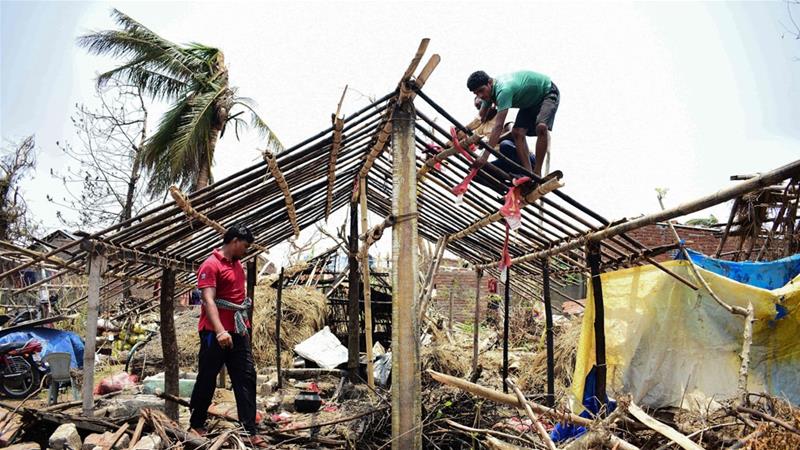
CYCLONE FANI: PREJUDICE IN TIMES OF NATURAL DISASTERS
- subhash gatade

Caste discrimination, even while faced with a calamity, is a clear outcome
of the brahminical ideology of purity and pollution that has permeated deep
into Indian society.
[image: Cyclone Fani: Prejudice in Times of Natural Disasters]
<https://www.newsclick.in/sites/default/files/2019-05/cyclon%20fani1.jpg>
Image Courtesy: Al Jazeera

*“[U]ntouchability, is a kind of disease of the Hindus...it is a mental
twist…. I do not know how my friend is going to untwist the twist which the
Hindus have got for thousands of years unless they are all sent to some
kind of hospital.’ Dr B.R.Ambedkar , 1954*

Cyclone Fani is over.

Despite being one of the strongest cyclones
<http://www.imd.gov.in/pages/press_release_view.php?ff=20190501_pr_464> to
hit India in last two decades the manner in which the state most affected
by it -- Odisha -- was successful in keeping loss of life and numbers of
affected people to a minimum has earned it kudos even from its critics.

People are slowly trying to pick up threads to restart their lives

It is rather difficult to say whether it will be easy for dalit villagers
of Baripada village -- part of Patali panchayat -- to do so, who had to
endure callous and inhuman behaviour from their own village brethren,
during the stormy winds. Around 85 of them from 25 families were denied
entry <https://thelogicalindian.com/news/dalits-denied-shelter-homes/> to
three shelters located within a radius of approximately four km by 'upper
caste' people. Nandini (name changed) belonging to the Dom caste narrated
how they had to ultimately take shelter beside an uprooted banyan tree,
while it was raining heavily.

It would be height of incredulity to believe that the torment faced by
dalits from Baripada -- whose plight made headlines around a week after the
incident -- would be an exception. If it is possible to reach out to dalits
in the area, one can discover many such instances. In fact, government
officials in the region have even acknowledged the prevalence of such
practice by the upper caste people. One among them was frank enough to
admit before the media that when there were floods in Puri in 2004-05, he
had witnessed similar instances and “no action was taken against the
perpetrators”.

Anyone who is little conversant with the way the graded hierarchy called
‘caste’ and the attendant discrimination unfolds in this part of South
Asia, can easily share similar instances from recent memory from different
parts of the country. Remember how the severe earthquake in Gujarat ( 001)
had revealed to the outside world the deep-seated caste bias in the
Gujarati community, apart from the much talked about bias against the
minority communities, and how at places the relief and rehabilitation work
bypassed both dalits and Muslims.

There was an encore of sorts when tsunami struck countries bordering the
Indian Ocean (2004), which proved to be one of the deadliest natural
disasters in human history. Tamil Nadu was one of the worst affected
regions in India. The way hatred for dalits manifested during those days
when they were thrown out of relief camps, cut out of food, water supplies,
toilets' prompted a newspaper to comment “[T]here's something even an
earthquake measuring 9 on the Richter scale and a tsunami that kills over 1
lakh people can’t crack : the walls between caste.”(*Indian Express* – Jan
7, 2005)

Like Fani, here too the discrimination did not spur government officials
into action who supposedly “did not want to disturb the social equilibrium
at this crucial juncture.”

For an outsider it may appear surprising how the ‘social nausea’ (to quote
Ambedkar) refuses to subside even in times of calamity. But for someone who
is familiar with the Indian social fabric, the age-old doctrine of
exclusion legitimised and sanctified by the brahminical ideology
culminating in such behaviour is a ‘routine matter’. There is a need to
understand that incidents of such nature demonstrate how this ideology of
purity and pollution has permeated deep down the social fabric of our
society. Discrimination on the basis of caste, even while faced with a
calamity, is a logical outcome of the common sense which gets built up in
such an ambience.

What is notable is that this realisation has now reached international
organisations engaged in humanitarian work during disaster-like situations.
A few years ago, a European Union-sponsored report
<http://idsn.org/wp-content/uploads/user_folder/pdf/New_files/Key_Issues/Disaster_response/EqualityInAid_web_version.pdf>
had
even called for plugging caste-based discrimination while disbursing
humanitarian aid. Titled, *Equality in Aid – Addressing Caste
Discrimination in Humanitarian Response*, this report prepared by the
International Dalit Solidarity Network (ISDN), with help from different
activists, scholars, had presented an overall picture of the effect of
caste-based discrimination in humanitarian aid and why it continues to be a
consistent problem in emergency programming.

Underlining various instances of caste-based discrimination against dalits
and the lack of political will exhibited by the governments to implement
anti-discriminatory laws for various flimsy reasons, the report had even
recommended that a “human rights perspective be in built into disaster
response and disaster risk reduction programmes of agencies to ensure that
humanitarian action meets human rights standards and the needs of rights
holders.” It had also called to adopt the principle of publicly recognising
the problem of such discriminations and exclusions in the organisational
mission, work plans and public engagement and also engage in the practise
of encouraging and adhering to a common approach to address the caste-based
discrimination in humanitarian programming.

No doubt many people when confronted with such incidents of denial of basic
human rights to dalits and the institutionalisation of such practices
prefer to comfort themselves with an understanding that such instances are
an exception.

Their response is understandable.

The fact is that a majority of people who are yet to shed their *varna* mindset
do not want to concede this simple fact. They do not want to recognise that
the doctrine of exclusion is an all-pervasive phenomenon simply because
they themselves are ‘beneficiaries of the caste-based order.’ They have an
interest in (to quote the *Report on Prevention of Atrocities against SCs
and STs* ) perpetuating “[t]he existing unequal social relations” and have
“[f]rustrated attempts to democratize the society because through the
customary arrangements the dominant castes are assured of ‘access to cheap
labour’ ; ‘social control over people’; ‘priviledged position with regard
to development resources’. Obviously, they are not bothered with clear
exposure of the deep contradictions in social values which are for everyone
to see, wherein while they are ready “to enjoy all rights and privileges
which a democratic liberal society has given them”, but deny the “same very
rights and privileges to the SCs”.

The benefits accruing to them for not recognising this reality are
palpable. Be it the denial of seats to dalits in academic institutions or
the deliberate attempts to deny the benefits due to them vis-v-vis the
programmes of affirmative action, or the refusal of the police to even
register cases against their perpetrators etc., they are the sole
beneficiaries from this. If the behaviour of the State leaves much to be
desired, the ‘civil society’ loaded with its *varna* mindset, does not at
all come out in flying colours. It is part and parcel of the conscious
attempts to exclude them from all seats of power or privilege.

We are repeatedly told that Indian society has been quite forthcoming in
imbibing new ideas and new technologies and assessing opportunities
resulting from the same. Our being the third largest scientific and
technological human resource pool is also trumpeted from rooftops. The
rulers of this country in recent times have also been clamouring for
‘superpower status’ on the basis of these strengths.

But the alleged readiness of our society to accept liberal or progressive
ideas from all corners of the world to shape its own lives, does not get
reflected in its conscious attempts to weed itself out of the structured
hierarchy that since ancient times.

One is once again reminded of Dr Ambedkar who had declared:

There are some protagonists of Hinduism who say that Hinduism is a very
adaptable religion, that it can adjust itself to everything and absorb
anything....It is quite true that Hinduism can adjust itself... can absorb
many things. The beef-eating Hinduism (or strictly speaking Brahminism
which is the proper name of Hinduism in its earlier stage) absorbed the
non-violence theory of Buddhism and became a religion of vegetarianism. But
there is one thing which Hinduism has never been able to do – namely to
adjust itself to absorb the Untouchables or to remove the bar of
Untouchability.

The 71st anniversary of India’s Republic Day would be celebrated next year.
How many more anniversaries do we need so that the promise of the
Constitution to usher in an era free of discriminations based on caste,
gender, race etc is fulfilled?

(https://www.newsclick.in/cyclone-fani-prejudice-times-natural-disasters)

--
You received this message because you are subscribed to the Google Groups
"humanrights movement" group.
To unsubscribe from this group and stop receiving emails from it, send an email
to [email protected].
To post to this group, send email to [email protected].
Visit this group at https://groups.google.com/group/humanrights-movement.
To view this discussion on the web visit
https://groups.google.com/d/msgid/humanrights-movement/CAJGPqcbX_MEicotS8pcEcnKf4Zx4ykP%2BYmnkhk3A_7LiDy6Q9g%40mail.gmail.com.
For more options, visit https://groups.google.com/d/optout.