On Thu, Aug 13, 2009 at 6:03 PM, Caroline
Meeks<[email protected]> wrote:
> Physics is so cool! One of the students today did a really great job with
> it:  http://www.youtube.com/watch?v=1nseWyxaN6g
> Does anyone have an idea for a 1 hour or so lesson I could do with
> Physics that would teach a Physics concept and still be incredibly engaging?
Yes, Alan Kay does, and I have extended his version at
http://wiki.sugarlabs.org/go/File:Gravity.odt. This is actually two or
more lessons, starting with a model of constant acceleration in Turtle
Art, Etoys, or elsewhere, with work in arithmetic and finite
differences leading to geometric insight. Then we take data with the
Record activity and analyze it, design further experiments (on balls
of different weights, for example), and consider implications. The
high point for Alan is the Galileo moment when students have concluded
that they can't time separately falling balls accurately, and one of
them figures out why they don't need to.

My high point was at the Leonardo da Vinci exhibit at The Tech Museum
of Innovation in San Jose, where I found out that Leonardo had solved
this problem more than a century before Galileo, but couldn't publish.
But the Greeks, who had all of the math needed, never even noticed
that here was a question posed by every water fountain, a question
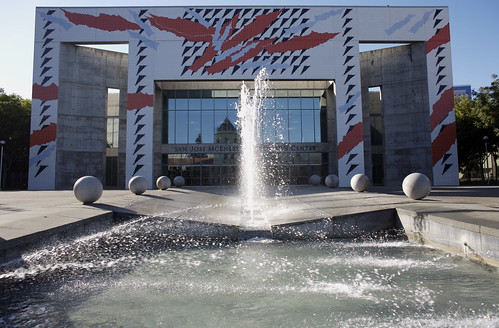
that contained its own answer. This question is beautifully posed at
the San Jose Convention Center across the street

http://farm1.static.flickr.com/69/219503234_a943a7b30b.jpg?v=0

and by every water fountain in the corridors of almost every school
and most public buildings in this country. Can you discover it? Have
you ever heard of it? How often do you see it, but not think about it?

We teach science in terms of the model of right answers, of confirmed
facts and theories leading to successful technologies. But that is not
how scientists work. The most prized discovery for the working
scientist is a good question. That is where scientific progress
begins. Similarly, in mathematics, proofs of theorems are an essential
target, but problems and conjectures are the material one can actually
work on.

This one topic can lead into several more branches of mathematics,
such as projective geometry (the projection of any conic section is a
conic section), synthetic and analytic geometry (circles and parabolas
come in only one shape each, while ellipses and hyperbolas have an
infinite range of shapes); and more physics, including the progression
from Galilean relativity to Newtonian, and then to Special and General
Relativity, each with a more accurate model of gravity and other
matters.

I know in a general way how to turn any topic in elementary physics
and other sciences and math into such lessons. It takes a bit of work
by programmers, teachers, historians, physicists, and others to do up
right.

> --
> Caroline Meeks
> Solution Grove
> [email protected]
>
> 617-500-3488 - Office
> 505-213-3268 - Fax
>
> _______________________________________________
> IAEP -- It's An Education Project (not a laptop project!)
> [email protected]
> http://lists.sugarlabs.org/listinfo/iaep
>


--
Silent Thunder (默雷/धर्ममेघशब्दगर्ज/دھرممیگھشبدگر ج) is my name
And Children are my nation.
The Cosmos is my dwelling place, The Truth my destination.
http://earthtreasury.org/worknet (Edward Mokurai Cherlin)
_______________________________________________
IAEP -- It's An Education Project (not a laptop project!)
[email protected]
http://lists.sugarlabs.org/listinfo/iaep