Dear Dr. Chadwell,
Thanks for your mail on the subject. I really appreciate the time and effort
you are putting in to help the group correct the identification of important
species groups and in showing a road map for improving the understanding of the
subject.


In as far as my post on Gentiana kurroo, I thankfully acknowledge your inputs.
However, I would like to clarify as under:


Firstly, I must confess that there is an error in my posting. The place Sangrah
is in 'Sirmour' district of Himachal Pradesh and not in Kinnaur as erroneously
mentioned.


Secondly, my post does not claim that the given site is the only one bearing
wild populations of the species. It states that the given site might perhaps be
the last remnant site to bear 'viable' populations (>500 individuals). Yes,
field teams did record its presence (20-50 individuals) from other localities
in Sirmour district and Solan district in Himachal Pradesh, as well from
Mussoorie (Suva Kholi area) and Chakrata areas in Uttarakhand. No specimen
could be located in Shali, perhaps due to wrong season of visit. Banihal area
in Jammu & Kashmir could not be visited, but local inquiries revealed that
locating this species, once common in the area, has become difficult. The
definition of what is considered 'sizeable' shall remain subjective.


Thirdly, the assessment of the species as 'Critically Endangered' has been
based on the IUCN's Red-Listing Criteria and Categories for the State of
Himachal Pradesh only. The major criteria used in assessing this species as CR
was population reduction over the period, mainly dues to gradual loss of
habitat and continuous destructive harvest for herbal use. The threat
categorisation surely helps in flagging the issue and getting conservation
action initiated. It was only after this threat categorisation that work on
regeneration of the species through multiplication started.


The action to locate more niches housing stray and viable populations of the
species is continuing and we hope to locate more such patches containing good
wild populations of the species in future.


Regards,


Dr. G S Goraya, IFS

Deputy Director General (Research),
Indian Council of Forestry Research & Education,
New Forest P.O., Dehradun - 248006.
(Uttarakhand, India)
Tel. (+91-941-802-5036)


________________________________
From: [email protected] <[email protected]> on behalf
of [email protected] <[email protected]>
Sent: Sunday, November 13, 2016 6:56 AM
To: efloraofindia
Cc: [email protected]
Subject: [efloraofindia:256531] Re: Campanulaceae & Gentianaceae Fortnight:
Gentiana kurroo from Himachal : GSG-09

Sorry, the colony in Kinnaur is not the only viable population of Gentiana
kurroo in the wild.  I was given directions to a sizeable colony not that far
from Mussoorie some years back by a 'Britisher' Doctor and plant enthusiast who
worked at a medical camp in the region and came across this late autumn
flowering spectacular gentian   There is no reason not to think that it is not
found in similar habitat along the full length of its range.  If you do not
know where to look, you will not find it.....

And DO read the EVIDENCE from Pakistan about this gentian which I provide at
the end of my comments.

Unfortunately, it is ESSENTIAL to be able to ACCURATELY and RELIABLE identify
plants before they can be conserved or understood.

I have just come across:
http://www.scind.org/297/Environment/need-for-the-conservation-of-gentiana-kurroo-a-critically-endangered-medicinal-plant.html.
  The problem is that whilst the photo to accompany this article is a gentian,
it is NOT Gentiana kurroo.   Rather a serious mistake.
Need For The Conservation Of Gentiana Kurroo: A Critically
...<http://www.scind.org/297/Environment/need-for-the-conservation-of-gentiana-kurroo-a-critically-endangered-medicinal-plant.html>
www.scind.org
Nature has been a source of medicinal agents for thousands of years, however,
in the recent past these plants are declining very


Indian scientists are not alone misidentifying this plant, see:
https://www.flickr.com/photos/26181971@N07/5982536972 - the gentian being grown
in this botanic garden is not Gentiana kurroo....
[X]2011-07-12 Gentiana kurroo - BG
Teplice<https://www.flickr.com/photos/26181971@N07/5982536972>
Czech Republic - Gentiana kurroo - in Botanic Garden Teplice

[https://farm7.staticflickr.com/6146/5982536972_f5dd276a5c_b.jpg]
<https://www.flickr.com/photos/26181971@N07/5982536972/>
[https://farm7.staticflickr.com/6146/5982536972_f5dd276a5c_b.jpg]


And it does not end there, a firm CLAIMING to supply quality Gentiana kurroo
has a photo of a gentian which is NOT Gentiana kurroo.... see:
http://www.himalyanassets.com/gentiana-kurroo.htm
Gentiana Kurroo,Gentiana Kurroo Wholesale Suppliers
Chamba<http://www.himalyanassets.com/gentiana-kurroo.htm>
www.himalyanassets.com
Kirpa Ram & Brothers is one of the best exporter & supplier of Gentiana Kurroo,
gentiana kurroos, Gentiana Kurroo, wholesale Gentiana Kurroo suppliers,
gentiana ...


Or you could pay for an image of Gentiana kurroo which is NOT Gentiana kurroo.
See: https://www.gapphotos.com/imagedetails.asp?imageno=192301


Stewart described Gentiana kurroo as a very fine, large-flowered autumn
species.  He recorded populations in Kurram, Hazara, Murree Hills, Poonch and
Kashmir.

Flowers of the Himalaya say it is found on grassy slopes from Pakistan to
Uttaranachal @ 1800-2700m.  It would not have been included in this book had it
not been a quite common plant that plant enthusiasts had a reasonable prospect
of getting to see.  Since the plant has the capacity to "seek refuge" on cliffs
inaccessible to most, I cannot see why it has now been described as 'Critically
Endangered', even IF its presence in less steep habitat has been reduced (IF,
in fact it has) but as very few plant surveys are undertaken by professional
botanists (and few of them can identify plants whilst "in the field") and there
are only a small number of amateur botanists/plant enthusiasts active "in the
hills and mountains" who can reliably identify plants, then how on earth can
anyone judge if this gentian (or any other plant in the Himalaya) is
'dominant', 'abundant', 'frequent', 'occasional' or a rarity?

I am the most widely-travelled person along the Himalaya over the past 30+
years who has the field botany skills to reliably recognise some of the plants
I have seen.  For those species I have taken an interest in, my field
experience in many parts of the Himalaya, combined with time spent in herbaria
and researching species recorded by others is unrivalled; I can say if a plant
is common/widespread but not how 'rare' species are.  Nobody can!!

The TRUTH is nobody actually knows about rarities along the Himalaya.   I can
say categorically that NUMEROUS species which are claimed to be 'Rare &
Endangered' are no such thing. Yes, there are botanists who known the flora of
particular regions or states or countries better than I do but overall my
knowledge of Himalayan flora is second-to-none. I do not make claims I cannot
substantiate being experienced and knowledgeable enough to know what I am
entitled to say and what I am not and modest too!!  Too many scientists (and
others) draw conclusions they are not entitled to make.

Gentiana kurroo was not easy to locate on that occasion.  The colony we found
was on very steep cliffs.  I don't think too many botanists I know could safely
negotiate such ground.  IF a meaningful assessment was needed of the size of
this population, then it would require an adventurous field botanist who can
safely scramble about on cliffs accompanied by rock climbers with ropes and
other equipment to supervise the botanist abseil down to conduct a full survey
on the steeper parts.  In the UK such surveying techniques are employed for
some of the colonies of Lloydia serotina - known as the 'Snowdon Lily' which,
in the UK, is restricted to base-rich rock ledges in Snowdonia.

But I doubt very much if Gentiana kurroo is 'Critically Endangered' - this
cannot possibly be known as insufficient surveys have been undertaken in
promising locations.   And if it proves to be typically found on steep cliffs
at these elevations which DEFINITELY have not been surveyed by Indian
botanists, then the species is clearly under no immediate threat as few, other
than rock climbers could reach such colonies!!

It might be that the species is not as widespread on less steep grassy slopes
than it was in the past, due to over-grazing and trampling and destruction of
this type of habitat but nobody actually knows.

This gentian is mentioned in 'Flora Simlensis' as growing on Shali, near the
top - and might still be there, though steep ground will probably need to be
inspected to check.   Perhaps this gentian retreats to base-rich rocky outcrops
when facing over-grazing and trampling elsewhere.

Last time I was in Kashmir I visited the University of Kashmir Botanic Garden
at Hazratbal.  Gentiana kurroo was being grown there or what had been
identified as such - I did not see it in flower to confirm the identification.
IF correct, then the plants must have been dug up and transported from a site
in Kashmir?  I cannot imagine they were taken all the way from Kinnaur.   I was
pleasantly surprised to find this gentian being cultivated in the botanic
garden - further evidence that this gentian may well be able to cope with
neutral or non-acidic soils.  Few gentians from the higher mountains in Kashmir
would stand much chance of being grown in a bed in a botanic garden which has
hot, dry summer - albeit that it was established there as live plant material
not raised from seed.

This gentian seems quite distinctive (though clearly from the evidence above
not everyone can recognise it) but many gentians are misidentified.  In the UK
this plant was introduced into cultivation in the 1920s but despite being
offered by a number of specialist nurseries and regularly in seed exchanges, I
suspect the genuine article has not been grown there for decades.  My informal
research suggests that AT LEAST 50% of all plants in specialist nurseries,
available from seed companies, in society seed exchanges and even many botanic
garden Index Semina, are misidentified.

I had not come across this gentian before.  The fact that I had help in
locating it does not mean it is automatically rare.  I have spent very little
time @ 1800-2700m, more interested in higher mountain plants, often passing
through as rapidly as possible or missing out on such elevations altogether.
2700m is about the lowest part of Ladakh (and much of the Indian TransHimalaya
(where it does not grow).  I have trekked from near Sonamarg in Kashmir a
number of times, which if my memory is correct is around this elevation, so
missed out the 1800-2700m part using a road.   And of course not all of these
elevations have suitable habitat for Gentiana kurroo, especially if it has a
propensity for base-rich rocks/soils?  IF that is the case, then looking for it
on acidic rocks would be pointless.  It would certainly be 'critically
endangered' in such habitat!!

So let me finish with the plant's occurrence in Pakistan.  I contributed 4
photos to 'Wild Flowers of Pakistan' by Nasir & Rafiq (Edited & its publication
paid for by Tom Roberts, another Britisher).  They list Gentiana kurroo (under
the name Gentianodes kurroo - see Gentianceae in 'Flora of Pakistan') as the
largest flowered of Pakistan's gentians being LOCALLY COMMON on grassy slopes
especially in Murree Hills & Abbottabad district.   This hardly tallies with
the claim it is 'Critically Endangered'.


Why would the authors include a species that those who bought a copy of their
book did not have a chance of seeing?  There are many Gentians in Pakistan.
They described and illustrated only a small number in this book.


On Friday, July 11, 2014 at 12:08:38 PM UTC+1, gurinder goraya wrote:
Dears,

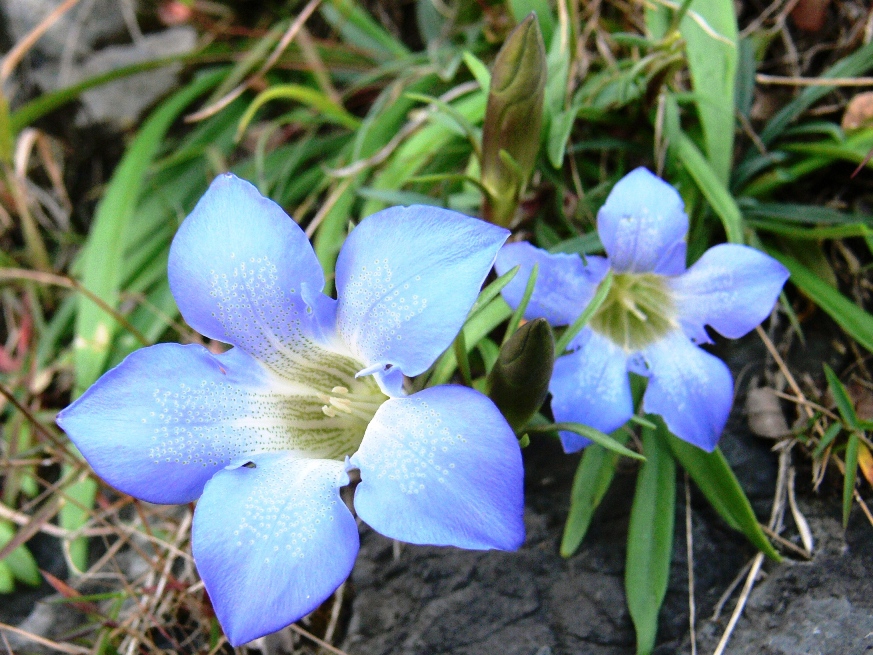
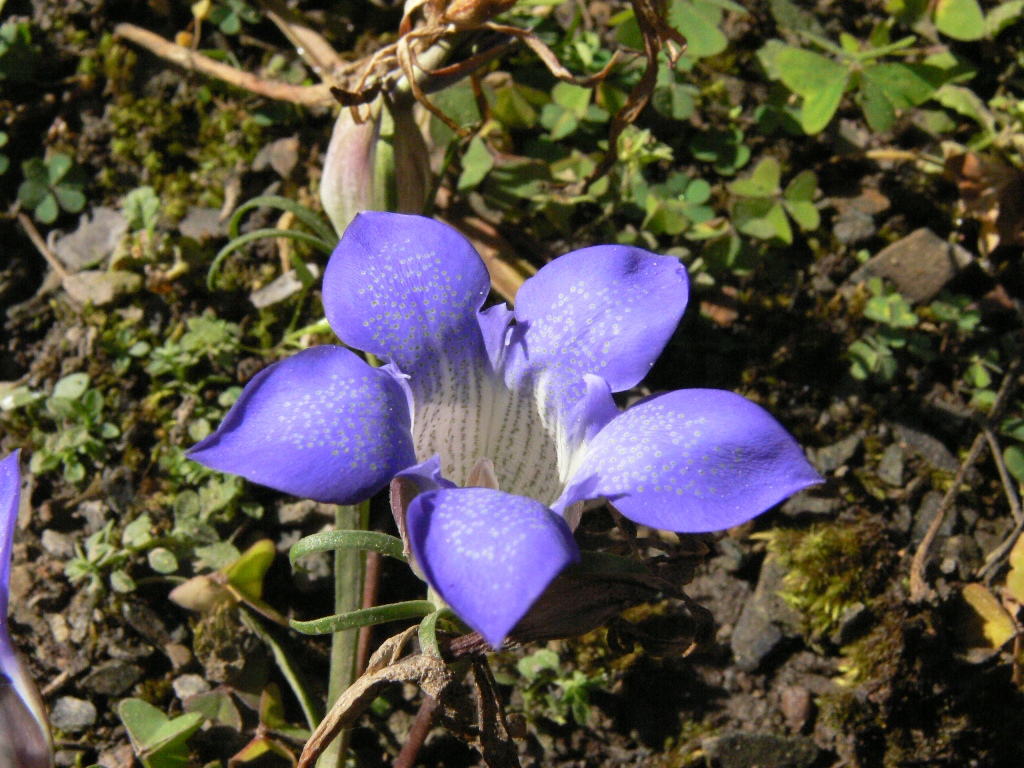
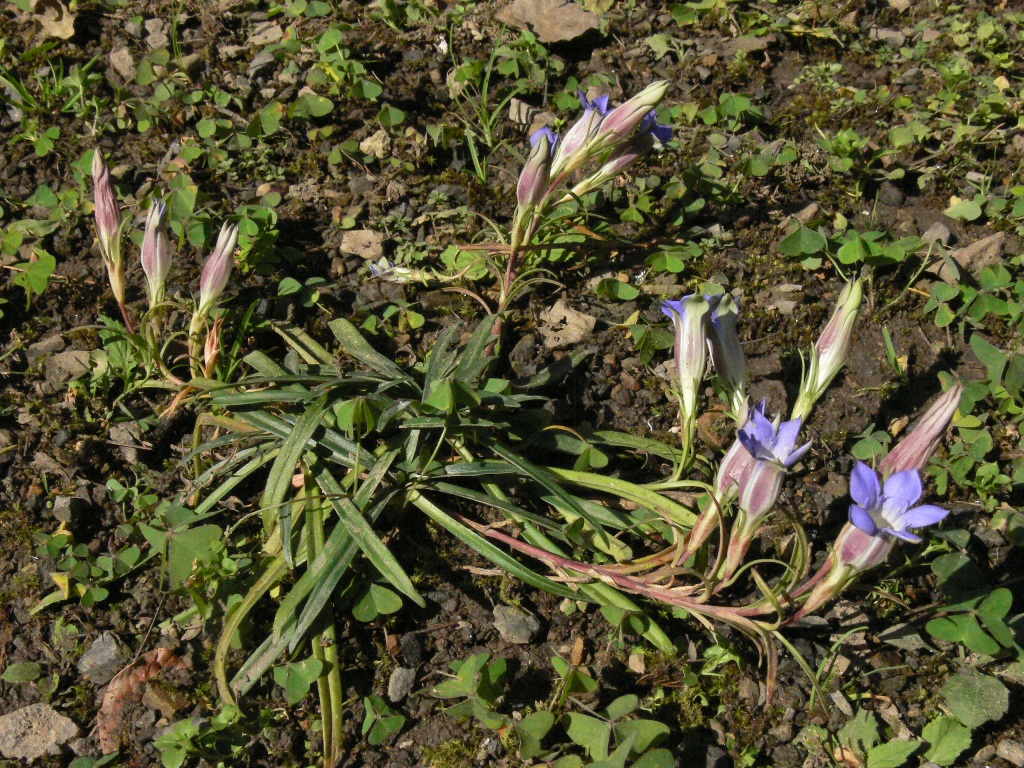
Gentiana kurroo from Himachal [Sangrah, Dist. Sirmour, 1700 m asl].

This Indian Gentian forming source of medicinally important 'Trieman' roots,
has been assessed as Critically Endangered in the wild. I feel happy to share
that our focused efforts have resulted in identification of perhaps the last
remnant viable population of this species on precipitous grassy slopes near
Sangrah in Kinnaur district of Himachal. This site bearing an estimated 500
plants of this species has been demarcated and set aside as Medicinal Plant
Conservation Area (MPCA) as an in situ conservation measure for this species.
Some photographs from this area...


[https://groups.google.com/group/indiantreepix/attach/d8c3b3b01b5dc124/Gentiana%20kurroo.jpg?part=0.1&authuser=0]


[https://groups.google.com/group/indiantreepix/attach/d8c3b3b01b5dc124/Gentiana%20kurroo-01.JPG?part=0.2&authuser=0]


[https://groups.google.com/group/indiantreepix/attach/d8c3b3b01b5dc124/Gentiana%20kurroo-02.JPG?part=0.3&authuser=0]


Regards,

Dr. G. S. Goraya, IFS
Deputy Director General (Research),
Indian Council of Forestry Research & Education,
New Forest P.O., DEHRADUN - 248 006.
Uttarakhand, India.

Tel & Fax (O): 0135-2757775

--
You received this message because you are subscribed to the Google Groups
"efloraofindia" group.
To unsubscribe from this group and stop receiving emails from it, send an email
to
[email protected]<mailto:[email protected]>.
To post to this group, send email to
[email protected]<mailto:[email protected]>.
Visit this group at https://groups.google.com/group/indiantreepix.
For more options, visit https://groups.google.com/d/optout.

--
You received this message because you are subscribed to the Google Groups
"efloraofindia" group.
To unsubscribe from this group and stop receiving emails from it, send an email
to [email protected].
To post to this group, send an email to [email protected].
Visit this group at https://groups.google.com/group/indiantreepix.
For more options, visit https://groups.google.com/d/optout.