Thanks a lot, Arti ji.

---------- Forwarded message ----------
From: Arti Garg
Date: 24 September 2018 at 13:24
Subject: Re: Fwd: Yet another discussion on Pedicularis! ABAUG2017/12
To: "J.M. Garg" <[email protected]>
If you have dissected the flower and compared characters then you might be
right in your conclusion as Pedicularis flowers are often deceptive in
identification merely by photographs.

Arti Garg,
Botanical Survey of India
Central Regional Centre,
10 Chattham Lines
Allahabad 211002


On Monday, 24 September, 2018, 12:39:37 PM IST, J.M. Garg <[email protected]>
wrote:


Going by the hairiness of corolla & upto 6 number of pinnae pairs of basal
leaves as per the keys and details at Critical Taxonomic Appraisal of Some
Taxa of *Pedicularis *from Indian Himalayas Belonging to Section *Siphonanthae
by* Arti Garg (2009)
<http://tai2.ntu.edu.tw/taiwania/pdf/tai.2009.54.122.pdf> (pdf), I feel it
may be more closer to *Pedicularis punctata *Decne.
<https://sites.google.com/site/efloraofindia/species/m---z/o/orobanchaceae/pedicularis/pedicularis-punctata>

---------- Forwarded message ----------
From: *Ashwini Bhatia* <[email protected]>
Date: 7 August 2017 at 10:18
Subject: Yet another discussion on Pedicularis! ABAUG2017/12
To: "[email protected]" <[email protected]>
Cc: Gurcharan Singh <[email protected]>, Tabish <[email protected]>,
Dinesh Valke <[email protected]>, "J.M. Garg" <[email protected]>


The long-tube pedicularis species, which is very common here above 3000m,
has confused me. I have followed the excellent discussion between Dr Singh,
Tabish ji and other senior members and have at times concluded that the
plants here are *P. siphonantha* but another doubt nags me and I start
looking at the characteristics again.

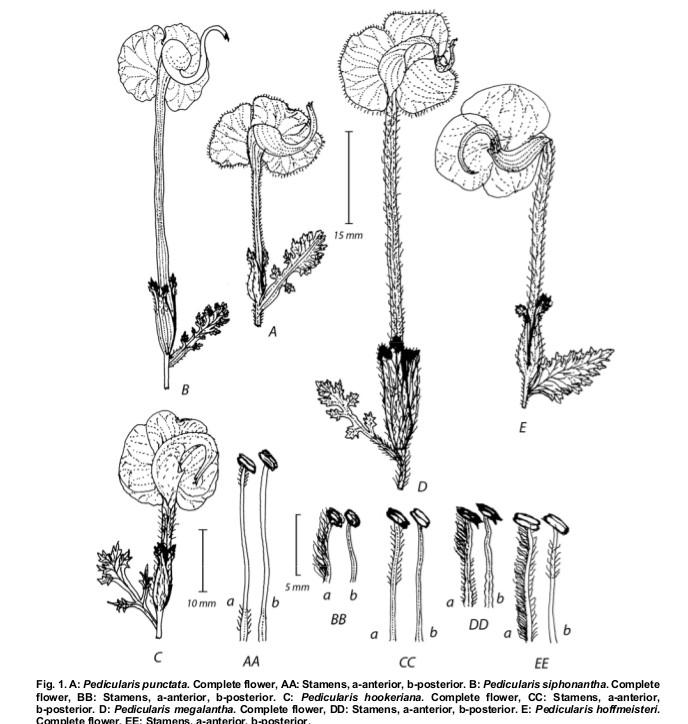
Looking at the sketch uploaded by Tabish ji here
<https://08511630493324166816.googlegroups.com/attach/e36d7a85e0216671/Pedicularis.jpg?part=0.1&view=1&vt=ANaJVrEtAptdaht5u2Pj-lcsDLZouMjVcxlJXpSBVs1GmC-hjQBpsFN3snYDVjCrDzlVfJDAcNq5AQ68UVg36SH3zpKVYbfLC8ls6wH-4nBhb2NUrJKOn0g>,
I would say that flowers of our plants are closer to *P. punctata* than *P.
siphonantha* (tube length and its ratio with the calyx). I have included a
photo of our flower (without calyx) on a ruler for comparison below.
Accounting for the absence of calyx in the photograph, the tube length
matches with figure A and so does the shape of the galea.

However, the lower lip on our flower is narrow (about 7-8mm) while *P.
punctata* should have a broader, 15mm, lower lip.

The number of lobes on the lower leaves is higher than 6 (see photo). The
petiole is long and not winged. This would suggest *not* *P. punctata*
again.

Dr Singh had suggested *P. hookeriana* which was described briefly by
Kletter and Kriechbaum here
<https://books.google.co.in/books?id=ODrIXj-48RsC&pg=PA171&lpg=PA171&dq=pedicularis+hookeriana&source=bl&ots=gUvRh-j7Jt&sig=vv_ReidCDSUxF3FLKEUVghwAg9g&hl=en&sa=X&ved=0ahUKEwjZ5tP1nsTVAhUEuI8KHRLiB5UQ6AEITzAN#v=onepage&q=pedicularis%20hookeriana&f=false>
in their 2001 discussion of *P. punctata *but it was concluded that since
the drawing in the 2009 paper shows shorter tube length, *P. hookeriana*
was not a possibility. But the tube length of *P. siphonantha* in the
drawing does not match our sample either.

Most of the images of *P. siphonantha* available online show a higher ratio
of tube-length to calyx than our flowers here.

Our plant is gregarious at 3200m with many clumps of flowers. I have tried
to include photos to show that.

I would request my seniors to look at this species again and advise. I am
at a loss as to which source takes precedence. I apologise for requesting
to open this discussion yet again and hope that you will find merit in
doing so.

Thanks and regards,
Ashwini


--
With regards,
J.M.Garg

'Creating awareness of Indian Flora & Fauna'
<http://en.wikipedia.org/wiki/User:Jmgarg1>

Winner of Wipro-NFS Sparrow Awards 2014 for efloraofindia
<https://sites.google.com/site/efloraofindia/award-for-efloraofindia>.

For identification, learning, discussion & documentation of Indian Flora,
please visit/ join our Efloraofindia Google e-group
<https://groups.google.com/forum/#!forum/indiantreepix> (largest in the
world- more than 2975 members & 3,00,000 messages on 25.7.18) or Efloraofindia
website <https://sites.google.com/site/efloraofindia/> (with a species
database of more than 12,000 species & 3,00,000 images of which 1,00,000
are directly displayed).

The whole world uses my Image Resource
<http://commons.wikimedia.org/wiki/Category:J.M.Garg> of more than a
thousand species & eight thousand images of Birds, Butterflies, Plants etc.
(arranged alphabetically & place-wise). You can also use them for free as
per Creative Commons license attached with each image.

Also author of 'A Photoguide to the Birds of Kolkata & Common Birds of
India'.


--
With regards,
J.M.Garg

'Creating awareness of Indian Flora & Fauna'
<http://en.wikipedia.org/wiki/User:Jmgarg1>

Winner of Wipro-NFS Sparrow Awards 2014 for efloraofindia
<https://sites.google.com/site/efloraofindia/award-for-efloraofindia>.

For identification, learning, discussion & documentation of Indian Flora,
please visit/ join our Efloraofindia Google e-group
<https://groups.google.com/forum/#!forum/indiantreepix> (largest in the
world- more than 2975 members & 3,00,000 messages on 25.7.18) or Efloraofindia
website <https://sites.google.com/site/efloraofindia/> (with a species
database of more than 12,000 species & 3,00,000 images of which 1,00,000
are directly displayed).

The whole world uses my Image Resource
<http://commons.wikimedia.org/wiki/Category:J.M.Garg> of more than a
thousand species & eight thousand images of Birds, Butterflies, Plants etc.
(arranged alphabetically & place-wise). You can also use them for free as
per Creative Commons license attached with each image.

Also author of 'A Photoguide to the Birds of Kolkata & Common Birds of
India'.

--
You received this message because you are subscribed to the Google Groups
"efloraofindia" group.
To unsubscribe from this group and stop receiving emails from it, send an email
to [email protected].
To post to this group, send an email to [email protected].
Visit this group at https://groups.google.com/group/indiantreepix.
For more options, visit https://groups.google.com/d/optout.