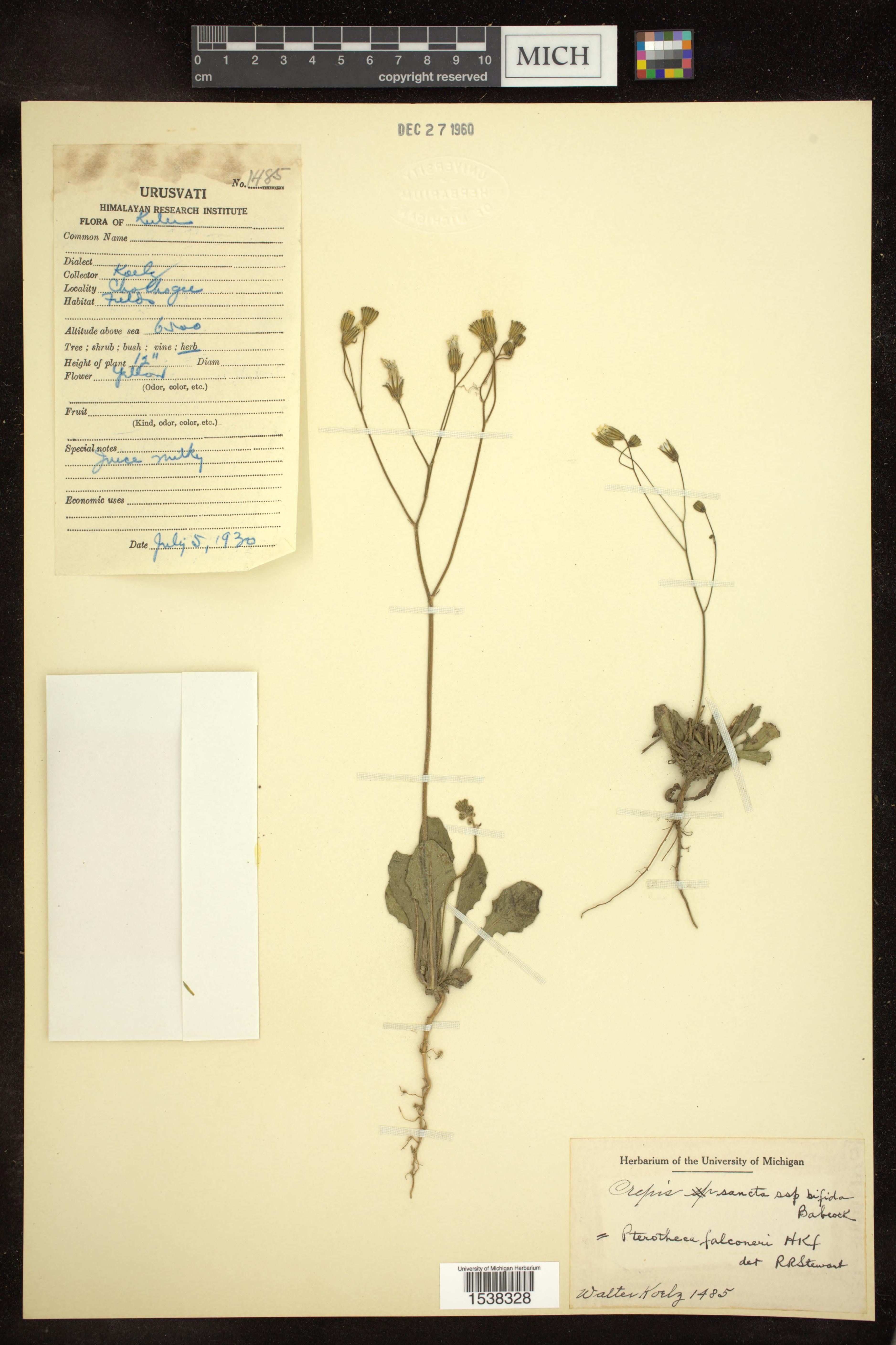
*Pterotheca falconeri* Hook.f. is another possibility as suggested by
Surajit ji as per GBIF specimens from India
<https://www.gbif.org/occurrence/gallery?country=IN&taxon_key=5702777>- one,
<https://api.gbif.org/v1/image/unsafe/https%3A%2F%2Fquod.lib.umich.edu%2Fcgi%2Fi%2Fimage%2Fapi%2Fimage%2Fherb00ic%3A1538328%3AMICH-V-1538328%2Ffull%2Fres%3A0%2F0%2Fnative.jpg>
two
<https://api.gbif.org/v1/image/unsafe/https%3A%2F%2Fwww.nhm.ac.uk%2Fservices%2Fmedia-store%2Fasset%2Ff242a4d3eb2c1a0321d5e3575975299a694b22fd%2Fcontents%2Fpreview>,
three
<https://api.gbif.org/v1/image/unsafe/https%3A%2F%2Fwww.nhm.ac.uk%2Fservices%2Fmedia-store%2Fasset%2Fdb3d93a79baff24cf8ca65fa1a725e4798e974c3%2Fcontents%2Fpreview>,
four
<https://api.gbif.org/v1/image/unsafe/http%3A%2F%2Fn2t.net%2Fark%3A%2F65665%2Fm38ce3b691-ce0c-4b97-b53e-885d551d3534>
.
Here the size of lower phyllaries appears Ok as per images, but hairiness
may be a factor as pointed out by Surajit ji.
On Sun, 27 Jun 2021 at 13:05, J.M. Garg <[email protected]> wrote:

> Thanks, Surajit ji, for the detailed analysis.
> I also tried my hand with comparative images at Cichorieae
> <https://efloraofindia.com/2016/09/24/cichorieae/> as well as those
> mentioned in previous discussions.
> Closest I can reach is that it can be some species of Crepis
> <http://www.efloras.org/florataxon.aspx?flora_id=110&taxon_id=108351> or
> Youngia
> <http://www.efloras.org/florataxon.aspx?flora_id=110&taxon_id=135219>.
> Lack of habit image, is also casting doubts. From 2nd image (with leaf in
> the background), it appears that it was the only flower on the posted
> plant.
> *Youngia japonica* (L.) DC.
> <https://efloraofindia.com/species/a---l/ar/asteraceae/cichorioideae/cichorieae/youngia/youngia-japonica-l-dc>
>  appears
> close but relative size of lower phyllaries appears to be a bit larger
> compared to images herein (considering that habit image are in line with
> those at the given link)
>
>
> On Sun, 20 Jun 2021 at 20:59, surajit koley <[email protected]>
> wrote:
>
>> This is most probably *Youngia japonica* (L.) DC. Usually, outer
>> phyllaries are apparently smaller than those can be seen in ths picture
>> set, ut instances are there, with a little larger outer phyllaries -
>> https://plants.ces.ncsu.edu/plants/youngia-japonica/.
>> Please, check both, FoC, and FoNA, along with other literatures.
>>
>> Another species with similar outer phyllaries, but with glandular hairs
>> is *Pterotheca falconeri* Hook.f. (check eFI).
>>
>> I would like to add that , as per description available, *Launaea
>> microcephala* Hook.f. also has ".... 2-seriate involucral bracts, 6-8 i
>> number, outer minute, inner linear. Radical leaves obovate-spathulate,
>> cauline ......."
>>
>>
>> Thank you
>> With regards
>> surajit koley
>>
>>
>> On Sun, 20 Jun 2021 at 10:54, [email protected] <
>> [email protected]> wrote:
>>
>>> This is no *Launaea acaulis*, neither any usual *Launaea* spp. Here the
>>> phyllaries are 2-seriate, each set having phyllary of equal size, I am yet
>>> to find that character in *Launaea*.
>>>
>>> Unfortunately, there is no herbarium of *L. microcephala*, neither any
>>> description except in Flora of British India ( same point admitted in one
>>> 2002 Pakistan paper (on *Launaea*). In spite of that it has no chance
>>> of being *L. microcephala*, neither flowering stem is filiform, nor
>>> peduncle is capillary.
>>>
>>> FBI has no *Taraxacum* that matches with this one.
>>>
>>> I am yet to know what this species might be.
>>>
>>> Thank you
>>> Regrads
>>> surajit koley
>>>
>>>
>>> On Wednesday, 16 June 2021 at 12:18:48 UTC+5:30 Saroj Kumar Kasaju wrote:
>>>
>>>> Any opinion on my earlier suggestion : Launaea acaulis (Hook.fil.)
>>>> Babc. ex Kerr <https://www.gbif.org/species/3144813>. ??
>>>> Thank you.
>>>>
>>>> Saroj Kasaju
>>>>
>>>>
>>>> On Tue, Jun 15, 2021 at 9:53 PM Gurcharan Singh <[email protected]>
>>>> wrote:
>>>>
>>>>> Forwarding for Id
>>>>> Distributed as Launaea species- enroute to Ghanghariya from Gobind
>>>>> Ghat
>>>>> <https://sites.google.com/site/efloraofindia/species/a---l/ar/asteraceae/cichorioideae/cichorieae/launaea/launaea-species/to-ghanghariya-from-gobind-ghat>
>>>>> At that altitude most likely species with slightly spiny margined
>>>>> leaves and solitary heads seems to be L. polyclada
>>>>> Group discussion at
>>>>> Asteraceae Fortnight Part 3-Ligulate Heads: Launaea? from VOF for id
>>>>> -NS 14 (google.com)
>>>>> <https://groups.google.com/g/indiantreepix/c/AWEQwe-Yk0w>
>>>>>
>>>>> On Thursday, December 24, 2020 at 10:49:32 AM UTC+5:30 JM Garg wrote:
>>>>>
>>>>>>
>>>>>>
>>>>>> --
>>>>>> With regards,
>>>>>> J. M. Garg
>>>>>>
>>>>>> On Wed, 23 Dec, 2020, 2:09 pm Saroj Kumar Kasaju, <[email protected]>
>>>>>> wrote:
>>>>>>
>>>>>>> Launaea acaulis (Roxb.) Babc. ex Kerr ??
>>>>>>> Thank you.
>>>>>>> Saroj Kasaju
>>>>>>>
>>>>>>> On Tuesday, July 30, 2013 at 7:17:59 PM UTC+5:45 D.S Rawat wrote:
>>>>>>>
>>>>>>>> I too have this species with me; pics and specimen. Like to know ID.
>>>>>>>> DSRawat Pantnagar
>>>>>>>>
>>>>>>>> On Sunday, July 14, 2013 7:23:58 AM UTC+5:30, Nidhan Singh wrote:
>>>>>>>>>
>>>>>>>>> Dear All,
>>>>>>>>>
>>>>>>>>> This composite was found growing along the route leading to
>>>>>>>>> Ghanghariya from Gobind Ghat..looks similar to *T**araxacum
>>>>>>>>> officinale*..but the leaves differ..can this be any *Launaea*..please
>>>>>>>>> help to id..
>>>>>>>>>
>>>>>>>>> --
>>>>>>>>> Regards,
>>>>>>>>>
>>>>>>>>> Dr. Nidhan Singh
>>>>>>>>> Assistant Professor
>>>>>>>>> Department of Botany
>>>>>>>>> I.B. (PG) College
>>>>>>>>> Panipat-132103 Haryana
>>>>>>>>> Ph.: 09416371227
>>>>>>>>>
>>>>>>>> --
>>>>>>>
>>>>>> You received this message because you are subscribed to the Google
>>>>>>> Groups "efloraofindia" group.
>>>>>>> To unsubscribe from this group and stop receiving emails from it,
>>>>>>> send an email to [email protected].
>>>>>>>
>>>>>> To view this discussion on the web, visit
>>>>>>> https://groups.google.com/d/msgid/indiantreepix/bc7f0f24-7e28-45f8-9479-9b1dd364ccf9n%40googlegroups.com
>>>>>>> <https://groups.google.com/d/msgid/indiantreepix/bc7f0f24-7e28-45f8-9479-9b1dd364ccf9n%40googlegroups.com?utm_medium=email&utm_source=footer>
>>>>>>> .
>>>>>>>
>>>>>> --
>>>>> You received this message because you are subscribed to the Google
>>>>> Groups "efloraofindia" group.
>>>>> To unsubscribe from this group and stop receiving emails from it, send
>>>>> an email to [email protected].
>>>>>
>>>> To view this discussion on the web, visit
>>>>> https://groups.google.com/d/msgid/indiantreepix/06b72895-a5a2-4ccd-a9b0-aaa9d411ea54n%40googlegroups.com
>>>>> <https://groups.google.com/d/msgid/indiantreepix/06b72895-a5a2-4ccd-a9b0-aaa9d411ea54n%40googlegroups.com?utm_medium=email&utm_source=footer>
>>>>> .
>>>>>
>>>> --
>>> You received this message because you are subscribed to a topic in the
>>> Google Groups "efloraofindia" group.
>>> To unsubscribe from this topic, visit
>>> https://groups.google.com/d/topic/indiantreepix/AWEQwe-Yk0w/unsubscribe.
>>> To unsubscribe from this group and all its topics, send an email to
>>> [email protected].
>>> To view this discussion on the web, visit
>>> https://groups.google.com/d/msgid/indiantreepix/70b2919f-6800-4acf-bb98-88e3e3a47e1an%40googlegroups.com
>>> <https://groups.google.com/d/msgid/indiantreepix/70b2919f-6800-4acf-bb98-88e3e3a47e1an%40googlegroups.com?utm_medium=email&utm_source=footer>
>>> .
>>>
>> --
>> You received this message because you are subscribed to the Google Groups
>> "efloraofindia" group.
>> To unsubscribe from this group and stop receiving emails from it, send an
>> email to [email protected].
>> To view this discussion on the web, visit
>> https://groups.google.com/d/msgid/indiantreepix/CAMV_mc15e7egXWCOyrKzdV_nVhxPFr7tsRAgrnYeoz4FDp%2B%2BwA%40mail.gmail.com
>> <https://groups.google.com/d/msgid/indiantreepix/CAMV_mc15e7egXWCOyrKzdV_nVhxPFr7tsRAgrnYeoz4FDp%2B%2BwA%40mail.gmail.com?utm_medium=email&utm_source=footer>
>> .
>>
>
>
> --
> With regards,
> J.M.Garg
>


--
With regards,
J.M.Garg

--
You received this message because you are subscribed to the Google Groups
"efloraofindia" group.
To unsubscribe from this group and stop receiving emails from it, send an email
to [email protected].
To view this discussion on the web, visit
https://groups.google.com/d/msgid/indiantreepix/CA%2BiuSFC3033PFqMSmaAv1%2BTVpEi1NrsWb1fKF3Q6LA%3DJQeFU4A%40mail.gmail.com.