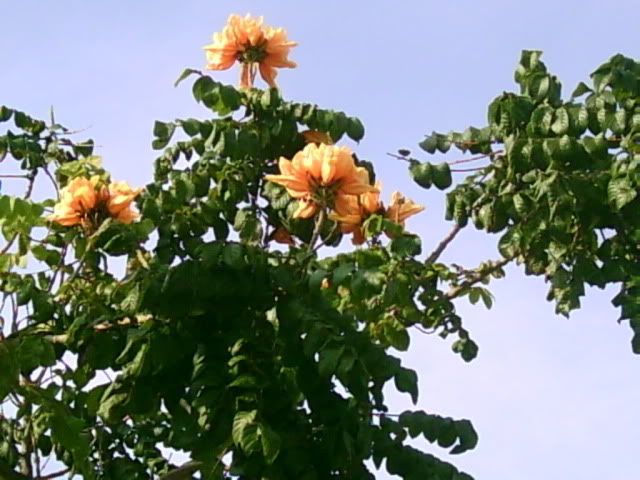
Hi Mr.Kenneth
Lovely pics of the rarely seen yellow blossoms of Spathodea.

i came to know from a book by Dr.H.Santapau  that there is no record
of the time when this tree was first introduced into India. It was
brought to Ceylon from Angola in Africa around 1873.
In Mumbai and many other cities along the coast, this tree flowers
regularly but never with the profusion with which it does in Pune,
Bangalore and other cities in the drier parts of the country.
The tree in Mumbai behaves like an evergreen tree, in drier parts of
the country it may lose all its leaves for a short time during the hot
weather. The wood is soft, and therefore may be damaged by strong
winds.
In Tropical Africa, where the tree actually belongs, the tree flowers
in Sept to May. In Mumbai, it flowers throughout the cold season and
early part of summer, and also often survives the monsoon months.
It is surely one of the finest avenue trees, but to get the best
result from it, the tree should be planted in well-drained soils. It
can thrive upto elevations of 1500 metres.
Regards
Shantanu : )


On Aug 29, 11:47 pm, tanay bose <[email protected]> wrote:
> Thanks for sharing informations Shantanu Da with was well supplemented with
> photos from Ken
> Tanay
>
>
>
>
>
> On Sun, Aug 29, 2010 at 2:18 PM, Kenneth Greby <[email protected]> wrote:
> >  Here are a couple of photos of the yellow-flowered form. It is fairly
> > common in Florida and to a lesser extent in Southern California, USA.
>
> >http://i192.photobucket.com/albums/z93/fastfeat/PHTO0016-4-1.jpg
>
> >http://i192.photobucket.com/albums/z93/fastfeat/Spathodeacampanulatay...
>
> > Regards--
> > Ken.
> >  ------------------------------
> > *From:* Shantanu Bhattacharya <[email protected]>
> > *To:* tanay bose <[email protected]>
> > *Cc:* Pankaj Kumar <[email protected]>; efloraofindia <
> > [email protected]>
> > *Sent:* Sun, August 29, 2010 1:28:41 AM
> > *Subject:* Re: [efloraofindia:45872] Tree for ID
>
> > Hi Tanay and Pankaj ji...
> > Thanks for the Id of this tree.
>
> > Some more info on this spcies. I came to know that it is commonly called
> > African Tulip tree. and* *in Bengali it is called Rudra Palash. It has
> > originated in Africa. *Spathodea* is a monotypi genus in the flowering
> > plant family Bignoniaceae. The single species it contains, *Spathodea
> > campanulata*, is commonly known as the *Fountain Tree*, *African Tulip
> > Tree*, *Flame-of-the-forest*, *Rudra Palash*, *Pichkari* or *Nandi Flame*.
> > It is a tree that grows between 7–25 m (23–82 ft) tall and is native to
> > tropical Africa. This tree is planted extensively as an ornamental tree
> > throughout the tropics and is much appreciated for its very showy
> > reddish-orange or crimson (rarely yellow), campanulate flowers. It has the
> > potential to become an invasive species, however.
>
> > The flower bud is ampule-shaped and contains water. These buds are often
> > used by children who play with its ability to squirt the water. The sap
> > sometimes stains yellow on fingers and clothes. The open flowers are
> > cup-shaped and holds rain and dew, making them attractive to many species of
> > birds. In Neotropical gardens and parks, their nectar is popular with many
> > hummingbirds, such as the Black-throated Mango (*Anthracothorax
> > nigricollis*), the Black Jacobin (*Florisuga fusca*), or the Gilded
> > Hummingbird (*Hylocharis chrysura*). The wood of the tree is soft and is
> > used for nesting by many hole-building birds such as barbets.
>
> > regards
>
> > Shantanu : )
>
> > On 8/29/10, tanay bose <[email protected]> wrote:
>
> >> Spathodea campanulata indeed
> >> Tanay
>
> >>  On Sun, Aug 29, 2010 at 2:57 AM, Pankaj Kumar
> >> <[email protected]>wrote:
>
> >>> Spathodea campanulata
> >>> Pankaj
>
> >>> On Sun, Aug 29, 2010 at 2:29 AM, Shantanu Bhattacharya
> >>> <[email protected]> wrote:
> >>> > Hi
> >>> > sharing a snap of a tall tree with crimson flowers....
> >>> > Location: Jadavpur. Kolkata.
> >>> > Date: 29th August 2010.
>
> >>> > Shantanu : )
>
> >>> --
> >>>  ***********************************************
> >>> "TAXONOMISTS GETTING EXTINCT AND SPECIES DATA DEFICIENT !!"
>
> >>> Pankaj Kumar Ph.D. (Orchidaceae)
> >>> Research Associate
> >>> Greater Kailash Sacred Landscape Project
> >>> Department of Habitat Ecology
> >>> Wildlife Institute of India
> >>> Post Box # 18
> >>> Dehradun - 248001, India
>
> >> --
> >> Tanay Bose
> >> Research Assistant & Teaching Assistant
> >> Department of Botany
> >> University of British Columbia
> >> 3529-6270 University Blvd.
> >> Vancouver, B.C. V6T 1Z4 (Canada)
> >> Phone: 778-323-4036
>
> --
> Tanay Bose
> Research Assistant & Teaching Assistant
> Department of Botany
> University of British Columbia
> 3529-6270 University Blvd.
> Vancouver, B.C. V6T 1Z4 (Canada)
> Phone: 778-323-4036- Hide quoted text -
>
> - Show quoted text -