A interesting set of information Shantanu Da
Tanay

On Mon, Aug 30, 2010 at 12:56 AM, Shantanu <[email protected]> wrote:
> Hi Mr.Kenneth
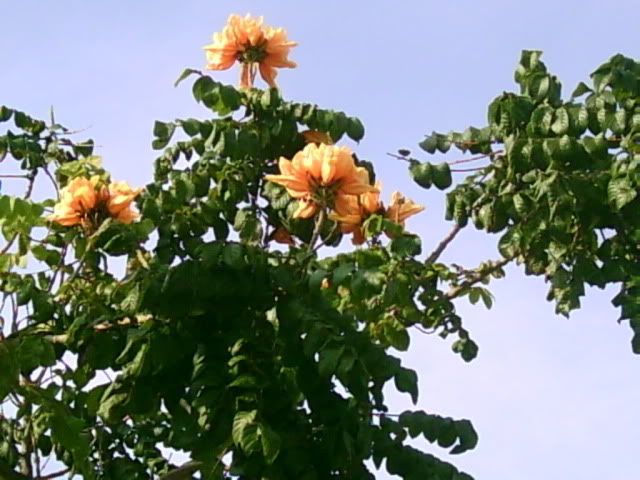
> Lovely pics of the rarely seen yellow blossoms of Spathodea.
>
> i came to know from a book by Dr.H.Santapau  that there is no record
> of the time when this tree was first introduced into India. It was
> brought to Ceylon from Angola in Africa around 1873.
> In Mumbai and many other cities along the coast, this tree flowers
> regularly but never with the profusion with which it does in Pune,
> Bangalore and other cities in the drier parts of the country.
> The tree in Mumbai behaves like an evergreen tree, in drier parts of
> the country it may lose all its leaves for a short time during the hot
> weather. The wood is soft, and therefore may be damaged by strong
> winds.
> In Tropical Africa, where the tree actually belongs, the tree flowers
> in Sept to May. In Mumbai, it flowers throughout the cold season and
> early part of summer, and also often survives the monsoon months.
> It is surely one of the finest avenue trees, but to get the best
> result from it, the tree should be planted in well-drained soils. It
> can thrive upto elevations of 1500 metres.
>
> Regards
> Shantanu : )
>
>
>
> On Aug 29, 11:47 pm, tanay bose <[email protected]> wrote:
> > Thanks for sharing informations Shantanu Da with was well supplemented
> with
> > photos from Ken
> > Tanay
> >
> >
> >
> >
> >
> > On Sun, Aug 29, 2010 at 2:18 PM, Kenneth Greby <[email protected]>
> wrote:
> > >  Here are a couple of photos of the yellow-flowered form. It is fairly
> > > common in Florida and to a lesser extent in Southern California, USA.
> >
> > >http://i192.photobucket.com/albums/z93/fastfeat/PHTO0016-4-1.jpg
> >
> > >http://i192.photobucket.com/albums/z93/fastfeat/Spathodeacampanulatay.
> ..
> >
> > > Regards--
> > > Ken.
> > >  ------------------------------
> > > *From:* Shantanu Bhattacharya <[email protected]>
> > > *To:* tanay bose <[email protected]>
> > > *Cc:* Pankaj Kumar <[email protected]>; efloraofindia <
>  > > [email protected]>
> > > *Sent:* Sun, August 29, 2010 1:28:41 AM
> > > *Subject:* Re: [efloraofindia:45872] Tree for ID
> >
> > > Hi Tanay and Pankaj ji...
> > > Thanks for the Id of this tree.
> >
> > > Some more info on this spcies. I came to know that it is commonly
> called
> > > African Tulip tree. and* *in Bengali it is called Rudra Palash. It has
> > > originated in Africa. *Spathodea* is a monotypi genus in the flowering
> > > plant family Bignoniaceae. The single species it contains, *Spathodea
> > > campanulata*, is commonly known as the *Fountain Tree*, *African Tulip
> > > Tree*, *Flame-of-the-forest*, *Rudra Palash*, *Pichkari* or *Nandi
> Flame*.
> > > It is a tree that grows between 7–25 m (23–82 ft) tall and is native to
> > > tropical Africa. This tree is planted extensively as an ornamental tree
> > > throughout the tropics and is much appreciated for its very showy
> > > reddish-orange or crimson (rarely yellow), campanulate flowers. It has
> the
> > > potential to become an invasive species, however.
> >
> > > The flower bud is ampule-shaped and contains water. These buds are
> often
> > > used by children who play with its ability to squirt the water. The sap
> > > sometimes stains yellow on fingers and clothes. The open flowers are
> > > cup-shaped and holds rain and dew, making them attractive to many
> species of
> > > birds. In Neotropical gardens and parks, their nectar is popular with
> many
> > > hummingbirds, such as the Black-throated Mango (*Anthracothorax
> > > nigricollis*), the Black Jacobin (*Florisuga fusca*), or the Gilded
> > > Hummingbird (*Hylocharis chrysura*). The wood of the tree is soft and
> is
> > > used for nesting by many hole-building birds such as barbets.
> >
> > > regards
> >
> > > Shantanu : )
> >
> > > On 8/29/10, tanay bose <[email protected]> wrote:
> >
> > >> Spathodea campanulata indeed
> > >> Tanay
> >
> > >>  On Sun, Aug 29, 2010 at 2:57 AM, Pankaj Kumar <
> [email protected]>wrote:
> >
> > >>> Spathodea campanulata
> > >>> Pankaj
> >
> > >>> On Sun, Aug 29, 2010 at 2:29 AM, Shantanu Bhattacharya
>  > >>> <[email protected]> wrote:
> > >>> > Hi
> > >>> > sharing a snap of a tall tree with crimson flowers....
> > >>> > Location: Jadavpur. Kolkata.
> > >>> > Date: 29th August 2010.
> >
> > >>> > Shantanu : )
> >
> > >>> --
> > >>>  ***********************************************
> > >>> "TAXONOMISTS GETTING EXTINCT AND SPECIES DATA DEFICIENT !!"
> >
> > >>> Pankaj Kumar Ph.D. (Orchidaceae)
> > >>> Research Associate
> > >>> Greater Kailash Sacred Landscape Project
> > >>> Department of Habitat Ecology
> > >>> Wildlife Institute of India
> > >>> Post Box # 18
> > >>> Dehradun - 248001, India
> >
> > >> --
> > >> Tanay Bose
> > >> Research Assistant & Teaching Assistant
> > >> Department of Botany
> > >> University of British Columbia
> > >> 3529-6270 University Blvd.
> > >> Vancouver, B.C. V6T 1Z4 (Canada)
> > >> Phone: 778-323-4036
> >
> > --
> > Tanay Bose
> > Research Assistant & Teaching Assistant
> > Department of Botany
> > University of British Columbia
> > 3529-6270 University Blvd.
> > Vancouver, B.C. V6T 1Z4 (Canada)
> > Phone: 778-323-4036- Hide quoted text -
> >
> > - Show quoted text -


--
Tanay Bose
Research Assistant & Teaching Assistant
Department of Botany
University of British Columbia
3529-6270 University Blvd.
Vancouver, B.C. V6T 1Z4 (Canada)
Phone: 778-323-4036