Dear All,

I am pleased to announce the release of R.E.D. Server 2.0.
See http://q4md-forcefieldtools.org/REDS/.
R.E.D. Server is a web service designed to automatically derive RESP
and ESP charges, and to build force field libraries for new
molecules/molecular fragments. R.E.D. Server provides to computational
biologists involved in AMBER, CHARMM, GLYCAM & OPLS force field based
biological studies the software and hardware required for charge
derivation and force field library building.
See http://q4md-forcefieldtools.org/REDS/faq.php
  &  http://q4md-forcefieldtools.org/REDS/news.php

A cluster of quadri-core Intel Xeon and AMD dual-Core Opteron is the
machine on which R.E.D. Server is installed and where calculations are
performed. R.E.D. Server uses Apache, Torque, Maui as well as OpenMPI
under CentOS 5.4.

R.E.D. Server 2.0 is open to all users and registration to interact
with R.E.D. Server is not mandatory. The source code of R.E.D. Server
2.0 is distributed under the GNU general public license allowing any
user to create her/his own R.E.D. Server. Consequently, the licenses
signed by the users of R.E.D. Server 1.0 are not valid anymore. In
agreement with the developers of GAMESS, Firefly and Gaussian Inc.,
R.E.D. Server provides the latest version of the GAMESS, Firefly and
Gaussian binaries:
See http://q4md-forcefieldtools.org/REDS/faq.php#3 for the conditions
of use of R.E.D. Server 2.0.
A standalone version of the RESP program is also interfaced:
See http://q4md-forcefieldtools.org/RED/resp/
R.E.D. Server 2.0 executes the latest version of the Ante_R.E.D. 2.0
and R.E.D. IV versions developed by the q4md force field tools team.

New features developed in Ante_R.E.D. 2.0 are:
- the resolution of molecular topology (with reconstruction of the
topology for bad input geometries),
- the determination of rigorous chemical equivalencing (used in charge
equivalencing),
- the development of various approaches for atom reordering as well as
- the definition of atom names and residue name(s) (i. e. two atoms in
a residue belonging to a force field library cannot share the same
name).
See http://q4md-forcefieldtools.org/REDS/news.php#2

R.E.D. presents the following features:
- compatibility with UNIX, MacOS and Windows operating systems
- RESP and ESP charge derivation for whole molecules and molecular fragments
- building of force field libraries for whole molecules and
potentially for any type of molecular fragments
- highly reproducible charge values independently of the QM programs
or initial structures selected
- use of multiple orientations, multiple conformations and/or multiple
molecules in RESP and ESP charge derivation
- modular approach allowing the development of new approaches/adaptations
- chemical elements up to Bromine automatically handled.
See http://www.ncbi.nlm.nih.gov/pubmed/20574571 NIHMSID: NIHMS215785

R.E.D. IV June 2010 presents many new features as well. This includes:
- the reinforcement of charge reproducibility,
- the recalculation of Cartesian coordinates for molecular fragments
originating from the fusion between two molecules,
- the building of complex force field topology databases for any type
of bio-organic and bio-inorganic molecules,
- the generation of all-atom force field libraries or united-carbon
force field libraries
- the development of a statistic module allowing charge value
comparisons (i. e. a first attempt for validating charge values).
See http://q4md-forcefieldtools.org/REDS/news.php#IV

Help for R.E.D. Server users is provided through a private assistance
system or a public mailing list.
See http://q4md-forcefieldtools.org/REDS/help-log.php
  &  http://lists.q4md-forcefieldtools.org/wws/info/q4md-fft

A demonstration is also available from the Demo service.
http://q4md-forcefieldtools.org/REDS/RED-Server-demo1.php

A tutorial is available and it has been updated according to the new
features implemented in R.E.D. Server 2.0.
See http://q4md-forcefieldtools.org/Tutorial.php

Data generated using R.E.D. Server might be automatically submitted to
R.E.DD.B. if one wants to use this option.
See http://q4md-forcefieldtools.org/REDDB/
  &  http://www.ncbi.nlm.nih.gov/pmc/articles/PMC2238896/

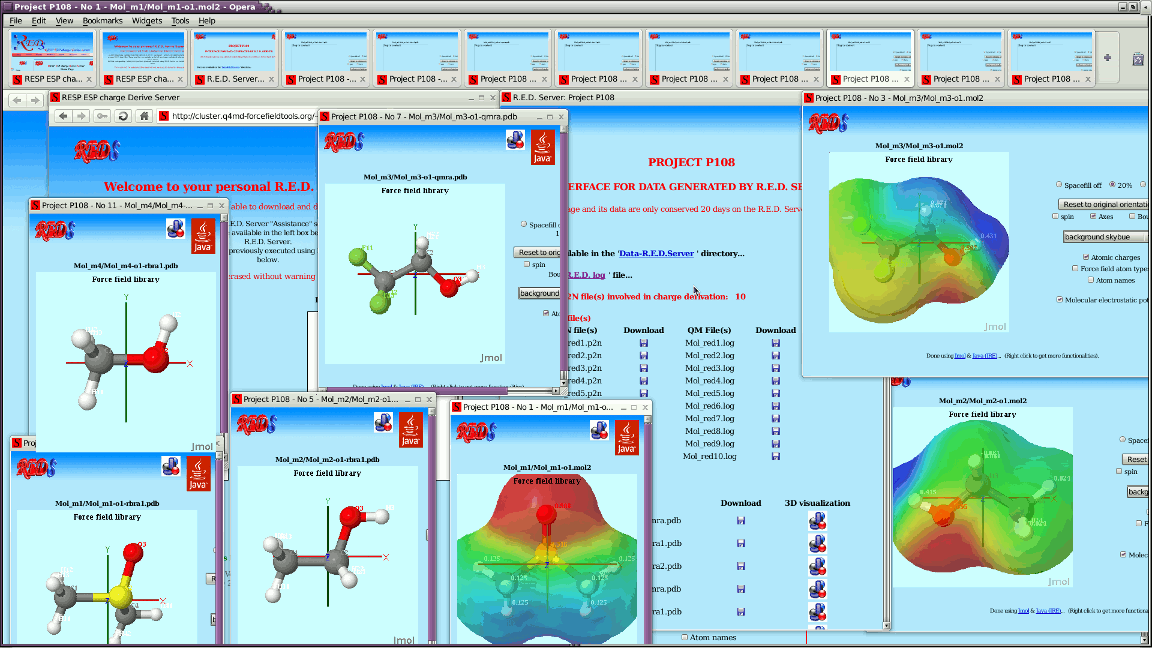
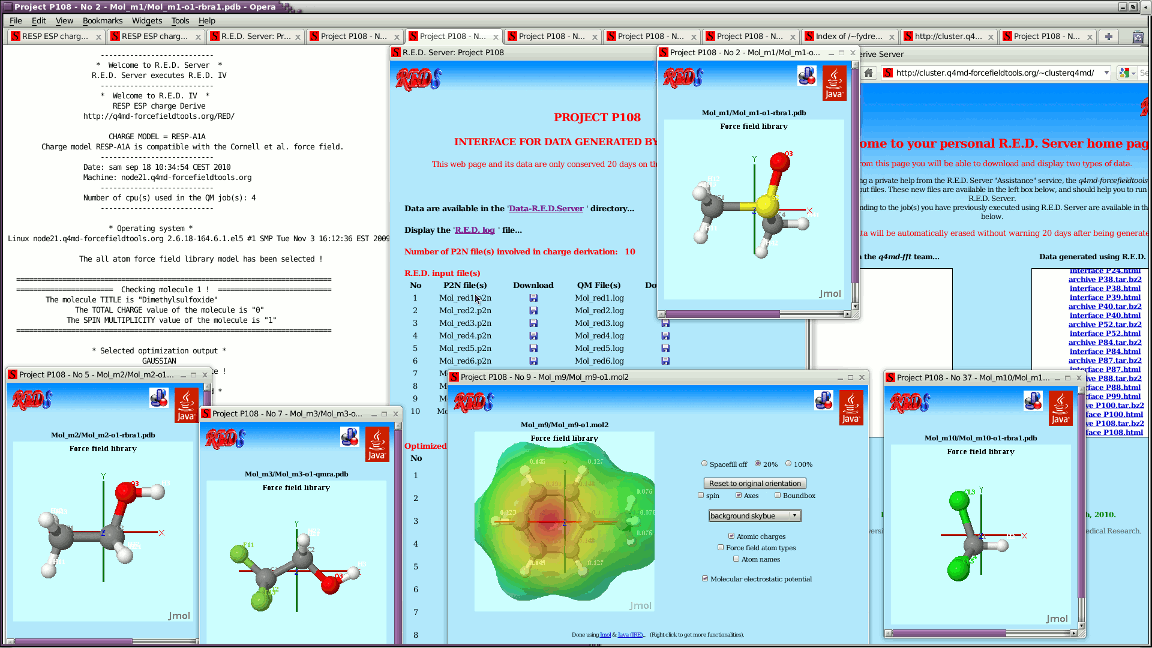
For each project computed by R.E.D. Server a Jmol based graphical
interface is also generated allowing the user studying and displaying
the corresponding data. See screenshots:
http://q4md-forcefieldtools.org/REDS/images/Screenshot1.gif
http://q4md-forcefieldtools.org/REDS/images/Screenshot2.gif
http://q4md-forcefieldtools.org/REDS/images/Screenshot3.gif

We are grateful to Alineos SA http://www.alineos.com/ for supporting
this project.

regards, Francois

           F.-Y. Dupradeau
                 ---
http://q4md-forcefieldtools.org/FyD/


------------------------------------------------------------------------------
Increase Visibility of Your 3D Game App & Earn a Chance To Win $500!
Tap into the largest installed PC base & get more eyes on your game by
optimizing for Intel(R) Graphics Technology. Get started today with the
Intel(R) Software Partner Program. Five $500 cash prizes are up for grabs.
http://p.sf.net/sfu/intelisp-dev2dev
_______________________________________________
Jmol-users mailing list
[email protected]
https://lists.sourceforge.net/lists/listinfo/jmol-users