Comrades,

I will be making a presentation on Marx' economics and the current crisis at
the:
The 1st Annual Los Angeles Anarchist Bookfair
December 13, 2008 from 11am - 9pm
at the Southern California Library
6120 S. Vermont Avenue, Los Angeles, CA 90044
www.anarchistbookfair.com

12:00 Reading Room
Anarchism & Economics
"Anarchism & Marxist Economics" by John Imani
Bio: A long time organizer, in the 1960s John helped organize a student strike
at LACC with the Black Student Union.  He is also a playwrite and journalist.
He's a community organizer, identifies as an anarcho-communist,
anti-authoritarian marxist and is currently a member of the Revolutionary
Autonomous Communities, collaborating with the free food program on Sundays in
Los Angeles' Mcarthur Park.

For those who are interestede but unable to attend, below are my notes for
presentation:

Notes on Marx' Economics and Today's Crisis


Last year, giving a similar presentation at the APOC conference, I began by
saying "Everybody knows shit's fucked up.  Ask anybody on the street.  What
will they say: "Shit fucked up."  Ask why and you will probably get the answer
too:  "We ain't working."  Intuitively, the average man or woman knows
economics.  Going further, if we inquire why we aren't working we will probably
get because the jobs have been shipped overseas.  And one step farther takes us
to the question, "Why have they been shipped overseas?"  And with answering
that one, one would have answered all the fundamental questions raised by Marx
in his critique of Capital.  For the answer to that one, why have the jobs been
shipped overseas, is because, under capitalism, the rates of profit have a
tendency to decline.


The profit rate (p') (i.e. return on investment) is the regulator of the
capitalist economy.


Capital flows to where profit rates are higher; capital flees where profit
rates are lower.


There is a problem with these profit rates and it is this, that over time they
tend to decline


Adam Smith identified 3 causes of this tendency to decline.  These are


(1)   Competition in the labor market. The accumulation of capital will result
in competition among capitalists in the labor market, with the result that
wages will rise. Increased wages would bring about a fall in profits.


(2)    Competition in the commodity market. Smith reasoned that as output
increased, so would competition among producers, with the consequences that
commodity prices would fall and profits decline.


(3)   Competition in the investment market. Smith believed that there were a
limited   number of investment opportunities.[1]

http://www.economictheories.org/2008/07/adam-smith-wage-profit-rent-theory.html


Others have also witnessed the phenomenon of the tendency of profit rates to
decline.


John Maynard Keynes, similar to Smith's third cause, saw it as the result of
savings outstripping investment opportunities.  Classical economic theory holds
that savings are equal to investment  but Keynes saw a problem with this.  His
logic:


1.)    All things being equal, a rich man is able to save a greater proportion
of his earnings than a poor man.  (Using salt as surrogate for subsistence, the
percentage of the rich man's wealth spent for this item is lesser than for the
poor man.)  This is perhaps the economic basis and, it is certainly, an
argument for the existence of graduated (i.e. rising with income) tax brackets.


2.)    All things being equal, a rich nation (a composite of rich men) is able
to save a larger percentage of its earnings than a poor nation.


3.)    As a nation's economy matures (i.e. grows richer) savings pour at a
faster and faster rate into its money-marketplace[2] seeking to be turned into
means and materials of production, competing amongst themselves for the 'right'
to align themselves with labor.[3]  These lower the rate of profit as the rate
of increase of investment outstrips the rate of increase of the labor force
lowering what Keynes termed the "marginal efficiency of capital"


Robert Brenner's thesis is that it is capitalist competition[4], in some cases
(esp Japan and Germany, then S Korea), backed by their respective national
government's economic policy[5] and its conscious intervention in currency
markets (so as to lower its value and thereby stimulate purchase of its
products as imports) that is at root of the tendency of profit rates to decline.


Then there is Fred Mosely who proposes that the increase in the number of what
are termed 'non-productive' workers (e.g. security guards, police, the army,
stock brokers, insurance salesmen) relative to productive workers.  We will see
later that Marx holds that new value (an increase in wealth (i.e. defined as
items satisfying needs and/or desires)) only comes from such productive labor.


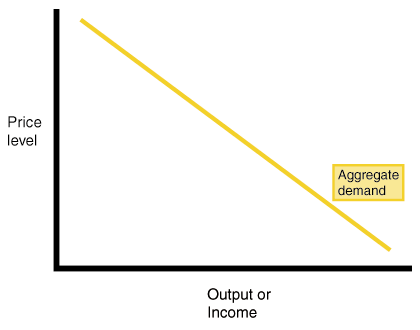
This tendency is also manifest in that great snapshot synopsis of capitalism,
the demand curve:


"The most noticeable feature of the aggregate demand curve is that it is
downward sloping.Recall that a downward sloping aggregate demand curve means
that as the price level drops, the quantity of output demanded increases." [6]


Wherein is demonstrated the maxim that a greater amount of goods can be brought
successfully to market (i.e. sold) only at the cost of a lowered price.  And
indeed, another theory as to the decline in the rate could center just so upon
this:  i.e. that output has sated and saturated demand by moving itself beyond
the confines of the chart i.e. more has been produced than the effective demand
for it.  By effective demand is meant the ability (as opposed to merely the
desire) to purchase.  And ability is equal to purchasing power.  This might be
schematically expressed as


                                                                    O+
$


(Such are the possibilities when production is not directed but instead is the
result of multiple decision-makers who have no idea what the production
decisions of the others are and this ignorance is matched with massive
manufacturing capability.  The result is demand has been glutted, production
ceases or drastically pares back workers are let go and machines are left to
rust.  But we are getting ahead of ourselves).


Marx explained this tendency of the rate of profit to decline in terms of the
growth of constant capital (c) i.e. the machinery, resources and ancillary
materials (e.g. fuel, electricity, etc.) even the factory building itself; all
these Marx' economic theory holds contribute no more than their own value to
the product produced.  Now, as we all know, and as we can now see with plant
closings, automobile dealerships folding and banks failing, under capitalism
production only takes place when there is a perception that there is a profit
to be made.  So, if this is so and the constant capital can contribute no more
than its own value, where is it and how is it that profit is to be made?


Marx held that new value comes only from additional human labor expended.  And
thus the economic basis for the sense and sensibility of our man on the street
who answered that the reason shit is fucked up is "Because we ain't working."
This is the Labor Theory of Value which, however, was not invented by Marx.
Benjamin Franklin, Sir William Petty[7] (who Marx is fond of quoting) even a
Muslim writer in the 14th Century, Ibn Khaldun, in his book on universal
history Muqaddimah , described labor as the source of value, necessary for all
earnings and capital accumulation.[8]  Adam Smith, in his wealth of nations
conceded,


"The real price of every thing, what every thing really costs to the man who
wants to acquire it, is the toil and trouble of acquiring it."[9]


Smith also saw that


"The whole produce of labour does not always belong to the labourer. He must in
most cases share it with the owner of the stock which employs him."[10]


These shares break down into what Marx called "necessary labor" and
"surplus-labor".  With necessary labor, the worker labored enough so that the
value of the wage that the capitalist paid him was re-paid. In a paper entitled
"Regarding Blacks and Mexicans"[11], as an economic justification of
immigration, I wrote


"There is a secret about work. A secret that is uncovered every time someone is
hired.  The secret is that that the worker brings more to the table than he
takes from it. Every person who labors adds more than she is paid."


The unique ability of human labor is to out-reproduce itself.  And this
out-reproductiveness manifests itself, in the production of a surplus,
production of something that was not there before.  Something that is more than
what was before. Something that is the product of this "surplus-labor",


This is the very secret of human progress, is also the sine qua non and raison
d'etre of that which hinders progress:  Capitalism.  For without the production
of a surplus by the worker neither capitalism's waged-slavery nor any other
form of slavery could exist.  And with this "surplus-labor" the cleavage of
society into two great classes of and laborers and owners, of workers and
capitalists.  What is the problem with this?  Aside from the fact that prima
facie it seems unjust?  The problem is is that after a while, it doesn't work.
Doesn't work for the capitalist.  It has never worked for the worker.  When
profit rates decline, capital either closes shop or moves its shops with the
result that labor is laid off.  With labor being laid off there are no wages to
purchase that which has already been made with the result that more shops close
and more workers are again laid off.  It is a vicious cycle that bottoms out in
a depression.  This is what has been happening in the inner cities for decades
as factories have closed and moved elsewhere.  This is what is happening all
across this country.  White 'middle-class' (in quotation marks) America is now
facing what racial minorities in mid-cities have been facing for some time.  It
is, as much as 9/11, their "chickens coming home to roost".


With profit rates deflating, capitalism has been repeatedly forced into the
inflation of 'bubbles' so as to try and 'jump-start' the economy.  Recent
examples have been the 'internet bubble' and stock market crash of 2000; the
'housing bubble', the military-industrial complex bubble of the Iraq and
Afghani Wars, the oil bubble of this year and the financial 'bubble'.  Each
time capitalism received a kick in the ass but each time these shenanigans have
failed to revive the patient.  Of the present crisis, a crisis of profitability
masquerading as a financial crisis, almost 150 years ago Marx wrote:


"In a system of production, where the entire continuity of the reproduction
process rests upon credit, a crisis must obviously occur.when credit suddenly
ceases and only cash payments have validity. At first glance, therefore, the
whole crisis seems to be merely a credit and money crisis. And in fact it is
only a question of the convertibility of bills of exchange (A bill of exchange
is a "purchase order') into money. But the majority of these bills represent
actual sales and purchases, whose extension far beyond the needs of society is,
after all, the basis of the whole crisis. At the same time, an enormous
quantity of these bills of exchange represents plain swindle, which now reaches
the light of day and collapses; furthermore, unsuccessful speculation with the
capital of other people; finally, commodity-capital which has depreciated or is
completely unsaleable, or returns that can never more be realised again. The
entire artificial system of forced expansion of the reproduction process
cannot, of course, be remedied by having some bank, like the Bank of England,
give to all the swindlers the deficient capital by means of its paper and
having it buy up all the depreciated commodities at their old nominal values."
[12]

At that APOC conference I mentioned that there were three things committed
revolutionaries ought to:


1.)    Participate in the class struggle;

2.)    Articulate and experiment with models of non-hierarchical institution
building so as to replace the hierarchical institutions of capitalism;

3.)    Study Marx' economics


I repeat those admonitions today.


JAI


--------------------------------------------------------------------------------

[1]
http://www.economictheories.org/2008/07/adam-smith-wage-profit-rent-theory.html


[2] "Keyenes saw that individuals with higher incomes saved a higher percentage
of their incomes.He concluded that this patter would hold for the whole of
society."  E. K. Hunt.  "Property and Prophets."  M.E. Sharpe.  Amronk, NY.
2003.  p168.


[3] Consider this from it's mirror-perspective:  "In America, the euro area and
Japan, total wages have fallen to their lowest share of national income in
decades, whereas the share of profits has surged. This is exactly what would
have been expected, given that the integration into the world economy of the
emerging economies has sharply increased the ratio of global labour to
capital."  The Economist.  "On the Hiking Trail."  Sept 2, 2006 P66.
http://economist.com/finance/PrinterFriendly.cfm?story_id=7854815


Or, this:  "the IMF estimates that global labour supply has in effect risen
fourfold since 1980 as China, India and once-communist countries have opened
up.With this surge of competition, you might expect labour's share of the pie
to shrink."   The Economist.  "Smaller shares, bigger slices."  April 7th,
2007.  P76.

http://economist.com/finance/PrinterFriendly.cfm?story_id=8959966


[4] "He (Brenner) proposes instead an explanation that puts the blame for the
problems of the past three decades squarely and exclusively on the shoulders of
destructive inter-nation trade struggles, especially among the US, Germany and
Japan."  Review of Robert Brenner's "The Economics of Global Turbulence".
James Crotty.  University of Massachusetts.
http://people.umass.edu/crotty/BR-chllge-ult.pdf


[5] The creation of the S Korean chaebols'  is a prime example of this:


"  the policies of President Park Chung Hee spurred rapid industrialization by
promoting large businesses, following his seizing power in 1961. Government
industrial policy set the direction of new investment, and the chaebol were to
be guaranteed loans from the banking sector. In this way, the chaebol played a
key role in developing new industries, markets, and export production, helping
place South Korea as one of the East Asian Tigers."
http://en.wikipedia.org/wiki/Chaebol


[6]
http://img.sparknotes.com/figures/2/27ecf3a3be058b371903d45b59973dfc/adgraph.gif


 [7] http://en.wikipedia.org/wiki/Labor_theory_of_value#cite_note-19


 [8] http://en.wikipedia.org/wiki/Ibn_Khaldun


 [9] http://en.wikipedia.org/wiki/Labor_theory_of_value


[10] "The Wealth of Nations."
http://books.google.com/books?id=70759KjSs0sC&pg=PA21&lpg=PA21&dq=%22The+whole+produce+of+labour+does+not+always+belong+to+the+labourer%22&source=web&ots=7Sh-ggX8AI&sig=yeDFEYQqNCgYOeZh7R_jNKN-8L4&hl=en&sa=X&oi=book_result&resnum=1&ct=result


[11]
http://www.blackcommentator.com/198/198_blacks_and_Mexicans_imani_guest.html


[12] Capital, Volume 3, Chapter 30, "Money-Capital and Real Capital, I."
http://marxists.org/archive/marx/works/1894-c3/ch30.htm


[Non-text portions of this message have been removed]


------------------------------------

---------------------------------------------------------------------------
LAAMN: Los Angeles Alternative Media Network
---------------------------------------------------------------------------
Unsubscribe: <mailto:[email protected]>
---------------------------------------------------------------------------
Subscribe: <mailto:[email protected]>
---------------------------------------------------------------------------
Digest: <mailto:[email protected]>
---------------------------------------------------------------------------
Help: <mailto:[email protected]?subject=laamn>
---------------------------------------------------------------------------
Post: <mailto:[email protected]>
---------------------------------------------------------------------------
Archive1: <http://www.egroups.com/messages/laamn>
---------------------------------------------------------------------------
Archive2: <http://www.mail-archive.com/[email protected]>
---------------------------------------------------------------------------
Yahoo! Groups Links

<*> To visit your group on the web, go to:
    http://groups.yahoo.com/group/laamn/

<*> Your email settings:
    Individual Email | Traditional

<*> To change settings online go to:
    http://groups.yahoo.com/group/laamn/join
    (Yahoo! ID required)

<*> To change settings via email:
    mailto:[email protected]
    mailto:[email protected]

<*> To unsubscribe from this group, send an email to:
    [email protected]

<*> Your use of Yahoo! Groups is subject to:
    http://docs.yahoo.com/info/terms/