http://www.marxist.com/iran-in-footsteps-of-tunisia-and-egypt.htm
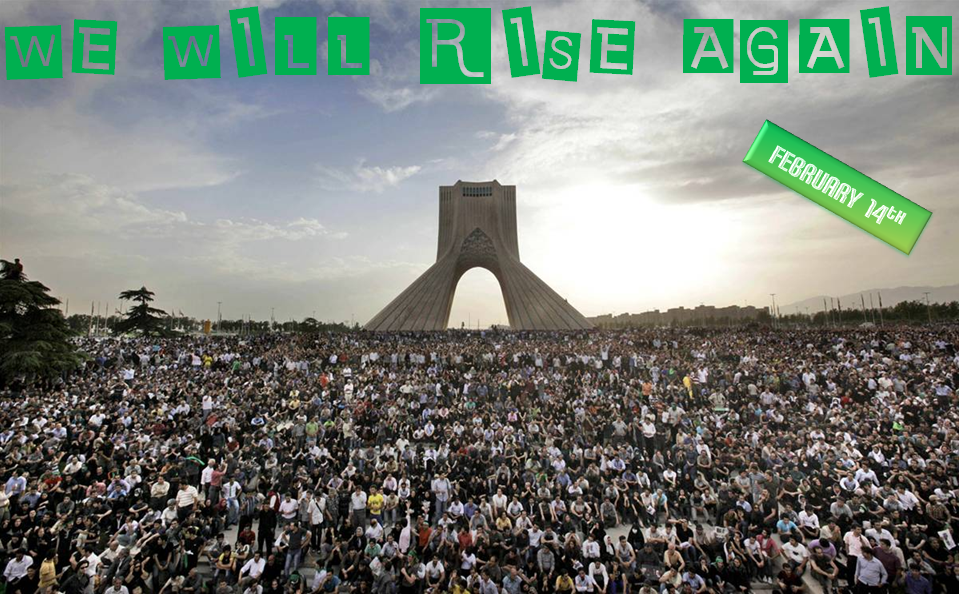
Iran: In the footsteps of Tunisia and Egypt<http://www.marxist.com/iran-in-footsteps-of-tunisia-and-egypt.htm> Written by Hamid Alizadeh Friday, 11 February 2011 [image: Print]<http://www.marxist.com/iran-in-footsteps-of-tunisia-and-egypt/print.htm#> *History is indeed being written with the fall of Mubarak and as the whole of the Middle East and North Africa erupts in one revolutionary upheaval after another. This is also now having an impact in Iran as the lines are once again being drawn for a new round of battles since the eruptions that started one and a half years ago. The focus is now on the call for a demonstration on Monday, February 14.* *[image: iran-egypt]*<http://www.marxist.com/images/stories/iran/iran-egypt.png> *As these lines are being written the Egyptian revolution has achieved its first victory as President Mubarak has been forced to resign and the crowds in Tahrir Square resounds with the thunderous roars of a jubilant people.* The regime in Iran initially was wary of expressing any support for the Tunisian revolution. They understood perfectly well that what was happening could spread and threaten their own power. Terrified of the effects of the Arab revolution inside Iran, it is now trying to confuse the situation through its so-called support for the Egyptian revolution. As they cannot hide what is going on in Egypt and the whole of the Arab world, they are trying to distort reality and present the movement as an Islamic revolution. The message they are trying to get across is this: look the Arab masses are in revolt because they want a regime like the one we have in Iran. The Iranian masses, however, are not being fooled. They correctly see the Arab revolution and the overthrow of ZineEl Abidine Ben Ali and Hosni Mubarak as a point of reference. They understand that what the Arab masses are fighting for is what the Iranian masses attempted to do just over one and a half years ago, that is to overthrow despotic, corrupt dictatorial regimes. Not only are the Iranian masses fed up with the reactionary dictatorship of the mullahs, they are also being plunged into desperate poverty by the neo-liberal policies of the regime. Mirhossein Mousavi and Mehdi Karroubi, the so-called leaders of the opposition, have called a demonstration in support of the Tunisian and Egyptian revolution for Monday, February 14. In an atmosphere of extreme tension, this demonstration could very likely re-ignite the protest movement that started after the 2009 presidential elections. Already, it seems, that the call is has received a wide echo among the youth. A Facebook group (25 Bahman), set up only days ago, has already seen more than 30,000 people joining. At many universities around the country, legal and underground student organizations have taken up the call and have started to mobilize around it. Shockwaves from the Arab world The overthrow of the Ben Ali dictatorship in Tunisia was indeed a historic event. Most importantly it was the first time in modern history that the masses in an Arab country had succeeded in directly toppling a dictator. Now the next dictator is already on his way out. These impressive acts cut right through the melancholy, hopelessness and pessimism that had overshadowed the lives of millions of people in the Arab world. In spite of the many attempts of the rulers of these countries to divide the Arabs and Iranians, the masses of Iran have been instinctively drawn to the revolution in the Arab countries and many lessons are already burrowing their way into their consciousness. The first lesson from the experience of the Tunisian and the Egyptian revolutions is clearly the necessity of the participation of the organized working class with strike action. It is a fact that it was the general strike in early January that gave Zane El Abidine Ben Ali the final and decisive push before he fled the country. Also in Egypt it is the strike movement, which has developed in recent days, especially when this is threatening the strategically important Suez-canal, which has raised the level of the struggle even higher, increasing the pressure on the regime. At the same time the movement in these two countries has also highlighted the weaknesses of Iranian opposition leaders Mirhossein Mousavi and Mehdi Karroubi. Firstly it has shown the complete impotence of the method of open letters and petitions, as opposed to mass action. Also the idea of merely changing the face of the presidency to achieve democracy has been thoroughly discredited. In fact the Tunisian experience is highlighting the fact that as long as the old rotten state apparatus remains it will form a reactionary bloc against the revolution and the achievements of the people, that only a complete shattering of the old state apparatus can satisfy the most basic needs of the revolution. The Iranian regime is indeed alarmed by the dangerous ideas that the events in the Arab world is raising in the minds of the people of Iran. After initially hesitating, the regime started to utter words of support for the Arab movements. In his sermon during Friday Prayers in Tehran on February 4, Ayatollah Khamenei claimed that the revolution in Egypt is the continuation of the 1979 Revolution in Iran and called on the Egyptian clergy to play a role in it [conveniently forgetting to mention that the so-called Islamic revolution was in reality a bloody counterrevolution that crushed the genuine mass movement that had arisen in 1979]. It is clear that the Iranian regime is trying firstly, to confuse the issue inside Iran as the Arab revolution is becoming a point of reference for thousands of Iranians and secondly to derail the Arab movements to suit the regimes own strategic aims within the region. But it is equally clear, that it will not succeed in its aims. It is no secret that the regime has tried for many years to befriend the very dictators it now denounces. Top Iranian officials have been courted many times by the many Arab dictators. Ahmadinejad himself dispatched his chief of staff and in-law Esfandiar Rahim Mashaei to Jordan with a message for King Abdullah, and he has often expressed his hope of re-establishing diplomatic relations with Egypt. At the same time, as the days pass, it is becoming clear to all Iranians that the revolutionary wave in the Arab world is aimed against totalitarian dictatorships, corruption and poverty all of which equally applies to the Islamic Republic in Iran. Cutting of subsidies all-out attack on the masses As the Arab masses rage over their living conditions, the people of Iran are being pushed deeper and deeper into poverty and misery. The regime, in conditions of chronic economic crisis, UN sanctions, the fall in the price of oil since its peak of over $140 (oil is estimated to count for 80 % of Iranian GDP) and pressure from the IMF, has been forced to cut its subsidies on basic goods. The subsidies on goods such as fuel, bread, cheese have been the Iranian equivalent of welfare systems in the west, but just as in the west, capitalism can no longer afford such luxuries and is going on to the offensive to protect its profits. On December 19, 2010 this so-called process of rationalization of Iranian subsidies was officially put in motion by the Ahmadinejad administration. The effects of these cuts have been massive. The subsequent price hikes include a trebling of the cost of water and electricity, a fourfold increase in the price of natural gas used in home heating and cooking, and a tenfold increase in natural gas used as vehicle fuel. The price of petrol is being raised by 4 times when bought as part of Iranians monthly ration allotment, and by seven times for other purchases. The price of flour has been raised by a factor of 40! The price of bread has tripled, on average, the government says; water, which used to be practically free, now costs between 10 cents and 85 cents per cubic meter, based on a sliding scale under which consumers pay a higher rate the more they use. The government says these are just the first steps in what it calls an economic transformation plan that will also include banking reform, sweeping changes in Irans tax and customs system, and ever more privatization of state-owned industries. At the same time a wave of factory closures is taking shape as the subsidy cuts hit Irans medium sized private industries who for decades have based their profits on subsidised energy prices. According to the Iran Students Committee, factories making building blocks, the machinery of which worked with electricity or gas oil, were reported to have been forced to close and announce their bankruptcy after subsidy cuts. Some of these factories are Tirche East Block, Omid Construction Material and Tirche Block Bahador. Thus, unemployment and inflation rates, that now stand at nearly 20 percent - nearly double the official figures of 11.8 percent and 12.2 percent respectively looks to be on the rise. A sick economy Ahmadinejad has stated that the economic reforms will create heaven on earth within five years, but for the majority of Iranians the reforms will be a nightmare that will push hundreds of thousands more into poverty. Ruling over a sick economy, the regime does not have many other options. The Iranian economy is a provider of raw material in the world market, based mainly on oil and a buy-cheap-sell-expensive mentality of the bazaar. Rather than investing in production and development, Iranian capitalism is completely dependent on foreign capital (France, Germany and increasingly, China) and the economy of the state is increasingly dependent on the draining of oil and shady privatisation schemes. Instead of investing in production, major industries like textile and sugar are being dismantled, while Chinese produce, at ever higher prices, are flooding the markets. The Reformist wing of the regime has formally expressed some discomfort at the policies of the regime, but their critique is merely about the form and not the content. In fact the blueprint for the cuts was already laid under the presidency of Rafsanjani. The only answer to this programme would be to have a centralised and democratic plan for the development and expansion of production and thus of the economy, but this would implicate a break with all imperialist allies and with capitalism in general. Such a programme would come directly into conflict with the allies of Iranian capitalism whether Chinese, Russian, European or American. Neither the regime, nor the opposition are capable of carrying out such a programme. It is only the masses who have an interest in such a break. And the prospect of the masses playing a vital role is getting more likely as they are increasingly being dragged onto the scene not by communist or reformist agitators, nor by any so-called dark foreign forces, but by the very policies of the regime itself. Preparing a bread revolution The policies of the government amount to an all-out attack on the living standards of the masses. It is clear that Iranian capitalism wants to unload the crisis onto the shoulders of the masses. The regime is trying to soften the blow by offering a direct payment of $40 dollars a month into the bank accounts of most Iranians an act that must be very humiliating for most people. But this is not enough to cover what has been lost through the cuts in the subsidies. And will in any case be quickly eaten up by the high and rising levels of inflation. Already we see how the masses are cutting in back in consumption as they tighten their belts. The number of cab rides in Tehran for instance has fallen drastically, as transportation costs rose 20% in the days after the introduction of the cuts. With this policy of cuts in subsidies, the regime is playing with fire here. The cuts are bringing completely new layers into the struggle. Transport workers are one of the first layers to be hit by these attacks as the price of diesel has rise. Already in the days and weeks after the introduction of the cuts we saw a number of isolated and small eruptions. In several petrol stations there have been small protests organised by ordinary people on the street. Also there have been reports of crane operators going on strike. In Kerman there was a strike of all heavy vehicle drivers, resulting in disruptions in supplies to the bazaar. In Bandar Abbas ferry boat employees stopped working and won a concession from the provincial governor, who announced in a news conference that ticket prices for 230 ferry boats would be raised by 20%. But even that may not be enough, according to some. One captain told the Mehr news agency that his boat now needs $44 worth of fuel per trip, but he only earns about $32. Potential labour unrest among truck drivers in the cities of Isfahan and Bandar Abbas was also only averted with the quick payment of bonus compensation before trouble spread to other cities. However, transport workers are not the only ones who are being affected. The attacks are fuelling anger and desperation within hitherto inert layers of Iranian society. The BBC published a very revealing report showing the upheavals brewing beneath the surface: Shahrbanoo, a 57-year-old widow waiting in the long queue at a state bank, burst into tears when she found out that she had not received the money promised by the president. "I am not familiar with the internet and new technologies, I have not completed the registration process. How can I afford to live with two daughters at home and pay the rising costs? ( ) But in Iranian culture and diet, bread is central. Bread and cheese are symbols of humbleness and are seen as food of the poor. However, the price of both are going up noticeably across the country. The owner of a bakery in northern Tehran faced many angry questions from customers about bread prices. "Officials should not play with the bread of the people. It may be polluted with blood, he said, referring implicitly to his expectation that riots would follow. Although all these incidents have been primarily isolated, they express the uncertainty and nervous tension that is building up beneath the surface of Iranian society. Not only are the struggles of the future going to be more bitter, but new layers are being pushed up from the depths of society. Support the February 14 call! As tensions are rising, the Mousavi and Karroubis call for a demonstration could strike a nerve within the masses that are looking to the Arab revolution as a point of reference. In fact the call itself is a reflection of the pressure building up from below. At the same time the successful use the methods of consistent direct action, used by the Arab masses, exposes the emptiness of Mousavis open letters and statements. At the same time these experiences, especially those in Egypt, highlight the fact that mere one-day street demonstrations are not enough either. What is needed is firstly a sustained stepping up of pressure, a consistent programme for the overthrow of the regime and most importantly the entrance of the working class onto the stage with strike action. This was what gave the final push to Ben Ali in Tunisia and this is what has finally given the death blow to Hosni Mubarak. By bringing society to a halt, cutting off the supplies and showing the collective might of the working class, a general strike not only significantly weakens the regime, but also strengthens the movement by bringing out many new layers and increases morale. No force on earth can withstand the might of the workers once they begin to move. Thus, a general strike, more than anything *poses* the question of power within society. This has been impressively demonstrated in Egypt and Tunisia. The February 14 demonstrations must be used as the first step to build such a movement in Iran as well. The demonstration must be used as an impulse to set up committees in all universities, factories and neighbourhoods, to mobilize for the demonstrations and to organise for the defence of the movement against the Basiji thugs. At the same time the committees must be used to continue the movement and prepare for a general strike for the overthrow of the regime. *All social layers in Iran are following the events in the Arab world, the regime with great fear, the masses with great joy and anticipation. This immense impulse must be used to gather all the forces of the Iranian revolution and overthrow the rotten regime in Tehran.* - *Spread the Arab revolution!* - *Prepare a general strike!* - *Down with the dictator!* - *Forward until full victory!* *Website of Iranian Marxists: Mobareze Tabaqati<http://www.marxist.com/weblinks/middle-east/mobarezeye-tabaghati-iran.htm>(Iran) * [Non-text portions of this message have been removed] ------------------------------------ --------------------------------------------------------------------------- LAAMN: Los Angeles Alternative Media Network --------------------------------------------------------------------------- Unsubscribe: <mailto:[email protected]> --------------------------------------------------------------------------- Subscribe: <mailto:[email protected]> --------------------------------------------------------------------------- Digest: <mailto:[email protected]> --------------------------------------------------------------------------- Help: <mailto:[email protected]?subject=laamn> --------------------------------------------------------------------------- Post: <mailto:[email protected]> --------------------------------------------------------------------------- Archive1: <http://www.egroups.com/messages/laamn> --------------------------------------------------------------------------- Archive2: <http://www.mail-archive.com/[email protected]> --------------------------------------------------------------------------- Yahoo! Groups Links <*> To visit your group on the web, go to: http://groups.yahoo.com/group/laamn/ <*> Your email settings: Individual Email | Traditional <*> To change settings online go to: http://groups.yahoo.com/group/laamn/join (Yahoo! ID required) <*> To change settings via email: [email protected] [email protected] <*> To unsubscribe from this group, send an email to: [email protected] <*> Your use of Yahoo! Groups is subject to: http://docs.yahoo.com/info/terms/