http://www.marxist.com/mubarak-has-fallen-revolution-until-victory.htm
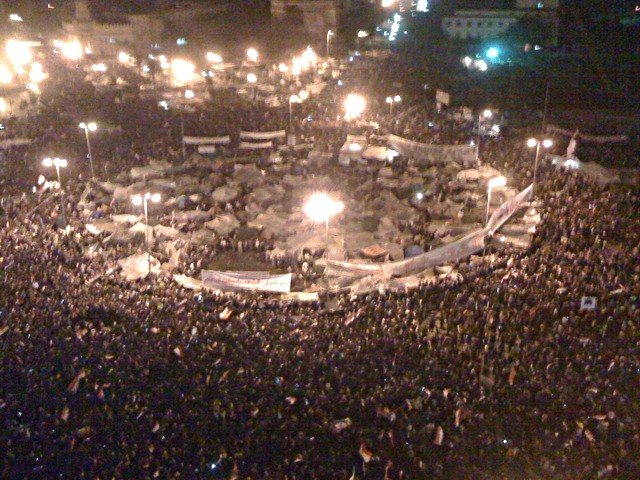
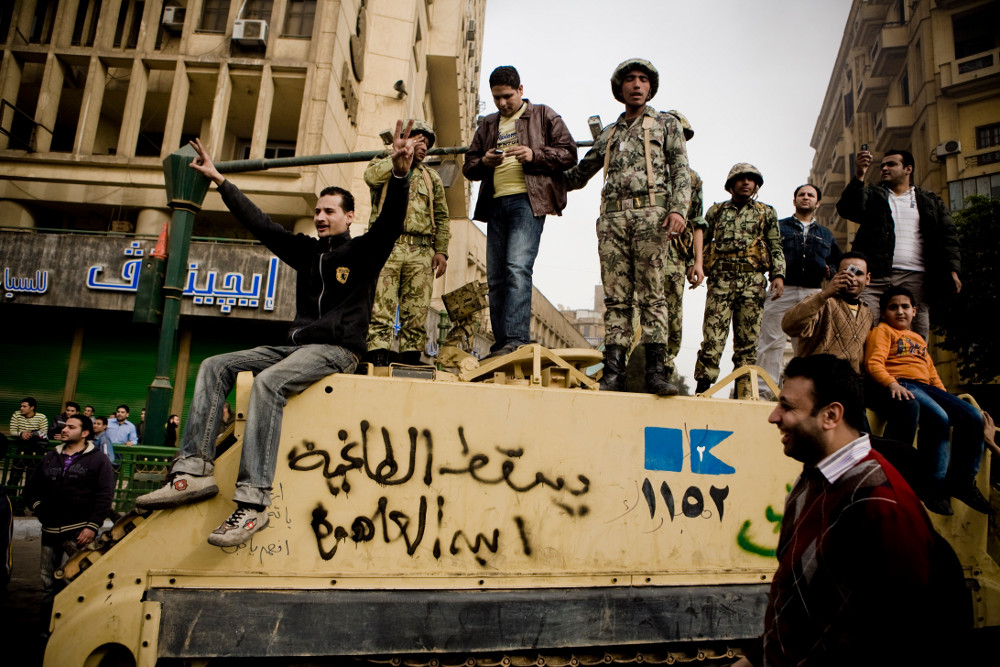
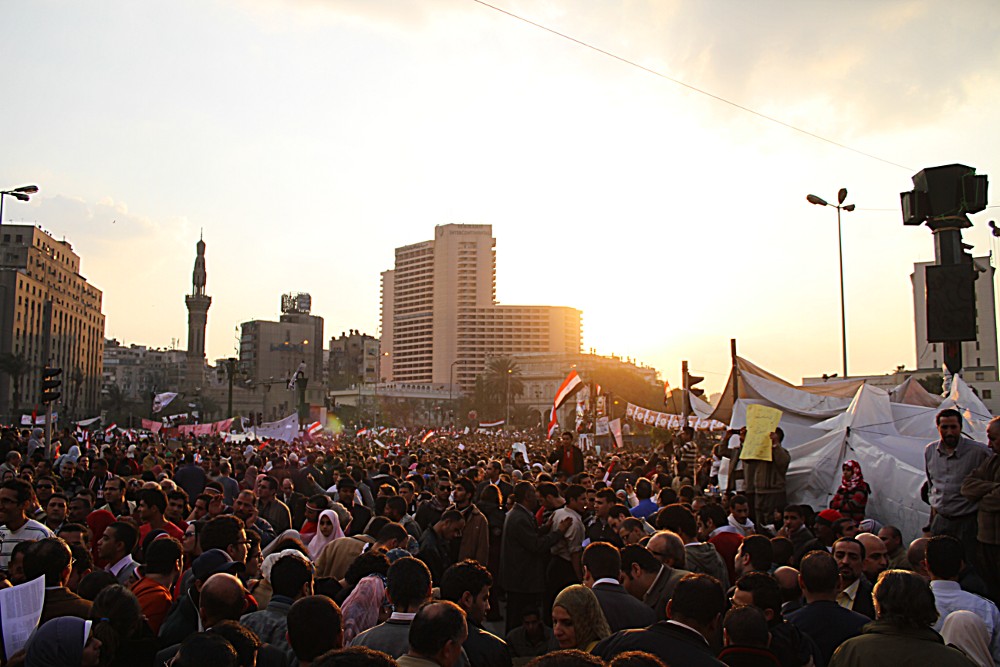
Mubarak has fallen! - Revolution until Victory!<http://www.marxist.com/mubarak-has-fallen-revolution-until-victory.htm> Written by Alan Woods Friday, 11 February 2011 [image: Print]<http://www.marxist.com/mubarak-has-fallen-revolution-until-victory/print.htm#> *The tyrant has fallen! As I write these lines, Hosni Mubarak has resigned. This is a great victory, not just for the people of Egypt, but for the workers of the entire world. After 18 days of continuous revolutionary mobilizations, with 300 dead and thousands injured, Hosni Mubarak's 30-year tyranny is no more.* **<http://www.marxist.com/images/stories/egypt/Feb_11_Tahrir_celebrating-matthew_cassel.jpg> *[image: Celebrations tonight]* *This is the result of the marvellous movement of the masses, which has faced the guns and batons of the police and courageously resisted every attack by the forces of reaction. It is the culmination of two weeks of revolutionary struggle that has been an inspiration to us all.* Yesterday the mass of demonstrators thought that they had won. But the past 24 hours convinced the masses that all the negotiations and compromises were leading nowhere. That explains why today more people than ever turned out to protest as the idea that nothing short of a popular insurrection would lead to the overthrow of a hated and despised autocrat. Last night, before Mubarak spoke on television, one demonstrator on Tahrir Square told the BBC: I will remain here until he goes. If he does not go, tomorrow will be a very rough day for Mubarak. Tomorrow has now arrived. Already at dawn thousands of people were converging on Tahrir Square, ready for a decisive confrontation with the regime. Events have moved with lightening speed. The movement was becoming radicalized by the hour. Protesters were "more emboldened by the day and more determined by the day", Ahmad Salah, an Egyptian activist, told Al Jazeera. "This is a growing movement, it's not shrinking." Political prisoners are being released from the jails. But there are still an unknown number of people missing, including activists thought to be detained during the recent unrest. Human rights groups have alleged that the Egyptian army has been involved in illegally detaining and sometimes torturing protesters. The mood today became angry and defiant. Al Jazeera's Ayman Mohyeldin in Cairo reported yesterday that in the northeastern town of Port Said at least five government buildings, including the governor's office and the office for public housing, were set alight in two continuous days of riots. People have been blocking roads, there have been clashes, and huge numbers of people poured into Liberation Square. Nobody knows the real numbers involved today but the demonstrators have been out all over Egypt in their millions. In the provinces things went even further than in Cairo. In Suez, where the movement has been particularly radical, and where the casualties have been especially numerous, the people occupied all official buildings. In Asyut, where tens of thousands have been out on the streets, they have taken over the headquarters of the ruling party and other official buildings. In El Arish in northern Sinai, where tens of thousands demonstrated, a crowd of about one thousand youths broke away from the demonstration and engaged in gun battles with the police, attacking police stations with Molotov cocktails. In Alexandria a crowd of at least 200,000 people gathered outside the Ras-el-Tin palace and fraternized with the sailors who distributed food to the protesters. Damietta, a city situated where the Nile meets the sea, has a population of around one million. Of these, 150,000 were on the streets today, surrounding the police stations and besieging government buildings. Similar reports are coming from all over Egypt. There was fury on the streets against the lying propaganda of the media. Last night on the BBC Newsnight programme the deputy editor of the official organ of the regime *Al Ahram* apologized to the people and promised to print truthful reports of the demonstrations: The people are angry with us, he admitted: I have even received telephone calls threatening to burn the building down. In Cairo the protesters surrounded the central television station which was protected by paratroops. But the attitude of the troops has been friendly and fraternization was taking place. Acoording to one eyewitness, a paratrooper Major, was seen smiling and shaking hands with protesters, who tell the officer: paratroopers are OK. But we dont want the Presidential Guards. He smiles back. All the soldiers on the other side of the fencing around the television building look sympathetic towards the protesters. It is a very emotional scene. There were constant rumours about a march on the Presidents palace. Several hundred demonstrators left Tahrir Square in Cairo to march all the way to the palace last night some 15 kilometers from the square. The palace was being defended by the army and the elite Presidential Guard. Some commentators speculated that, while the army would not fire on them, the Guard might do so, in which case there could have been a confrontation between the army and the Guard. But according to the reports, instead of shooting the protesters down, the Army were serving breakfast. CNN reported that the soldiers and the crowd were cheering each other. In a gesture pregnant with meaning, the tanks turned their guns away from the demonstrators, who responded with wild cheering. A soldier climbed out of a tank and hung an Egyptian flag on the barrel of its gun. Manoeuvres at the top To put these developments in context: the first indication that something was going on at the top was when on Thursday 10, the military's supreme council met, in the absence of its commander in chief, Hosni Mubarak, and announced on state TV its "support of the legitimate demands of the people". In reality, the real decisions were made, not by the army council but on the streets and in the factories. After weeks of sitting on the fence, the officer caste has been knocked off its perch by the actions of the working class and the revolutionary people. <http://www.marxist.com/images/stories/egypt/Jan_29_3-3arabawy.jpg> [image: 29 January. Photo: 3arabawy] The council was in permanent session "to explore what measures and arrangements could be made to safeguard the nation, its achievements and the ambitions of its great people". AFP quoted an army source as saying: "We are awaiting orders that will make the people happy." By 3.34 pm euphoria had gripped the crowd in Tahrir Square. People were cheering loudly, and once again calling for the fall of the Mubarak regime and: "the army and the people stand together, the army and the people stand united". General Hassan al-Roueini, the military commander for the Cairo area, told thousands of protesters in central Tahrir Square: "All your demands will be met today."Since the first demand was the disappearance of Mubarak, people naturally assumed that the President had been deposed. A senior field commander who preferred to remain anonymous told *Ahram Online* that the Supreme Council had taken over authority in the country, for an interim period, the duration of which was to be determined later. Asked about what such a step might mean for the president, the vice-president and the prime minister, the armed forces commander said "these are people who have no power over the of the armed forces." A senior member of Egypt's governing party told the BBC he "hoped" that President Hosni Mubarak would transfer power to Vice-President Omar Suleiman. However, there were already some indications that Mubarak was not willing to go quietly. One hour later contradictory messages were circulating. Reuters quoted Egypt's information minister, Anas el-Fekky as saying: The president is still in power and he is not stepping down. The president is not stepping down and everything you heard in the media is a rumour. It was said that Mubarak was still in negotiations over whether to hand power to Suleiman. An Egyptian official told the Reuters: "It is not decided yet ... It is still in negotiation. But what was there to negotiate? Mubaraks little surprise President Hosni Mubarak had a little surprise prepared. His decision not to resign evidently came as a rude shock both to the Egyptian military chiefs and to Washington. CIA Director Leon Panetta had spoken earlier as if his resignation were a done deal and a resolution to the crisis was guaranteed. Other sources in Cairo spoke in the same sense. On the other side of the Atlantic Ocean President Obama, with his customary sense of an actors rhetoric, spoke of an historic moment that was being prepared before our eyes. Once again the old man tricked them all. Mubarak was pursuing his own agenda. Many asked what his motivation could be. He was under intense pressure from all sides to step down quickly. The Americans were terrified that if he did not go soon the situation, which was already getting out of control, would get much worse. Instead of merely changing a few faces at the top, the direct intervention of the masses would sweep everything away; the whole regime would go, and with it the last vestiges of US influence in Egypt. The problem was that he was also hearing other voices. The Saudi monarchy, even more corrupt, rotten and reactionary than the Mubarak regime, is terrified and realise that now their friend in Cairo has gone, they could be next. They have been offering large sums of money to Egypt, but on condition that at all costs Mubarak should stay. The Israelis are equally terrified of the consequences of losing their faithful Egyptian ally, the man who enabled them to sell the so-called Peace Plan that vicious piece of deception - to the world. They were anxiously pleading with everybody to cease criticising the Egyptian President. But the most influential voices were the ones in the Presidents head. They were telling him that he was great, that he was good, that he knew better than anybody what was best for Egypt. Like the Absolute Monarchs of old, he regards himself as above all laws, parliaments, parties and generals. He considered himself the embodiment of the Nation and the supreme judge of the Peoples Will. As he spoke in calm and measured tones last night, his face as inexpressive and stony as the funeral mask of a Pharaoh, one got the impression of a man who had lost all touch with reality. The people of Egypt, however, reacted to Mubaraks speech, among other things, with a kind of black humour which often disguises a serious message. Here is an example: The Interior Minister asks Hosni Mubarak to write a Farewell Letter to the Egyptian people. Mubarak replies: Why? Where are they going?" The crowds who gathered in Tahrir Square with Egyptian flags, waiting impatiently for news of his resignation, listened in shocked disbelief as he repeated the same old platitudes. He sympathised with the youth of Egypt, he regretted past mistakes, he wept for the blood of the martyrs and promised to punish those responsible for their deaths (at this point the Father of the People did not even blush), he promised a new and better life. But he did not resign. Shock then turned into anger a cold fury gripped the masses, a fury even more intense because of the high hopes that had been aroused by the earlier rumours. All the plans of the Egyptian military were suddenly in ruins. Instead of a managed transition Egypt was once again plunged into a revolutionary maelstrom. Key role of strike movement The decisive element in the revolutionary equation, that eventually forced Mubarak out, was the intervention of the working class. This is the answer to all those clever ladies and gentlemen who argued that the workers were not revolutionary or even that the working class did not exist. In the past few days across the country, workers and unions have been joining the protests. Nationwide strikes gave a new and irresistible momentum to the mass demonstrations in Cairo and other cities. All over Egypt the workers moved into action with more than 20 strikes in the railroads and also in textile industry, among nurses and doctors, in a hospital, in both government-owned and also privately owned factories. The numbers are in the region of tens of thousands and have been growing all the time. On Wednesday there was a spate of strikes in Kafr El-Zaiat, Menoufeia and the Suez Canal zone. The *CTUWS *reported that in the textile town of Mahalla, more than 1,500 strikers blocked roads and that more than 2,000 workers from the Sigma pharmaceutical company in Quesna went on strike. In Giza, hundreds of young women and men held a protest in front of the Giza governorates office, demanding housing. In Assiut 7,000 Asyut University employees protested, expressing their anger at not working under proper contracts, and low wages. The protesters demanded that they be given the same rights as the permanent employees. Another 200 employees of the Assiut Petrol Company continued their protest from yesterday in front of the companys headquarters, where they had spent the night. The protesters said that they would refuse to move until they are given proper contracts. In the governorate of Qena, 200 employees of Siyanco went on strike for the day, demanding that financial guidelines be implemented, with equality for all. Thousands of oil workers also went on strike and protested in different parts of the country. In Ismailia, employees of the Suez Canal University, Petrotrade and the general hospitals demanded better work conditions and proper contracts. In Aswan in the south of Egypt, 300 employees of the Development and Agricultural Credit Bank protested against corruption. Egypt Telecom, one of the countrys largest telecommunications companies also saw widespread protests in front of its various headquarters throughout the country over the last two days. The workers are calling for proper contracts and better wages. In Cairo, 700 Mukattam Hospital employees, including doctors and nurses, held a protest demanding better wages and proper labour contracts. The doctors and nurses have been striking and demonstrating. In Ain Shams hospital, 1000 employees protested demanding better wages and proper contracts and health insurance for hospital staff. Even the actors have been protesting against their union, demanding the resignation of its head, Ashraf Zaki and that the general prosecutor launches an investigation of corruption. Yesterday (Thursday) thousands of medical students, doctors dressed in white coats and lawyers in their black robes, marched in central Cairo and were hailed by pro-democracy protesters as they entered Tahrir Square. It is well named. This is indeed* Liberation* Square. They were joined by artists and public transport workers, including bus drivers, all of whom had joined the strikes. The movement is growing. Many of these strikes are of an economic nature. Of course! The working class is pressing its immediate demands. That is to say, they see the Revolution as a means of fighting not just for formal democracy but for better wages, for better working conditions for a better life. They are fighting for their own class demands. And this struggle will not cease just because Hosni Mubarak is no longer sitting in the Presidential Palace. But these are also political strikes. Mubarak has gone, but the workers have been demanding that the unjust system upon which he rested must also go. The workers are raising the question of democracy in the factories and in the unions. The official government union federation, the Egyptian Trade Union Federation (the only legal union), supported Mubarak. But they have disappeared. The strikers are demanding the removal of the old leadership. On January 30 a new federation was established, the Federation of Egyptian Trade Unions (FETU), across many cities, both private and public sector. Workers prepared the ground Let us remind ourselves that the Egyptian Revolution was prepared by the biggest strike movement Egypt has witnessed in more than half a century. >From 2004 to 2008 over 1.7 million workers participated in more than 1,900 strikes and other forms of protest. In the recent period there have been 3,000 strikes, including all sectors, both government and private. Many of them were successful, leading to wage increases. But improved living standards were no longer enough to satisfy the workers. Thousands of workers of the Mahalla Spinning and Weaving Company went on strike on Thursday demanding better wages. According to the Center for Trade Union & Workers Services (CTUWS), 24,000 workers took part in the protest. The workers from the morning shift had joined their colleagues from the night shift and gathered this morning in front of the companys headquarters, where they announced their strike and their solidarity with the protesters in Tahrir Square. The workers at government textile mills at El Mahalla el Kubra and tens of thousands more at smaller private factories are the soul of the Egyptian labour movement. Events in Mahalla on April 6, 2008 changed everything. Tens of thousands of people in this city of half a million came onto the streets. "Our slogans now are not labour union demands," said Mohamad Murad, a railway worker, union coordinator and leftist politician. "Now we have more general demands for change." The police opened fire, killing two people, and crowds rampaged through the streets, setting fire to buildings, looting shops and throwing bricks at the officers. Protesters tore down and stomped on a giant portrait of Mubarak in the central square. "This uprising was the first to break the barrier of fear all over Egypt," Murad said. "On that Friday, the crowds controlled the city". [ ] No one can say that Egypt was the same afterward." There is no question that these strikes played a key role in breaking the fear of the rest of the people, starting with the workers themselves. The April 6 youth movement grew out of that movement of the workers. The army Yesterdays events already showed that the general staff was no longer interested in saving Mubarak but rather in saving itself and the regime upon which its power and privileges depend. Mubarak is 82 years old and in any case would be leaving office in September. He was a spent force and the generals knew it. Yesterday they obviously decided to ditch him. But to their immense surprise and irritation, the old man refused to go. In theory, the final decision was made by the army, clearly shaken by the events of the past 24 hours. But the army itself was showing signs of cracking under the pressure of the masses. Al Jazeera reported yesterday of an army Major dropping his weapons and joining the demonstrators in Tahrir Square together with his soldiers. He announced that he was not alone but part of a group of 15 officers of different ranks joining the revolution. Apparently it was not as isolated case. Under these circumstances there could be no question of using the army against the revolutionary people. This, and the massive strike wave that has been sweeping Egypt, explains why in the end the army council decided to ditch Mubarak. The army may now have taken over the government in Egypt, but they do not control the streets or the factories. Millions of Egyptians were pouring onto the streets. The military had to act quickly or lose control of the situation completely. But the generals had only a few choices. The first was to do nothing, allow the crowds to grow and let them march to the presidential palace and hope for the best. The second choice was to try to block more demonstrators in Tahrir Square. The third was to overthrow Mubarak. The problem with the first option was that it would mean that the masses and not the military, determined the course of events. The second option would create a situation where the army might have to fire on the protesters. But a bloody clash with the people would have lead directly to a split in the army. That left them with only one option, which was a coup. This should already have been done last night so that it could have been announced before demonstrations started to build up after Friday prayers. The delay in acting shows that the army high command was itself divided, paralysed and incapable of decisive action. They wanted the Boss to disappear but at the same time they feared the consequences of his disappearance. Maybe Mubarak sensed this and that is why he treated them with such contempt. The fears of the army chiefs were well grounded. Now that Mubarak has gone a heavy weight will be lifted from the shoulders of Egyptian society. The flood gates will be open and every section of society will press for its demands to be satisfied. But how could a military regime satisfy them? Revolution until Victory <http://www.marxist.com/images/stories/egypt/Feb_8-omarroberthamilton.jpg> [image: 8 February. Photo: omarroberthamilton] The overthrow of Mubarak is only the first step. The Revolution has now entered into a new phase. The fight for democracy is only the first half of the task. The second half will be the fight against the dictatorship of the rich: for the expropriation of the property of Mubarak and the entire ruling clique; for the expropriation of the property of the imperialists who backed them and kept them in power for three long decades. Washington is watching events unfold with bated breath. Leon Panetta, the head of the CIA said yesterday there was a strong likelihood that Mubarak may step down this evening, which would be significant in terms of where the, hopefully, orderly transition in Egypt takes place. What the Americans understand by an orderly transition is a transition controlled by the CIA. But this is not going to happen. The situation has gone too far, the masses are aroused and will take this victory, not as a signal to demobilize but to press for their demands. By clinging to power to the bitter end, Mubarak radicalized the whole situation. Any chance of a managed transition has been fatally undermined. The Americans were frantically manoeuvring with the tops of the army to replace Mubarak by Omar Suleiman. But now Suleiman has had to go together with his master. The people did not trust Suleiman any more than Mubarak. Let us remember that Suleiman told the American television station ABC that Egyptians were "not ready" for democracy. He also warned that if protesters did not enter into dialogue with the Mubarak government, the army could have been forced into carrying out a coup. How could such a man be trusted with introducing democracy in Egypt? One protester said that if Omar Suleiman takes over from Mubarak: "all that will happen is that everyone in Tahrir will rewrite their signs, and then carry on demonstrating". The regime finally cracked under the hammer blows of the Revolution. On Wednesday, Gaber Asfour, the recently appointed culture minister, resigned from Mubarak's cabinet for health reasons. Today Hossam Badrawi, the General Secretary of the NDP, the ruling party, has just resigned from it. Others will follow. The rats are already hurrying to desert the sinking ship. In the absence of any alternative, the army high command has taken over. But despite appearances, they too are powerless. The Army Council has taken over on the crest of a revolutionary wave. Tanks and guns are all very well, but they cannot provide jobs for the unemployed, or feed the hungry, or house the homeless, or reduce the high cost of food. The army taking power under these circumstances, therefore, will want to hand power to a civilian government as soon as possible. It may well call elections in September or even sooner. There is no lack of candidates for the job of president and prime minister. El Baradei is waiting impatiently in the wings. But none of the burning problems of Egyptian society can be solved by a market economy. Egyptian society suffers from rising prices and unemployment. There are seven million people unemployed [about 10 percent of the workforce]. 76 percent of young people have no job. Wages are low. Most government workers (about five million people) make about $70 a month. In the private sector, wages are about $110 a month. There is a severe housing problem and some poor people are living in cemeteries. Four million people are without any rights to healthcare. They are not even recognized as part of the working force in any contractual way. There is a burning anger against inequality and corruption. Independent journalists are highlighting the all-pervading corruption that is the chief characteristic of the old regime. Billions of dollars are missing. The * Guardian* published an estimate of $12 billion for the Mubarak family alone. This has provoked fury and disgust, in a country where 40 percent live under the poverty level. Now the Egyptian worker will say: I want my rights, where are our rights? No bourgeois government can give the workers their rights or solve any of the fundamental problems of the Egyptian people. The working class is now the real motor force of the Revolution. Until recently the demands of the Revolution had been political, centring on the fight for democratic rights. But the workers are giving the programme a social-revolutionary character. Yesterday we published the programme of the iron and steel workers of Helwan, an industrial city on the banks of the Nile. This is a very advanced programme that expresses the desire of the workers to carry the Revolution through to the end. Yesterday in Helwan, five military factories were on strike. Today the workers of Helwan Military Factory number 63 were in Tahrir Square carrying a banner that said simply "thawra hatta'l nasr" (Revolution until Victory), and they meant it. The Egyptian Revolution has begun but it has not finished. In order to solve the problems of Egyptian society, it is necessary to break with capitalism, expropriate the capitalists and imperialists and carry out the socialist transformation of society. This is both possible and necessary. What we have seen today shows that once the workers are mobilized to change society, no force on earth can stop them. It is a lesson that sooner or later will be learnt by the workers and youth of all lands. *The people of Egypt are rejoicing and we rejoice with them. Anything is possible now. Let our slogan be: Revolution until Victory!* - *Long Live the Egyptian Revolution!* - *Long Live Socialism!* - *Workers of the world, unite!* [Non-text portions of this message have been removed] ------------------------------------ --------------------------------------------------------------------------- LAAMN: Los Angeles Alternative Media Network --------------------------------------------------------------------------- Unsubscribe: <mailto:[email protected]> --------------------------------------------------------------------------- Subscribe: <mailto:[email protected]> --------------------------------------------------------------------------- Digest: <mailto:[email protected]> --------------------------------------------------------------------------- Help: <mailto:[email protected]?subject=laamn> --------------------------------------------------------------------------- Post: <mailto:[email protected]> --------------------------------------------------------------------------- Archive1: <http://www.egroups.com/messages/laamn> --------------------------------------------------------------------------- Archive2: <http://www.mail-archive.com/[email protected]> --------------------------------------------------------------------------- Yahoo! Groups Links <*> To visit your group on the web, go to: http://groups.yahoo.com/group/laamn/ <*> Your email settings: Individual Email | Traditional <*> To change settings online go to: http://groups.yahoo.com/group/laamn/join (Yahoo! ID required) <*> To change settings via email: [email protected] [email protected] <*> To unsubscribe from this group, send an email to: [email protected] <*> Your use of Yahoo! Groups is subject to: http://docs.yahoo.com/info/terms/