http://www.marxist.com/us-marxist-support-egyptian-revolution.htm
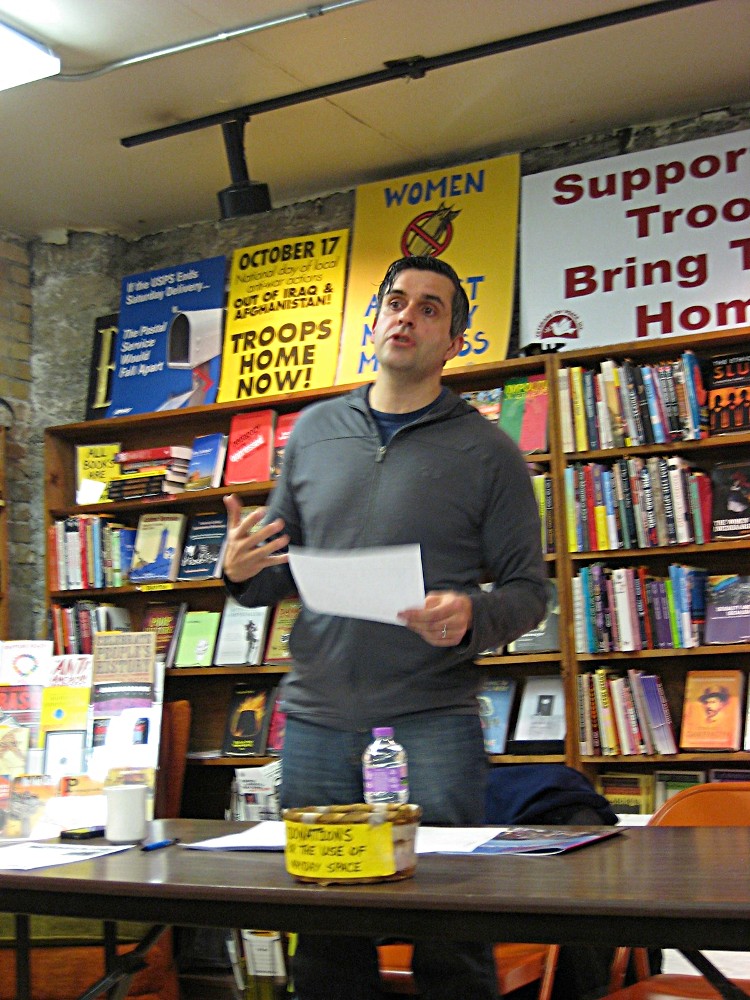
United States Marxist expresses support for the unfolding Egyptian Revolution<http://www.marxist.com/us-marxist-support-egyptian-revolution.htm> *Written by John Peterson Friday, 11 February 2011 * *[image: Print]*<http://www.marxist.com/us-marxist-support-egyptian-revolution/print.htm#> *While Obama sits bewildered as he watches the Egyptian masses overthrow the hated dictator Mubarak, in the United States there are workers, trade unionists, youth and socialist activists who rejoice at the scenes we have been witnessing in these historical moments in Egypt. Here we publish a speech by the Editor of the US Socialist Appeal, John Peterson.* ***<http://www.marxist.com/images/stories/usa/John_Peterson_on_Egyptian_revolution.jpg> * *[image: John Peterson]* *On** Thursday, February 10, supporters of the **Workers International League* <http://www.socialistappeal.org/>* in Minneapolis organized a public forum to discuss the uprisings in Egypt and Tunisia in solidarity with the Arab Revolution. With Mubarak still clinging to power and protests swelling to ever larger numbers, there are many questions yet unanswered. The coming hours and days will be decisive. In his introduction to the discussion, John Peterson, chief editor of **Socialist Appeal*<http://www.socialistappeal.org/> *, summarized the Marxist analysis and approach to analyzing and understanding this revolutionary process, with emphasis on what we can learn and apply in our own struggle for change in the US. The following is a rough transcript of his speech.* Hi everyone, my name is John Peterson, and in addition to being involved in various campaigns and coalitions locally, Im a member of the Workers International League, the chief editor of *Socialist Appeal* magazine, and a regular correspondent for the *In Defence of Marxism* website at Marxist.com. Thanks a lot for coming out tonight. Things in the Middle East have been changing and shifting from day to day and hour to hour. Theres no better example of the fact that far from the relative stability of the past few decades, we have entered a period of sharp, sudden changes, and that on the basis of events and experience, peoples consciousness can shift dramatically in a very short space of time. No matter what happens in the next few hours and days, the fundamental problems facing the Egyptian people are far from being resolved, and simply cannot be resolved through a mere change in government. The Egyptian revolution is far, far from over. Omar Suleiman is just as bad as Mubarak or even worse. Its possible the military may step in and try to take over the government. But yet another military coup and martial law is not what millions of people have been fighting for. People across the region are fighting for genuine freedom and democracy and for a better quality of life. That is simply not possible on the basis of capitalism. What is required is a fundamental change of society, not just a political revolution that replaces one group of capitalist rulers with another group of capitalist rulers, but a social revolution as well, one that transforms the fundamental economic relations in Egyptian society and throughout the Middle East. But Ill speak more about that later. Now, the mood in Tahrir Square this morning was one of anticipation for tomorrows planned day of protest, another final push to get rid of Mubarak. Contingents of workers and professionals were joining the crowd and the strike movement was spreading. It was one of the biggest protests so far. Then, when rumors began to circulate that Mubarak was actually stepping down today, it turned into a giant celebration party, with hundreds of thousands of more people pouring into the square. But that all quickly changed when Mubarak again refused to step down. Millions of people across Egypt exploded in collective outrage. Could Mubarak really be so arrogant, and frankly, so stupid? The mood quickly shifted from victory celebration to even harder resolve and anger. Some crowds appeared to march off toward the state TV offices, others started preparing for a march to the Presidential Palace, which is surrounded by the military. More strikes are being planned. The next few hours really will be decisive. Everyone should tune in to AlJazeera.net when they get home tonight and keep it on 24/7. For those of us who have an interest in the Middle East, in the struggles of workers around the world, and of course, in revolution, the last few weeks have been a whirlwind. There has been a tsunami of information on the events in Tunisia, Egypt, Yemen, Jordan, Algeria, etc. The Egyptian revolution is the biggest story in the US media in the last 4 years. Its not very often that the top story, which keeps audiences glued to the TV screen or Internet is a living, developing revolution. Its not often that we get to see these kinds of events unfold in real time, to see the squirming and maneuvering of the US administration and its allies in the Middle East, and to see the heroic actions of literally millions of ordinary men, women, and even children, fighting against the most terrible poverty and oppression. In short, its not very often that we get to see a revolution, not in some dusty old history book, but actually taking place before our very eyes. Over the last decade or so, Latin America has also been swept by a revolutionary wave. But it has been taking place in a kind of slow motion, and with all the inherent contradictions of such a process, combined with the gross media distortions about what is actually taking place in countries like Venezuela, Bolivia, Ecuador, and Honduras, many people are not quite sure what to think about it all. But it is crystal clear to millions of ordinary workers and youth around the world that what we are seeing in Egypt is in fact a revolution. This is why so many solidarity protests have been organized spontaneously. This is why you hear people talking about Tunisia and Egypt in the grocery store and on the bus. This is why people are so excited about what is happening: because it means that revolutions are possible in this day and age, and that if a tyrant like Ben Ali can fall, many others can and will follow. It means that no matter how things turn out in the short term, things in the Middle East will never be the same. All the old conceptions, both of the imperialists and of ordinary people have been blown out of the water. Every government in the region is terrified, because while Tunisia could be written off as an anomaly, if it happens in Egypt, it can happen anywhere. Already they are bending over backwards to offer concessions, reshuffle cabinets, lower food and energy prices and create jobs. But it could well be too little, too late for them as well. Now, this is a vast topic, and I could spend several hours giving a chronological history of the region, of the economies of Tunisia and Egypt, and how all of this combined to to lead up the recent and ongoing events, but Im sure most of you already have plenty of information on the poverty and unemployment figures, the growing polarization in society, the corruption and cronyism, the USs role in backing up Ben Ali in Tunisia and Mubarak in Egypt, about the waves of strikes that have taken place in the last few years in Egypt, which is the largest and the key country in the Arab world, and also the largest recipient of US military funding after Israel. Im sure you all know about a young Tunisian named Mohamad Bouazizi, a university graduate who like millions of others could not find a job, about how he set up a fruit and vegetable cart to try to make ends meet, only to be shaken down, beaten up, and humiliated by the police, about how he set himself on fire out of indignant desperation, and how this was the spark that lit up the kindling, how millions of others saw themselves in him and decided that enough was enough, and how this unleashed a series of events that are transforming the entire Middle East. Im also sure everyone here will have plenty more to add to the discussion, plenty of details and facts and interesting analysis, so I want to focus on a few bigger picture questions, on some general theoretical and practical questions illustrated by these events, how Marxists approach and analyze revolutions, and above all, what we can learn from them for our own work here in the US, and I want to leave plenty of time for discussion. So first of all, what is revolution, anyway? It seems that over the last 30 or 40 years, many people, even many on left have forgotten what one looks like or that it is even possible. Even though Latin America has been in the throes of revolution for over a decade, the peculiar, protracted nature of this process has led many to doubt whether it is a revolution at all. But I think the most basic, simple, and accurate description of what a revolution is was given by Leon Trotsky in the preface to his *History of the Russian Revolution*: As he put it: The most indubitable feature of a revolution is the direct interference of the masses in historical events. In ordinary times the state, be it monarchical or democratic, elevates itself above the nation, and history is made by specialists in that line of business - kings, ministers, bureaucrats, parliamentarians, journalists. But at those crucial moments when the old order becomes no longer endurable to the masses, they break over the barriers excluding them from the political arena, sweep aside their traditional representatives, and create by their own interference the initial groundwork for a new régime. Whether this is good or bad we leave to the judgement of moralists. We ourselves will take the facts as they are given by the objective course of development. The history of a revolution is for us first of all a history of the forcible entrance of the masses into the realm of rulership over their own destiny. After watching the scenes in Tunisia and Egypt over the last few weeks, how can anyone deny that what we are witnessing is a revolution? Even the mainstream media is forced to acknowledge this, and are using the term revolution more than I have ever seen. Because a revolution is not granted a stamp of approval only if a fundamental change actually takes place. The reason this is a revolution is because win or lose, the masses have decisively entered the stage of history. No longer are they passive players in their lives, but active participants in trying to change society. A revolution is a process, not a single act. So even if Mubarak is able to keep his seat and his neck for a while longer, nothing will ever be the same. The Arab Revolution has begun, and that changes everything. The Tunisian Revolution in many ways had an almost classic development. It has been like reading an account of the Russian Revolution. The insane levels of corruption and arrogance at the top, the intrigues and scandals of the ruling clique, combined with growing misery for the majority. Bouazizis self immolation was the spark that lit up the accumulated flammable material, and the protest movement spread to the main cities, starting with the students, then spreading to the organized working class. Ben Ali stood firm at first and resorted to repression, and when that failed, he offered concessions. But it was too little, too late, and he was forced to abdicate. A cabinet reshuffle or two later, and everyone was supposed to go home. But the old regime continues in all its fundamentals and none of the problems that sparked the revolt have been resolved. So while the situation in Tunisia is in a bit of a state of limbo at the moment, and while all eyes are on Egypt, the protests in Tunisia continue, the trade union federation is split, and the revolution there is far from over either. In both Egypt and Tunisia you had US backed dictators - though Obama and Hillary never used that word to describe them before. There were stifling economic conditions. A majority of the population across the Middle East is young, under 30, many of them illiterate due to crushing poverty, but millions more are highly educated, none of them with any future under the current regime and the current system. A crass and obscenely arrogant ruling class, living lavishly while the majority sunk deeper into poverty. As one young Egyptian told the BBC: We are poor. We have no work, no future. What should we do? Should we burn ourselves? And although the details and degree of open corruption and economic misery vary, this pretty much describes almost every country in the Middle East, and in fact every country in the world, including the Unites States. Things are not as overtly and visibly miserable for the majority here in the US as they are in Tunisia or Egypt, but believe me, life is getting exceptionally hard for millions of American workers and young people, especially for young Blacks and Latinos. The American Dream is dead for the vast majority, and I think it is only a matter of time before similar processes start to take off right here at home. Because remember, after the collapse of the Soviet Union, we were told that it was the end of history, that revolutions were no longer on the order of the day, and that the struggle for socialism was dead. That idea has now been exposed a hollow wishful thinking. In fact the epoch of the world revolution is just beginning. Just one week before Ben Ali was forced to flee, *The Economist* magazine denied that he would be overthrown, or that his regime would even be shaken. Then, once Ben Ali was kicked out, they reassured their readers that the Tunisian revolution would not spread to countries like Egypt, because Egypt was different. Within a few days Egypt erupted. Now they say that the rest of the Middle East is somehow different. But they are not that different. Every country from Saudi Arabia to Israel, Yemen to Iran is also torn apart by class contradictions and growing polarization. As we all know, we live in an epoch of a global economy, as with it, comes global economic crisis. Everything is more interlinked than ever. Obama even said that today in his comments on Egypt. But with this greater interconnectedness comes an epoch of world revolution - revolutions do not respect borders. We have seen this already in Latin America, and now, even more graphically, in North Africa. Tunisia was first and Egypt followed, but it will not be the last. So as you can see, there are many questions which arise when we start to analyze a revolutionary process. For example, there is the question of the youth and their role in revolutionary change as a barometer and expression of discontent in society. The raw energy and willingness to sacrifice and even die for freedom of the Tunisian and Egyptian youth cannot be denied. But mass demonstrations are not always enough to settle the question. Then theres the key question of the working class, the unions, and the traditional mass workers political parties. Because the fact is that the working class, due to its role in the productive process - that is to say, because workers actually make things work - is the only class and force in society that can physically bring society to a halt, impose the will of the majority on the regime, and bring about a fundamental change in how society is organized. This leads to the question of economic and political strikes, sit ins, and the indefinite general strike, and the need to coordinate and organize this throughout all sectors of the economy. The question of the traditional unions and the role of the labor leaders in defending the old order, and how these organizations and even some of these leaders can be transformed and pushed further to the left by mass pressure from below. How the UGTT in Tunisia, which was as top down, corrupt, bureaucratic, and linked to the state as you can get, has been transformed by the surge of workers entering the struggle in the last few weeks. The unions in Egypt, which have been shaken by massive strikes in the last few years, are also being transformed at this very moment. In the not too distant future, similar convulsions will also shake up the US labor movement. There is also the question of the role of social media like Twitter and Facebook in speeding up communications, as a tool to organize, even when the Internet itself has been shut down. Theres role of the media generally, and how they cannot fool all of the people all the time, and that reporting the truth about what is happening, as Al Jazeera and a few other independent outlets have done, effectively poses a danger to the entire edifice of capitalism. The experience of the last few weeks shows that even in a society with an iron grip on the media and on the Internet itself, the truth will always find a way to make itself heard, especially in extraordinary situations such as this. It also shows that despite the tremendous power of the media in shaping public opinion, this is cannot stop revolutions from happening, and can in fact make the eventual social explosion that much more explosive. I think you can see more parallels with the situation here in the US. Then theres the question of diplomacy, and how it is used to confuse people, the use of double speak to cynically hide the real interests being defended. To make dictatorship appear democratic and democracy appear like anarchy. There are complex and contradictory pressures being put on Mubarak by the Saudis, the CIA, the Obama Administration, the Israelis, his own generals and cabinet, etc., not to mention the clear pressure from below for him to step down. The Egyptian ruling class and their allies are split between those who want to grant more freedoms but fear a social explosion as the steam is let out of the pressure cooker, and others who want to use repression, to put the lid on the pressure cooker even more tightly, but fear an even greater social explosion. And both are right. They have created the conditions for revolution and must now suffer the consequences. But there are many other important questions - for example, the question of the state and whose interests it represents, the armed bodies of men of the military, the police, the courts, the prisons, the laws. The fact that in Egypt, the government is in effect the state, and the state is the government, and how Mubarak does not rule alone, but stands at the head of a vast bureaucracy and military tailor made to defend the interests of the rich and imperialism. How Constitutions are really just pieces of paper, reflecting the class balance of forces at any given time, and how the Mubarak regimes sudden interest in Constitutionality is nothing but a sham to hide the fact that in reality, they have no legitimate right to continue ruling. But millions of Egyptians now understand that as long as the fundamentals remain the same, it will be impossible to truly change anything by merely changing the leaders at the top. Then there is the all-important question of the class divisions in the military, how the generals represent different interests than the rank and file soldiers, and in recent weeks, the emergence of neighborhood defense committees and the defense of Tahrir Square. In the hours ahead, the question of which way the military will go is of crucial importance, how the army could split along class lines and even lead to Civil War. We have seen also how different layers of society enter the struggle at different stages, and new layers can breathe fresh air into a struggle that seems to be losing steam. Revolutions also poses the question of democracy, of what genuine democracy is, of bourgeois democracy versus workers democracy, and what little regard the ruling class has for the law and the trappings of democracy when their core interests are at stake. How, since they could not rely on the military to repress the people and the police had been driven off the streets, they were willing to unleash the dogs of undercover police and hoodlum violence against unarmed protesters. But on February 2nd in the Battle of Tahrir Square, the masses fought back with sticks and stones. And won. This was a crucial turning point in the process. Because having lost their fear, the Tunisian and Egyptian revolutions show that the masses cannot be stopped through brute repression alone. All the tanks and jets and guns in the world cannot stop the masses once they start to move. And when repression fails, the ruling class resorts to lies and deceit, to playing one layer of the population against another, trying to buy support, isolate the more advanced elements, and so on. But so far this has failed, and Mubaraks refusal to step down has only served to strengthen the protesters resolve even further. There are also some important theoretical questions raised by a living revolution, questions that should be of interest to all activists, not just those who consider themselves Marxists. For example, there is also the long standing debate on the left and even among Trotskyists themselves over Trotskys Theory of the Permanent Revolution. I believe that it is impossible to understand what is happening in North Africa and around the world today without a solid grasp of this theory. Summed up, the Permanent Revolution explains that in the ex-colonial world, there is no such thing as a progressive bourgeoisie, as they are too tied to the major imperialist powers and the capitalist system to play an independent, progressive role. Tied as they are to the for-profit capitalist system, they cannot raise the standard of living of the majority of the population. Therefore, only the working class, again, due to its role in the productive process, can place itself at the head of all the oppressed and exploited layers of society and fight not only for national-democratic demands, but for the socialist transformation of society, not in 2 distinct stages, but as part of a single process. Furthermore, such changes cannot be limited to a single country, but must ultimately be extended worldwide. In short, the Theory of the Permanent Revolution explains that there is no solution to the problems facing the majority on the basis of capitalism, that only the working class can lead society in the fight for socialist transformation, and that the revolution must be international in scope and outlook. Connected to this is a question that will emerge more clearly once Mubarak has gone, which is that while the majority of Egyptians are currently united against Mubarak, not everyone will agree with what comes next. A revolution awakens all layers of society, from the lumpen thugs that were mobilized by the police to smash the occupation of Tahrir Square to the doctors and lawyers that marched en masse to the square today. Some would be satisfied with replacing Mubarak with Suleiman. Others will want to get rid of Suleiman and the regime altogether, but believe that a nice and prosperous capitalist democracy is somehow possible. But the majority of the people in Egypt want a root and branch change of the system. They may not yet understand that this means the struggle for socialism, but revolutions have a logic of their own. Experience will prove a mere change in political regime is not enough. Even the most advanced political freedoms do not create jobs, health care, education, infrastructure, and so on. So those who were allies in the struggle against Mubarak will inevitably see their interests diverge in the coming weeks and months, and new contradictions and tensions will arise. Then there is the question of dialectical materialism, the philosophical foundation of Marxism, as applied to living reality. There are ebbs and flows, advances and retreats seen in every revolutionary process, the gradual building up and sudden, explosive release of tensions in society. Much like an earthquake, forest fire, or volcanic explosion, a series of smaller incidents, uprisings, strikes, and protests can eventually turn into a region-wide conflagration, seemingly out of the blue. There is the question of dual power, of situations where the old state power continues to exist, mostly out of inertia, but the real power is already on the streets, in the factories, and in the barracks. In Egypt over the last few weeks, at several key points in the revolution, there has been no central power to speak of, the police were off the streets, the army divided and paralyzed, the ruling NDP party in a shambles and with its headquarters burnt to the ground. Power has in reality it has been on the streets and in the neighborhood militias. Even with the military position throughout Cairo and other major cities, the real power was up in the air. But without a far sighted revolutionary leadership, the initiative has at times been allowed to slip back to the regime. Now the momentum is again on the streets. But what is needed more than ever is for workers, peasants, soldiers, student, and neighborhood councils or committees to be created, linked up at the local, regional and national level, and thereby constitute a new state power, a workers state. These committees should, among other things, replace the police coordinate food and water distribution, transportation, and education. They should coordinate production in the factories, take over the key banks, lands, and industries, and begin running them democratically under workers control. This would be a new form of state power, a truly democratic and accountable form of government. They were called soviets in Russia, but call them what you will, the basic form has been the same in every revolution since 1905. These types of directly elected and recallable committees have already sprouted up in Tunisia, with entire towns taken over by the citizens and governed through elected committees of representatives from the workplaces, neighborhoods, and schools. They have also emerged in embryonic form in many Egyptian factories, with workers kicking out the old management and even their old union leaders, often with real kicks. Theres also the important question of the nature of resistance to imperialism in the Middle East. Many doubted or wrote off the working class, or even thought that the masses of the Middle East were too backward for democracy. With no confidence in the primary role that would have to be played by the working class, many on the left backed reactionary groups like Hamas or the Muslim Brotherhood. Due to a vacuum of leadership and options on the left, and due to the even more rotten and corrupt alternatives, some of these groups have in fact gained sympathy among layers of the population. But in the final analysis these people are defenders of the capitalist system, the same system that exploits the workers, peasants, youth, women, urban poor, and national minorities of the region. Now, every people has a right to elect whomever they choose, and the US was completely hypocritical when they refused to recognize the election of Hamas in Gaza. But look at the role they are playing in. Hamas has tried to prevent solidarity protests in Gaza and even attacked some of the protesters who went ahead and protested anyway. Far from welcoming the salvation that a successful Egyptian Revolution would represent for the oppressed Palestinian masses, they are afraid the revolutionary contagion will spread there as well. And look at the role of the Muslim Brotherhood in Egypt. At first they rejected the protests, then they reluctantly joined in when it was clear they were losing credibility. Then said they would not negotiate with Mubarak, only to join in the negotiations a few days later. They are also in contact with the US State Department and presumably the CIA, being pushed to play a moderate role in taming the revolution and ensuring it doesnt go too far. Even Hillary Clinton has said she can work with these people. They also support the repressive regime in Iran. In other words,, they are for a regime change, but only insofar as their own interests are maintained and enhanced. They want to be part of the new ruling clique. The same goes for people like Mohamad El Baradei. These folks may be for more formal political democracy, but they do not want a fundamental change, a social change, which would threaten capitalist property relations and their own interests. Many people, unfortunately even many on left, looked to fundamentalist groups in the region simply because they appeared to be anti-imperialist on paper. But they ignored the fact that these people are in fact the products of imperialism, created by the imperialists to cut across the socialist and communist movements of the region, and as a way of creating a bogeyman that the Israeli and American ruling class could use to justify propping up reactionary dictatorships like Mubarak, Ben Ali, Saudi Arabia, the horrific treatment of the Palestinians, etc. Two years ago, when millions of Iranians rose up against their own repressive and reactionary pro-capitalist regime, many people on the left stood on the sidelines or even sided with the Mullahs as they physically crushed the revolution and rounded people up to be tortured. They lost sight of the fact that the fundamental reasons for what happened in Iran and what is happening now in the Arab world are the same: poverty, unemployment, repression, and lack of basic freedoms. Many people seem to have an overly simplistic approach to politics. They proceed from the premise that the enemy of my enemy is my friend. But life is more complex than that. Because if the enemy of your enemy is also the enemy of your friend, then there is no reason why they should not be your enemy as well. For example, just because we oppose US intervention in Iran, it doesnt mean we cant also be against the Mullahs who oppress their own people. I think it is important that we always approach these questions from a much more nuanced, but still quite simple standpoint: Marxists support that which increases working class solidarity, unity, consciousness, and confidence, and we are against that which harms working class solidarity, unity, consciousness, and confidence. Again, for Marxists, it is the working class that is key. There have been countless heroic moments and actions in the last few weeks, but it has to be said that the key to turning the situation decisively in favor of the revolution was the entry of the organized working class in the last few days. The movement seemed to be running out of steam, and it seemed that the regime was going to be able to cordon off the protesters in Tahrir Square. But then the workers started to enter the square as an organized force. Economic and political strikes, sit ins, workers committees, and demonstrations tipped the balance. Because if theres anything that the unfolding revolutions show, it is the immense power of the working class once it is mobilized. The intervention of the working class in Egypt has been the decisive turning point. Workers in all sectors have come out in economic and political strikes in the last few days, from steel works to textile mills, museum workers to hospital workers. In Suez, some 6,000 workers connected to the canal and thousands of others in other industries are on strike. 40% of world trade passes through Suez, so a serious strike there would have worldwide implications. Now that tomorrows protests and strikes will likely proceed as originally planned, and probably on an even higher scale given the intransigence of Mubarak, things could truly get out of the ruling class and imperialists control. Not only will Mubarak and his regime, but the entire capitalist system be under threat. Because once the workers start to realize realize just how strong they are, nothing can stop them. One commentator has pointed out how the toppling of the brutal Ben Ali dictatorship in Tunisia cost around 100 lives and took about 4 weeks. Not to minimize the deaths of these revolutionary martyrs, but compared to what the US imperialists have spent in Iraq: $1 trillion or more, 4,500 US soldiers killed, tens of thousands more wounded or traumatized, as many as a million Iraqis killed, etc. And still, nearly 10 years later, the imperialists still do not fully control the country. Compared to all this, 100 dead and 4 weeks of mobilizations, of mostly unarmed, peaceful protesters, against one of the more brutal dictatorships in the region, shows just how powerful the united and organized workers are. So when people dismiss the very possibility of revolution because of the enormous military might of imperialism, at least on paper, just look at how impotent all that power is in the face of an awakened, revolutionary people. The US and their allies are terrified of what could happen in the coming weeks and are working around the clock to try to contain the situation and defend their interests. But although they are sending extra warships to the region, the US is not able to intervene directly. And the Egyptian military, funded by billions of US taxpayer dollars, has so far not been able to be used as a tool to crush the revolution. In fact, earlier today, many soldiers, including army officers, were seen turning in their weapons to join protesters in Tahrir, according to CBS News' Khaled Wassef and reports on Twitter. This has big implications for what will come in the next few hours, days, and weeks. One last question I would like to address is the extremely important question of revolutionary leadership, of relying merely on spontaneity versus the building of a revolutionary party trained and forged in struggle before the revolution erupts. Spontaneity has been both a strength and a weakness of the movements in Tunisia, Egypt, and elsewhere. The masses incredible creativity, energy, heroism and willingness to fight to the end has taken the ruling class by surprise, but it has also led to a lack of coordination and focus. New leaders have emerged in the heat of the revolution, programs of struggle developed as things unfolded, but at times, the masses have clearly been unsure how to proceed. Up until a few hours ago, it was unclear what the next steps were. Rumors of a general strike were in the air, and a program of demands issued by various groups of union workers clearly posed the question of power, of seizing the assets of the Mubarak clique and nationalizing the key levers of the economy. But none of this was yet generalized and coordinated nationally. The fate of the future of the revolution still hangs in the balance, despite todays developments. Because in many ways, a revolution is like a war, with a series of battles, with different troops involved, fresh reinforcements arriving and other troops being worn out and retreating. There are battles won, and battles lost, and battles that dont determine much of anything. But also on both sides there are generals, officers, leaders, plotting their strategies and tactics in order to outmaneuver their opponents. So too in the class struggle, the ruling class has its strategists and leaders, and the working class needs them too. Now that Mubarak has been dislodged by the raw power of the masses, the real struggle begins, and a revolutionary leadership is more necessary than ever. Hosni Mubarak is fighting for his own survival and his estimated $70 billion fortune. Omar Suleiman is fighting for the survival of the regime, on behalf of the millions of state bureaucrats who owe their position to Mubarak and have material interests to defend. The masses are fighting to change their conditions of life. They may not yet know exactly what they want, but they know clearly what they do not want. But the imperialists are fighting for the survival of capitalism and their puppet regimes in the Arab world. The latter are worried about where Egypts revolt will go, and how far it will spread. We must all work to build solidarity with Arab Revolution, as well as with the Iranian Revolution, and with the Latin American Revolution. People used to say that this was only possible in Latin America. Not anymore. Now it is becoming clear that revolutions can erupt in what may seem the most unlikely of places. Because what were talking about here is not a revolution in this or that country, but of entire regions, and in the next historical period, of the entire world. Including right here in the U.S. Whether its Cairo or Detroit, Tunis or Los Angeles, there is simply no long term way out of the economic crisis other than fighting back and fighting for socialism. And if you like the analysis Ive presented, be sure to check out www.Marxist.com <http://www.marxist.com/> and pick up a copy of Socialist Appeal magazine, available right here at Mayday Books. You can also visit us online at www.socialistappeal.org, and if you read Arabic, do check out Marxy.com. Because if you read through our analysis of the last few years, you will see that we clearly understood the revolutionary potential of the Middle East, paying special attention to the situation in Iran and in Egypt. You can see for yourself that we were not taken by surprise by these events, like Hillary and Obama were. This is not because we have a crystal ball, but because we study and apply the Marxist method to the living world. But it is not just about analysis of other countries and other revolutions from afar. Because in the not too distant future, we will have tremendous social upheavals in this country as well. We would be negligent as Marxists, labor and solidarity activists if we did not understand this and start preparing for our own revolution. So I invite you to learn more about becoming a member or a supporter of Socialist Appeal and the Workers International League, you can sign up for more information and we can meet up to discuss in more detail how we might work together. We also have a variety of political and solidarity materials available. And if you can make a donation toward the work and analysis of Marxist.com, please do so. These ideas dont fall from the sky, there are real people writing articles, maintaining websites, and so on. And of course, please make a generous donation to Mayday for their generous use of this space, which is truly a unique resource for our community. Ill finish now and we can open it up for questions and discussion, its clear that there is a lot to discuss, and we should probably organize a follow up event to continue the discussion. [Non-text portions of this message have been removed] ------------------------------------ --------------------------------------------------------------------------- LAAMN: Los Angeles Alternative Media Network --------------------------------------------------------------------------- Unsubscribe: <mailto:[email protected]> --------------------------------------------------------------------------- Subscribe: <mailto:[email protected]> --------------------------------------------------------------------------- Digest: <mailto:[email protected]> --------------------------------------------------------------------------- Help: <mailto:[email protected]?subject=laamn> --------------------------------------------------------------------------- Post: <mailto:[email protected]> --------------------------------------------------------------------------- Archive1: <http://www.egroups.com/messages/laamn> --------------------------------------------------------------------------- Archive2: <http://www.mail-archive.com/[email protected]> --------------------------------------------------------------------------- Yahoo! Groups Links <*> To visit your group on the web, go to: http://groups.yahoo.com/group/laamn/ <*> Your email settings: Individual Email | Traditional <*> To change settings online go to: http://groups.yahoo.com/group/laamn/join (Yahoo! ID required) <*> To change settings via email: [email protected] [email protected] <*> To unsubscribe from this group, send an email to: [email protected] <*> Your use of Yahoo! Groups is subject to: http://docs.yahoo.com/info/terms/