http://www.marxist.com/arab-revolution-knows-no-frontiers.htm
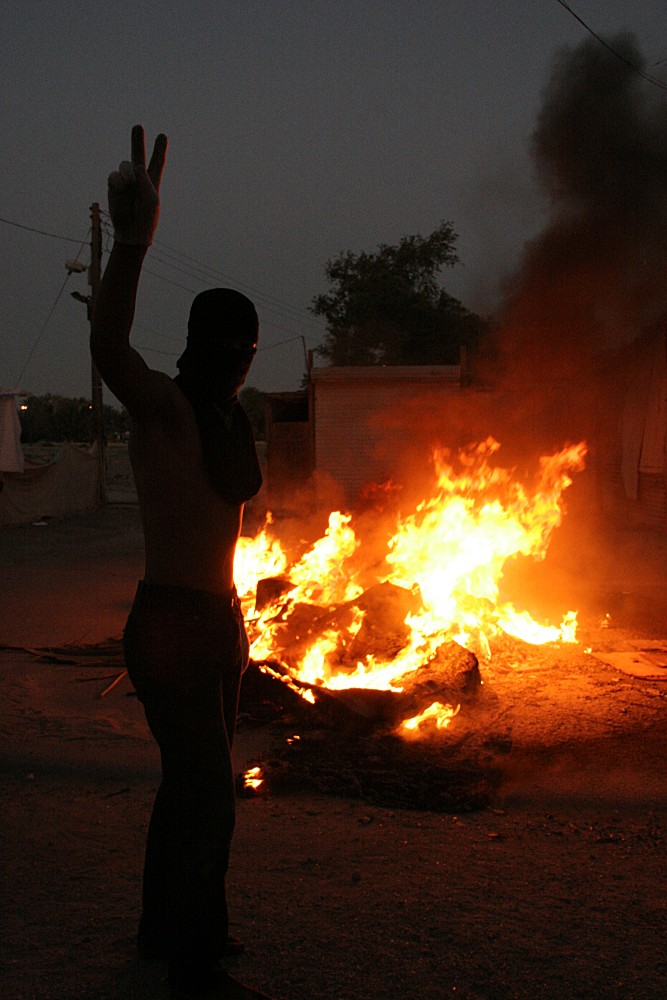
The Arab revolution knows no frontiers<http://www.marxist.com/arab-revolution-knows-no-frontiers.htm> Written by Fred Weston Friday, 18 February 2011 [image: Print]<http://www.marxist.com/arab-revolution-knows-no-frontiers/print.htm#> After the Tunisian people overthrew Ben Ali we were told by so-called expert analysts that the revolution would not spread to Egypt. After it did just that these experts werent so sure any more about what could happen next. Already there had been powerful movements in Jordan and the Yemen, as well as big protests in Algeria and other countries. Now Libya and Bahrain are joining the queue, as is Iraq, while the Yemen is flaring up again. Libya burning <http://www.marxist.com/images/stories/middleeast/youth_with_fire-Sara_Hassan.jpg> [image: Young protester in Bahrain. Photo: Sara Hassan/ Al Jazeera] Official reports coming in from Libya indicate that more than twenty anti-government protesters were killed in Thursday, February 17 anti-Gaddafi Day of Rage. Protests broke out in four cities across the country, as Libya feels the knock-on effects of the overthrow of the dictators in neighbouring Egypt and Tunisia. Thousands were out on the streets of Benghazi. This indicates that Libya, which until recently seemed to have escaped the wind of revolution sweeping across from Tunisia and Egypt, is now also being affected. In an attempt to stave off protests the Libyan government had announced it would double the salaries of government workers. It also released a sizeable number of Islamic militants from prison. Similar tactics have been adopted by several of the other despotic regimes in the region. To counter the anti-Gaddafi protests, the regime also mobilized forces similar to what we saw in Egypt when pro-Mubarak thugs were sent into Tahrir Square. At least four protesters were killed by Internal Security Forces in al-Beyda, but other sources say the figure could be eleven. There were also mass protests in Benghazi, Libya's second-largest city. Two others were killed in Zentana, and another in Rijban. In Zentana the protesters chanted anti-Gaddafi slogans and carried a banner that read "Down with Gaddafi - Down with the regime." Videos available on the Internet show a building on fire in al-Beyda and young Libyans chanting: "The people want to bring down the regime," the same revolutionary slogan of the masses in Tunisia and Egypt. Reports from people on the ground indicate that the situation has gone much further than this. In al-Beyda for instance it seems protesters have bulldozed the airport runways to stop the regime sending in further mercenary forces and at the same time captured prisoners have been freed. In Ajdabia the police seem to have sided with the protesters to fight government mercenaries and the government has reacted by shutting down electricity supplies and access to the internet has been blocked. The town is now surrounded by the military. Benghazi is also surrounded by the military. In some areas it also seems that the police and security forces are showing sympathy for the protesters. The number of protesters in Benghazi today is estimated at being around 100,000. Gaddafi is under extreme pressure now and is fighting back like an enraged wild animal. He is is quoted by the BBC as saying, "The puppets of the USA, the puppets of Zionism are falling." He is still claiming to be a revolutionary, trying to revive the aura of anti-imperialism that he had about him in the past. However, this ignores the fact that Libya eventually made a deal with imperialism, abandoning its nuclear arms programme, in exchange for western investment. In the past Libya suffered UN sanctions but these were lifted in September 2003. This was followed by the United States beginning to remove all their unilateral sanctions the following year. And finally all sanctions were removed by June 2006. This opened up Libya to greater foreign direct investment, especially in the energy sector. Part of the deal involved a commitment on the part of the Libyan government to begin dismantling much of the old state-controlled economy. The country also applied for WTO membership, which involved reducing subsidies on some basic foodstuffs and plans for privatization. This has led to the economy being opened up to the whims of the world market, thus increasing social polarisation. This process actually began back in 1993 and 1994 when the Libyan government announced measures that would allow for liberalization of the wholesale trade and legal guarantees for foreign investment, as well as the convertibility of the Libyan Dinar. The legal framework for privatization was quite far-reaching but in practice during the nineties the process was very slow. But in in 2003, as part of the deal reached with the imperialist powers, the process accelerated with legislation being introduced by the Libyan government that prepared the privatization of 360 state owned companies. According to an April 2009 report in The Telegraph, Libya's National Information Board estimates that prices in the third quarter of 2008 increased by 9.8 percent compared to the same period in 2007. Post's informal market basket survey showed significantly greater increases in the price of foodstuffs than the GOL's official figures, particularly for previously subsidized goods such as sugar, rice, and flour, which have increased by 85 percent in the past two years. Overall inflation for 2007 was 6.3 percent, and 12 percent for 2008. ( ) Concern that a radical program of privatization and government restructuring proposed by Muammar al-Qadhafi earlier this year could be at least partly implemented have prompted fears that the quality of life for ordinary Libyans may erode further still as the GOL wrestles to implement economic reforms. [Source: *The Telegraph<http://www.telegraph.co.uk/news/wikileaks-files/libya-wikileaks/8294902/INFLATION-ON-THE-RISE-IN-LIBYA.html> *] The same report quoted Libya's National Information Board figures that indicated that the third quarter prices in 2008 rose by 9.8 percent compared to the third quarter of 2007 and that foodstuffs, beverages and tobacco saw the largest increases. Housing costs increased by 6.1 percent, clothing and shoes by 4.9 percent in the same period, while official government figures indicated that inflation for 2007 was 6.3 percent and in 2008 12 percent. But even these figures hide reality as unsubsidised goods increased by about 25 percent in 2008: the price of previously subsidized goods such as sugar, rice, and flour increased by 85 percent in the two years since subsidies were lifted. This is the direction that Libya has taken in recent years, and the result of privatisation and cuts in subsidies is that the country has gone through a process of growing social polarisation and inequality. Latest available figures indicate that unemployment stands at 30%. High revenues from the oil and gas exports coupled with the fact that Libya has a small population means that the country has one of the highest per capita GDPs in Africa. The problem is similarly to all the other Arab countries that this is not equally shared out, with little of it reaching the lower layers of society. The policies that Gaddafi has adopted in the past decade or more are policies imposed by the World Bank, the IMF, the European Union and the United States. They are the same policies that were adopted by Ben Ali in Tunisia and Mubarak in Egypt. And now they are producing the same social consequences and with this come political consequences with the masses beginning to enter the scene. Bahrain cannot escape wave of revolution Thousands of protesters, encouraged by the successful mass mobilisation in Egypt and Tunisia, have been on the streets of Bahrain this week demanding democracy and an end to the rule of the monarchy. Initially the protesters were calling on the Sunni monarchy to adopt more liberal policies and also grant more rights for the country's majority Shiite population. But as the movement grew in strength after it started on Monday of this week the demands of the protesters have become bolder, calling for jobs, better housing conditions and freedom for all political prisoners. On Monday clashes with security forces had already provoked two deaths. After that it seemed the government had taken on board at least one lesson from the experience of Egypt, i.e. that repressive measures do not work against the masses once they have risen decisively. Fearing an escalation of the movement the government held back the police on Wednesday as tens of thousands of demonstrators marched into Pearl Square Protesters had thus been hoping to turn Pearl Square into Bahrain's equivalent of Tahrir Square in Cairo and set up a camp as a focus of more widespread protests. However, at this point, fearing a repeat of the events in Egypt the government again changed tactics and sent in more than 50 armoured cars to clear the square and this has left at least three people dead and 231 wounded while a further 60 have gone missing. The army took over key points of the capital Manama on Thursday after three days of protest. If the government thought that by stepping up repression one only has to look at the scenes unfolding as the thousands who have turned out for the funerals of two of those killed shouting slogans such as down with the government together with calls for those responsible for the killings to be punished with the slogan, "Trial, trial for the criminal gang," Some have gone beyond the initial demands and are even calling for the removal of the royal family. What aggravates the situation even further is the fact that while the Royal Family are Sunni Muslims, the majority of the population is made up of Shias, whose lifestyle is far less affluent than that of the Sunni elite. This in the past has led to clashes between the two communities. Formally speaking, Bahrain is a democracy, with a constitutional monarchy that was established back in 2001. In 2002 a 40-member parliament was elected in the first elections for 30 years. However, the monarch maintained supreme authority and his family members occupy key posts in politics and the military apparatus. The Khalifah family has in fact ruled the country since 1783, although for years it was under a British protectorate status. According to the World Bank, in gross national product per head was estimated to be $40,400 in 2010, far higher than most countries in the region. The country is a centre for banking and financial services centre and has what is considered to be a reasonably prosperous economy. It has the structure of an advanced economy with only 0.5% of its GDP coming from agriculture, while industry provides 56.6% and services 42.9%. And according to the BBC, The country has enjoyed increasing freedom of expression, and monitors say the human rights situation has improved. So one would imagine that Bahrain would have been one of the last of the Arab countries to be affected by the spreading wave of revolution. But there is another side to this picture. For example, official youth unemployment presently stands at 19.6%. If one consider that the average age of the population is 30.4 years, and 56% are below the age of 25, once can see how the issue of youth unemployment is a key one. The unemployment rate amongst Bahraini youth between the ages 15 and 24 years old is as follows: Males 55.90%; Females 51.20% and the overall total standing at 54.10% (Source<http://www.naseej-cyd.org/files/Bahrain_Profile_en.pdf>, pdf). While this is the case for most young people, the country is treated as a playground for the rulers of neighbouring countries such as Saudi Arabia, who while they impose strict Islamic laws on their own people have no qualms about enjoying the more western style entertainment available in Bahrain. The social contradictions, in what is formally a wealthy country, are at the root of the present protests. But it is not merely a question of social and economic problems. It is also one of a people that has suffered under an authoritarian government, albeit one with a constitutional monarchy, that yearns for freedom. The events in Egypt have shown the people of Bahrain that even the most oppressive of dictatorships can be overthrown. And now, as in Egypt, western governments have suddenly discovered the need for restraint and for the government of Bahrain to listen to the concerns of the protestors. Obama is singing this song as is Cameron in Britain. They must be very concerned indeed. Bahrain hosts the US Navy's Fifth Fleet and is right next to Saudi Arabia another key ally of the United States in the region. The hypocrisy of western governments stinks to high heaven. For years they have done good business with the rulers of Bahrain. They UK even provides them with the weapons, including the tear gas that is being used on the protesters today. Now they will have to face the consequences in the form of the revolt of the working people of Bahrain. Yemen flaring up again Yemen has been on the boil for some weeks now. On February 3 more than 20,000 people protested on the streets of Sanaa, calling on President Ali Abdullah Saleh to go. The Presidnet had only just announced that he would no longer be standing in 2013. By making that announcement he was hoping to appease the masses. And similarly to other Arab despots who face overthrow, he had announced wage increases and tax cuts and other economic concessions. We explained then that, These are all clearly manoeuvres to try and avert the protest movement from growing and becoming like that in Tunisia and Egypt. But the protesters have indicated that this is not enough. The latest news from the Yemen confirms what we wrote. Yesterday over a thousand protesters clashed with pro-government elements on what was the seventh straight day of protests. In scenes reminiscent of what we saw in Tahrir Square on February 2, pro-government thugs armed with daggers and batons fought anti-government protesters. The police fired warning shots into the air, but then withdrew from the streets allowing the thugs to attack the anti-government protesters. other. As a result dozens were wounded and one protester was killed in Aden on Wednesday. Sanaa, the capital, also has its Tahrir Square and the government has organised its thug elements to occupy the square to stop it being used as a rallying point for anti-government protesters. But in Taiz, south of Sanaa, anti-government protesters occupied the main square some days ago. Those participating have grown with several thousands joining the action. Apparently, according to Al Arabiya, Recent protests have been smaller than in preceding weeks, when tens of thousands of demonstrators took to the streets. But they are erupting more spontaneously and violently, and have become more strident in calling for Saleh's resignation. Encouraged by events in Egypt the masses in Yemen are keeping up the pressure and no amount of manoeuvring by the regime is going to calm this situation down. In fact the actions of the President are merely serving to enrage further the youth. However long it may take, it is clear the President will have to go at some point. Meanwhile in Egypt and Iraq Meanwhile in Egypt we have today's massive victory march" through Cairo's Tahrir Square to celebrate the overthrow of Mubarak a week ago. Some reports say that the number of demonstrators is the largest ever. This is not just a celebration, there is a strong feeling that the revolution has only achieved one of its aims, but that there is still a lot to accomplish. The coalition of youth groups which played a key role in the revolutionary movement has announced a list of demands including the dismissal of the Cabinet, the convening of a Constituent Assembly amongst others. As we indicated in an earlier article, Egyptian army manoeuvres in attempt to cut across worker protests, <http://www.marxist.com/egyptian-army-manoeuvres-against-worker-protests.htm>the Egyptian elite are struggling to win back control of the situation with all kinds of manoeuvres. But the masses are alert and their revolution has only just begun. The fall of Mubarak was only the first act of this great revolution. In a number of neighbourhoods in Cairo and in other cities and industrial centres we have seen the setting up of Committees for the Defence of the Revolution. Now a new period opens up as the workers and youth of Egypt attempt to impose their demands on the new regime. As the Egyptian masses move ahead, they will be encouraged by what is happening all around them in the other Arab countries. Even Iraq is now being affected as mass protest have erupted across the country, particularly in the Kurdish areas of the country where violent protests have broken out as the anger of the youth has reached boiling point. Ten people are reported to have been killed by KPD and police forces during protests in Sulaymaniya. Violent protests have taken place at various locations in Iraq, with anti-government protesters taking out rallies against corruption, poor basic services and high unemployment. In Basra, the country's second largest city in the south, around a thousand people rallied today, demanding jobs and improved pensions. (We will publish a separate article on the events in Iraq). If any of the bourgeois analysts thought that worst was over with the end of Mubarak they are in for very big shocks in the coming period. Their idea was that by removing Mubarak they could start the process of getting things under control. Instead what we have is the revolution spreading from country to country. As we explained in previous articles, similar conditions lead to similar results. *Across the Arab world for the past thirty years or so the imperialists have imposed policies aimed at dismantling much of the old state-owned sector of the economy, together with cuts in subsidies of basic goods. For decades everything seemed to be going according to plan as foreign investment grew and big profits were to be made. But all this was eating away the very foundations upon which the old stability was based. By destroying much of the old welfare measures, the conditions of the masses gradually worsened over the years. Quantity has reached a point where a qualitative change has taken place in the form of revolution. And we are only at the very early stages. Greater events are on the way.* [Non-text portions of this message have been removed] ------------------------------------ --------------------------------------------------------------------------- LAAMN: Los Angeles Alternative Media Network --------------------------------------------------------------------------- Unsubscribe: <mailto:[email protected]> --------------------------------------------------------------------------- Subscribe: <mailto:[email protected]> --------------------------------------------------------------------------- Digest: <mailto:[email protected]> --------------------------------------------------------------------------- Help: <mailto:[email protected]?subject=laamn> --------------------------------------------------------------------------- Post: <mailto:[email protected]> --------------------------------------------------------------------------- Archive1: <http://www.egroups.com/messages/laamn> --------------------------------------------------------------------------- Archive2: <http://www.mail-archive.com/[email protected]> --------------------------------------------------------------------------- Yahoo! Groups Links <*> To visit your group on the web, go to: http://groups.yahoo.com/group/laamn/ <*> Your email settings: Individual Email | Traditional <*> To change settings online go to: http://groups.yahoo.com/group/laamn/join (Yahoo! ID required) <*> To change settings via email: [email protected] [email protected] <*> To unsubscribe from this group, send an email to: [email protected] <*> Your use of Yahoo! Groups is subject to: http://docs.yahoo.com/info/terms/