http://www.marxist.com/perspectives-socialist-revolution-iran-1.htm
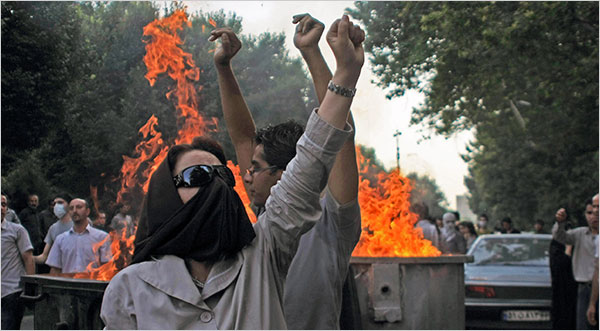
Perspectives for socialist revolution in Iran Part One: Crisis of world capitalism<http://www.marxist.com/perspectives-socialist-revolution-iran-1.htm> Written by Mobarezeye Tabagathi Thursday, 07 April 2011 [image: Print]<http://www.marxist.com/perspectives-socialist-revolution-iran-1/print.htm#> *Today we start the publication of a three part document on the perspectives for the Iranian revolution. In this first part we look at the general world economic situation and how this relates to the crisis facing the Iranian economy.* Introduction [image: 18tir88_4]<http://www.marxist.com/images/stories/iran/18tir88_4.jpg>For years many leftist intellectuals and even some so-called Marxists had written off, in words or in deeds, any chance of a genuine revolutionary movement in Iran and the Middle East. For them the hegemony of Islamic fundamentalism overshadowed everything else. In adopting this stance they not only revealed their utter lack of confidence in and contempt for the masses who they considered as mere pawns in the hands of this or that faction but also showed their complete lack of understanding of the laws governing society and the movement of the masses. The answer to these people was given, not by the Marxists, but by the masses of Iran who in the summer of 2009 started to take their destiny into their own hands. What we witnessed after the elections was the beginning of a revolution, i.e. an open struggle that can only lead to the settling of the question of power in the most raw and irreconcilable form. The thrust of the masses has upset all the balances within the ruling elite, as they begin to play an active role in the sphere of power, that is, politics. Just as the act of workers organizing to halt production is called industrial action, the process of a living struggle for power between the different social classes is called a revolution. And just as a union leader would be making a big mistake in not recognizing a strike when one takes place, a revolutionary would be betraying the revolution if he denies its very inception. A revolution if anything is signified by the normal workings of society being put aside by the internal laws and logics of the revolution. If one does not recognize this it is impossible to develop a correct orientation in the seemingly chaotic social storm that revolution brings with it. At present there has not been a decisive defeat of the mass movement in Iran and there is no social grouping, faction, layer or class that is capable of, or that will shortly become capable of, taking and consolidating power. On the contrary the stage is set for a sharpening of the situation and thus for a more bitter and desperate class struggle. Within the youth there is an incredible thirst for ideas and especially the ideas of communism. The material base for the granting of genuine reforms within the framework of capitalism no longer exists. At the same time there is no consolidated rotten trade union or social democratic bureaucracy acting as a deadweight such as the ones we see in the western countries. The scene is therefore set for huge steps forward for the communists. We can state with complete conviction that in the next period, precisely because we are in a revolutionary period, there will be not one but many opportunities for the communists to reach the masses. But this does not mean that we can afford to lose time or that it will happen by itself. The ideas of Marxism are the only ones that can explain the situation and show a way out of the impasse of capitalism. But if the Marxists are only a scattered minority, as they are now, they cannot play any significant role. The task must be to reach a critical mass in order to allow us to intervene in the revolution and thus win the leadership of the masses who, pushed by the hammer blows of events, will rapidly move towards our ideas. We can and will fill the vacuum that is opening up in front of us and lead the masses of Iran towards victory. It is therefore the most urgent task of all revolutionaries to study and discuss the political situation - not for the sake of discussion, but in order to intervene, build and organize the forces of Marxism. This is the main purpose of the document below. Perspectives are not prophecies about the future, as if one had a crystal ball. Our main aim with the present document is to analyze the fundamental processes that are taking place below the surface of Iranian society *as a guide for action*. Also a word of warning when it comes to dealing with facts, figures and statistics when dealing with Iran: they are not always completely reliable due to the nature of the regime and the way it easily manipulates these to serve different interests. Therefore one must also base oneself on the logic of the overall process as a whole to confirm the validity or not of the facts and figures we have sifted through in the maze of contradictory information. [Note: In this document when dates of western sources and quotes are given they are in the Gregorian, or Western, Calendar. At times the Iranian calendar is used, wher the new year usually begins within a day of 21 March and the years are numbered starting from the year of the Hegira of Muhammad from Mecca to Medina in 622 AD. Thus to convert Iranian years into Western one has to either add 621 or 622, depending on the time of the year.] Crisis of world capitalism The beginning of the world economic crisis has marked a new period in the whole history of capitalism. More than any other this period is one of complete impasse and dead end of capitalism. In every single country the capitalist classes are forced to engage in fierce attacks on the working class and the poor masses in order to preserve their profits. The masses on the other side will only have one way out class struggle. Through the development of industry and the formation of the nation state, capitalism developed and centralized the productive forces to incredible levels. This in turn opened the road for an unparalleled development of science and culture creating for the first time in human history the potential to eradicate such things as hunger and curable diseases. Ironically it is exactly the high level of development that places the biggest obstacles in front of capitalism. Production has become completely social, but the means of production are private and centralized in the hands of a small minority. Their interest is not to develop society, but in competition with one another, to obtain profit. Marx explained: ...Modern bourgeois society, with its relations of production, of exchange and of property, a society that has conjured up such gigantic means of production and of exchange, is like the sorcerer who is no longer able to control the powers of the nether world whom he has called up by his spells. For many a decade past the history of industry and commerce is but the history of the revolt of modern productive forces against modern conditions of production, against the property relations that are the conditions for the existence of the bourgeois and of its rule. It is enough to mention the commercial crises that by their periodical return put the existence of the entire bourgeois society on its trial, each time more threateningly. In these crises, a great part not only of the existing products, but also of the previously created productive forces, are periodically destroyed. In these crises, there breaks out an epidemic that, in all earlier epochs, would have seemed an absurdity the epidemic of over-production. Society suddenly finds itself put back into a state of momentary barbarism; it appears as if a famine, a universal war of devastation, had cut off the supply of every means of subsistence; industry and commerce seem to be destroyed; and why? Because there is too much civilisation, too much means of subsistence, too much industry, too much commerce. The productive forces at the disposal of society no longer tend to further the development of the conditions of bourgeois property; on the contrary, they have become too powerful for these conditions, by which they are fettered, and so soon as they overcome these fetters, they bring disorder into the whole of bourgeois society, endanger the existence of bourgeois property. The conditions of bourgeois society are too narrow to comprise the wealth created by them. And how does the bourgeoisie get over these crises? On the one hand by enforced destruction of a mass of productive forces; on the other, by the conquest of new markets, and by the more thorough exploitation of the old ones. That is to say, by paving the way for more extensive and more destructive crises, and by diminishing the means whereby crises are prevented. The weapons with which the bourgeoisie felled feudalism to the ground are now turned against the bourgeoisie itself. But not only has the bourgeoisie forged the weapons that bring death to itself; it has also called into existence the men who are to wield those weapons the modern working class the proletarians. (Karl Marx and Frederick Engels, The Communist Manifesto, 1848) The lines quoted above and in fact all of Marx and Engels writings are today more relevant than ever and should be studied meticulously in order to understand the workings of capitalism that fundamentally have not changed since they were written. The state of world capitalism The collapse of the Soviet Union and the fall of the Berlin Wall because it did not lead to the working class taking control of the economy, but on the contrary led to the restoration of capitalism was a big setback for the working class. The strategists of capital did not hesitate to proclaim the final victory of capitalism. The US philosopher Francis Fukuyama even went as far as to proclaim *the end of history*. At the same time, a prolonged period of general capitalist boom started to take shape that would further support the apparent legitimacy of capitalism. This boom was especially prolonged by the entrance of China, Russia and the further integration of India into the world market and through this the enormous expansion of world trade and further deepening of the world division of labour. At the same time by the end of the 1990s a hitherto unseen expansion of credit, based especially on the housing market, helped postpone a looming crisis by expanding the markets far beyond their natural limits. The above factors helped capitalism prolong its period of boom for more than a decade. However, contrary to the wishes and illusions of the capitalists the main contradictions of capitalism were not solved. On the contrary, the basic laws of capitalism, that Marx outlined many years ago, have not changed at all. The expansion of credit *did* allow the capitalists to expand the boundaries of the marked temporarily! But credit is debt, and debt, as we all know, must be paid back at some point. This general expansion and integration of the world market *did* allow for *some* development of capitalism, but only at the cost of preparing a deeper and more synchronized crisis on a world scale. The main characteristics of the capitalist system are that it is a class-divided society based on a market economy. The workers, who own nothing but their labour power, are forced to sell this to the capitalist who owns the means of production. However, in return for this generosity the worker is only paid what is needed to sustain his own existence and propagation. The capitalist in turn receives the rest of the unpaid value that the worker has created through social labour. Thus, *in the final analysis*, the workers are not able to buy back all the commodities they themselves produce. To reduce the cause of the present crisis to a financial crisis or a crisis caused by greed and failed legislations in this or that country is pure impressionism that cannot explain anything. Marxism is the only method that can and does look at the underlying reasons for the crisis. Ted Grant also explained: The fundamental cause of crisis in capitalist society, a *phenomenon peculiar to capitalist society alone, *lies in the *inevitable over-production *of both consumer and capital goods for the purposes of capitalist production. There can be all sorts of secondary causes of crisis, particularly in a period of capitalist development - partial over-production in only some industries; financial juggling on the stock exchange; inflationary swindles; disproportions in production; and a whole host of others - but the fundamental cause of crisis lies in *over-production. *This in turn, is caused by the *market economy, *and the division of society into mutually conflicting classes. (*Will There Be A Slump?<http://www.marxists.org/archive/grant/1960/slump.htm> *, Ted Grant, 1960) These are the true causes behind the present crisis that some have dubbed a financial crisis. What has to be understood is that the crisis is a deep and organic crisis of the world system of capitalism. It is not due to the subjective greed of individuals or countries. We also have to understand that a crisis under capitalism serves the purpose of dealing with its inner contradictions *by destroying immense amounts of overproduced commodities and capital*. However, in the present situation nothing has been solved. The main factors leading to the crisis are still valid and even inflated in some areas. As Rob Sewell writes: With all the excess capacity throughout the world economy, the capitalists are investing their money in anything but production. This again shows the limits of capitalism where the productive forces have outgrown the nation state and private ownership of the means of production. The world is awash with surplus liquidity money capital searching for profitable investment. Why invest in industries already saturated with overproduction, when you can speculate in currencies and make billions? This financialisation by capitalism, a reflection of its impasse, builds crisis and instability into its very foundations, as we are now seeing. Colossal amounts of fictitious capital (paper wealth not backed by real values) are sloshing around the world economy like loose cargo on the deck of a ship, knocking holes in the sides at every turn. Such unsound investments, as during the credit crunch, threaten to bring down the financial house of cards. ( ) To put things in perspective, in 2007 world GDP was around $65 trillion. The total value of companies quoted on the worlds stock markets was $63 trillion. But the total value of derivatives was $596 trillion 8 times the real economy. The total currency traded was $1,168 trillion or 17 times world GDP. The bulk of this is clearly fictitious capital as it is not backed by real collateral. This whole insane structure has completely lost sight of the fact that without real production there is no value. They are the phantom of imagination, to use Marxs expression. (Currency wars: what's next? <http://www.marxist.com/currency-wars-whats-next.htm>, Rob Sewell, 27 October, 2010) Have these inflated markets been reduced since 2007? No! On the contrary, the derivatives market today is valued at $1.2 quadrillion. Thats $1.200.000.000.000.000 or 20 times as much as the world economy in total. All this is sustained by creating massive state deficits by borrowing and printing of money. In the US the gross national debt has risen from about $9 trillion to $13.4 trillion from 2007 until September 2010. The pumping of money into the system by quantitative easing (printing of money) may seem like a good way of keeping up demand to a certain degree. It may even have contributed to avoiding a steep fall in the stock markets, but the question that has to be asked is: for how long can this be kept up and at what cost? By printing trillions of dollars and running a massive state deficit the bourgeoisie is not solving anything. It is merely creating the basis of a mix of the worst situation high inflation and an enormous debt burden that the working class will have to pay in the future. In *Will there be a slump?* Ted Grant explained: Why cannot expenditure by the capitalist state solve the problems of the economy in a capitalist society? In an economy where private ownership is the dominant form of production, production remains for the market. All taxes must come from the economy itself, either they must come from the profits of the capitalists, or they must cut into the income of the working class. In either case it cannot over a period prevent crisis. To cut into the income of the capitalist would cut into the rate of profit; money spent by the state, taken from the pockets of the capitalists, cannot be spent by the capitalists. Similarly, money extracted from the workers in taxes for the benefit of the capitalists and their state, cuts into the market for consumer goods. Thus, either way, the state eats into the vitals of the economy. The state in the modern period has become a monstrous incubus and parasitic burden on production. What the state gains on the swings, the capitalists lose on the roundabouts. The worst thing from a capitalist point of view is for the state to cut into the profits of the capitalists. For that aggravates the crisis while 80 per cent of the economy remains in the hands of private 'enterprise'. That is why as speedily as possible the capitalists get their state to lessen the taxes on profits and especially the allowances for new investments. The Tory government (and the Labour government after them) systematically lessened the taxes in this way. On the other hand the various Keynesian 'solutions' of this problem are basically unsound. If the state, by 'deficit financing', as advocated by Gaitskell, spends in effect money it does not possess, it means that there will be an inflation of the currency, and over a period it would amount to the above propositions on the distribution of the national income. The only difference being that crisis would be aggravated by the ruin of the currency. The reason for this would be the inevitable rise of prices, other things being equal, to the same proportion as the increase of the money in circulation not backed by goods or money. (ibid) At the same time we see today an increasing movement towards protectionism, which is nothing but an attempt to export unemployment. Again, in *Currency wars: what's next? <http://www.marxist.com/currency-wars-whats-next.htm>** *Rob Sewell explains: In particular, hostility between Washington and Beijing has escalated into something resembling trench warfare. If not an actual war, then they are without doubt on the brink of an out-and-out currency war. Salvos have been launched. The US imperialists have accused the Chinese of currency manipulation because they are refusing to increase the value of the renminbi (which would make their exports dearer). The Chinese, in turn, have attacked the Americans for having a super-loose monetary policy which has resulted in the destabilising of the flow of capital. The Japanese, struggling with a declining economy, have intervened with a fusillade to hold down the value of the yen and boost their exports. The Brazilians are using guerrilla tactics to stop the real from rising, after complaining that Beijings currency was hurting their exports. But they dare not squeal too loudly as China is their largest customer. The South Africans are taking unilateral action to protect their markets. Meanwhile, India and Thailand have threatened to bring heavy ordnance into play. In the 1930s the recession was turned into a decade long depression precisely because of increasing protectionism and thus a freezing of world trade. The strategists of capital know this, but can do very little about it. The reason for this is exactly that capitalism is an anarchic system that cannot be controlled. A period of revolutions and counter-revolutions As we can see, the main factors that contributed to the development of capitalism the nation state and private ownership of the means of production are now turning into their opposites. The fact that under capitalism production is social (meaning it draws in the whole of society), while the ownership of the means of the production is private (producing only for the sake of profit for the few), means that it has become an absolute fetter for the development of society. According to the World Bank, in 2005, more than 80 percent of humanity lived on less than $10 a day and about 40 percent lived on less than $2 a day. About 925 million people do not have enough to eat. 10.9 million children under five die in developing countries each year. Malnutrition and hunger-related diseases cause 60 percent of the deaths. It is estimated that 684,000 child deaths alone could be prevented by increasing access to vitamin A and zinc. Malnutrition contributes to 53 percent of the 9.7 million deaths of children under five each year in developing countries. In the United States the income gap between the richest and poorest grew in 2009 to its largest margin ever. The top-earning 20 percent of Americans those making more than $100,000 a year received 49.4 percent of all income generated in the US, compared with the 3.4 percent made by the bottom 20 percent of earners, those who fell below the poverty line, according to the new figures. That ratio of 14.5 to 1 was an increase from 13.6 in 2008 and nearly double a low of 7.69 in 1968. According to the USDA, 14% of US households experienced food insecurity during 2008, an increase from 11% the year before. 49.1 million people lived in food-insecure households. According to an ILO report, 212 million workers were unemployed in 2009 or 6.6 per cent of the global workforce. That is the highest level ever recorded. The report also stated that some 633 million workers and their families were living on less than $1.25 per day in 2008, with as many as 215 million additional workers at risk of falling into poverty. At the same time industrial capacity utilization remains around 75 percent in most countries. This means that although the need for production, the capacity for production and the workforce that is to perform production all exist, productions is not set in motion because it is not profitable for the owners of the means of production. Marx and Engels put it thus: Hitherto, every form of society has been based, as we have already seen, on the antagonism of oppressing and oppressed classes. But in order to oppress a class, certain conditions must be assured to it under which it can, at least, continue its slavish existence. The serf, in the period of serfdom, raised himself to membership in the commune, just as the petty bourgeois, under the yoke of the feudal absolutism, managed to develop into a bourgeois. The modern labourer, on the contrary, instead of rising with the process of industry, sinks deeper and deeper below the conditions of existence of his own class. He becomes a pauper, and pauperism develops more rapidly than population and wealth. And here it becomes evident, that the bourgeoisie is unfit any longer to be the ruling class in society, and to impose its conditions of existence upon society as an over-riding law. It is unfit to rule because it is incompetent to assure an existence to its slave within his slavery, because it cannot help letting him sink into such a state, that it has to feed him, instead of being fed by him. Society can no longer live under this bourgeoisie, in other words, its existence is no longer compatible with society. (Communist Manifesto) In spite of the tight control that the bourgeoisie has over the mass media, the education system, the religious institutions, the political propaganda apparatus and many other powerful levers that they utilize to control public opinion, they will not be able to stop the movement of the masses against the system, because in the final analysis material conditions are decisive. This fact has become increasingly clear during the last few years, and particularly in the recent months. In contrast to the 1990s when mass revolutionary movements were not so common and when many so-called leaders of the workers movement fell into pessimism, praising the hegemony of liberalism, the last decade has seen one revolutionary movement after another, and the numbers are still rising. Most importantly we have had the Venezuelan revolution, where for the first time since the fall of the Soviet Union, President Hugo Chavez has put the idea of socialism on the agenda as an alternative to capitalism. Under huge pressure from the masses Chavez has moved far more to the left than he initially had in mind when he stood as presidential candidate more than 10 years ago. The revolution has been a massive focal point for millions of workers and youth, but at the same time it is now at a crossroad. The bourgeoisie still controls the main levers of the economy and is using this to sabotage the revolution, for instance by provoking food scarcity. To succeed the revolution must make a decisive break with the capitalist system by nationalizing the main levers of the economy under workers control. The masses can sense this and are tired of speeches and good intentions; they want action. There is no middle road between capitalism and socialism and if the revolution does not break decisively with the capitalist system it eventually leads to demoralization and thereby to the strengthening of the counterrevolution that will not hesitate in clamping down. Apart from the Venezuelan revolution there have also been many other revolutionary movements in the last few years. From Bolivia, Honduras, El Salvador, Mexico to Kyrgyzstan, Thailand and even in Greece and Iceland there have been massive movements marking the advent of a new period in the history of capitalism. And in the recent period we have seen the marvellous revolutionary movement of the Arab masses. Although these movements are still in their initial phases they mark the advent of a new period of revolutions and counterrevolutions a period where the question of socialism will be put on the agenda in one country after another. *[To be continued...]* [Non-text portions of this message have been removed] ------------------------------------ --------------------------------------------------------------------------- LAAMN: Los Angeles Alternative Media Network --------------------------------------------------------------------------- Unsubscribe: <mailto:[email protected]> --------------------------------------------------------------------------- Subscribe: <mailto:[email protected]> --------------------------------------------------------------------------- Digest: <mailto:[email protected]> --------------------------------------------------------------------------- Help: <mailto:[email protected]?subject=laamn> --------------------------------------------------------------------------- Post: <mailto:[email protected]> --------------------------------------------------------------------------- Archive1: <http://www.egroups.com/messages/laamn> --------------------------------------------------------------------------- Archive2: <http://www.mail-archive.com/[email protected]> --------------------------------------------------------------------------- Yahoo! Groups Links <*> To visit your group on the web, go to: http://groups.yahoo.com/group/laamn/ <*> Your email settings: Individual Email | Traditional <*> To change settings online go to: http://groups.yahoo.com/group/laamn/join (Yahoo! ID required) <*> To change settings via email: [email protected] [email protected] <*> To unsubscribe from this group, send an email to: [email protected] <*> Your use of Yahoo! Groups is subject to: http://docs.yahoo.com/info/terms/