http://www.marxist.com/different-travel-report-from-morocco.htm
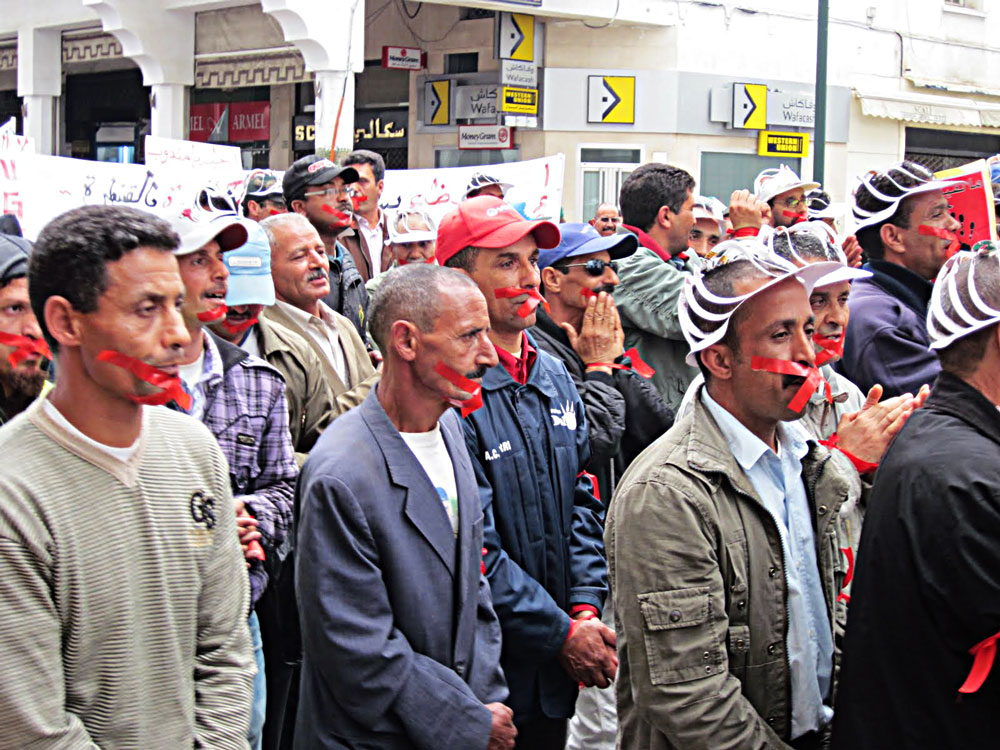
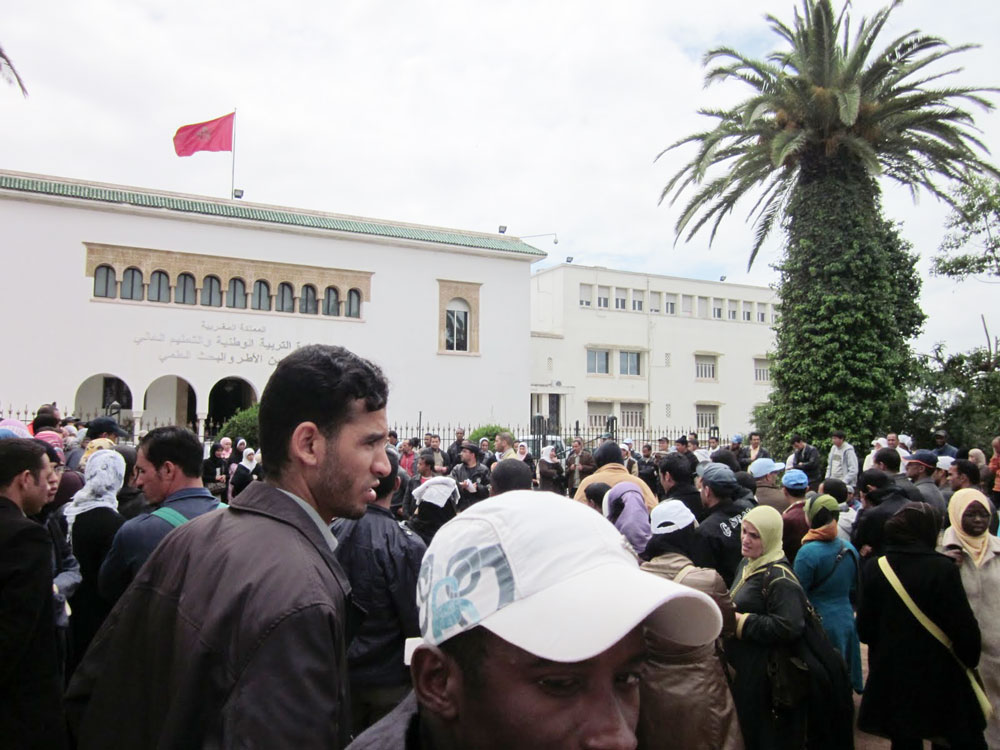
A Somewhat Different Travel Report from Morocco<http://www.marxist.com/different-travel-report-from-morocco.htm> Written by Tom Dietrich Monday, 27 June 2011 [image: Print]<http://www.marxist.com/different-travel-report-from-morocco/print.htm>[image: E-mail]<http://www.marxist.com/component/option,com_mailto/link,02c5bba41773089b18004dbc1bdda4df4e5765b4/tmpl,component/> Share15<http://www.facebook.com/sharer.php?u=http%3A%2F%2Fwww.marxist.com%2Fdifferent-travel-report-from-morocco.htm&t=A%20Somewhat%20Different%20Travel%20Report%20from%20Morocco%20%7C%20In%20Defence%20of%20Marxism&src=sp> We provide an eyewitness account by a recent German visitor to Morocco, who provides a taste of the mood that prevails in the country, describing some of the many protests that are taking place and the manoeuvres of the regime to avert an outright revolution. All to no avail of course! [image: 1 May]<http://www.marxist.com/images/stories/morocco/May_1-Tom_D.jpg>1 MayRecently I attended a conference in Marrakesh, and subsequently stayed for a few days longer with a friend in the capital Rabat. During my stay I witnessed a society full off inner tensions, a society that is split along class lines from top to bottom. These tensions are simply waiting to erupt. Amongst the youth, there is a revolutionary movement aiming for complete freedom. This youth movement has started to infect more and more ordinary workers, who are coming to the same conclusions. They are fighting for higher wages, they want an improvement in their everyday lives, and eventually they will also end up with demanding freedom for all. Morocco has started to change. A change that is affecting everyone who lives in the country whether one is with the revolution or not. Seeing the current turbulence affecting the shaky Moroccan monarchy was an eye opening experience. Therefore, what I write here is not impartial but clearly sides with the struggling Moroccan masses. I was also very moved by what I witnessed. And I hope that my experience there will enrich the readers understanding of the processes that are currently taking place in the Maghreb. Marrakesh The first days of my stay in Marrakesh were quiet. I was put up in a nice hotel, listening to interesting talks at the conference, and relaxing in the touristic atmosphere of Marrakesh. Indeed, I did not see any protests. Such was the atmosphere that one could well be led to believe the idea that Morocco is an exception. In the recent decade, Morocco has started to open up to Europe and the West. Since the death of King Hassan II, there have been modest reforms. The new King Mohammed VI is also known as the King of the poor. In contrast to his father, he was trying to clean up the image of the regime and reformed the old system into something that is officially called a constitutional monarchy. In spite of this, Morocco still fits the definition of a dictatorship, as we know it from our school textbooks. We all have seen the pictures of the events unfolding in the Maghreb and Egypt in the recent months. These events without any question have had a deep impact on Morocco. There is one experience I had on the first evening, when I was sitting in a taxi with friends from the conference driving to Jamaal El-Fna Square. The taxi driver asked us all where we came from. One of my friends told the driver he was from Tunisia; the other said his was from Egypt; and I explained that I am from Germany. The driver then said this is a revolution taxi. I was wondering whether this included me. Then, I remembered the German events of 1989, 22 years ago and realized he was referring to that. And of course, the taxi driver included himself in the list and was of the opinion that a revolution is unfolding in Morocco. Later on, I was to discover that currently in Morocco virtually everybody is talking about revolution. Not all agree that there will be a revolution, but still they are talking about it. Our quiet stay at the science conference was shaken by the events that happened on April 28, when a bomb exploded in the popular Argana Café at the Jamaal El-Fna Square. The bomb was remotely detonated by some fundamentalists, and it killed 14 and left 20 injured. In the first hours, we actually heard nothing about the bombing inside the gates of the hotel. Then, bit by bit, the information started getting through to us. It was a really big thing in Morocco. Everybody was talking about the bombing. Later, I even heard from one of those attending the conference that the wife of his friend was inside the Argana café at the time of the bombing. She survived because she was in the rest room, when the bomb went off. The bombing shows that in Morocco the oligarchy is sitting on a tinderbox. There are contradictions inside society that are so strong that they can instantaneously unfold in an apparently uncontrolled way. For a short period of time, Morocco was in the world news. Soon it was clear that the bombing was not an accident but an assassination attempt by fundamentalists. For the remaining days of the conference, additional security measures were applied at the entry of the hotel and all over the city of Marrakesh. Still, the news broadcasts only referred to the bombing and the fundamentalists. There was no mention of the other events currently taking place. The main German news channel Tagesschau reported that so far, there have been no big demonstrations in Morocco. Everybody who has followed the big Moroccan protests on 20th February know this is not true. On the last day of the conference, April 30, King Mohammed VI was visiting the city. There were police and security barricades throughout the whole city. I saw his majestys motorcade driving by on the street that is named after him Avenue Mohammed VI. This was strange I thought. Surely, his majesty was trying to show that there was no chaos and that he is still the commander-in-chief. On the evening, I was driving from Marrakesh to the capital city Rabat, and I saw what it means in Morocco when the King shows his power. All over the country, there were police road blocks along our way. I would like to give you an impression of what it is like. It is dark. Your car has to drive slowly. Unformed men are carrying heavy weapons. With their spotlights, they blind you through the cars windows. Then, eventually they wave you through. I felt it was like crossing a border to enemy territory, with a border within the country itself. This situation reminded me of the novel *1984* By George Orwell. I counted four road blocks on our way. Finally, after this long trip, we arrived in Rabat late in the night. May 1st I got up early on the next day, because it was May 1st. I have been attending May Day rallies ever since my parents took me with them when I was a child. But this was the first time in my life that I had reason to worry about my safety. It was my first demonstration under a dictatorship and I was on my own. Before coming to Morocco, I had watched the clips of the 20th February events on YouTube where policemen were pushing men and women around on the streets. I read about the injured comrade from the city of Fez. I saw one picture of a female who was at the demo badly beaten about the face. One can only imagine how bad her injuries must have been under her veil. The first problem I had was how to find the assembly point. How can one ask for the way to a demonstration in a dictatorship? Okay that was an easy one: Sorry, I have been told to avoid this terrible demonstration. Can you tell me what areas in the city I should avoid? The answer was exactly the place where I wanted to get to. There was a strange atmosphere. In the area where I was staying there were soldiers with machine guns. I walked down Mohammed V Avenue (the grandfather of Mohammed VI). I passed by the so-called Moroccan parliament, which is occupied by MPs elected in elections no living democrat would ever trust. The parliament building was guarded by policemen and two soldiers. The two soldiers were holding machine gunsone on the outer left of the building and the other on the outer right. First, I did not see any protester, only policemen. Was that group of people sitting on the sidewalk the demo? Finally, I spotted a young man with a Che Guevara cap. It seemed like I was at the right place. Half an hour later, I saw the first group of workers coming around a corner, and they were followed by thousands of other protesters. Although it was raining, there was a very positive and militant mood amongst the workers. Many workers were holding banners and placards with slogans in Arabic I could not read. The only thing I could read was the Arabic number 20, which was printed on countless banners throughout the rally, 20 referring to 20th February. This date has become the name of the movement, or 20F for short. This was a clear statement that the workers and the trade unions support the youth movement. It was abundantly clear that the workers were angry, shouting their slogans loudly. Many groups were singing Arabic fighting songs. Luckily, I could understand the pictures on some of the banners, as well as some of the few French and English slogans. The Moroccan workers are demanding higher wages, decent living and working conditions, human rights, and an end to corruption. Most of the workers came in medium-sized, well-organized groups of between ten and up to a hundred members. Each group was formed by particular trade unions and sectors, such as the UMT (Moroccan Workers' Union), the UNTM (Moroccan National Workers' Union), and the CDT (Democratic Labor Confederation). There were not only workers, but also many young people. There were women and they were shouting the slogans as confident as the men. Some of thembut not allwore veils. These thousands of protesters made the few policemen look very lonely! It was not only a very loud but also a very colourful demonstration. Some of the workers were dressed up as vampires and monsters, showing what kind of people their oppressors are. One worker put his head in a noose, expressing the idea that he feels strangled in his living conditions. A group of trade unionists had taped their mouths to protest against the fact that there is no freedom of speech in Morocco. There were the service workers that came in their work clothes. There were the taxi drivers that came with their cabs. There were workers protesting against the low level of retirement pensions. Although the Moroccan government recently tried to calm down the workers by increasing the wages of public service workers, the minimum wage and pensions, this is not enough as rising inflation is making life ever more difficult. There were the Coca Cola workers who were protesting against bad working conditions. Working for this multinational corporation has taught them: that precarious work = modern slavery. And the Coca Cola workers were the loudest participants in the whole march; they were beating on a red pickup truck using it as a giant drum, as if to tell their bosses how they would treat the giant red multi if it keeps on treating them as slaves. At the beginning of the demonstration, I was a feeling unsafe, and so I did not take pictures. But I was not the only one who was afraid; the protesters who were distributing flyers were also obviously afraid. They secretly slipped their flyers into peoples hands. However, the more workers turned up and the louder they sang, the more I began to feel safer myself. None of the others were afraid to be photographed or to take pictures. Thus, I started taking pictures and filming like a paparazzi. I was the only white spot in the crowd and some of the demonstrators recognised me as somebody from abroad. They were smiling into my camera, and they raised the victory V-sign with their fingers. I was very impressed by this openness since I had been told that most Moroccan protesters are not used to foreigners being on their marches. See the photos<https://picasaweb.google.com/104679065169618836076/1stMayRallyInRabatMorocco2011?authkey=Gv1sRgCPepx_OJwNyUfg&feat=directlink> The May protests were all peaceful and the police did not attack the people on the streets. To have done otherwise would have provoked an uprising. Despite all this, the Marrakesh bombing helped the regime to show the workers who has the power, as on that day all public buildings, in other words all the buildings of the state, were guarded by soldiers with machine guns. That evening, when I got back to my hotel, I saw a squad of soldiers climbing onto a truck. As they left, it was absolutely clear that they had not been mobilised to protect the Moroccan people against al-Qaida, on the contrary! The Sit-In [image: Sit-In]<http://www.marxist.com/images/stories/morocco/May_3_sit-in-Tom_D.jpg> Sit-InTwo days later I was waiting to meet Hossam. I was meeting Hossam to go with him to a sit-in in front of the Moroccan Ministry of Education. Hossam is an English teacher and the Secretary-General of the Teacher s Union of a town in the south of Morocco. I got his cell phone number from the comrades. All I knew of him was his name and that this was not his real one. His real name I preferred not to know for security reasons. I was really happy to meet Hossam and I took the opportunity to ask him all the questions I had. Hossam is one of a generation of young teachers that currently face unashamed inequity in their jobs. Some years ago there was a serious lack of teachers on a national scale and the government was trying to quickly solve this problem by the mass hiring thousands of emergency teachers on a national level. These teachers were educated on a fast track. After their studies, which ended with a written exam, first, they were hired to work in a school as part of a final practical education. During this time, the young teachers had a lower wage than their colleagues who had been on long term study. Nevertheless, the government promised the young teachers that they would be given full positions within one year. Then, after one year, the teachers asked for the agreed salary. The government tried to appease them, but said they would only get the full payment if they did another written exam. However, this exam would simply be a repetition of the old exam. In other words, they were trying to delay things. The young teachers travelled from all over country to protest against the unfulfilled promise and the inequalities. Some of them travelled all night and day to get to the capital. Most of them were exhausted. Still, when Hossam and I arrived at the sit-in, there were hundreds of teachers in front of the building of the Ministry that was guarded by police and soldiers; they were singing and shouting loudly and stand up for their rights. Hossam explained to me that now there is a special situation in Morocco. Since the Moroccan revolution started on 20F, more and more people are no longer afraid. They are not satisfied with the modest reforms that the King promised on March 9. They have been continuing the protests on the streets, and since then, they have lost their fear and are daring to express their opinion openly. Hossam told me also that the situation is developing further. Their teachers union has been one of the most active unions in the town where Hossam comes from. Many of the existing unions are loyalist unions. The King owns the biggest enterprises in Morocco, and in these companies the Kings people have founded loyal unions that care more about the interests of the King than taking care of workers rights and their interests. Recently, the local teachers union was contacted by the workers of such a company. They have left the loyalist union, and they have founded a new independent workers union, and they have been on strike. Next, they wanted to get into contact with the revolutionary teachers union in order to organize together. The teachers expected 5 or 6 trade unionists to come to a joint meeting. However, 53 workers turned up. This example is not an exception. On the same day, the sit-in was not the only protest in Rabat. There were two other demonstrations on the same dayanother group of teachers and another demonstration by land registry officials in front of their land registry department. These examples clearly show that not only the working class has started to move, but also the middle class. But the movement also faces problems. Although it seems that the people on the demonstrations are very courageous and militant, they are also understandably afraid. And there are many more who do not go to protests because they are afraid. For example, on that day at the sit-in, I saw significantly fewer women taking part in contrast to the May Day protest. As Hossam explained to me, this is because many families of female teachers would not allow them to attend. At the time of my stay in Morocco, the Moroccan monarchy was trying to calm down this situation. Although at the beginning of the movement in February and March, there were several incidents of crackdowns and with protesters being killed, the repression has brought many more people onto the streets than it has scared away. At the end of March, the Monarchy therefore suddenly changed its tactics. They increased the wages of many sections of the public services, and they have raised pensions. On March 9, the King even announced several reforms. Although those reforms will not really change the status quo of the Monarchy, they have been trying to make some concessions to the movement and they have been trying to avoid provoking the people in any way. That explains why they let the demonstrations go ahead, and the police did nothing against the protesters. But even at the beginning of May the activists were not naïve; they did not trust the regime. While some are discussing whether the Monarchy would use the Marrakesh bombing as an excuse to go against the movement, others argued that they would still play for time. However, they were all sure that eventually repressive measures would be adopted once more. But that made them only shout louder and more determined to build a strong movement at that time. Hossam and I joined the sit-in. We were standing in a circle, clapping our hands, and singingwell I was not singing, since my Arabic is not that good. I was glad that Hossam could translate to me every song they sung and every slogan they shouted. They were singing governments come and governments go, but we are staying and we are the ones who suffer and other such slogans. One of the teachers then stepped into the middle of the circle, took a mega phone, and gave a very powerful speech. There were also other English teachers at the sit-in. Since most Moroccans cannot speak English, they were the only ones that I could speak to. They were asking me, if I was a journalist? I had to regretfully say that I wasnt, but I promised them that I would report abroad about what is happening in Morocco. The few people at the demonstrations I could speak to, would have been very interested to meet a journalist. However, there was no CNN, no BBC, no Tagesschau, and also no Al Jazeera looking for them. It seemed here also that the revolution will not be televised. At the end of the sit-in the protest reached its climax as the protesters moved directly in front of the gates of the ministry building, where the police and soldiers were standing by. The situation stayed peaceful, but there were several militant speeches, while we looked into the bored faces of the police and soldiers. The protest ended with a 10-minute silence in protest against the fact that there is no freedom of speech. A little later, the protesters went to their temporary accommodation. Because most of them had been travelling the whole night, they wanted to rest and be ready to come back to protest in front of the ministry the next day, and the following day... The following day I received a call from Hossam. He told me that the protesters had crossed the police lines, and they were continuing their sit-in on the grounds of the ministry. Again the police did do nothing. This just served to show how the authorities fear the masses in the current situation. They know a single spark could ignite an explosion of protests. See the photos of the sit-in<https://picasaweb.google.com/104679065169618836076/SitInn?authkey=Gv1sRgCPTJkbPNhYqRUw> Conclusion It was a great experience to see the revolutionary situation in Morocco, to meet the activists and to learn from them. The day after the sit-in when I was walking around in the city, and I was coincidentally stopped by a young lady on the street that saw me passing by. She was very excited. She said I saw you yesterday in front of the ministry . Yes, I was at the sit-in, I said. It turned out that she was an English teacher who was also there. She asked me whether I was a journalist, but unfortunately I had to say no. But I explained to her that I was a trade unionist and that I went there to make contacts with the rank and file. I told her that I think that all workers must get together and discuss their problems and learn how to organize. I told her that some teachers in Germany also have problems similar to those of Moroccan teachers. In Germany, there is a generation of young teachers that are no longer hired as civil servants on a life time contract. They are temporarily employed for 11 months. Then just before the long summer holidays, they get laid off, and are unemployed for six weeks until the next term. In the meantime, they receive social security. When working on such a contract, even a German teacher that earns much more money than a Moroccan teacher, cannot live a good life, cannot settle down and start a family. I explained this to her to show her that in the industrialised countries, we also live in a society with a lot of contradictions and that capitalism is bringing us also to a situation where it becomes necessary for the people to get together to discuss and to overcome their situation. In the remaining days, I also interviewed Hossam and also a member of the committee of the 20F movement in Rabat. I will publish this interview soon. So please, check out our Web page for an update in the next days. To conclude, I would like to repeat the fact that Moroccan society is full of tensions. What was very interesting for me was to see both sides of the divide. I was not only visiting protests, but I was also sitting in salons with friends who do not yet believe in the need for change. It would be too long to report in detail on the discussions I had with these people, but all I can say at this point is that the events in the whole Arab world are widely discussed also in these parlours. They discuss Tunisia and Egypt, the imperialist intervention in Libya and they are not at all happy about all this. They also discuss the assassination of Osama Bin Laden. Revolution is a process that changes the people and society at all levels. When I was leaving Morocco, I realised that this process had also affected me. I was coming to Morocco and I was afraid of going on a demonstration under a dictatorship. At the time I left I was no longer afraid of this system. For me, despite the systems power, it no longer had any legitimacy. Even those policemen and soldiers with their machine guns all over the city of Rabat no longer looked so frightening to me. I felt that soon they will be gone. It is true that some things have not changed yet. The King is still in power. But, the regime is weak. Although they seem to have complete power, they cannot use it without losing it. However, they are preparing for the last fight. On the day before I left, the terrorists of the Marrakesh bombing had just been arrested by the police, but the road blocks remained. They had not been put up to find a single terrorist. Some days later after I arrived back to Germany, and I received a message from Hossam in Morocco that repression had just started up again. Hossam told me that the first trade unionists that tried to link their struggle to the 20F movement had been arrested. Since the second half of May the situation has changed drastically. Repression that was aimed against the official 20F demo in the economic and political capitals of Casablanca and Rabat has started again. This repression is now a persistent feature of the reaction of the state against the political movement. At least one demonstrator died from the injuries he received recently. The police now have new orders, and these orders are clear: hit legs, arms, and heads; dont arrest people or imprison them. This new wave of repression reflects the fear of the regime faced with the growing erosion of its social support. They are losing their control over the middle classes. This has become clear from the demonstrations and strikes of the teachers, the land registry officials, and particularly the doctors. All the regime has achieved is complete failure to convince the 20F movement of its constitutional reform and its measures to tackle the towering increase of the public debt. The working class has awakened, so they had better run, and run fast! Home <http://www.marxist.com/> » Africa <http://www.marxist.com/africa/> » Morocco <http://www.marxist.com/morocco/> [Non-text portions of this message have been removed] ------------------------------------ --------------------------------------------------------------------------- LAAMN: Los Angeles Alternative Media Network --------------------------------------------------------------------------- Unsubscribe: <mailto:[email protected]> --------------------------------------------------------------------------- Subscribe: <mailto:[email protected]> --------------------------------------------------------------------------- Digest: <mailto:[email protected]> --------------------------------------------------------------------------- Help: <mailto:[email protected]?subject=laamn> --------------------------------------------------------------------------- Post: <mailto:[email protected]> --------------------------------------------------------------------------- Archive1: <http://www.egroups.com/messages/laamn> --------------------------------------------------------------------------- Archive2: <http://www.mail-archive.com/[email protected]> --------------------------------------------------------------------------- Yahoo! Groups Links <*> To visit your group on the web, go to: http://groups.yahoo.com/group/laamn/ <*> Your email settings: Individual Email | Traditional <*> To change settings online go to: http://groups.yahoo.com/group/laamn/join (Yahoo! ID required) <*> To change settings via email: [email protected] [email protected] <*> To unsubscribe from this group, send an email to: [email protected] <*> Your use of Yahoo! Groups is subject to: http://docs.yahoo.com/info/terms/