http://www.marxist.com/elections-in-russia-tide-is-turning.htm
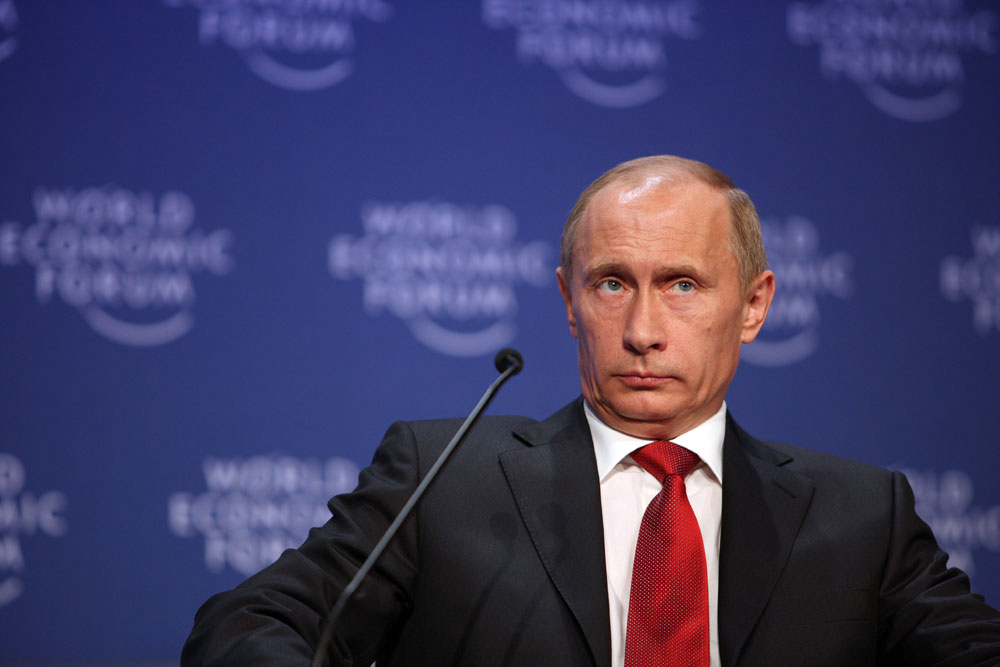
Elections in Russia: The tide is turning<http://www.marxist.com/elections-in-russia-tide-is-turning.htm> Written by Alan Woods Tuesday, 06 December 2011 [image: Print]<http://www.marxist.com/elections-in-russia-tide-is-turning/print.htm#> *The parliamentary elections in Russia on Sunday, December 4, were seen as a popularity test of Prime Minister Vladimir Putin, who is running for the presidency in March. The result was a blow to Putin, registering a sharp fall in support for his United Russia party. According to the official results, which are undoubtedly rigged, United Russia obtained just under half of valid votes cast, which gives it a very small majority in the State Duma.* [image: Vladimir Putin. Photo: World Economic Forum]<http://www.marxist.com/images/stories/russia/Vladimir_Putin-World_Economic_Forum.jpg>Vladimir Putin. Photo: World Economic ForumParliamentary election took place in Russia, simultaneously with local elections in 27 Russian regions. Lenin often stressed the importance of studying each and every statistic that could shed light on the evolution of class consciousness. He paid careful attention to even the smallest election and tried to assess its significance for the development of the class struggle; the changed relationship between parties and classes. It is therefore necessary to ask: what is the meaning of these elections and in what direction is Russia moving? Elections in Russia have a very relative importance, since everybody knows they are rigged by the Kremlin. Many Russians are understandably cynical about elections and political parties. Nevertheless, Sundays election to the Russian parliament (the Duma) revealed a significant change in the situation. The result for United Russia must be compared to the 64% that they won in the parliamentary elections in 2007. The Duma elections were an important indicator for Russias future. The result of the presidential elections in March next year is a foregone conclusion. Putin will be the next President of Russia. But the Kremlin needed to win a constitutional majority in Sunday's vote, or 66% of the seats (about 62% of the vote). In the end it barely managed to scrape a majority. The ruling party lost its previous two-thirds majority which allowed it to change the constitution unchallenged. Seven parties stood for 450 seats, which are allocated on a pro-rata basis to those parties that garner more that 7% of the votes cast nationwide. This is calculated to eliminate the smaller parties. It means that just four parties stood a chance: Putins United Russia, the Communist Party (KPRF), Just Russia (Spravidlivaya Rossiya) and the comically misnamed Liberal Democratic Party (LDPR) of the right wing demagogue Zhirinovsky. The allocated seats are filled by the candidates from the party lists filed with the Central Election Committee at the start of campaign. The preliminary result on Monday morning, with 95.71% Ballots counted, was as follows: - United Russia: 49.54% - Communist Party: 19.16% - A Just Russia: 13.22% - Liberal Democratic Party: 11.11% - Yabloko: 3.3% - Patriots of Russia: 0.97% - Right Cause: 0.59% The breakdown in seats in the Duma will be: - United Russia: 238 (315 in 2007) - CRRF: 92 (57) - A Just Russia: 64 (38) - Liberal Democratic Party: 56 (40) United Russia was founded exclusively as a vehicle for Putin. Now his authority has suffered a blow from which it will be difficult to recover. It indicates a slump in his support. It reflects a sharp shift in public opinion. An increasing number of Russians blame him for the rampant corruption, falling standards and a stagnant economy. United Russia is now known as the party of thieves and crooks. Despite this, few people expected any party but United Russia would be declared the winner. But voters hoped at least to give Putin a kick. They certainly succeeded. The drop in support for Putin and his party was felt even in places such as Vladivostok, Russias Pacific capital and seven time zones east of Moscow. This region was once a bastion of support for Putin. But many voters here turned to the opposition on Sunday for the first time in a decade. Vladimir Putin's party got as little as 25.5% in the Noginsk industrial district outside of Moscow, where the CPRF won. In the central election district of St. Petersburg (27.7% for United Russia) on Sunday, Putins party barely beat A Just Russia, which tries to present itself as a socialist party. United Russia also polled poorly in Kareliya (32.3%), the Russian region near Finland; in Arkhangelsk (31.8%), the Arctic Sea port; and in Primorsky Krai (33.4%), the Pacific coastal region in the Far East. Meanwhile, in the Dmitrov area of the Moscow region (29.0%), home to ailing industrial districts, the Communist Party captured almost as much of the vote as UR. Regime in crisis Putin was recently named by Forbes magazine as the worlds second most-powerful person, behind only U.S. President Barrack Obama. Now suddenly he looks like a Colossus with feet of clay. Twelve years ago, when Putin was first propelled to power on the basis of the widespread revulsion with the rule of the western stooge Boris Yeltsin, he enjoyed wide public approval. He seemed to take measures against the oligarchs who had enriched themselves under Yeltsin and his nationalist demagogy and pose of standing up to the West temporarily assisted him. Yet, the main reason was the economic recovery that followed the economic debacle of 1998. Russian nominal gross domestic product (GDP) rose to $1.9 trillion this year, as opposed to only $200 billion in 1999. This was a temporary relief. Now, all illusions have evaporated. People realise that the supposed attack on the oligarchs was merely a case of transferring the loot from one group of gangsters to another, while the majority are no better off than they were before. Russia has been hit hard by the global economic crisis. Putin is now commonly referred to as a dictator, while United Russia is seen by many voters as deeply corrupt. This election was really a referendum on Vladimir Putin and the ruling United Russia party. Boris Gryzlov, the speaker of parliament and United Russias chairman, argued that the party put in a strong performance compared with other European ruling parties. But this argument will fool nobody. The truth is that Putins regime has lost all legitimacy among voters, particularly in large cities. The results were also a blow for Dmitri Medvedev, who as United Russias candidate for prime minister was theoretically the partys leader in the Duma elections. Taken the more complicated configuration of the Duma, we will have to enter in to coalitions and agreements [with other parties] on certain issues, he said Sunday. This is what parliamentarianism and democracy are about. To talk about parliamentarianism and democracy in Russia is, of course, a joke in poor taste. The Duma is rightly seen by most people as merely a rubber stamp body for the Kremlin. However, if United Russia loses its majority that situation may change. The Kremlin clique will be compelled to manoeuvre and negotiate with other parties. The March presidential elections previously expected to be a coronation for Mr. Putin may now prove to be more complicated. The constitution stipulates that political power should be concentrated in the Duma because it is an elected body. In reality, however, it is in the hands of the Kremlin clique controlled by Putin. Putin served as president from 2000 to 2008 but was prohibited by the constitution from running for a third consecutive term. He got around this inconvenience by a transparent manoeuvre. When Putin was obliged to stand down as President, he gave the job to his stooge Dmitry Medvedev. But real power remained in Putins hands. >From the start it was clear that Putin intended to return to his old job as president. Medvedev predictably said he would back Putin's bid, hoping to be given the office of prime minister as a reward. Putin planned to return to the presidency in March for another two terms until 2024. But as Robert Burns said long ago: *The best - laid schemes o' mice an 'men gang aft agley*. Dirty tricks Abraham Lincoln pointed out that it is possible to fool some of the people all the time, and all of the people some of the time, but it is not possible to fool all the people all of the time. Nobody believes the official lies anymore. There was widespread cynicism about the election. There can be no doubt that even the bad result for United Russia was greatly inflated. The real result will have been much worse. There have been widespread reports of ballot-stuffing, voter intimidation and the harassment of election observers. During the election campaign there were many reports of illegal manipulation of the press and other dirty tricks organized by the Kremlin. We have received thousands of calls from regional offices, confirming massive violations and fraud, said Communist Party deputy head Ivan Melnikov on the party website. Throughout the day, it was like receiving reports from a war zone. CPRF leader Gennady Zyuganov denounced electoral fraud and described the election as theft on an especially grand scale. He said police had barred Communist monitors from several polling stations across the country, adding thatsome ended up in hospital with broken bones. Some ballot boxes, he said, had been stuffed with ballots even before voting began. In various cities, business managers demanded that their employees vote for United Russia, threatening them with pay cuts or even dismissal if they didnt. During classes, teachers made their students check off United Russia on hundreds of blank ballots. Entire apartment buildings discovered that none of the residents were on voter lists. It was also reported that none of the students, scholars or teachers at Moscow State University from outside Moscow could vote. They had to return to their hometowns to cast their ballots. Violence was widespread. In Belgorod, a Communist Party regional deputy was beaten up by the police. In Perm, the campaign manager for an oppositional party was beaten by unidentified men using baseball bats. In Bratsk, Irkutsk region, unidentified masked men kidnapped the 16-year-old daughter of the head of the local Communist Party branch office. They released her with a message for her mother: Quit the campaign, or we'll kidnap her for real. Several prominent Russian news organizations, including *The New Times* and *Kommersant *newspapers, as well as *Echo *of Moscow radio, saw their websites crash under apparent denial-of-service attacks just before polling stations opened, leaving them unable to report on the growing number of complaints about irregularities at polling stations. Small protests broke out on the streets of Moscow and other cities, and the approaches to the Kremlin and Red Square were blocked on Sunday night by rows of Interior Ministry soldiers and troop carriers. The rigging was blatant. The slogan of the day was: Vote early and vote often. *The Economist* reported: Throughout the day young people in identical white coats were ferried between polling stationssome voting more than a dozen times, according to Russian journalists. I saw several organised groups casting ballots in different polling stations with distant voting permits. In some regions the sum of votes cast for all parties exceeded 140%. In Chechnya, ruled by a Putin stooge, Ramzan Kadyrov, United Russias result was 99.5% - just as in the good old days of the Soviet Union! It is perhaps appropriate that a similar result was achieved in a Moscow psychiatric hospital. Russians know that parties like Zhirinovskys LDPR and Just Russia are in the Kremlins pocket and will vote with United Russia in parliament. Just Russia, which masquerades as a Social Democratic party, was in fact set up by Putin to take votes away from the CPRF. Gennady Gudkov, a senior member of Just Russia, admitted in a sudden attack of sincerity: We are losing votes to the Communist Party, who people think of as more of an opposition party because it doesnt have a history of cooperation with the authorities like we sadly do. Even before the counting was complete, the partys leader Mironov said he did not rule out a coalition with United Russia. Zyuganov has apparently made similar statements. All this lifts the curtain behind which the dirty game of political intrigue is being constantly played out in Russia. Despite all the dirty tricks and vote-rigging, the Kremlins campaign to maintain the current ruling clique in power has gone badly wrong. All the manoeuvres and vote-rigging has failed to prevent a spectacular decline in the vote for Putins party. The CPRF By one of those ironies with which history is so rich, the Soviet Union collapsed 20 years ago this week. Yet the main winner in Sundays election was the Communist Party of the Russian Federation. This was no accident. Reuters yesterday carried an article with the title: *Russian communists win support as Putin party fades*. It comments: Just 20 years ago, they seemed consigned to the dustbin of history. [...] The Communist Party (CPRF) for most Russians evokes images of bemedaled war veterans and the elderly poor deprived of pensions and left behind in a New Russia of glitzy indulgence. Large swathes of society have appeared beyond the reach of the red flag and hammer and sickle. But Sundays vote has changed this perception. The CPRF doubled its vote to about 20 percent and is now the second largest party in the Duma. Not that this expresses any great enthusiasm for the policies of Zyuganov. Many people do not trust the party because of its past and because of Zyuganovs manoeuvres. So how is this vote to be explained? The answer is not difficult to find. The vote for the CPRF reflects a growing undercurrent of discontent in Russian society with all that has happened in the last two decades. The end of the Soviet Union led to an unprecedented economic collapse and the wholesale plundering of the state by big business. The result was the rule of wealthy and corrupt oligarchs, who fought for the division of the spoils looted from the Russian people. After the economic collapse of 1998 there was a certain revival mainly based on the export of Russian oil and gas. Huge fortunes were made by a few, but most Russians were left in a state of poverty. The levels of inequality soared. Russia was hard hit by the crisis of 2008, but the economy is beginning to recover, and expected to grow at around 4-4.5% this year. But Russias 143 million people have not seen much benefit from this growth. They have seen their living standards eroded by high prices, a slowdown in real wage growth, a crumbling welfare state and unemployment. They compare this to the vast riches of the oligarchs, huge and growing inequality and obscene corruption at the top. The benefits of recovery are being skimmed off by the business elite around the Kremlin. The people of Russia have now got the worst of all worlds: the chaos, exploitation and inequality of capitalism and the corrupt, authoritarian and bureaucratic state left over from Stalinism. The Russian blogosphere compares Putins party to the old CPSU of Stalinist times. One popular image shows the face of an aged Putin's face superimposed on a portrait of the decrepit Soviet leader Leonid Brezhnev. The ruling party is hated, but people who wish to protest against it do not have much choice. The regime has made it impossible for small parties to register, so the smaller Communist Parties like the Russian Communist Workers Party (RKRP) are excluded. Just Russia is widely seen as a puppet of the Kremlin (although in Petersburg they got more votes than the CPRF). The CPRF has gained for the simple reason that there is no alternative. For many Russians disillusioned by rampant corruption and a widening gap between rich and poor, the communists represented the only credible opposition to Putins United Russia. Partly it is a question of organizational superiority. When the Soviet Union collapsed, the party retained a strong national organization based on regions and workplaces. Most of the others are parties in name only. The nationalist LDPR is built around one man, the right wing demagogue Vladimir Zhirinovsky. Other parties lack national structure. One Western banker in Moscow is quoted by Reuters as saying: The Communists are the only real party out there. United Russia is a joke, Just Russia is a joke and the LDPR is a joke and many people know it. So they vote communist because they realize it is a real vote for the opposition and against United Russia. United Russia has angered everybody and people are looking for an alternative, said Alexander Kurov, 19, a student of physics in Moscow told Reuters: I don't particularly like the communists but there is no one else (to vote for) and I don't want my vote to be stolen. They are a different party than in Soviet times, Anna, 21, a student of mechanics at the Moscow State University, said. I have a lot of friends who are activists for the Communists Party. Its become popular. Even a layer of the middle class and professional people, disillusioned with Putin and the Kremlin clique, is turning to the CPRF. Reuters quotes the words of a young woman, Yulia Serpikova, 27, a freelance location manager in the film industry: With sadness I remember how I passionately vowed to my grandfather I would never vote for the Communists. It's sad that with the ballot in hand I had to tick the box for them to vote against it all. The success of the CPRF undoubtedly reflects disenchantment with Putin and his party. But that is only part of the story, however. For many Russian workers, the old Soviet Union, for all its faults, was far preferable to what they have now. The idea is widespread, especially in the provinces far from Moscow and Petersburg: Things were better before. This mood must be widespread among older workers, but it is beginning to find a reflection in a layer of the youth, as shown by one contributor to the CPRF's chat forum, who offered a new genre of communist cool with a rap composition, the words of which are interesting: Want to get back what they took from me Free schooling aint no free lunch Free medicine is my right, you see What matters to you? Whose side you on? Want to help your country So it's our choice and it's our rap So we go vote for the CPRF A sea-change in Russia In retrospect, these elections will be seen as a sea-change in Russian politics. Slowly but surely, the working class is recovering from the apathy, trauma and disorientation that followed the collapse of the USSR. Beneath the surface there is a growing mood of anger, frustration and rage. There is a burning hatred for the ruling clique and the bloated oligarchy that has enriched itself at the expense of the majority of Russians. The fate of Russia is now firmly tied to the vicissitudes of the world capitalist market, which is sliding inexorably in the direction of a new and even deeper slump. A further collapse of demand in Europe and the United States will mean steep falls in the price of oil and gas and the other raw materials that are the mainstay of the Russian economy. Falling living standards and unemployment will throw petrol onto the flames of the rage that is already felt by millions of ordinary Russians. People are sick and tired of Putin, said Yevgenia Albats, editor in chief of *The New Times*, a pro-opposition newspaper in Moscow. They turn on the TV and they see Putin, Putin, Putin, and at the same time they see dont see their lives improving significantly. The anger is growing and dissent is becoming bolder and more vocal. Recently, Putin was jeered during an appearance at a mixed-martial-arts match in Moscow clear evidence Russians had turned on the strongman in the Kremlin. The idea that Putin cannot be defeated has now been punctured. And the CPRF has emerged clearly as the only alternative. One CPRF Deputy hailed the victory as a new political reality on Sunday evening. That remains to be seen. The CPRF has yet to establish its credentials as a real opposition party. But in spite of the policies of Zyuganov, support for the CPRF will grow for the simple reason that there is no alternative. Putins plan to return to the presidency next year faces a more serious challenge following his stunning electoral setback in Sundays elections. After the election, Medvedev said that they should re-introduce the rule allowing people to vote against all. This is intended to take votes away from opposition parties like the CPRF. This is an expression of the desperation of the ruling clique. The Kremlin will do everything in its power to prevent genuine opposition candidates from registering. But if they try to hold onto power by rigging the elections again, that can have even more explosive consequences. The crisis of the regime will deepen in the next period. The leaders of United Russia will be fighting like cats in a sack, with Putin trying to put the blame on the others for all his problems. These divisions at the top are a distorted reflection of the growing tensions in Russia society, and they will further increase the tension and discontent in society. Recently *The Financial Times* carried a long article about Russia in which it compared the present situation to the position just over 20 years ago just before the collapse of the Soviet Union. After two decades of gangster capitalism the people of Russia are disenchanted with the joys of market economics. The vote last Sunday was a massive vote of no confidence, not just in Putin and the Kremlin crew but in the entire economic and political system. The recent election results were only a very muted reflection of the widespread anger that is reaching boiling point. Western observers fear that the anger that is building up will sooner or later erupt onto the streets of Russian cities. Business New Europe expressed these fears when it wrote after the elections: [...] ruling Russia by presidential fiat rather than debate amongst parties increases the likelihood of some sort of revolution, as the people are excluded from the political process entirely and have nowhere to blow off steam except on the street. (http://www.bne.eu/) *The crisis of the regime and the political intrigues and electoral combinations are only a caricature expression of the insoluble social contradictions and the discontent that is building up beneath the surface. The longer Putin and his clique try to hang onto power, the more explosive the contradictions will become. What happened in Tunisia and Egypt can happen also in Russia.* *London 6th December 2012* [Non-text portions of this message have been removed] ------------------------------------ --------------------------------------------------------------------------- LAAMN: Los Angeles Alternative Media Network --------------------------------------------------------------------------- Unsubscribe: <mailto:[email protected]> --------------------------------------------------------------------------- Subscribe: <mailto:[email protected]> --------------------------------------------------------------------------- Digest: <mailto:[email protected]> --------------------------------------------------------------------------- Help: <mailto:[email protected]?subject=laamn> --------------------------------------------------------------------------- Post: <mailto:[email protected]> --------------------------------------------------------------------------- Archive1: <http://www.egroups.com/messages/laamn> --------------------------------------------------------------------------- Archive2: <http://www.mail-archive.com/[email protected]> --------------------------------------------------------------------------- Yahoo! Groups Links <*> To visit your group on the web, go to: http://groups.yahoo.com/group/laamn/ <*> Your email settings: Individual Email | Traditional <*> To change settings online go to: http://groups.yahoo.com/group/laamn/join (Yahoo! ID required) <*> To change settings via email: [email protected] [email protected] <*> To unsubscribe from this group, send an email to: [email protected] <*> Your use of Yahoo! Groups is subject to: http://docs.yahoo.com/info/terms/