http://www.marxist.com/women-in-the-paris-commune.htm
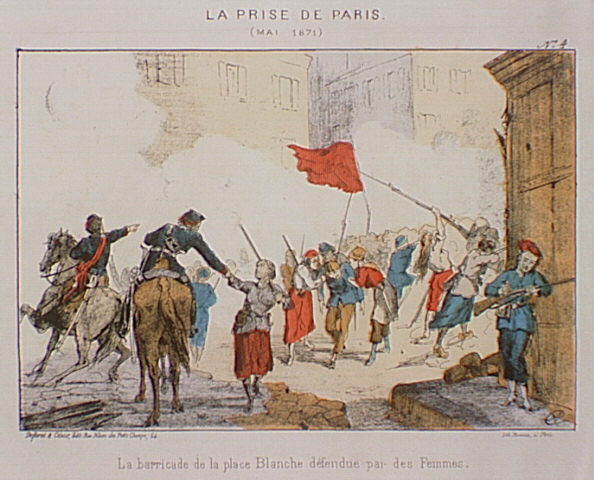
Women in the Paris Commune<http://www.marxist.com/women-in-the-paris-commune.htm> Written by Christina Gridley and Carolyn Kemp Thursday, 08 March 2012 [image: Print] <http://www.marxist.com/women-in-the-paris-commune/print.htm>[image: E-mail]<http://www.marxist.com/component/option,com_mailto/link,8d2c4b16d14fca8aba9c2f60f4cfa309a47bd183/tmpl,component/> *We have come to the supreme moment, when we must be able to die for our Nation. No more weakness! No more uncertainty! All women to arms! All women to duty! Versailles must be wiped out! These were the words of Nathalie Lemel, participant in the Paris Commune of 1871, and member of the Union des Femmes pour la Defense de Paris et les Soins aux Blesses (The Union of Women for the Defense of Paris and Aid to the Wounded).* [image: from "Le Chambard Socialiste," by Théophile-Alexandre Steinlen]from "Le Chambard Socialiste," by Théophile-Alexandre SteinlenSuch a bold statement is quite contrary to the demur and frailty that is attributed to women of that time period. These were militant women fighting for the gains of the working class in the Paris Commune. In honor of International Working Womens Day, we would like to highlight the efforts and achievements made by the working women during the Commune. Women like Louise Michel, Elisabeth Dmitrieff, André Léo, Anne Jaclard, Paule Mink, and Nathalie Lemel, organized secular schools, ambulance services, and work cooperatives, as well as taking up arms for the revolution. The working women of the Commune fought for womens rights on a class basis, and defended the revolution with their very lives. The times leading up to the Paris Commune were difficult for all workers, but especially for women. It was typical for a woman to work 13 hours a day, six days a week. Even still, the wages she received for that work were woefully shy of the cost of living at the time, even if her wages were added to her husbands. This contradiction drove many working women to prostitution. The Franco-Prussian war put further strain on the French people, particularly during the months-long siege of Paris, when they were completely blocked off from the outside. This led to soaring inflation and to long lines to get bread that was scarce, and often mixed with straw and paper. It was primarily the women who had to stand in these lines and literally fight for the bread needed to feed their families. This laid the basis for the militancy that was seen amongst women during the Commune, who led the charge on many occasions. After the French armies of Emperor Louis Bonaparte were defeated by the Prussians, the Parisian workers rose up and declared a republic. However, power fell into the hands of the right-wing representatives of the bourgeoisie. On March 18, the reactionary leader of the new government, Adolphe Thiers, sent troops to take cannons out of Paris in the middle of the night. His aim was to disarm the workers and to sell out to the Prussians. The women of the neighborhood of Montmartre awoke and charged up the hill where they swarmed and fraternized with the troops, placed themselves on the cannons, and stopped them from being removed. The troops were so persuaded by the women and the peoples militia of the National Guardsmen of Paris that they went over to the people, arresting and firing upon their own commander. With this, a situation of dual power developed. Thiers lost control of Paris and had to flee with the bourgeois government to nearby Versailles. The workers of Paris declared the Commune, the worlds first workers republic. The most advanced elements in the Commune, including hundreds of women, gathered to march to Versailles in an attempt to stop the bloodshed and to tell Versailles that the Assembly [the old government] is not the lawParis is! But the leadership of the Commune vacillated and the opportunity was lost. By allowing the forces of reaction to regroup, by not decisively marching on Versailles to crush the enemies of the revolution, the balance of forces eventually tipped back in favor of the bourgeois and their representatives, with fatal consequences for tens of thousands of Communards. The beginnings of a new society [image: paris commune]The Commune formed many clubs, which often commandeered churches to hold their meetings. These meetings had open, heated discussions, and used direct democracy. A main topic of discussion in the clubs was anti-clericalism. The working women denounced the way the churches controlled wealth, mistreated workers, controlled girls schools, and invaded family privacy. It was also suggested by some that the nuns be thrown into the Seine River, while others requested that all priests be arrested until the end of the war. Many of the workers in France were influenced by the proto-anarchist Proudhon, who believed that the proper place for women was either as housewife or harlot, and by no means as part of the workforce. He even put forth a series of equations to illustrate that women were physically, intellectually, and morally inferior, and should therefore keep to child rearing and nothing else. This, along with the generally backwards attitudes of many men at that time, including many advanced workers, led to the French section of the First International presenting a memorandum against women participating in the workforce. Nonetheless, there were several women in France who belonged to the International, and this line of thinking had nothing to do with the ideas of Marx and Engels, its key leaders, who were doing their best to keep up with events from London. Louise Michel and the Montmartre Vigilance Committee Another important group was the Montmartre Vigilance Committee, which was divided into a mens section and a womens section. Louise Michel, one of the most inspiring figures of the Commune, belonged to both. The Vigilance Committee held workshops, recruited ambulance nurses, gave aid to wives of soldiers, sent speakers to the clubs, and hunted draft dodgers who refused to serve in the peoples militia. Louise Michel was elected as its president, and served as a fighter and medical worker in the 61st Battalion during the Commune. Before the Commune was elected, Michel offered to go to Versailles to shoot Thiers herself, but was dissuaded for fear of retribution. Nevertheless, she went to Versailles just to prove she could come back unscathed. [image: paris-commune2]<http://www.marxist.com/images/stories/women/paris-commune2.jpg>During the Commune, Michel sent a letter to the mayor of Montmartre with a series of demands, including the abolishment of brothels, that the Bell of Montmartre be melted down to make a cannon to defend the workers neighborhoods, and to requisition abandoned houses and the wine and coal within them to set up shelters and provide for the old, infirm, and children of Montmartre. Some men in the Commune did not want to allow prostitutes to be ambulance workers, saying the wounded must be tended by clean hands, but Michel saw the necessity of involving these women in the work of the Commune and recruited them to help in this work. After the fall of the Commune, Thiers forces fought their way through Paris and murdered tens of thousands of Communards over a period of several weeks. Michel fought on the barricades at the cemetery of Montmartre during the Bloody Week, and was subsequently arrested and deported to New Caledonia along with Nathalie Lemel. *The Union des Femmes* Elisabeth Dmitrieff was born in Russia and co-founded the Russian section of the First International. Active in the Narodnik movement, Dmitrieff was sent to London to work with Marx and study the London workers movement. After the declaration of the Paris Commune, the London General Council decided to send Dmitrieff as one of two envoys to the Commune. After meeting with other working women active in the Commune, she saw the need to organize the working women of Paris to defend the Commune at the barricades, ambulance stations, and canteens, as well as to fight for socialist measures that would emancipate working women from exploitation. This led to the setting up of the Womens Union, the *Union des Femmes*. Nathalie Lemel joined the Union [4.] after its formation and, as a book binder, had a wealth of experience in the Parisian labor movement, in addition to being a member of the First International. The influence of Lemels labor and strike experience is instantly recognizable in the work of the *Union*. The first meeting of the Union [6.] took place on April 11, after an Appeal to the Women Citizens of Paris was put up on the walls of the city and published in the papers. A provisional Central Committee was appointed which included Dmitrieff and seven other working women. The *Union des Femmes* was made up of working-class women and was part of the First International. It was organized around citywide associations, with a central committee and a paid executive committee. All positions were democratically elected and recallable by the union members. Each *arrondissement* (mayoral district of Paris) had *Union* committees for recruiting militant working women, for finances, and for summoning the members to defend the Commune at any given moment. The *Union* financed itself with dues as well as money it received from the central bodies of the Commune. After the executive committee was paid, they used the remaining money to help support ill and/or impoverished members of their union, as well as to buy weapons for defense of the Commune. The *Union des Femmes *represented the most advanced layer of the working women of Paris. They consistently showed their militancy and willingness to fight to defend the gains of the Paris Commune. On May 3, a poster was put up throughout Paris calling for an armistice with Versailles and signed by an anonymous group of Citizens. The *Union* responded days later with a militant manifesto decrying an armistice with the counterrevolution and demanding the right of the working women of the Commune to take up arms alongside the men in defense of the revolution, saying: Women of Paris will prove to France and to the world that they too, at the moment of supreme dangerat the barricades and at the ramparts of Paris, if the reactionary powers should force her gatesthey too know how, like their brothers, to give their blood and their life for the defense and triumph of the Commune, that is, the People. This manifesto flies in the face of anyone who doubts the courage and ability of women in revolutionary battle. Because so many of the business owners had fled Paris, many working women found it difficult to find jobs. The *Union* presented the Commission for Labor and Exchange with a request for immediate work making uniforms for the National Guard militia, and a long-term request to form a Federation of Womens Associations. This document, signed by Dmitrieff, clearly displayed the internationalist, socialist character of the *Union des Femmes* while rejecting bourgeois feminism: An end to all competition between male and female workerstheir interests are identical and their solidarity is essential to the final worldwide strike of labor against capital. The document also stated that every member was to be a member of the First International. The Central Committee was to liaison with foreign organizations for product exchange, and the *Arrondissement *Committees would enroll women workers to keep track of occupations, as well as women who work at home. The federation would be made up of five members of each Arrondissement [16. italicize] Committee. On May 17, the *Union* put out an appeal to working women to meet on the 18th with the objective of setting up a Federal Chamber of Working Women. The final drafting of the syndicate and federal chambers took place at the Hôtel de Ville on May 21. The *Union des Femmes* also fought for the working women of the Paris Commune by demanding equal pay for women, the right to divorce, education for girls, and much more. To help the worker cooperatives that sprang up during the Commune compete with independent businesses, the *Union* made an organizational plan for cashiers and accountants of these cooperatives, to help them formulate price and wage structures during the transition from capitalism to a socialist future. They also fought to end the distinction between legitimate and illegitimate children. A pension was enacted for wives or concubines of dead National Guardsmen, as well as each of her childrenlegitimate or not. Orphans were to receive an education at the expense of the Commune. In short, many measures were enacted that benefited the working women of Paris directly. On the day before Versailles troops entered Paris to crush the Commune in blood, equal pay for men and women workers was declared. But this advanced reform was lost along with the Commune, and still remains unrealized in most of the world to this day. Bourgeois feminism Bourgeois feminism analyzes the issue of womens exploitation on a gender basis, from the standpoint of the oppression of women at the hands of men. They do not recognize that women workers are a super-exploited layer of the working class. They applaud bourgeois women for breaking the glass ceiling, or running for president, without understanding or admitting that these women do not at all represent the interests of working womenwho make up the vast majority of women in society. The *Union des Femmes* had a very different approach. They analyzed working womens oppression on a socialist, working class basis. They understood and explained that the only way to emancipate women from their exploitative conditions was to reorganize their work and give *all* workers ownership and control over the means of production. The only way for working women to fight their exploitation is on a class basis, inside the labor movement, and to link the suffering of women to the suffering of the entire working class. A U.S. labor party armed with a socialist program could fight for legislation that would help working women and ease the burden of the second unpaid shift. It would fight for universal, socialized health care, child care, laundry services, cheap and nutritious community restaurants, enforcement of anti-discrimination laws, equal pay for work of equal value, and card-check legislation that would allow more working women (and men) to organize and join labor unions. These reforms would ease the dependence of working women on their also-exploited husbands, giving them financial independence and the ability to escape abusive partnerships. They would allow men and women to relate to each other on a new basis, as workers, in solidarity, and in the best interests of society as a whole. As Marxists, we fight for any reforms that help working women, while at the same time explaining that the only way to fully emancipate women is to abolish capitalism. The achievements of the working women of the Paris Commune cannot be overlooked when discussing womens issues and are an important tool in our arsenal. History & Theory <http://www.marxist.com/history-and-theory/> » Topics<http://www.marxist.com/history-and-theory/>» Women & Marxism <http://www.marxist.com/women/> [Non-text portions of this message have been removed] ------------------------------------ --------------------------------------------------------------------------- LAAMN: Los Angeles Alternative Media Network --------------------------------------------------------------------------- Unsubscribe: <mailto:[email protected]> --------------------------------------------------------------------------- Subscribe: <mailto:[email protected]> --------------------------------------------------------------------------- Digest: <mailto:[email protected]> --------------------------------------------------------------------------- Help: <mailto:[email protected]?subject=laamn> --------------------------------------------------------------------------- Post: <mailto:[email protected]> --------------------------------------------------------------------------- Archive1: <http://www.egroups.com/messages/laamn> --------------------------------------------------------------------------- Archive2: <http://www.mail-archive.com/[email protected]> --------------------------------------------------------------------------- Yahoo! Groups Links <*> To visit your group on the web, go to: http://groups.yahoo.com/group/laamn/ <*> Your email settings: Individual Email | Traditional <*> To change settings online go to: http://groups.yahoo.com/group/laamn/join (Yahoo! ID required) <*> To change settings via email: [email protected] [email protected] <*> To unsubscribe from this group, send an email to: [email protected] <*> Your use of Yahoo! Groups is subject to: http://docs.yahoo.com/info/terms/