http://www.marxist.com/brotherhoods-victory-what-does-it-mean.htm
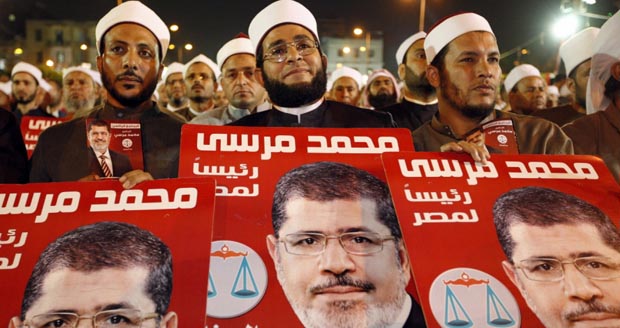
Egypt: The Muslim Brotherhood’s election victory – What does it mean?<http://www.marxist.com/brotherhoods-victory-what-does-it-mean.htm> Written by Alan Woods Tuesday, 26 June 2012 [image: Print]<http://www.marxist.com/brotherhoods-victory-what-does-it-mean/print.htm#> *The Muslim Brotherhood's candidate Mohammed Mursi has won Egypt's presidential election with 51.73% of the vote. Ahmed Shafiq, the candidate of the military, got 48.27%, according to the election commission. However these figures should be treated with caution.* [image: mohammed-mursi]<http://www.marxist.com/images/stories/egypt/mohammed-mursi.jpg>The turnout was officially claimed to be 51.8%. However, many eyewitnesses say that the real level of participation was far lower than this. Even if we accept the official estimate, it would mean that the Muslim Brotherhood only won the support of about 25% of the electorate. Moreover, an unknown number of these votes may have come from left-wing people who voted for the Muslim Brotherhood as “the lesser evil”. Huge cheers went up from thousands gathered in Cairo's Tahrir Square after the result was known. But the cheering will not last for long, for these elections revealed deep fault lines in Egyptian society. At one point the antagonisms reached such a fevered pitch that they threatened to break into open civil war if the generals had declared their candidate as the winner. That was clearly their intention. The elections were rigged. But they realised that such a move would provoke a social explosion with unpredictable results. Crowds had been growing in Tahrir Square all day despite the sweltering heat. They were listening to the election result announcement silently and patiently. Loudspeakers were playing a live broadcast of the election commission announcement. Some gathered round TV sets under tents. They were preparing either to celebrate or to riot. Tension was running high. There were fears that a violent response would be sparked if the result gave victory to Shafiq. Mohammed Mursi of the Muslim Brotherhood and former Prime Minister Ahmed Shafiq both claimed victory. The generals looked into the abysm and reluctantly drew back, no doubt under pressure from Washington, which holds the purse strings. Farouq Sultan, the spokesman of the electoral commission, delivered an interminable speech, clearly unwilling to make the announcement of the result. Then a great cheer went up in Tahrir when he confirmed that Mursi had won. Thousands were dancing and singing, waving Egyptian flags. Posters of the Muslim Brotherhood candidate were everywhere, as people chanted slogans through loudspeakers. The chant went up: "to the square, to the square" as people chanted "Mursi, Mursi, Allahu Akbar" and "Revolution, revolution until victory. Revolution, revolution, in all the streets of Egypt." For a brief moment the people of Egypt felt united in an explosion of joy and relief. But this outburst of euphoria conceals deep divisions in Egyptian society and politics. For many people the electoral victory of Mursi and the Freedom and Justice Party (the political front of the Muslim Brotherhood) represented a defeat for the open agents of counterrevolution. But the nation is now polarised as never before. *“President of all the Egyptians”* The Muslim Brotherhood candidate, assuming that there are no new dirty tricks by the military, will be sworn in by the end of the month. The prime minister appointed by the military rulers, Kamal el-Ganzouri, met Mohammed Mursi on Monday to resign formally and assume caretaker duties until the new president's team is in place. Mursi has already moved into his new office in the presidential palace and begun work forming a government. The new president declares that he is “president of all Egyptians” but the soothing announcements of Mursi are unlikely to defuse the social and political tensions. The Christian Copts fear domination by the Muslim Brotherhood. The secular revolutionaries, some of whom voted for Mursi in the mistaken belief that the Brotherhood represented the “lesser evil”, are about to receive a stern lesson in political realities. Above all, the workers and peasants, whose expectations have been aroused by the Revolution, demand jobs and houses. Mursi promises stability, freedom and prosperity, but these promises are in direct contradiction with the crisis of capitalism. Egypt’s economy is in a deep slump. Unemployment is high and poverty is increasing. Homeless people are sleeping in the cemeteries. The Egyptian people will judge the success of the new government on concrete results, especially in the economic field. For the masses the Revolution is above all a question of bread, work and houses. Samir Radwan, Egypt's finance minister just after the revolution told the BBC that the new president will have to deal with serious financial problems: "When I started my work just five days after the revolution, we had $36bn in reserves, international reserves - that's 18 months of imports. Now it's less than $15bn; it's rock bottom, really. Tourism, by any standard, has gone down tremendously, exports have gone down, unemployment is as high as 12% - that's the official figure which is understated; 42% of the population is below the poverty line." Above all, the generals and bureaucrats of the old regime remain in charge. As a precaution, just before the election results were announced, they took the step of dissolving parliament and concentrating all the main powers in their hands. The new “democratically elected” president will be an impotent tool in the hands of the generals. The SAF, which seized power after last year's revolution, has issued a series of anti-democratic decrees: - The justice ministry gave soldiers the right to arrest civilians for trial in military courts until the ratification of a new constitution - A decree was issued dissolving parliament after a court ruling that the law on elections to the lower house of parliament was invalid - The Scaf granted itself legislative powers and reinforced its role in the drafting of a permanent constitution - Field Marshal Tantawi announced the re-establishment of a National Defence Council, putting the generals in charge of Egypt's national security policy Thus, the elections have solved nothing. 'Stability' On hearing the news of his victory, tens of thousands of cheering people in Tahrir Square, chanted: "Down with military rule!" But this correct demand found no echo in the statements of the new president-elect. In his speech on Sunday, Mursi, urged Egyptians "to strengthen our national unity" and promised an inclusive presidency. Mursi paid tribute to the protesters who died in last year's uprising against former President Hosni Mubarak but also praised the role of Egypt's powerful armed forces. He also said he would honour international treaties. "There is no room now for the language of confrontation," he said. This was a coded message to the generals and to Washington. Mursi is anxious to soothe their jangling nerves. In effect, he tells them: “Don’t worry. You can trust us. Like you, we want to put an end to the Revolution and finish the chaos and instability that is bad for business. Only we will do this more effectively than you, not by guns and bayonets but by cunning and trickery.” The imperialists immediately sent a message back to the Muslim Brotherhood: “We understand you perfectly.” The White House declared that the Egyptian election result was a “milestone in the movement to democracy”. Israeli Prime Minister Benjamin Netanyahu said on Monday: "We expect to work together with the new administration on the basis of our peace treaty." There was confusion, however, over an alleged interview quoted by Iran's semi-official Fars news agency. Fars said that Mursi planned to expand relations with Iran to "create a balance of pressure in the region", but Mursi's spokesman denied the interview had taken place. Evidently, the policy of being all things to all men had been taken a little too far in the case of accommodating both Washington and Teheran! A Mursi spokesman, Yasser Ali, said the president's key concern was *political stability*. State television showed Mursi meeting on Monday with Field Marshal Mohamed Hussein Tantawi, the head of the ruling military council, the Supreme Council of the Armed Forces (SCAF). Field Marshal Tantawi, the chief of the counterrevolutionary forces, said the military would "stand by the elected, legitimate president and will cooperate with him for the stability of the country". So here we have it. The counterrevolutionary generals and the Muslim Brotherhood are singing the same song in different keys. The generals promise to “respect” the election result and co-operate with Mursi. The latter, for his part, has promised to appoint a range of vice presidents and a cabinet of "all the talents". These gentlemen are now haggling like merchants in the bazaar. The first point Mursi has to haggle over with the SCAF will be the dissolution of the Muslim Brotherhood-dominated parliament, which happened days before the presidential run-off vote. Because of the dissolution of parliament, it is not even clear where the new president will take his oath of office. This shows where the real power lies. The Muslim Brotherhood has been seeking, not the immediate rescinding of this anti-democratic decision, but only a *partial recall of parliament* so that he is sworn in before MPs. But they have even retreated from this timid demand. The Mena news agency quoted a Muslim Brotherhood spokesman as saying the oath would be taken before the Supreme Constitutional Court – *that is, before the very same Mubarak-appointed judges who were responsible for the dissolution of parliament and the undemocratic seizure of presidential prerogatives*. What does this mean? It means that the Muslim Brotherhood, instead of fighting for real democracy, is striving with all its might to arrive at a deal with the SCAF. Instead of fighting to uphold the results of the elections, they are willing to accept the generals’ right to rule from behind the scenes. All they ask is that the generals and bureaucrats move over a little to allow them a share of the rich pickings of state power that the latter have monopolised for decades. In other words, Mursi and the Muslim Brotherhood have used the elections to haul themselves into positions of government that will enable them to haggle more effectively with the generals. All the sacrifices of the revolutionary masses in the last eighteen months are reduced to “mediation” (that is, horse-trading) between the Islamists and the SCAF on the president's powers. The notion of a “government of national unity”, that is, a government representing all classes is even hollower in Egypt than it was in Greece and Italy. When Mursi says he will be president of all Egyptians, what does that mean? How is it possible to represent the interests of the rich and the poor? How is it possible to defend the Revolution while accepting the rule of the army jackboot? How is it possible to stand for democracy while allowing the generals to dictate the rules? The conduct of the Muslim Brotherhood is of no surprise to Marxists. Indeed, it should be of no surprise to any thinking person, especially in Egypt. Those who presented the MB as a “revolutionary force” before the elections were simply deceiving themselves and others. The leaders of the MB represent that wing of the Egyptian bourgeoisie that was hitherto excluded from political power. Its sole aim is to lean on the masses to pressurise the generals to share power with it. These bourgeois leaders were never revolutionaries, but they cynically leaned on the revolutionary masses to carry them to power. Now they have achieved this objective they will not hesitate to detach themselves from the Revolution and join hands with the counterrevolutionary generals and imperialists to suffocate the Revolution. That is what is meant by the establishment of *security and stability.* "As a businessman who engages in industrial activity, I belong in this place – even if the previous circumstances didn’t allow me to participate in it." (See Ahramonline, 12 May, 2012) These words, spoken by Khairat El-Shater, a leading Muslim Brotherhood figure and disqualified presidential candidate, were part of a speech delivered recently before members of the Egyptian Federation of Industries. El-Shater, who has substantial business interests, is typical of the bourgeois leaders of the Brotherhood. They convey very clearly both the class basis of the MB and its real aim: to be allowed to participate in the plunder of the Egyptian state, from which they were previously excluded. El-Shater in his opening remarks let the cat out of the bag: "Investors from the Gulf countries see potential in Egypt's large market, but they need security and stability to invest... without these things you cannot conduct economic activity." This bourgeois ardently desires *security and stability*, as the prior condition for investment, that is, *for the making of profit*. The victory of the Muslim Brotherhood is only a stage in the Revolution, which is destined to go through a whole series of stages before it is finally resolved one way or the other. The first wave has brought them to power. The second wave will dash them to pieces. The most pressing task of the Egyptian revolutionaries is to unmask the counterrevolutionary nature of the Muslim Brotherhood and win over that section of the masses that have been misled and deceived by the Brotherhood. Instead of participating in the cynical fraud of a “government of national unity”, it is necessary to step up the strikes, demonstrations and sit-ins. All attempts to eliminate the class antagonisms in Egyptian society by talk of “national unity” will necessarily fail. The workers and peasants demand bread. The unemployed demand work. The homeless people demand houses. And the revolutionary people are demanding the immediate revocation of the sweeping new powers that the ruling generals have usurped, not deals at the top. The workers and peasants of Egypt must now pass through the school of the Muslim Brotherhood. It will be a very harsh school, but it will teach them some important lessons. In the end, one class must win and the other lose. Either the greatest of victories or the greatest of defeats: that is the real choice before the working class and Egyptian people as a whole. London, 26 June 2012 [Non-text portions of this message have been removed] ------------------------------------ --------------------------------------------------------------------------- LAAMN: Los Angeles Alternative Media Network --------------------------------------------------------------------------- Unsubscribe: <mailto:[email protected]> --------------------------------------------------------------------------- Subscribe: <mailto:[email protected]> --------------------------------------------------------------------------- Digest: <mailto:[email protected]> --------------------------------------------------------------------------- Help: <mailto:[email protected]?subject=laamn> --------------------------------------------------------------------------- Post: <mailto:[email protected]> --------------------------------------------------------------------------- Archive1: <http://www.egroups.com/messages/laamn> --------------------------------------------------------------------------- Archive2: <http://www.mail-archive.com/[email protected]> --------------------------------------------------------------------------- Yahoo! Groups Links <*> To visit your group on the web, go to: http://groups.yahoo.com/group/laamn/ <*> Your email settings: Individual Email | Traditional <*> To change settings online go to: http://groups.yahoo.com/group/laamn/join (Yahoo! ID required) <*> To change settings via email: [email protected] [email protected] <*> To unsubscribe from this group, send an email to: [email protected] <*> Your use of Yahoo! Groups is subject to: http://docs.yahoo.com/info/terms/