http://www.marxist.com/xi-jinping-and-the-future-of-china-part-two.htm
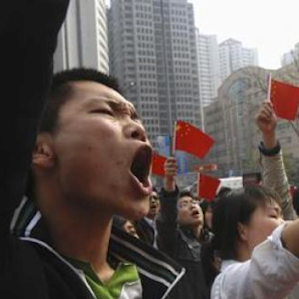
Xi Jinping and the Future of China Part Two<http://www.marxist.com/xi-jinping-and-the-future-of-china-part-two.htm> Written by Daniel MorleyThursday, 22 November 2012 [image: Print]<http://www.marxist.com/xi-jinping-and-the-future-of-china-part-two/print.htm#> At the moment, the Chinese capitalist class, on the whole, is happy to go along with the status quo. They see no alternative, and are terrified of lifting the lid on the anger of the working class, therefore they seek stability at all costs. [*Read part one here<http://www.marxist.com/xi-jinping-and-the-future-of-china-part-one.htm> *] [image: Anger]<http://www.marxist.com/images/stories/china/angry-workers.png>The removal of Bo Xilai, not a socialist threat but a political loose-cannon, sufficiently demonstrates their fear of the appearance of any divisions and any legitimisation of a leftist alternative. But as these figures suggest, capitalism cannot deliver stability forever. Should an economic crisis break out, and a wave of defaults flood through the system, engulfing the state finances, what will happen then? Notwithstanding the upturn in the class struggle this is likely to generate (this we will deal with shortly), such a crisis will also expose all the splits amongst the Chinese ruling class and in the state. Those salivating at the prospect of breaking up the monopolistic SOEs will try to seize the opportunity. In Wenzhou, the government is already experimenting with liberalising the banking system. The*Financial Times* has also reported that, China will give foreign investors greater access to its stock and bond markets as part of a cautious reform push to open its financial system to the world. Guo Shuqing, the securities regulator, said China would increase the quotas that are allocated to foreign institutions for investing in its closely guarded capital markets. With the ruling Communist party gathered in Beijing this week for a congress at which they will unveil the countrys leaders for the next decade, Mr Guo signalled that the government wanted to accelerate the opening of the countrys financial system. Already Li Keqiangs department, as mentioned earlier, has published a joint report with the World Bank which concluded that the banking and other monopolies must be broken up. If these monopolies, which are basically state subsidised capitalist firms, had state support withdrawn, many of them would go bust. Thus the situation is analogous to the crisis in the British economy in the 1970s, when Keynesianism had run its course. The unprofitable state owned companies were privatised, others had state subsidies withdrawn. The result was massive layoffs, worsening in terms and conditions, and naked profiteering from which the British working class is still suffering. Those smug liberals in journals such as *The Economist *and *The Guardian*, who look forward to the breaking up of these monopolies as the heralding of a glorious democratic era in China, are deluded. Although, in the face of economic crisis and a strike wave, a section of the Chinese leadership may pose as democratic reformers in the hope of diverting this anger (democratic reform is often spoken of as necessary, both by Chinese politicians and liberal intellectuals, because it can help to stave off revolution), this would always be a smokescreen for full-scale privatisation. Such a policy is no solution to the Chinese working class problems. It would raise unemployment, increase inequality and accelerate the development of capitalism. The only people to really benefit would be the bureaucrats at the top of the SOEs. As Marxists we are utterly opposed to privatisation in all its forms, even when hidden behind the mask of democratic reform. It is also completely false, as the liberals maintain, that corruption is due to the state owned character of much of the Chinese economy. As already explained, corruption represents the capitalist corrosion of the old state apparatus. Much of the anger of the Chinese people is correctly directed at the corruption generated by privatisation. Companies are sold off at knockdown prices to insiders, top bureaucrats, who then become top capitalists. Privatisation involves and encourages corruption; it is not its solution. The brewing economic crisis threatens to turn Chinas simmering class struggle into an all out explosion. The slowing economy has recently led to a rise in unpaid bills between businesses. Another expression of the scarcity of cash is the sudden sharp increase in wage arrears, according to*China Labour Bulletin*. This has led to an immediate increase in strike activity and workers protests, which this October reached their highest level for almost two years. There was a strike surge in September as well, especially in the service sector. The infamous Foxconn, which employs an incredible one million workers in China, has been particularly strike prone and seems to represent the vanguard of the class struggle in China. It is reminiscent of Petrograds legendary Putilov Works. The production of the iPhone 5 twice came to a halt due to strikes in one fortnight in October. Apple, whose profit margins are around 30%, compared to Foxconns 1.5%, is well known to put extreme demands onto Foxconn, which in turn puts unbearable pressure onto its workers so that that tiny profit margin is maintained. Every job is tagged to time, there are targets on how many things must be completed within an hour, said Xie Xiaogang, 22, who worked at Foxconns Shenzhen plant and was transferred to Taiyuan in June this year. You dont have much time to relax. In this environment, many people cannot take it. (Quoted from *Bloomberg*). So intense is the pressure that riots are frequent occurrences. The most recent one took place in Foxconns Taiyuan factory in the province of Shanxi. This factory employs 79,000 people and the riot involved anything between 2,000 and 10,000 workers. The immediate cause of the riot appears to be the ongoing brutality of the security staff, who apparently stabbed a female worker. In another incident, four or five guards almost beat one worker to death. This brutality is a general feature of Foxconn and is a direct result of the equally brutal drive for profits. So intense is the pressure that this factory alone loses 400-500 workers a day. Some of them, as was widely reported, left the company by committing suicide. And some workers from other Foxconn plants in Henan, Shandong, and Shenzhen posted letters praising the Taiyuan workers for their courage to start a riot...workers had not meant to instigate a riot but they had no other way to address injustice. When they called a hotline to complain about the abusive security guards, for example, they were told their complaint could not be handled...Although several workers posted demands to set up their own more representative trade union, they are unlikely to gain support from local official unions. (*China Labour Bulletin*) This is only one example of the extremity of the class contradictions in China, and helps to explain why the Chinese ruling class cannot tolerate any genuine democratic reform, especially the granting of genuine trade union freedom. October also witnessed a successful strike at Xinfei Electronics Co. in Henan Province. During a public consultation regarding revisions to the Labour Contract Law, half a million people submitted suggestions, forcing the delay of the drafting of this law. No doubt this inundation reflected the burning desire for genuine workers rights. These are the class tensions that threaten to explode and which Xi Jinping is charged with holding down at all costs. Further evidence of the simmering class struggle is the famous Siege of Wukan, lasting from September to December last year. Protests several thousand strong erupted in this Southern Chinese village of around 15,000 people, gathering momentum and militancy after the police cruelly tricked the population into electing their own leaders, 5 of whom were then kidnapped by police and one of them, Xue Jinbo, was killed. Although police laughingly claimed he died of a sudden heart-attack from his non-existent heart condition, relatives eventually allowed access to his body (but not a post-mortem) reported it being covered in large bruises, cuts, dried blood and with his thumbs twisted and bent backwards. 7,000 took part in Xues funeral ceremony after his murder. What caused this movement is very instructive both of the social crises caused by the development of capitalism in China, and of the relationship between the looming economic crisis and the class struggle. For the past 30 or so years the Chinese peasantry has been experiencing something like the infamous Enclosure of the Commons which laid the basis of the industrial revolution in Britain. Untold hundreds of millions of peasants have had their land stolen from them by local Communist authorities in collusion with predatory land developers. These landless peasants have fed what has been the worlds largest ever industrial revolution by flocking to the cities, where they have been and still are ruthlessly exploited. Although the solvency of local authorities has now been so heavily undermined by their involvement in the fiscal stimulus that the central government has recently allowed them to start selling bonds (thus dragging them into the inescapable trap of debt), until recently they have relied heavily on selling off communal land (tilled by peasants) to raise funds. One report has estimated that in 2010 74% of local authority income was from illegally selling off communal land. According to the Chinese Academy of Sciences, by the end of 2011 there was a total of 50 million displaced farmers across China (from all preceding years), and an average of 3 million farmers are displaced across China per year. (Wikipedia). This process has accelerated greatly since 2008, because local authorities were the chief vehicle for delivering the vast stimulus whose intention was to prevent economic crisis. All the debt burden of this short-sighted stimulus was (and is) borne by local authorities, who were obliged to borrow heavily, against dubious collateral of local, communal land, to fund the infrastructure projects. In order to be able to keep the ball rolling, these authorities have had to rob peasants of land, selling it off to dodgy property speculators and developers, who apparently buy it up for an average 40 times more than what the authority pays to the peasants (if it pays anything at all)! Nice work if you can get it! This is another example of the way in which the Chinese economy resembles the bus from the Hollywood movie *Speed*. The boom has been based on such unstable foundations, with so much swindling and so much debt borrowed on the assumption that the market will keep going up and up, that they will do anything to keep it from moving forward so that the rotten reality does not come to the surface. So Wukans local authority had naturally been practicing this scam on its own people. The CCP village leader, who had been in the position for 42 years, was only too happy to sell off the land, without permission from the peasants, to local developers, who have already been building vulgar nightclubs, holiday resorts and sumptuous CCP local HQ in the area for years. This also demonstrates why corruption in China is not some sort of mistake which its politicians can opt out of. It is not a question of bad morality. The local CCP leaders are merely carrying out the brutal requirements of capitalisms violent entry into China, and taking a cut for themselves in the process. Two days before Xue died, on 12th December, daily protests against this land theft started taking place, and on 14th, when it became known Xue had been killed by the police, an uncontrollable mass of the villagers overwhelmed the local authorities. All police and CCP officials were utterly expelled from the village, which was now administered by the village population. 1,000 police stormed but failed to retake this village of only 15,000. The unity and militancy of the entire village population, their determination in beating off the formidable forces of the Chinese state, shows, in an anecdotal way, the shared experience of exploitation and injustice amongst the Chinese masses, and the immense potential they have for running society themselves when united. By 21st December the movement ended in victory. The Guangdong provincial CCP stepped in, terrified of the irrepressible determination embodied in this small number of peasants. They agreed to the demands of making Wukan Villages finances public and to redistribute all the recently taken land. Elections were then held in which the CCP authorities had no choice but to allow the people to elect their own leaders, and unsurprisingly it was the recognised leaders of the movement who took the positions. However, being a one-party state, they were of course elected as CCP officials. The demands and the political character of this movement are useful as a litmus test as to the consciousness of the Chinese masses. Although on the one hand driving out *all *CCP officials and the forces of the state, the villages also displayed banners pledging their support for the CCP as a whole. To an extent, this will have been to protect them from government reprisals and to make it easier for the provincial party to give in to their demands whilst saving face. But it also represents the contradiction at the centre of the coming Chinese revolution. There is certainly a very militant opposition to the apparatus of the CCP, which is really part of the state and is correctly seen as thoroughly corrupt. Workers and peasants rightly want to see all these place seekers who have profiteered from the labour of hundreds of millions in China purged from all positions of influence. In this respect, the Chinese revolution will bear some resemblance to the Tunisian revolution, in which the Tunisian people attempted to drive out the whole apparatus of power. The hated and corrupt party of the dictator Ben Ali was expelled from Tunisian politics, just as the local CCP leadership in Wukan was driven out of the village. The demands were for the wealth of this entire layer, who had lined their pockets at the Tunisian peoples expense, to be confiscated. This would be a good demand for all those corrupt officials in the Chinese state, *especially those at the top like Wen Jiabao*. All wealth acquired in China through the looting of the former planned economy must be put back in the hands of the people. Thus there is a high level of consciousness that those running the CCP are fake communists. There is a strong desire for a purgation of these types and the building of a real Communist Party, which for millions of Chinese is the real tradition of China. However, as they move into struggle, they will find that it is not a question of simply a few corrupt officials and capitalist-roaders at the top. In fact a great deal of the CCP has been transformed into one half a part of the state apparatus, like a spy network, and the other half a career ladder and old boys club. This means that the CCP as a whole is unwinnable to the interests of the working class. However, the party has around 80m members, and it is the party of the 1949 revolution, the war against Japan and the ending of feudal anachronisms. It is impossible to imagine that a movement in China powerful enough to transform society, that is a worker led revolution involving hundreds of millions, will not in some way express itself inside the CCP, which is after all the only party in China. Not all these 80m party members are careerists and crooks! Therefore, in the event of a new Chinese revolution, we can anticipate the splitting of the CCP, and the formation of a workers CCP. Those who represent capitalism, such as Xi Jinpgin will receive a fate similar to that of Ben Ali, Gaddafi and Mubarak. Xis ten years of power will not be anything like those of Hu Jintao. They will be wracked by social turmoil and possibly even revolution. *For a workers Communist Party! No to privatisation of the SOEs! For workers control of the SOEs to prevent corruption and creeping privatisation! Re-nationalise the privatised SOEs! Nationalise all major private corporations! Confiscation of the property of all who have amassed wealth through corruption and privatisation! Full trade union freedom for all workers! End the capitalist transformation of China! For a planned and democratically controlled economy!* *[End]* [Non-text portions of this message have been removed] ------------------------------------ --------------------------------------------------------------------------- LAAMN: Los Angeles Alternative Media Network --------------------------------------------------------------------------- Unsubscribe: <mailto:[email protected]> --------------------------------------------------------------------------- Subscribe: <mailto:[email protected]> --------------------------------------------------------------------------- Digest: <mailto:[email protected]> --------------------------------------------------------------------------- Help: <mailto:[email protected]?subject=laamn> --------------------------------------------------------------------------- Post: <mailto:[email protected]> --------------------------------------------------------------------------- Archive1: <http://www.egroups.com/messages/laamn> --------------------------------------------------------------------------- Archive2: <http://www.mail-archive.com/[email protected]> --------------------------------------------------------------------------- Yahoo! Groups Links <*> To visit your group on the web, go to: http://groups.yahoo.com/group/laamn/ <*> Your email settings: Individual Email | Traditional <*> To change settings online go to: http://groups.yahoo.com/group/laamn/join (Yahoo! ID required) <*> To change settings via email: [email protected] [email protected] <*> To unsubscribe from this group, send an email to: [email protected] <*> Your use of Yahoo! Groups is subject to: http://docs.yahoo.com/info/terms/