http://www.marxist.com/marx-revolution-in-philosophy.htm
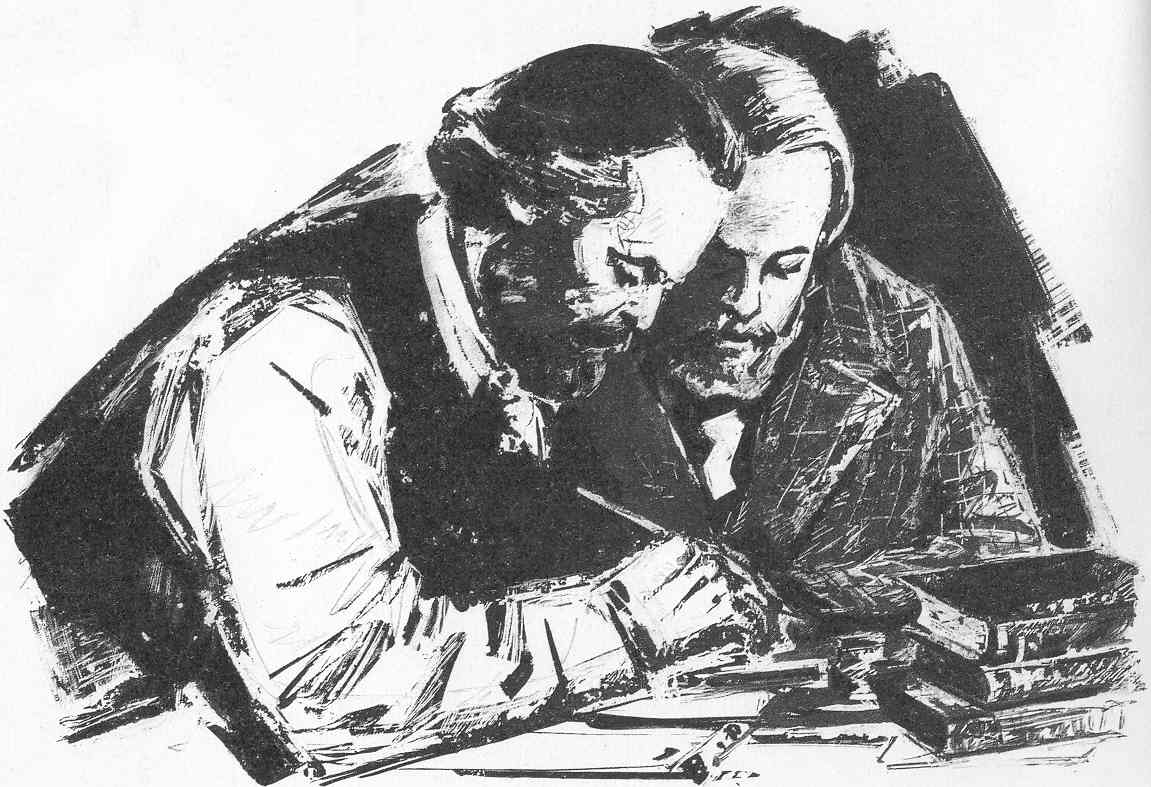
Marxs revolution in philosophy - Reflections on the Theses on Feuerbach<http://www.marxist.com/marx-revolution-in-philosophy.htm> Written by Alan WoodsFriday, 17 May 2013 [image: Print]<http://www.marxist.com/marx-revolution-in-philosophy/print.htm>[image: E-mail]<http://www.marxist.com/component/option,com_mailto/link,2647e4306e60dc43d4e137b2d5f893c0cbac72ce/tmpl,component/> - - - *The question whether objective truth can be attributed to human thinking is not a question of theory but is a practical question. Man must prove the truth i.e. the reality and power, the this-sidedness of his thinking in practice. The dispute over the reality or non-reality of thinking that is isolated from practice is a purely scholastic question. (Marx, Second Thesis on Feuerbach.)* [image: marx-engels] <http://www.marxist.com/images/stories/marx-engels.jpg>The problem of knowledge has occupied a central place in philosophy for centuries. But this so-called problem only arises when human knowledge is regarded a) as something separate from a physical body, and b) as something separate from the material world. What we have here is a one-sided view of consciousness, which is presented as a*barrier* that is supposed to shut us off from the external world. In fact, we are part of this world, not separate from it, and consciousness does not separate us but *connects us to it*. The relationship of humans to the physical world from the very beginning was *not contemplative but active *. We do not only think with our brain, but with our whole body. Thinking must be seen, not as an isolated activity (the ghost in the machine) *but as part of the whole human experience, of human sensuous activity and interaction with the world and with other people*. It must be seen as part of this complex process of permanent interaction, not as an isolated activity that is mechanically juxtaposed to it. Materialism rejects the notion that mind, consciousness, soul etc. is something separate from matter. Thought is merely the mode of existence of the brain, which, like life itself, is only matter organised in a certain way. Mind is what we call the sum total of the activity of the brain and the nervous system. *But, dialectically, the whole is greater than the sum of the parts*. This materialist view corresponds closely to the conclusions of science, which is gradually uncovering the workings of the brain and revealing its secrets. By contrast, the idealists persist in presenting consciousness as a mystery, something that we cannot comprehend. At this point our old friend the Soul re-emerges triumphantly accompanied by the Holy of Holies, angels, the Devil and all the rest of the mystical paraphernalia that science ought to have consigned to a museum long ago. Descartes and dualism Hiding behind the respectable façade of philosophical idealism is religion and superstition. Idealism is always at bottom, religion. The Immaculate and Eternal Soul was supposed to be locked up inside the grubby, imperfect and short-lived material body, longing for release at the moment of death, when we give up the ghost and float up to Paradise (if we are lucky). In this way, matter was thought of as a second class citizen, a scruffy peasant, destined to give way before His Majesty the Immortal Soul. This idea is as at least as old as Plato and Pythagoras, who saw the physical world as a poor imitation of the perfect Idea (Form), which existed before the world was thought of. The idea that the soul existed independently of the body was carried into modern times by the famous French philosopher Descartes (1596-1650). He confused the issue then and it has been confused ever since. He introduced the notion of dualism, which says that thought (consciousnesses) something separate from matter. Here mind is regarded a something that is present inside the body, but is quite different to it. The insurmountable difficulty with dualism is this: if the mind is entirely different to the physical body, *how can they interact*? The mistake is to treat consciousness as a thing, an independent entity, separate and apart from human sensuous activity. Modern science has forever banished the notion of consciousness as an independent thing. We now know what Descartes did not know about the workings of nature, the world of molecules, atoms and sub-atomic particles, of the electric impulses that govern the workings of the brain. In place of a mysterious soul, we are beginning to acquire a scientific understanding of how the human body and brain function. The action of nerve cells is both electrical and chemical. At the ends of each nerve cell there are specialized regions, the *synaptic terminals*, which contain large numbers of tiny membranous sacs that hold neurotransmitter chemicals. These chemicals transmit nerve impulses from one nerve cell to another. After an electrical nerve impulse has travelled along a neuron, it reaches the terminal and stimulates the release of neurotransmitters from their sacs. The neurotransmitters travel across the synapse (the junction between the neighbouring neurons) and stimulate the production of an electrical charge, which carries the nerve impulse forward. This process is repeated over and over again until a muscle is moved or relaxed or a sensory impression is noted by the brain. These electrochemical events can be considered the "language" of the nervous system, by which information is transmitted from one part of the body to another. This scientific explanation immediately does away with the mystical-idealist view of thought and consciousness as something mysterious and inexplicable, something divorced from the normal workings of nature and other bodily functions. Hand and brain The idealist view of consciousness and language is at odds with the facts of human evolution. It is abstract and arbitrary. It is also unhistorical. The relationship of early humans (and proto-humans) to the physical environment was determined by the need to find food and escape from the attentions of predators. The erect stance (brought about by the changes of the environment through climate change) freed the hands, which could then be used for manual labour. Consciousness arises from the evolution of the brain and the central nervous system. This evolution is in turn intimately related to human practical activity, that is, work. Humans transform their environment through physical labour, and in doing so, also transform themselves. This process has taken place over millions of years, and has its roots in earlier stages of evolution, in particular, the transition from invertebrates to vertebrates, which leads to the development of a central nervous system and eventually a brain. The connection between hand and brain is well documented. Increased manual dexterity and the development of a multiplicity of manual activities led to a rapid growth of the brain and increased capacity for thinking. As a matter of fact, there is a dialectical relationship between the large size of the brain, the erect posture and the development of the hand for specific operations. What a marvellous production of evolution is the human hand! The opposition of the thumb to the rest of the hand is the first adaptation that permits gripping and manipulation. This is the prior condition for all subsequent development. The apes used their hands to swing in the trees. They also used them for grasping sticks and in some cases even as primitive tools for quite sophisticated operations like digging for termites. Once our distant ancestors adopted the upright stance, the hands were free to experiment with many other operations. With constant practice, the hands became ever more skilled and able to perform finer and more complex operations, particularly the manipulation of natural objects as tools. It was the hand that developed the brain, not vice versa. This can be seen also in lower animals. They also do not contemplate the world *they eat it *. In the same way a human baby knows the world by putting it in its mouth. Likewise, language is not a tool, like a hammer or a shovel that is manufactured and manipulated at will. In fact, language evolves together with consciousness, as a product of social intercourse and collective production. It is not made but arises spontaneously from collective human activity and social life over a long period of time. The regular use of tools and collective labour must have necessitated some kind of language, triggering off a whole series of interdependent factors. All bodily and mental functions are closely connected. Dialectically, cause becomes effect and effect becomes cause. The human hand is closely linked to the eye and the brain, and the co-ordination needed to create even the most rudimentary stone tool is considerable. All humans make and use tools and the correlation of hand, eye and brain required for tool making is what drove the development of the brain over millions of years. "Use of tools appears to have predated major growth of the brain in mankind and is associated with fossil men of the Australopithecus type." (H.J. Fleure and M. Davies,* A Natural History of Man in Britain*, p. 47.) The conscious manufacture of elementary stone tools was clearly the driving force of the formation of elementary concepts and therefore the development of thinking. This undoubtedly had an effect on the inner structure of the brain, which was manifested in a growth in brain size. These transformations, taken in their totality, represented the qualitative leap that separated humanity from all other forms of living matter. Our species was therefore not fashioned by God as a special act of creation, but was the product of evolution, in which the decisive element was manual labour. *Thus, as Engels explained over a hundred years ago, it was not the brain that developed our humanity, but the hand that developed the brain*. Marxs philosophical revolution In his *Third Thesis on Feuerbach*, Marx wrote: The materialist doctrine that men are products of circumstances and upbringing, and that, therefore, changed men are products of changed circumstances and changed upbringing, forgets that it is men who change circumstances and that the educator must himself be educated. Hence this doctrine is bound to divide society into two parts, one of which is superior to society. The coincidence of the changing of circumstances and of human activity or self-change [*Selbstveränderung*] can be conceived and rationally understood only as *revolutionary practice*. In these few concentrated sentences is contained a philosophical revolution. The great German philosopher Hegel came close to discovering the truth, but despite his colossal genius he failed to make the decisive leap from theory to practice, blinded as he was by his idealist preconceptions. In Hegel, the dialectic remained obscured, its profound truths hidden in a mass of abstract and abstruse reasoning. It required the genius of a Marx to discover the rational kernel that lay hidden in the pages of Hegels *Logic* and apply it to the real, material world. With Marx philosophy finally emerges out of the dark and airless cellar to which it was confined for centuries by scholastic thought and dragged out, blinking, into the light of day. Here at last thought is united with activity not the one-sided purely intellectual activity of the scholar but real, sensuous human activity. The great German poet Goethe, answering the biblical assertion in the beginning was the Word, wrote: In the beginning was the*Deed*. But real human activity (labour) is not the activity of isolated atoms. It is necessarily collective in essence. It is the combination of the individual efforts, strivings, creativity of men and women that gives rise to all the wonders of civilization. It is the concrete realization of what old Hegel called the unity of the Particular and the Universal. Yet this necessary unity has been stubbornly denied. The thoughts and actions of humankind are presented, not as a collective activity, but as the work of isolated individuals. This false idea is at once a reflection of bourgeois prejudice and an attempt to justify the structures, morals and values of bourgeois society, a society in which the Ego (the individual) is said to rule supreme. In reality, the individuality of the great majority is crushed and enslaved to the individuality of a tiny handful that own and control the means of production and thus the key to life itself. And to tell the whole truth, even this minority is subject to forces that they do not control. Alienation and bourgeois society The late unlamented Margaret Thatcher once remarked famously: there is no such thing as society. But when Aristotle said Man is a political animal, he meant: Man is a *social *animal. The key to all human development (including thought and speech) is social activity and this has its roots in collective labour. Hegel said that the richness of a persons character is the richness of their connections. A person who is marooned on a desert island or held for many years in solitary confinement would find their ability to think and communicate gravely impaired. Capitalism tends to isolate, atomise and alienate people, who are taught to see themselves as individuals, that is, as isolated atoms. This reflects the social reality of the bourgeoisie and petty bourgeoisie, who are constantly competing against each other. This finds its reflection in politics, religion and philosophy. The bourgeoisie wages its first great battles against feudalism in the wars of religion of the 16th and 17th centuries when the Protestants claimed the right of every individual to worship God in his own way. Bourgeois individualism was a progressive force in the period of capitalist ascent, when the bourgeoisie was still capable of developing the productive forces and pushing forward the horizons of human civilization and culture. But that has receded into mists of history. In the epoch of capitalist decay, individualism has become mere egotism, selfishness and inhumanity. It breeds indifference towards the sufferings of others and foments barbaric attitudes and behaviour that threaten to undermine the very basis of culture and civilization. We all like to think that we are free to do what we like. But this is not the case. As the German philosopher Leibnitz once observed, if a magnetic needle could think, it would doubtless imagine that it pointed north from its own free will. In the 19th century Darwin fought to show that human beings were not the special creation of the Almighty but had evolved from the animal world. In the 20th century, Freud demonstrated that many of our actions are unconscious and that "free will" is really an illusion. At every stage, however, men and women have tried to deny these facts and sought to assert a special, privileged status for human beings in the great order of things. The very notion that we are not free agents and that our actions are determined by forces we cannot understand and control is profoundly repugnant to us. Yet, as Hegel explained, true freedom is not the denial of necessity but the understanding of necessity. Consciousness is determined by the physical environment. If Albert Einstein had been born in a peasants hut in some Indian village, his native intelligence might have made him an expert in planting rice, but does anyone believe that he would have discovered the Theory of Relativity? Trotsky once asked: How many Aristotles are herding swine, and how many swineherds are sitting on thrones? The whole outlook of the bourgeois is egotistical. But with the working class things are very different. Marx explains that without organization the working class is only raw material for exploitation. The workers are obliged to co-operate in collective labour, on the production line, where the mode of production is social, not individual. A peasant can say: I grew that cabbage. But no worker in Ford can say: I made that car. The consciousness of the worker is therefore naturally collective. The weapons of working class struggle are collective in character: the strike, the general strike, the mass meeting and mass demonstrations. Individualism is the hallmark of a strike breaker who places his own egotistical interests above those of his workmates. That is why the capitalist press always praises the courage of the scab, who is allegedly standing up for the freedom of the individual. Men and women make their own history by fighting to change and mould the circumstances that surround them. However, in changing social conditions, we also change ourselves. The idea that there is an eternal and fixed thing called human nature is a deeply engrained prejudice, but has no basis in fact. So-called human nature has been transformed many times in history, and is still changing and will change even more in the future. We live in an alienated, irrational world, which people cannot understand. In such a world, rational thought is unfashionable. In such a world it is *better not to think at all*. The emptiness of modern bourgeois philosophy reflects this idea perfectly, as in the vacuous platitudes of Post-Modernism. Men and women feel that they have lost control of their lives, that they are being displaced by strange and incomprehensible forces that are beyond their control. Human life is stripped of all its value and humanity and plunged into savagery and violence that destroys the foundation of a civilized and rational existence. Reason becomes Unreason, as Hegel put it. The alienation that is an all-pervasive feature of life in modern bourgeois society is even expressed in popular culture. How can one explain this strange modern fascination with robots, which are frequently portrayed as escaping from human control and taking over the world, as in the *Terminator * movies? Such works of science fiction tell us little or nothing about the nature of consciousness, whether in humans or robots, but rather speaks volumes about the alienated world that humans inhabit in the first decade of the 21st century. In the nightmare world of Terminator, things (machines, robots) have taken over the world and are enslaving people. But this nightmare is already a reality. In our times, *people are reduced to the level of things and things (especially money) are elevated above the level of people*. In ancient times pagan priests sacrificed babies to Moloch. Today millions of babies are sacrificed every year at the altar of Capital. The only way to abolish this sense of alienation is to abolish its material base. The only way to abolish irrational thought is to abolish the irrational relations between human beings in capitalist society. The only way to eliminate the feeling that we have lost control of our lives and destinies is to overthrow the contradictory relations of production and establish a rational planned economy, where all the decisions are taken democratically by free men and women. In a rational society, that is to say, a socialist planned society, the domination of people by things will be replaced by the administration of things by free men and women. Instead of being slaves to the machines, the later will be our obedient slaves. Under capitalism, every advance of technology only serves to lengthen the working day and increase the servitude of the workers. Under socialism, instead of toiling longer to produce ever greater amounts of surplus value, people will work less and live life more. The stunning advances of science and technology over the past century have placed in our hands all that is necessary to transform the planet. What science has revealed about the workings of the universe is far more fascinating, exciting and beautiful than all the supposed revealed truths of religion. By revolutionising its conditions of life, humanity will prepare the way for transforming itself, putting an end to the prehistory of our species, so that human beings will live, act and think as humans, not animals, as free men and women, not slaves. This brings us back to Marx's *Third Thesis on Feuerbach* where he wrote: The materialist doctrine that men are products of circumstances and upbringing, and that, therefore, changed men are products of changed circumstances and changed upbringing, forgets that it is men who change circumstances and that the educator must himself be educated. Hence this doctrine is bound to divide society into two parts, one of which is superior to society. The coincidence of the changing of circumstances and of human activity or self-change [*Selbstveränderung*] can be conceived and rationally understood only as *revolutionary practice*. This means simply: *To revolutionise thought it is necessary to revolutionise society.* London, 17 May, 2013. [Non-text portions of this message have been removed] ------------------------------------ --------------------------------------------------------------------------- LAAMN: Los Angeles Alternative Media Network --------------------------------------------------------------------------- Unsubscribe: <mailto:[email protected]> --------------------------------------------------------------------------- Subscribe: <mailto:[email protected]> --------------------------------------------------------------------------- Digest: <mailto:[email protected]> --------------------------------------------------------------------------- Help: <mailto:[email protected]?subject=laamn> --------------------------------------------------------------------------- Post: <mailto:[email protected]> --------------------------------------------------------------------------- Archive1: <http://www.egroups.com/messages/laamn> --------------------------------------------------------------------------- Archive2: <http://www.mail-archive.com/[email protected]> --------------------------------------------------------------------------- Yahoo! Groups Links <*> To visit your group on the web, go to: http://groups.yahoo.com/group/laamn/ <*> Your email settings: Individual Email | Traditional <*> To change settings online go to: http://groups.yahoo.com/group/laamn/join (Yahoo! ID required) <*> To change settings via email: [email protected] [email protected] <*> To unsubscribe from this group, send an email to: [email protected] <*> Your use of Yahoo! Groups is subject to: http://docs.yahoo.com/info/terms/