*Turkey KESK union expands June 5 public sector strike to 48h strike June
4/5 #genelgreve <https://twitter.com/search?q=%23genelgreve&src=hash> #
occupygezi <https://twitter.com/search?q=%23occupygezi&src=hash>
*
*
*
*DISK union calls for work stoppages and rallies tomorrow from 12 to 14h
http://www.disk.org.tr/default.asp?Page=Content&ContentId=1529
…<http://t.co/VUb0CH82pK>
#occupygezi <https://twitter.com/search?q=%23occupygezi&src=hash> #
genelgrevedavet <https://twitter.com/search?q=%23genelgrevedavet&src=hash>
*
*----------------------------------------*
http://www.marxist.com/turkey-join-declaration-of-general-strike-needed.htm


Turkish Protests: A joint declaration of general strike in solidarity with
the protests is urgently
needed!<http://www.marxist.com/turkey-join-declaration-of-general-strike-needed.htm>
Written by The Hook Monday, 03 June 2013
[image:
Print]<http://www.marxist.com/turkey-join-declaration-of-general-strike-needed/print.htm>[image:
E-mail]<http://www.marxist.com/component/option,com_mailto/link,a69770eae929302790c2b8dcf659fb372d4d35fe/tmpl,component/>

   -
   -
   -

I am sure that the fund managers in the City of London or New York’s
Manhattan or Frankfurt’s financial distrcit are very surprised. They may
even be shocked. I am quite sure that many fund managers and bankers who
have helped Erdogan's government stay in power for so many years by
channelling their hot money to Istanbul’s stock market are now calling
their brokers in İItanbul.

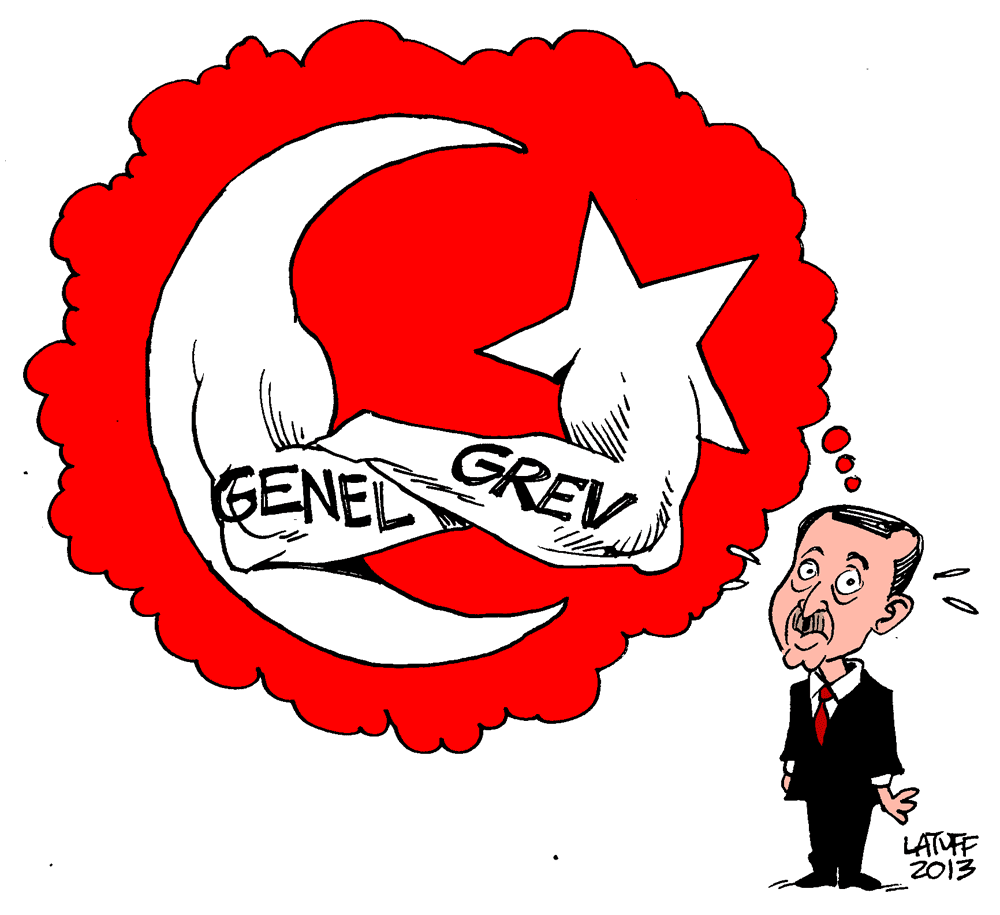
[image: Erdogan fears general
strike-Latuff]<http://www.marxist.com/images/stories/turkey/Erdogan_fears_general_strike-Latuff.gif>They
are saying: “But why? Why? it makes no sense to me! Turkey was growing at
the fastest rates in Europe and even in the world. The stock market was
rising, we were making good money as investors, there was political
stability and everything was fine! So what happened? This is totally
absurd!” And the brokers and their counterparts here in Istanbul are
answering back with the  following lines: “well, the government's
redevelopment plan of a city park in central Istanbul to turn it into a
shopping mall and residencial area, together with the new ban on alcohol
sales during night hours and blah, blah, blah …” They are answering in this
way and giving these explanations because this is the only thing they can
see with their narrow eyes and biased way of thinking…

In fact, what we see in Turkey and especially in Istanbul is a mass
movement, it is a mass revolt … What I saw when I walked among the
protestors in some areas of Istanbul was the following: they were around
the age of 18-25 mostly, educated, mostly students and some of them young
workers, and their anger was directed against the authoritarian rule of the
government of prime minister Recep Tayyip Erdogan. They were mostly secular
although there were tiny islamist groups among them who were calling
themselves “anti-capitalist muslims”… In addition to the protests in all
major cities of Turkey and violent clashes with the riot police, there is a
grass roots movement in Turkey that is going on currently. At 9 pm every
evening people take to the streets with their pans and pots and spoons and
maybe in their balconies, they are making a noise to show solidarity and
support for the protest movements all around the country. These people are
not only students or activists, you see older women and men of 60 or 70. So
it is combination of all age groups that I see here in Turkey participating
in the movement.

The movement that has erupted in Turkey for the past couple of days is
actually the result of the authoritarian style of the prime minister. But
the important thing is the following: he is authoritarian to only the
students, workers and to those who are oppressed. In fact, whatever he does
is to the benefit of the  bosses, the big industrialists and big banks and
international funds etc. So the prime minister of Turkey has a very clear
class identity. He is serving the interests of  big business, local and
international. Although he says that he is representing the interests of
the nation, by nation he understands those who vote for him. For him “the
nation” means big business.

In my opinion these protests can continue for a few more days but the point
is that there is one  element missing from the equation. In order for these
protests to be effective, we should see immediate involvement of the
working class in the movement. While I was writing these lines, I read in
the media that one trade union confederation called KESK (conferederation
of public workers trade unions) declared that it will go on a strike
starting from 12 am tomorrow. But this is not enough. In order to get a
meaningful result from these events that are unfolding in Turkey, we should
see the joint declaration of a political general strike in solidarity with
these protests from all major trade union confederations. Unless we hear
this, do not expect a major development from Turkey. Otherwise, people will
continue with their protests, but the result will be of no major
significance.

Comradely greetings,

The Hook

http://www.marxist.com/turkey-mass-movement-against-government-needs-general-strike.htm

Turkey: mass movement against government - general strike
needed<http://www.marxist.com/turkey-mass-movement-against-government-needs-general-strike.htm>
Written by Jorge Martín Monday, 03 June 2013
[image:
Print]<http://www.marxist.com/turkey-mass-movement-against-government-needs-general-strike/print.htm>[image:
E-mail]<http://www.marxist.com/component/option,com_mailto/link,66f8af9cf1c648962def0ff6e7aa288366c35a20/tmpl,component/>

   -

What started as a small scale protest against the destruction of Gezi Park
that stands next to Taksim Square in Istanbul has now developed into a
nationwide movement demanding the resignation of Prime Minister Erdogan, of
the AK Party.

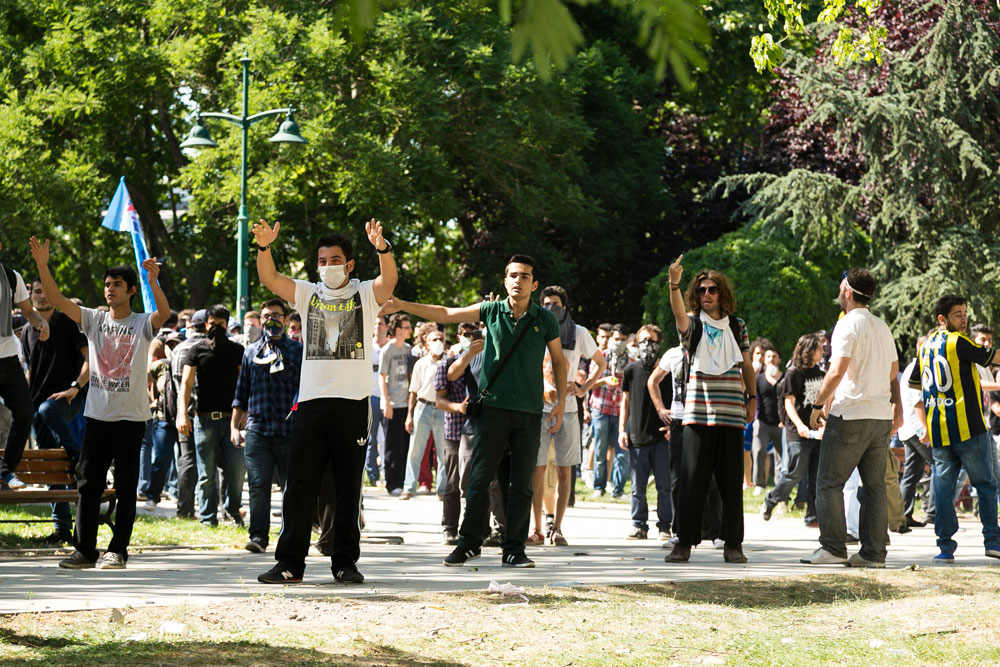
[image: Photo:
occupygezi]<http://www.marxist.com/images/stories/turkey/201306-occupygezi.jpg>Photo:
occupygezi <http://occupygezipics.tumblr.com/>On May 28, a few dozen people
decided to physically prevent work being carried out in Gezi Park to build
a shopping mall and were met with brutal repression by the police and
paramilitary thugs. They were surrounded so that there would be no escape
route and then subjected to a barrage of tear gas. Their small camp was
destroyed and their tents burnt.

Turkish police is known for its brutality (and there were violent clashes
when they prevented the May Day demonstration from entering Taksim Square).
However, something was different this time. Perhaps it was the fact that
the protesters kept coming back night after night, despite being subjected
to the same treatment. Or perhaps the fact that the public saw them as
ordinary citizens as opposed to hardened “radicals” or trade union
activists. Whatever the reason, the protests and the brutal police
repression sparked a wave of sympathy which very quickly became a mass
movement against the government which spread throughout the country.

The first reaction of Prime Minister Erdogan was typically arrogant,
taunting the protesters. “If you get 20 people we can get 100,000, if you
get 100,000 we will get 1 million” he challenged them, adding that his mind
was made up and there would be no change in the project.

The response from the masses was a huge demonstration on Friday, May 31.
Hundreds of thousands took to the streets of Istanbul. In Istiklal Avenue
tens of thousands fought against the police which used a massive amount of
tear gas and water cannons to attempt to prevent the crowds from entering
Taksim Square. Barricades were erected in different parts of the city and
clashes continued into the early hours of Saturday, June 1st. This was no
longer a small movement of a few activists, but a mass protest involving
diverse sectors of the population: “we are not activists, we are the
people”, some shouted. There was banging of pots and pans in neighbourhoods
across the capital, while in some places the protest took the form of
switching the lights on and off at regular intervals. The whole city was
alive and supporting the movement, horrified at the brutality of police
repression. "About half past one the entire city started to reverberate.
People were banging on pots, pans, blowing whistles," one eye-witness told
BBC News.

Another eyewitness described the composition of the crowd in this way: “you
could see members of the Communist Party with their red flags, but also
‘Anti-capitalist Muslims’, revolutionary socialist fronts, trade unionists,
Kurdish parties, even the CHP (social democratic nationalists), or elderly
men and women, unemployed youth, professionals (teachers, architects),
lower class people, middle class people and even upper class people.”

Football supporters from rival teams reached a deal to unite their forces
against police violence. The first to join forces were supporters of the
big three: Beşiktaş, Fenerbahçe and Galatasaray, but they were soon joined
by Beşiktaş’ sworn enemies Bursaspor, and then by Trabzonspor supporters
who have a long running feud against Fenerbahçe. A Beşiktaş fan tweeted:
“The pride I had when Galatasaray and Fenerbahçe fans were
shoulder-to-shoulder walking to the district shouting ‘Beşiktaş you are our
everything’ was worth everything. I am grateful.” As in the Tunisian and
Egyptian revolutions, football supporters provided their valuable
experience in street fighting against the police.

The participation of Kurds and Alevis in the movement is also significant
and should not be taken for granted. It was a member of parliament for the
Kurdish party BDP who was defending the Gize Park protesters in the initial
days of repression, only to be joined then by members of parliament for the
Republican Party CHP. The site of Kurdish flags side by side with Turkish
flags with the picture of Ataturk, next to red flags of socialist and
communist organizations reveals the broad scope of this movement.

A Reuters report described the following scene on Saturday: “After the
police withdrew from Taksim Square, supporters of Turkey's pro-Kurdish BDP
party danced a Kurdish dance in celebration just yards from nationalists
waving Turkish flags. They jointly chanted ‘shoulder to shoulder against
fascism’. A group of soccer fans from fierce rival Istanbul clubs
Fenerbache, Besiktas and Galatasaray joined the chant.”

This is very significant. As a matter of fact, we have argued for a long
time that the majority of the Kurdish population now lives in the urban
areas, they are workers in the huge cities of Istanbul and Ankara, and
their future will be determined by what happens there. Their national and
democratic demands can only be solved as part of a united struggle with
their Turkish class brothers and sisters against capitalism.

Only a few months ago many would have argued that this was impossible, that
the Turkish workers and even a significant section of the Turkish left
organizations are infected by national chauvinism. That was, and still is,
true, to a certain extent. But a few days of fighting the police together
in the barricades and marching together against Erdogan seem to have gone a
long way in uniting in struggle Turkish and Kurdish workers and youth in a
common struggle, showing what would be possible.

By this time the demonstrations had already spread to the capital Ankara
and other cities like Izmir, Izmit, etc. The demands and slogans of the
protesters had moved from the issue of defending Gezi Park to a general
opposition to the government and the demand for the resignation of Erdogan.

Then on Saturday, June 1st, a huge demonstration of tens of thousands which
had gathered in Kadikoy, in the Asiatic part of the city, decided to march
onto Taksim Square with the clear aim of taking it over and fighting back
against police brutality.

They walked the 20 km which separate Kadikoy from Taksim and nothing could
stop them. The country’s president called for the police to be withdrawn
and a court ruled that the building project in Gezi Park should be stopped
(in fact the mayor only has planning permission for an underground car
park!). At 4pm the order was given for riot police to retreat. Had they not
done so, they would have probably been over-run by the masses, angry at
police brutality and now aware of their own strength. This video gives an
indication of the size of the march and the mood of those present.

The masses entered Taksim Square in a mood of jubilation. A first, partial
victory had been achieved. The riot police, despite their brutality, had
been shown not to be invincible. This emboldened the masses. The movement
had now become truly national. According to official figures from the
Ministry of Interior, there were over 90 demonstrations in 48 provinces
across the country, with over 1000 people arrested, just on May 31 and June
1. The same official figures for June 2 were of over 200 demonstrations in
97 cities.

Clashes now moved to the Beşiktaş district, where the office of the prime
minister is located. The masses wanted to take it over. There were running
clashes with the police for two days. On the night of June 2nd, the
protesters commandeered a huge digger which had been brought to clear out
the barricades and used it to charge against the riot police, coming to
within 200 metres of the PM’s office. In Istanbul, but also in Ankara,
Izmir and other places, the movement had acquired insurrectionary features,
with the masses fighting back against the police and in some cases
successfully forcing them back.
The background to the movement

What is the background to this movement? How is it possible that an
apparently small issue (a “few trees” as Erdogan put it) has sparked such a
huge movement? Many learned commentators and clever analysts are puzzled.
How could this happen in an economy which has consistently registered very
high rates of economic growth and in which GDP per capita has more than
trebled in the ten years of the AKP government?

[image: 1 June. Photo: Eser
Karadağ]<http://www.marxist.com/images/stories/turkey/20130601-youth-Eser_Karadag.jpg>Defian
youth on 1 June. Photo: Eser Karadağ
<http://www.flickr.com/photos/turcain/>This
is not like the “Arab Spring”, they insist, which was motivated by economic
and social problems. Turkey has a democratic system, unlike Tunisia and
Egypt, they stress. However, if you look beneath the surface you can find
the accumulated combustible material which has now been ignited.

First of all, the issue of the building of a shopping mall in Gezi Park is
not just a question of “a few trees”. To start with, Taksim Square has an
historic significance for the Turkish left and trade union movement. It was
here that a huge demonstration of half a million people on May Day 1976 was
attacked by paramilitary gangs (in all probably linked to the state
apparatus and with the support of the CIA) and the security forces, who
killed 42 and injuring hundreds. The return of the May Day demonstration to
Taksim Square and the punishment and trial of those responsible for the
killing (none of whom have yet been brought to justice) has become a cause
of enormous symbolic importance for the left and trade union movement in
Turkey.

There is more to it. The official plan of the municipality is to build a
reconstruction of the Ottoman Empire Taksim Military barracks which would
house the shopping mall. This is seen as part of the AKP agenda to reclaim
the ancient grandeur of Turkey under the Ottoman Empire. Last week it was
announced that a planned third bridge over the Bosphorus is going to be
name after Sultan Selim I (Selim the Grim). This has infuriated the Alevi
minority, which Selim massacred in the 16th century. All this reclaiming of
the legacy of the Ottoman Empire is deeply offensive not only to Alevis but
also to many Turks, who are attached to the secular tradition of the
bourgeois national movement of Ataturk, on which the modern Turkish
republic was founded.

It is not just a religious vs. secular issue either. The planned shopping
mall in Taksim has come to symbolize the type of speculative urban
development model on which the economic growth during the AKP government
has been based upon. Opposition to the gentrification of whole areas of the
city, the pushing out of working class people to the outskirts of the
capital, the shoddy construction deals going to cronies of the ruling
party, the glaring contradiction between the luxury homes of the
millionaires and the shanty towns where the recently arrived workers live
was all concentrated in the struggle against the bulldozing of Gezi Park to
make room for yet another shopping mall. A speculative building boom was in
fact a key element of the sustained economic growth which Turkey
experienced for the best part of ten years and which is now coming to an
end.

There are also of course, democratic issues. For ten years the AKP has
ruled with an iron hand, arresting independent and critical journalists,
censoring the media (which did its best not to report anything about the
current movement as it was developing), maintaining thousands of political
prisoners, using repression and arrests against the trade union movement,
etc. This has been combined with a creeping assault on the secular
character of the state, the latest measure being a law which curtails the
public sale of alcohol.

Many of these things were passively accepted, or at least did not provoke a
mass movement up until now, as the economy was growing. It was mainly on
the basis of this economic growth that the AKP solidified its electoral
support, which went from 34% in 2002, to 46% in 2007 and nearly 50% in 2011.

On the surface, the AKP had achieved very impressive rates of growth.
Between 2002 and 2011, the Turkish economy grew by an average rate of 7.5
percent annually. Average per capita income rose from $2,800 U.S. in 2001
to around $10,000 U.S. in 2011. The economy was hit by the global crisis of
capitalism in 2008/09, but recovered quickly with strong rates of growth of
9% and 8.5% in 2010 and 2011.

However, quite a lot of this growth was based on a massive influx of
foreign direct investment, attracted by a programme of wholesale
privatisation of public assets, which meant the country accumulated a
massive foreign debt. Between 2008 and 2012, GDP grew by $44 billion, while
foreign debt grew by $55 billion. This became unsustainable.

While Turkey benefited from trade agreements with the European Union, the
crisis in Europe has forced it to pursue a more aggressive political, trade
and diplomatic offensive in the Middle East and North Africa in recent
years. Behaving like a regional imperialist power, Turkey has attempted to
secure markets and spheres of influence in the whole region by linking up
with the newly established Muslim governments of Tunisia and Egypt,
building strong links with the Kurdish Regional Government in Northern Iraq
and becoming actively involved in supporting the Free Syrian Army rebels
against the Assad regime.

All the factors that created the “Ottoman tiger” are now turning into their
opposite. Three weeks ago a bomb in Reyhanli, on the border with Syria,
killed 46 people. Many are blaming the government’s involvement in the
Syrian civil war for the killing of innocent civilians in Turkey. Erdogan,
who had previously openly clashed with Israel, is now seeking rapprochement
with the Jewish state as he finds himself on the same side of the Syrian
conflict.

>From an economic point of view, the “miracle” is over. Some have described
the Turkish economy as “*a gradually-deflating balloon, subject to erratic
and irregular whims of the markets.*” GDP growth has dramatically slowed
down to an almost standstill. The rate of growth for 2012 was just 2.2%,
with domestic private consumption contracting 0.8% in the last quarter.

The headline figures of economic growth in reality were hiding a persistent
and deep divide between the rich and the poor. In 2011, when GDP grew by
8.5%, the richest 20 percent of the population held almost half of national
income while the poorest 20 percent had just 6 percent. Despite the
economic growth of the last decade, Turkey is the third most unequal
country in the OECD.

The glaring contradictions between the wealthy elite and the majority of
the population are exemplified by a tax system in which indirect taxation
represents 2/3 of revenue hitting working people and the poor hardest. Even
indirect taxes are skewed in favour of the wealthy, with the general sales
tax at 18%, while it is a mere 8% for caviar and 0% for some precious
stones.

The unemployment rate has remained at around 9% throughout this period, and
the official figures grossly underestimate the situation in which many have
ceased looking for a job altogether. Youth unemployment amongst university
graduates is around 30%. The official figure for people living below the
poverty line is 16%.

The resentment created by an economic boom which maintained inequality was
contained by a general improvement in living standards, while at the same
time created higher expectations which could not be met. Now that economic
growth is slowing down sharply, all the contradictions have come to the
fore.

It is this combination of democratic issues and social tensions which has
now exploded in this massive movement against Erdogan which has taken
everyone by surprise.

The speed at which it has developed from an apparently minor issue into a
national mass movement against the government also reflects the enormously
turbulent period we live in globally. The overthrow of Mubarak and Ben Ali
in 2010 and the massive protests against austerity cuts in Southern Europe
in the last two years will have certainly had an impact on the
consciousness of millions of people in Turkey. For a while, it seemed that
those movements had nothing to do with them, but when conditions became
ripe, the idea that united mass action is the only way forward captured the
imagination of the masses and has became a material force.
Regional implications

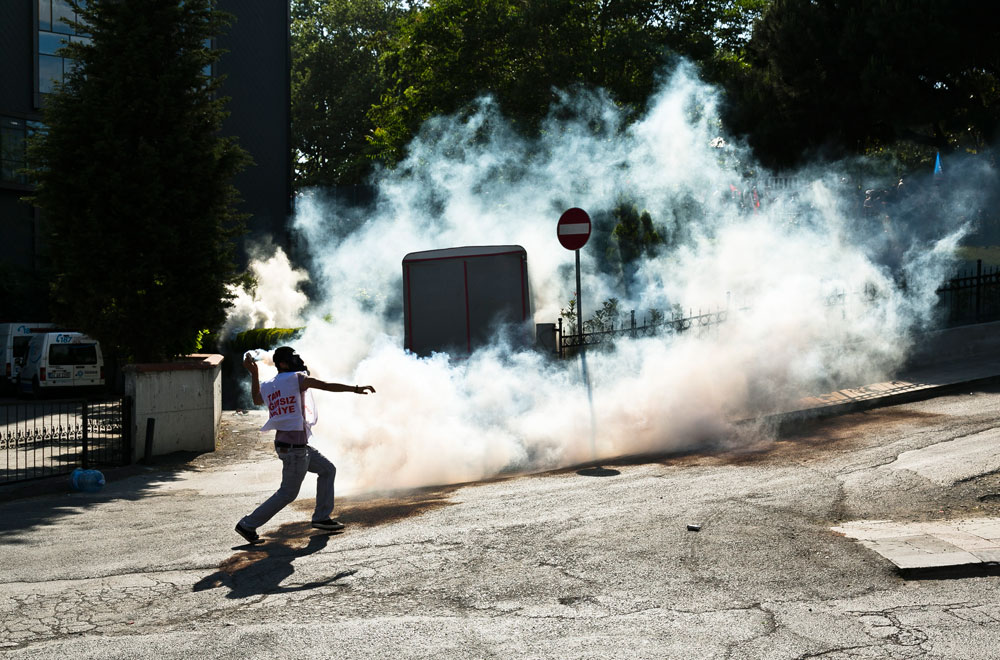
[image: Teargas on the streets of Istanbul. Photo: Eser
Karadağ]<http://www.marxist.com/images/stories/turkey/20130601-teargas-Eser_Karadag.jpg>Teargas
on the streets of Istanbul. Photo: Eser
Karadağ<http://www.flickr.com/photos/turcain/>Revolutionary
developments in Turkey will have a massive impact throughout the region,
both in the Middle East and in Europe. A mass movement against an Islamic
conservative capitalist government in Turkey can only weaken the appeal of
the Islamists in other countries and at the same time strengthen the
revolutionary movement against the EnNahda government in Tunisia and the
Muslim Brotherhood government in Egypt.

There have already been demonstrations in Cyprus where we now can see the
prospect of revolutionary developments on both sides of the national
divide. In Greece solidarity demonstrations have already taken place, and a
revolutionary movement in Turkey is the best way to push back the old ugly
ghost of Greek vs. Turkish national chauvinism.

Washington is certainly very worried at the prospect of revolutionary
developments in yet another of its allies in the region. Turkey is a key
player from the point of view of imperialist intervention in the civil war
in Syria which threatens to destabilise the whole region. This goes to
highlight how it is only revolutionary events in the countries with a
stronger working class that can prevent the descent of the region into the
inferno of a bloody sectarian civil war with imperialist powers involved on
both sides.

The last thing the US want is the revolutionary overthrow of Erdogan. For
this reason they have advocated restraint and have officially complained
about “excessive use of force”. Of course, if excessive use of force could
have achieved the intended aim of smashing the movement, then there would
have been no complaints. What they are really saying is that they are
worried that excessive use of force by the police is provoking the opposite
effect.

Erdogan is combining arrogance and the use of brutal repression (there were
reports yesterday of helicopters throwing tear gas into residential areas),
with an attempt to play the religious card. He is now saying that what he
really would like to build in Gezi Park is a mosque! He wants to give the
image of being strong and decisive, but there are growing voices of
opposition even from within his own party.

As we have witnessed before in the revolutionary movements in Tunisia and
Egypt, the most dangerous moment for any regime is when it can no longer
crush a movement by force, but making concessions could also encourage it
to go further. This is the dilemma facing Erdogan and the section of the
ruling class he represents at this moment.

We should not forget that he probably still has reserves of support amongst
the more backward and conservative layers in society. But this will
probably be inert, passive layers, not a force than can be mobilised in
massive numbers to decisively face the protesters. There have been reports
of plain clothes AKP thugs helping the police in several cities, but these
are small gangs, not a mass movement.

Already they are playing a game of "concessions" in order to defuse the
movement. The country's president Abdullah Gül has apparently distanced
himself from Primer Minister Erdogan, by saying that he understands the
reasons of the protesters and that democracy is not only ballots every few
years. However, these are just words, as he has not actually made any real
concessions and is calling for protests to stop. Erdogan is waving the
stick and Gül a symbolic carrot, but what they both want is the same: that
the masses should go back home and abandon the streets.

What happens in the next few days and hours will be decisive. The movement
has not yet exhausted its reserves of support, is confident and becoming
emboldened. If it takes a decisive step forward it could bring the
government down.
Which way forward?

The movement so far has been largely spontaneous in its nature, as it could
not be otherwise. It developed extremely quickly from a small protest of 50
people to a mass movement which now involves probably millions in one way
or another. It has also united different sections of society and different
national groups and minorities. This is its strength.

[image: Solidarity from Spain. Photo:
Fotomovimiento]<http://www.marxist.com/images/stories/turkey/20130601-Spain_Istanbul_is_not_alone-Fotomovimiento.jpg>Solidarity
from Spain. Photo:
Fotomovimiento<http://www.flickr.com/photos/acampadabcnfoto/>However,
the movement cannot remain at this level if it is to move forward.
Yesterday there were intense discussions about the need for a general
strike. This is really the way forward for the movement. There have already
been mass demonstrations in most of the country. People have fought back
against the riot police. The state apparatus has not been able to crush the
movement for now. However, the government remains in place and the state
apparatus is intact.

The entry of the working class as an organized force in the movement could
decisively change the balance of forces. A general strike is needed.
Already the public sector workers union KESK has expanded its planned
national strike on June 5 for June 4 as well. The leaders of the DISK union
confederation were present in Taksim Square and its general secretary
addressed the protesters. DISK has also called for workplace stoppages
tomorrow from 12 to 14h to discuss the situation and is planning a national
executive meeting to discuss the issue of the general strike.

Today, both DISK and KESK are jointly discussing the calling of a general
strike coinciding with the public sector workers’ strike on June 5.
According to some reports the Istanbul Education Union n. 6, organizing at
universities and colleges, has already issued a strike call for today and
tomorrow. There is news that hospital workers in Ankara are also coming out
on strike.

Turkey has a strong working class, replenished and strengthened in the last
20 or 30 years with a massive influx of migrants from the countryside. Its
revolutionary traditions are second to none. While containing many areas of
backwardness, Turkey also has a very modern industrial working class.

The call for a general strike should be combined with a call for the
setting up of committees of action in every factory, workplace and working
class neighbourhood to give the movement an organised and democratic
character. Such committees could be coordinated at a local, regional and
national level through elected representatives.

In fact, if there were a revolutionary leadership with roots in the working
class, we would be on the eve of a revolutionary overthrow of capitalism in
Turkey.


[Non-text portions of this message have been removed]


------------------------------------

---------------------------------------------------------------------------
LAAMN: Los Angeles Alternative Media Network
---------------------------------------------------------------------------
Unsubscribe: <mailto:[email protected]>
---------------------------------------------------------------------------
Subscribe: <mailto:[email protected]>
---------------------------------------------------------------------------
Digest: <mailto:[email protected]>
---------------------------------------------------------------------------
Help: <mailto:[email protected]?subject=laamn>
---------------------------------------------------------------------------
Post: <mailto:[email protected]>
---------------------------------------------------------------------------
Archive1: <http://www.egroups.com/messages/laamn>
---------------------------------------------------------------------------
Archive2: <http://www.mail-archive.com/[email protected]>
---------------------------------------------------------------------------
Yahoo! Groups Links

<*> To visit your group on the web, go to:
    http://groups.yahoo.com/group/laamn/

<*> Your email settings:
    Individual Email | Traditional

<*> To change settings online go to:
    http://groups.yahoo.com/group/laamn/join
    (Yahoo! ID required)

<*> To change settings via email:
    [email protected]
    [email protected]

<*> To unsubscribe from this group, send an email to:
    [email protected]

<*> Your use of Yahoo! Groups is subject to:
    http://docs.yahoo.com/info/terms/