Miroslav Lichvar wrote:
On Wed, Jul 01, 2015 at 11:39:47AM +0000, Poul-Henning Kamp wrote:
They dropped the raised-cosine thing, because the change of frequency
was bad for the NTP clients PLL's.
The linear smear is just a slightly different frequency for a fixed
period of time, that's a lot easier for the PLL to track.
A frequency step of ~14 ppm is easier to follow than a gradual change?
That doesn't sound right to me, at least not with the standard NTP
PLL/FLL loop.

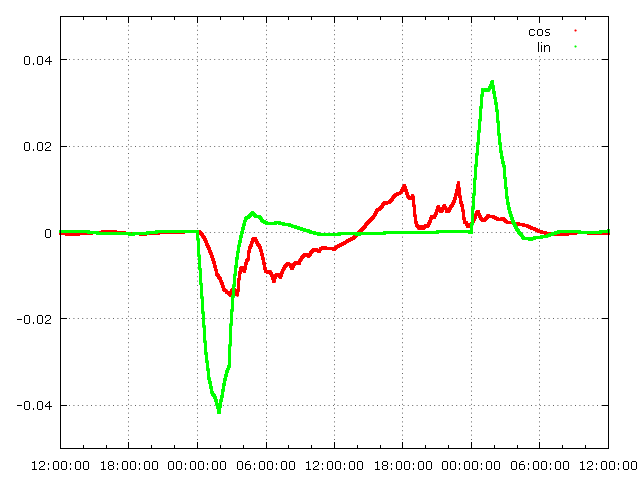
I actually have some data from experiments I did when was I implementing
a server smear in chrony. Here you can see the offset of ntpd
synchronized with a server using a cosine function and a server
using a linear function over the same interval.

https://mlichvar.fedorapeople.org/tmp/leap/cos_lin_smear.png

The maximum offset with the linear smear was almost three times larger
than with the cosine smear. I think there is a different reason why
they switched to the linear smear.
I haven't tried the linear smear, yet, but the cosine approach showed
similar results with the patch I've submitted for ntpd.
Here's the smear offset applied by the server:
http://people.ntp.org/burnicki/leap-smear/leap-smear-offset-cosine-86400s.pdf

And here the client response:
http://people.ntp.org/burnicki/leap-smear/leap-smear-cosine-86400s-linux-ntpd-4.2.6p5.pdf

I'm going to run a test with a linear approach, too.

Martin
--
Martin Burnicki

Senior Software Engineer

MEINBERG Funkuhren GmbH & Co. KG
Email: [email protected]
Phone: +49 (0)5281 9309-14
Fax: +49 (0)5281 9309-30

Lange Wand 9, 31812 Bad Pyrmont, Germany
Amtsgericht Hannover 17HRA 100322
Geschäftsführer/Managing Directors: Günter Meinberg, Werner Meinberg,
Andre Hartmann, Heiko Gerstung
Web: http://www.meinberg.de
_______________________________________________
LEAPSECS mailing list
[email protected]
https://pairlist6.pair.net/mailman/listinfo/leapsecs