Yes, I know of just a few in Europe who are doing this. I'm not sure
I would say "quite a few", it is still rare, especially here in the US.
There are some nice pictures on the website of relative string sizes.
I prefer Mimmo's gallery of the originals, but it is good to compare
what we are using with what they had back then.
I would slightly differ, or amplify,  on the statement about some
musicians using all gut in the 18th century--it is instrument
specific. On the violin, all gut, unwound strings were the standard
into the late 19th century, and even the early 20th century.
On the cello, you start to see silvered fouth strings in the 18th
century in paintings, and there are a small number even earlier.

Although the strings are perhaps the most most important, the other
things that affect the sound are the bridge--which as thicker--the
bass bar (smaller) and one of the most overlooked of all--the bow.
Original bows were lighter and had far less strands of hair than the
ones that are used now in baroque performance.

Just as an experiment, you can take a typical heavy baroque violin
bow and try it yourself or have the player try it on a cello or bass
viol. You will then immediately hear what a huge difference just
using a lighter, thinner bow makes.

Put it all together, the bow, the bridge, the strings, the bass bar,
and on and on, and you get a sound that is radically different, much
more vocal, and, most importantly, does not drown out the lute!

Can't say I agree with the Bonta bits about the cello sizes, they
obviously had dozens of different kinds of cellos and violones back
then, and the sizes persisted well into the Classical period.
Trying to "match" terms to instruments only works if the terms were
used consistently in the historical period in question, which, as far
as I can tell, they were not.
The result is that certain historical instruments perform a scholarly
disappearing act because the terminology has been regularized.

Exactly when that metal string started appearing on the lowest note
of the cello is an interesting topic all by itself.
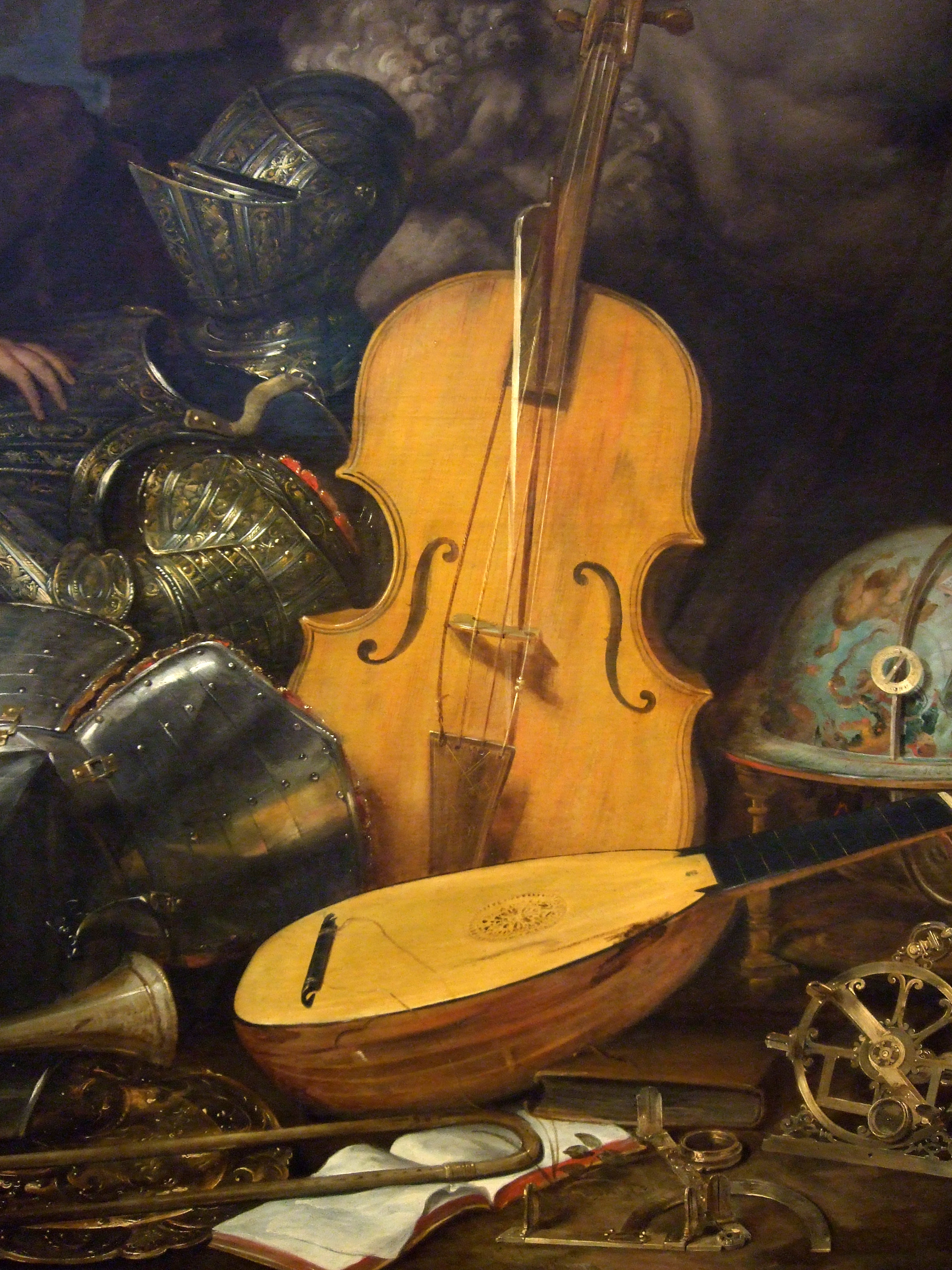
If you look at this amazing painting
http://voicesofmusic.org/baroque_cello.jpg
You can see the strings clearly, as well as how thin the bow is

dt

At 08:05 PM 3/25/2010, you wrote:

>On Mar 24, 2010, at 2:48 PM, David Tayler wrote:
>
> > I've yet to play in an orchestra where the violins used all gut
> > strings on all four strings, as was the practice of the time, but it
> > will happen, I think.
>
>This aroused my curiosity, so I posted a question to the early music
>list, and, as expected, got a response from Oliver Webber, which
>might be of interest:
>
>On Mar 25, 2010, at 6:18 PM, Oliver Webber wrote:
>
> > This is a subject close to my heart - in the UK and other parts of
> > Europe (Amsterdam, France) there are quite a few period instrument
> > ensembles which insist on proper historical stringing now.
> > For music pre-1660 or so, this unequivocally means all gut (and
> > nothing else!); between 1660 and about 1750, we know wound strings
> > existed, but their incorporation into general use seems to have been patchy
> > at best, and varied a lot from one country to another. Certainly some
> > musicians were still using all gut in the middle of the 18th century
> > (we know this from sales records).
> > Another issue is the tension profile of the strings - but I'd better
> > not get into that now. If you're curious, have a look at
> > www.themonteverdiviolins.org; the site is desperately in need of
> > updating (sorry!) but there's a link there to an article about strings
> > I wrote which might be of interest.
> >
> > Anyway - to answer the OP's question, I frequently play with ensembles
> > where the strings are nothing but gut: my own group, the Monteverdi
> > String Band, does so, as does (at least for earlier repertoire) the
> > Gabrieli Consort. It's now easier to get good quality thick gut
> > strings which make this viable, and the sound, especially in a large
> > ensemble, can be thrilling.
> >
> > For early 18th century repertoire, ensembles which use historical
> > stringing might use wound C's for cellos and violas, and wound Gs for
> > violins - if made to the right proportions (ie, plenty of gut and a
> > nice thin silver winding!). With the right tension profile this is
> > still quite a different sound from the "old-fashioned" (ie 70s and
> > 80s!) so-called baroque stringing - very light, with lots of thin
> > wound strings. The sound is much more weighty and substantial, and
> > articulation comes to the fore.
>
>--
>
>To get on or off this list see list information at
>http://www.cs.dartmouth.edu/~wbc/lute-admin/index.html