Chris Evans a écrit :
------------------------------------------------------------------------
*From:* Claire Robinson <[email protected]>
*To:* [email protected]
*Sent:* Friday, January 13, 2012 6:45 AM
*Subject:* Re: [Mageia-dev] FireFox ESR <= we should totally go for
this wrt stable releases
On 13/01/12 11:37, Michael Scherer wrote:
> Le vendredi 13 janvier 2012 à 11:21 +0000, Claire Robinson a écrit :
>> On 13/01/12 09:36, nicolas vigier wrote:
>>> On Fri, 13 Jan 2012, Sander Lepik wrote:
>>>
>>>> 13.01.2012 03:20, Maarten Vanraes kirjutas:
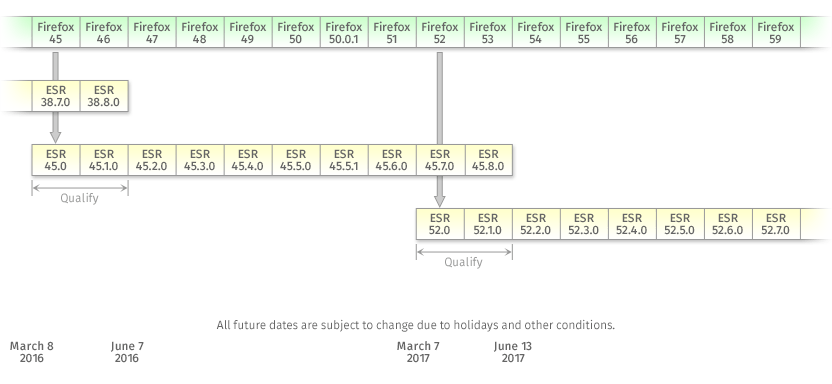
>>>>> see
https://blog.mozilla.com/blog/2012/01/10/delivering-a-mozilla-firefox-
>>>>> extended-support-release/
>>>>> see https://wiki.mozilla.org/images/9/9d/Esr-release-overview.png
>>>>>
>>>>> ESR is a 1y extended supported release...
>>>>>
>>>>> looking at the image we'd be having supported versions for our
9month release
>>>>> schedule every time... we should totally use this release and
not go towards
>>>>> FF11 for our release.
>>>>>
>>>>> We've been complaining about the too quick release schedule...
this is our
>>>>> chance!
>>>>>
>>>>> ( i think if the FF maintainer wishes, he could also do
backports of the
>>>>> regular releases... )
>>>>>
>>>>> i'm hoping everyone agrees? including FF maintainer?
>>>> I don't agree. But i'm not the maintainer.
>>>>
>>>> Why not?
>>>> * Since fx10 all non-binary extensions are compatible by default
(so our
>>>> main problem goes away).
>>>> * fx10 in 6 months is dead old for users POV. Many unhappy users.
Lower
>>>> popularity for Mageia. (Ubuntu AFAIK is going with fast schedule).
>>>> * We will miss too many new and cool features.
>>>> * When we release
>>>
>>> We could say the same about any other software. Firefox was an
exception
>>> on updates policy because there was no other choice. But there's no
>>> reason to keep it as an exception when they provide a supported
version.
>>>
>>
>> With 12 months support more often than not it would need updating
in the
>> lifespan of the Mageia 9 month release anyway.
>>
>> Firefox is one of those programs that people like to be bang up to date
>> with.
>
> All softwares are one of those programs. The only one that some non
> technical users do not want to be updated are those that they do not
> know, like glibc, python, perl. But still, there is people that want it
> up to date, so firefox is nothing special.
>
>> It is 'bragging rights' to ship with the latest and something
>> reviewers always give version numbers of along with libreoffice,
kde, gnome.
>
> Sure, and we neither update libreoffice, kde, gnome or the linux kernel.
> Some people do ( kde is upated by Fedora, as well as the linux kernel ).
> So that's a consistency issue, about what we promise to users.
>
> Stability is just that, stuff that do not have interface changes every 6
> weeks, stuff that do not have slight mistranslation everytime string
> change, stuff that do not risk breaking software after every updates.
>
>> I understand the arguments to go with the 12 months support but I think
>> for the reasons above we should stick with the normal release cycle or
>> maybe even offer both?
>
> Offering both would mean to double our workload of supporting firefox,
> and have no advantages by using the long supported release.
>
> And that's rather useless from my point of view, if the goal is to
> reduce the workload. There is already enough work to support the
> distribution.

My meaning was that it isn't just general software. As I said, it is one
of those packages that reviewers quote version numbers and users expect
to be updated.

IMO we should be on the latest version but I really do understand the
arguments against it so I understand why you disagree :)
----(previous post)
This really doesn't make sense. The browser is our interface to the
internet. I (as a user) feel a need to have the latest version of my
browser complete with all security patches. I really couldn't care
less if I have the latest gnome or kde. Surfing the net using a
browser with known security issues bothers me. I think this is why so
many people consider firefox to be an exception to the rule. Where
most software that is older is considered to be more stable, when
talking about a browser it is generally the opposite. It would be nice
to at least give the users a choice, maybe have the LTR version as
well as the latest release available. I have seen other distros
provide chrome stable, testing, and unstable. Allowing the user to
choose which version they are most comfortable with.
Wait.
A long-term release version is kept updated for bugs, particularly
security bugs, but doesn't add new features.
Since it doesn't add new features, it is less likely to introduce new
bugs, and so would be more secure.
(That is why, in case you haven't noticed, that Firefox has more
security issues than Seamonkey, which is one step behind Firefox in
adopting new features.)
So if you want a stable, secure browser, prefer among Mozilla browsers
the Firefox long-term release, or for more stable, Seamonkey.
For the minority of users who want the latest features, despite the
greater risk, like the cauldron of Mozilla, it is easy to download the
latest Firefox release, direct from upstream. (It will be available
there at least a week sooner.)
Upstream Firefox by default warns when the latest update is available.

--
André