The few Uighurs I know are certain that the Chinese government treats them in
repressive ways. They recount many instances and policies of oppression.
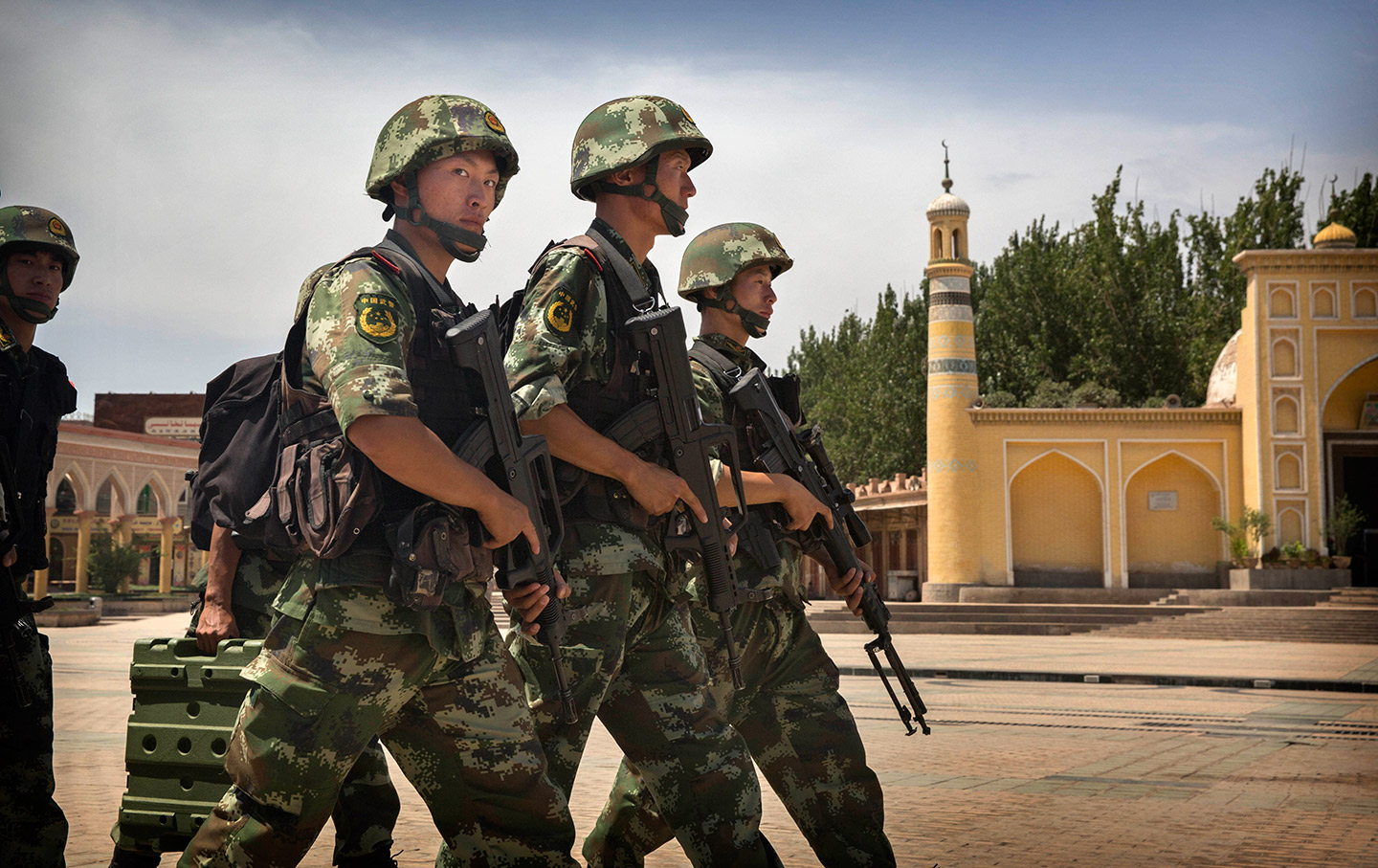
But it is a mistake to assume that there is an ethnic group called "Uighurs." That is really a blanket term for the Muslim central Asians who live in Xinjiang, disparate peoples ethnically, who are banded together against Chinese repression. I see this as a religiously-based imperialism against people who for expedient purposes band together under the Uighur banner. Wythe > On July 7, 2021 at 8:27 AM Louis Proyect <[email protected]> wrote: > > Xinjiang Denialists Are Only Aiding Imperialism > Denying China’s oppression of Uighurs helps empire—both China’s and the > US’s. > By Gerald Roche https://www.thenation.com/authors/gerald-roche/ Twitter > https://twitter.com/GJosephRoche > > The Nation Magazine, YESTERDAY 10:27 AM > > > [facebook sharing button] > [twitter sharing button] > [flipboard sharing button] > [pocket sharing button] > [email sharing button] > > > [Chinese Troops Xinjiang] > https://www.thenation.com/wp-content/uploads/2021/07/xinjiang-kashgar-gty.jpg > > Chinese soldiers march in front of the Id Kah Mosque on July 31, 2014, in > Kashgar, China. (Getty Images) > Sign Up For Our Wine Club Today. > Did you know you can support The Nation by drinking wine? > https://www.thenationwineclub.com/ > > Opposing American empire should never justify supporting perpetrators of > atrocities, and yet that’s exactly what some anti-imperialists are doing with > their analysis of events in China’s Xinjiang region. These pundits claim that > efforts to expose human rights abuses in Xinjiang are really aimed at > generating consensus for a “new Cold War” against China. It is only the > latest manifestation of American denialism, and instead of challenging US > empire, it only helps to cover up US government complicity in the oppression > of Uyghurs in Xinjiang. > > > > Americans have a history of rejecting the facts of unjust violence > abroad. The tactic is most associated with right-wing Holocaust denialism. > The historian Deborah Lipstadt traces > https://www.google.com.au/books/edition/Denying_the_Holocaust/_yLm_cHp_REC?hl=en&gbpv=0 > American Holocaust denialism back to interwar historians and their > criticisms of America’s decision to enter World War I. Unlike denialists, > these revisionists had truth on their side. Britain had falsified reports of > Germans’ using babies as target practice, mutilating civilians, and > committing other acts of brutality in order to lure America into the war. > > > > Post–World War II critics adopted similar strategies, often portraying > the Germans as victims and the Allies as aggressors. But Germany had actually > committed mass murder this time. And so revisionists became denialists. They > claimed that the Holocaust had been fabricated to coax America into another > European war. For these right-wing denialists, the point was never about what > had happened to the victims. It was about making domestic political gains. > And if that involved supporting abhorrent regimes and refusing to acknowledge > their crimes against humanity, so be it. > > > > Although these denialists mostly aimed to promote US isolationism, others > have followed, pursuing different agendas using the same techniques. These > have included anti-imperialists on the left > https://www.tandfonline.com/doi/abs/10.1080/1462352032000149495 who, in > order to critique American empire, dismiss obvious truths and question > https://www.researchgate.net/publication/332083260_Denying_Rwanda_Why_Do_Leading_Leftists_Deny_the_Rwandan_Genocide_of_1994 > whether well-documented massacres ever happened. > > > > Most notorious among anti-imperialist deniers are Edward S. Herman and > David Peterson. In their book The Politics of Genocide > https://www.pambazuka.org/governance/politics-denialism-strange-case-rwanda , > they argue that most accusations of genocide are justifications of US > imperialism in the name of “humanitarian intervention.” Looking for US > interests behind every report of genocide, they even invert the role of > victim and perpetrator in the Rwandan Tutsi genocide, portraying the > post-genocide government as a tool of US empire. Noam Chomsky, despite his > otherwise nuanced views on genocide > https://scholarcommons.usf.edu/cgi/viewcontent.cgi?article=1738&context=gsp , > legitimized these arguments by providing a foreword to the book. > > > > XINJIANG DENIALISM > For many anti-imperialists, the need to denounce US empire is reason > enough to support any of its opponents. And if those opponents commit > atrocities, their abuses can be denied. Xinjiang is just the latest iteration > in this pattern. The specific identities of the Xinjiang denialists don’t > really matter, and I have no intention of inflating their cause by naming > them or linking to their work. What brings them together is a tireless effort > to debunk every aspect of the “mainstream” narrative about Xinjiang, and to > scream “got his ass” at anyone who refuses to debate their ludicrous ideas. > > > > To understand the perversity of this denialism, you don’t have to believe > every think tank report and news item about Xinjiang; indeed, there are good > reasons to approach all of these critically. Nor do you have to agree that > what’s happening to the Uyghurs constitutes genocide (though I do). This is > because what these anti-imperialists deny is much broader than the > application of a term in international law. They deny basic facts of history. > > > > CURRENT ISSUE https://www.thenation.com/issue/july-12-19-2021-issue/ > > > View our current issue > https://www.thenation.com/issue/july-12-19-2021-issue/ > If you like this article, please give today to help fund The Nation’s > work. https://www.thenation.com/email-signup-module-donate/ > > > > Like the United States itself, China is an imperial state. Its > contemporary borders are the result of conquest, and its current population > is a collection of peoples violently confined by the forces of the state. > Whether you think China is socialist or capitalist doesn’t change this. > > > > The territory now known as Xinjiang (literally, “new frontier”) was > invaded in the mid-18th century amid a global spree of imperial expansions. > It was retained by the People’s Republic of China because of a loophole in > the decolonization process that enabled states to hold on to colonial > possessions that were part of the same landmass. Because China didn’t cross > an ocean to colonize Xinjiang, the territory and its people were ineligible > for decolonization within the UN’s framework. Thus, praising China’s policies > in Xinjiang is praising contemporary imperialism. It also means praising mass > incarceration and surveillance, the criminalization of minority identities, > assaults on language and culture, and the violent repression of dissent. > > > > And yet, applauding China is often a part of these anti-imperialists’ > strategy. In addition to endless ad hominem attacks and insisting that > everything they disagree with is a CIA psy-op, these denialists create > YouTube deep-dives and interminable Twitter threads presenting the “real” > Xinjiang. These inevitably present a “flipped script,” where everything in > Xinjiang is good, actually. People are happy; the government is providing > jobs; reeducation camps are super-helpful; and minority languages are > flourishing exuberantly. Everyone can practice whatever religion they want in > exactly the way they want, and the people are protected from extremist > Muslims by friendly cops. > > > > RELATED ARTICLE > > > [The Nation] > https://www.thenation.com/article/world/xinjiang-uigher-camps/ > > > WE NEED TO THINK ABOUT XINJIANG IN INTERNATIONALIST TERMS > https://www.thenation.com/article/world/xinjiang-uigher-camps/ > A. Liu > These assertions are backed up by an endless stream of facts. A > photograph shows an elderly Uyghur man praying. A graph shows an increase in > Xinjiang’s population. A video shows Uyghur men and women dancing. Someone > points out that the Chinese constitution states that minorities have the > freedom to use and develop their languages. > > > > And some of these things are true. But in presenting these facts as > evidence of benign governance in Xinjiang, rather than the shallow tokenism > of colonial rule, they exemplify a hallmark of what Richard Hofstadter once > called the paranoid style in American politics > https://www.google.com.au/books/edition/The_Paranoid_Style_in_American_Politics/XcLSoljnmBcC?hl=en&gbpv=0 > . These denialists do not lack “verifiable facts,” just “sensible judgment.” > > > > COMPLICITY, NOT DUPLICITY > If these people want to criticize America, they can highlight US > complicity > https://www.zedbooks.net/shop/book/genocide-war-crimes-and-the-west/ in > ongoing colonialism in Xinjiang. One doesn’t need to invent conspiracies. For > example, China’s designation of all forms of Uyghur resistance as terrorism > has been directly inspired and enabled by the US-led Global War on Terror > https://press.princeton.edu/books/hardcover/9780691202181/the-war-on-the-uyghurs > . Within a year of the 9/11 attacks, the US deputy secretary of state, > Richard Armitage, had capitulated to pressure from China and identified the > Uyghur resistance group East Turkestan Islamic Movement a terrorist group, > which helped pave the way for the eventual mass incarceration of Uyghurs in > the name of “De-Radicalization’ > https://islamiclaw.blog/2020/06/23/limeng-sun/ .” The US War on Terror made > it easier for the Chinese Communist Party to redefine Uyghur resistance as > terrorist extremism, rather than national liberation or anti-colonialism. > > > > Until recently, this framing of the issue has allowed them to act with > impunity in Xinjiang, partly because they have followed > https://madeinchinajournal.com/2019/07/09/good-and-bad-muslims-in-xinjiang/ > the American anti-extremist playbook. Then President Donald Trump even told > Xi Jinping, in person, that building the so-called reeducation centers was > “exactly the right thing to do > https://www.sbs.com.au/news/donald-trump-told-china-s-xi-jinping-detaining-uighurs-was-right-thing-to-do-new-book-claims > .” > > > > We know > https://madeinchinajournal.com/2019/02/12/transnational-carceral-capitalism-xinjiang/ > that the founder of US mercenary corporation Blackwater, Erik Prince (also > brother of former US secretary of education Betsy DeVos) transferred his > expertise from Iraq to China via the security service provider Frontier > Services Group, which trained anti-terrorism personnel in Beijing and planned > to open a “training center” in Xinjiang. And despite Blackwater’s claim that > it is pulling out of the region, a 2020 financial report > https://doc.irasia.com/listco/hk/frontier/interim/2020/int.pdf sets aside > nearly $2.7 million for “setting up business” in Xinjiang. We also know that > US tech companies have helped create a surveillance state in Xinjiang. > Companies like Thermo Fisher Scientific > https://www.nytimes.com/2019/02/21/business/china-xinjiang-uighur-dna-thermo-fisher.html > and Promega > https://foreignpolicy.com/2020/02/19/china-xinjiang-surveillance-biosecurity-state-dna-western-tech/ > have sold equipment to help > https://www.chinafile.com/reporting-opinion/viewpoint/not-forensic-genetics-anymore-surveillance > police in Xinjiang build a system of racial profiling, based on DNA samples > obtained, in part, from a prominent US geneticist. And finally, we know that > the supply chains > https://www.wsj.com/articles/western-companies-get-tangled-in-chinas-muslim-clampdown-11558017472 > of dozens of US companies run through Xinjiang. Companies like Nike and > Apple even lobbied > https://www.nytimes.com/2020/11/29/business/economy/nike-coca-cola-xinjiang-forced-labor-bill.html > against legislation that would affect their capacity to do business in > Xinjiang. > > > > Whether you think these complicities support genocide, “mere” atrocities, > or “only” colonialism doesn’t change the fact that the US security state has > inspired, aided, and profited from the domination over Muslim minorities in > Xinjiang. > > > > A VERY AMERICAN ANTI-IMPERIALISM > US involvement in Xinjiang means that it’s perfectly possible to oppose > US empire without engaging in denialism, praising colonialism, and debasing > the dignity of victims and survivors. But doing so would undermine the impact > of the anti-imperialist argument on their target audience: Americans. As part > of their laudable but misguided efforts at building popular opposition to US > imperialism among Americans, these anti-imperialists want to portray the > United States as a two-dimensional comic book villain engaged in a program of > global deceit. > > > > In the end, although not all these denialists are American—there are many > in Canada, Pakistan, and Australia—all of them are engaging in a celebrated > American tradition of denying other countries’ human right abuses in order to > make arguments about America to Americans. This narcissistic parochialism is > surely one of the most successful exports of American empire. > > > > > > > Gerald Roche https://www.thenation.com/authors/gerald-roche/ TWITTER > https://twitter.com/GJosephRoche Gerald Roche is an anthropologist and a > senior research fellow at La Trobe University in Australia. > > > > > -=-=-=-=-=-=-=-=-=-=-=- Groups.io Links: You receive all messages sent to this group. View/Reply Online (#9790): https://groups.io/g/marxmail/message/9790 Mute This Topic: https://groups.io/mt/84043062/21656 -=-=- POSTING RULES & NOTES #1 YOU MUST clip all extraneous text when replying to a message. #2 This mail-list, like most, is publicly & permanently archived. #3 Subscribe and post under an alias if #2 is a concern. #4 Do not exceed five posts a day. -=-=- Group Owner: [email protected] Unsubscribe: https://groups.io/g/marxmail/leave/8674936/21656/1316126222/xyzzy [[email protected]] -=-=-=-=-=-=-=-=-=-=-=-