Dear List and Mystery Object Fans Everywhere,

First, what IS a "flanged button"?
It is not just a rounded shape with a fringe around
its edge. It is a shape that forms at a specific stage
of the ablation of a solid spheroid shape at high
speed.

The formation of flanged buttons was unriddled by
the aerodynamic analysis done by Dean Chapman
while working for NASA in the early 1960's. A quote:

   "To Dean it was fairly obvious that one face of the
button tektites had been melted by aerodynamic
heating and the viscous liquid surface thus formed
had been swept back, like the waves of the sea, by
aerodynamic forces. Indeed, in an arc-jet tunnel,
using actual tektite material, he was able to produce
a tektite button, complete with ring waves, that was
almost identical with the better preserved of the
natural specimens found in Australia. Natural tektites,
cut in half, revealed flow lines in the surface material
from which flight speed could be deduced; and it also
became clear that, for the most part, the buttons had
originally been spheres, a shape acquired following
a previous melting."
--- From SP-4302 Adventures in Research: A History
of Ames Research Center 1940-1965:
http://history.nasa.gov/SP-4302/ch3.4.htm

Take a look at Illustration 383 on that webpage which
shows a "research" flanged button and a natural one.
Identical.

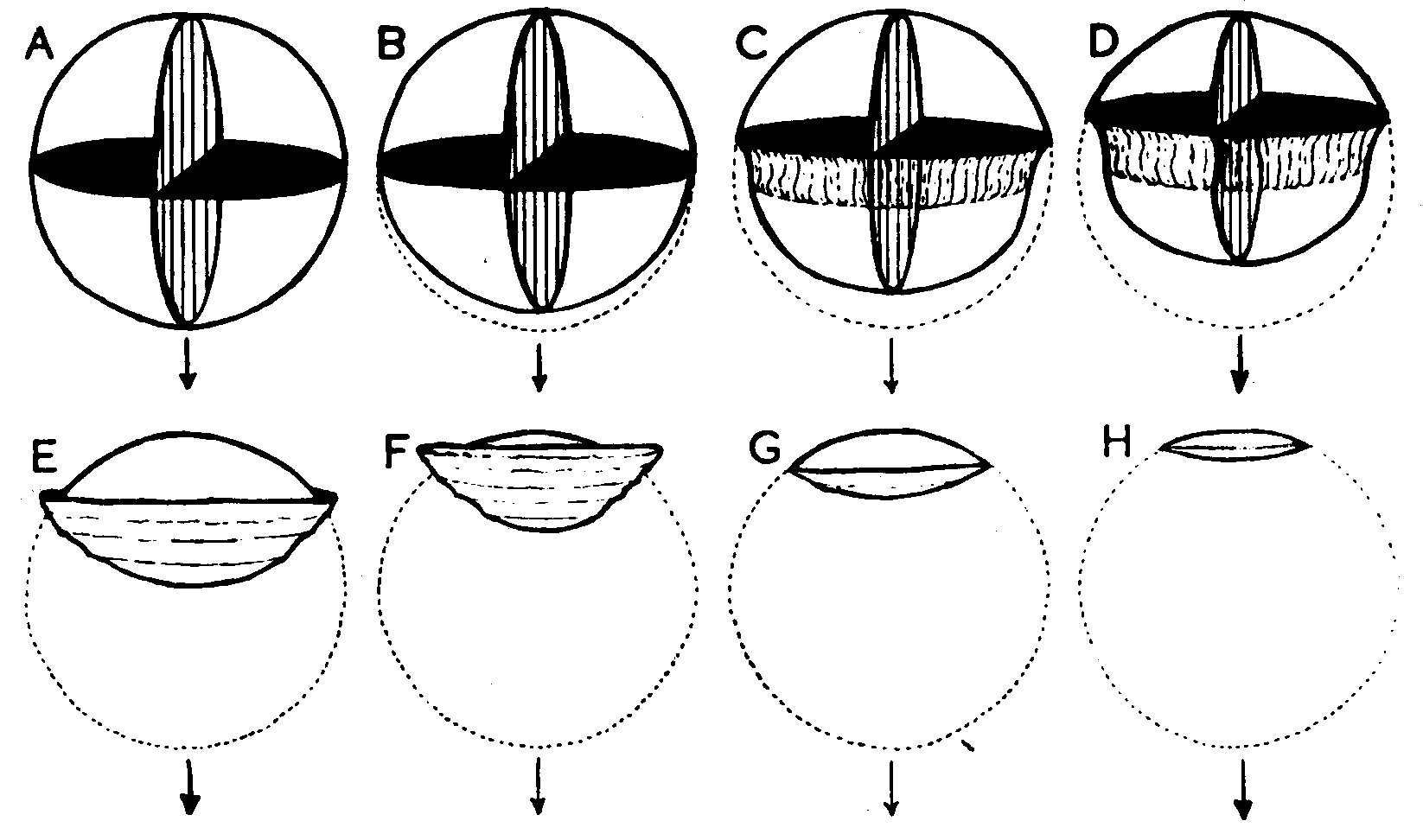
Here is a diagram showing the formation of ablative
shapes by stages from a molten sphere in flight.
Item F is the stage of the flanged button shape:
http://originoftektites.com/resources/Figure16.GIF

This is from John O'Keefe's "Tektites and their Origins,"
1976. The project has "stalled" before posting the
complete book, but the first six chapters can be found
online at:
http://originoftektites.com/

But a flanged button with a hole in it? That's pretty
strange. Has there ever been a flanged button with
a hole? Well, there has been found a flanged button
that was a hollow bubble! Look at page 42 of this:
http://adsabs.harvard.edu/full/1966Metic...3...35B

So, what would happen if an ablating molten hollow
bubble of a flanged button burned through, connecting
the hollow with the ablating surface? That question,
too, is answered in this paper. There is one example
of this and the burn-through was only a narrow tunnel,
not the "asymptotic" shape in the RSPOD.

One difficulty with the RSPOD shape is, while it starts
from what have been the ablative face, it has turned
the "object" inside-out. This would require "plastic flow"
of the entire object as molten iron.

There's one problem right there. Iron meteorites do
not melt all the way through. Is this piece small enough
to have melted completely without being instantly
ablated away in a hot flash of the oxygen blowtorch
of the atmosphere?

I doubt it.

One possibility: the "burn-through" could have occurred
by ablating atmosphere contacting an internal troilite
nodule and cutting through very fast, melting the entire
object and turning it inside-out. It's about a one-in-a-trillion
chance.

Another suspicious circumstance is the apparent
uniformity of the thickness of the metal everywhere
the shape is preserved, everywhere except the edge
of the "flange." This is highly improbable in a "natural"
object, but universal in the case of any manufactured
objects.

The final nail in the coffin, for me, is the absence of
"ring-waves." ANY molten sphere will develop ring-waves.
No way not to. There is no trace, not even a relict
impression, trace or palimpsest of any ring waves.

Button line: this object was not shaped by aerodynamic
forces in atmospheric flight and likely is not a meteoritic
object.

It's a Wrong.


Sterling K. Webb
------------------------------------------------------------------------
----- Original Message -----
From: "Galactic Stone & Ironworks" <[email protected]>
To: "JoshuaTreeMuseum" <[email protected]>
Cc: <[email protected]>
Sent: Saturday, May 08, 2010 11:11 AM
Subject: Re: [meteorite-list] FW: Rocks from Space Picture of the Day -
May8, 2010
Hi All,

Flanged buttons of this type are limited to tektites, which undergo a
vastly different formation process than meteorites.  There are no
meteorite flanged buttons, or if there is, I have not seen in during
my experience of handling thousands of meteorites and seeing photos of
tens of thousands of meteorites.  Nor I have ever read anything in the
scientific literature that allows for meteorite flanged buttons of
this type.

This is either a meteorwrong, or a million-dollar find of the century
- I'd bet on the former.

Best regards,

MikeG


On 5/8/10, JoshuaTreeMuseum <[email protected]> wrote:
Why would you even think that's a meteorite? I think Darren called
it.
It's a snap fastener.


Phil Whitmer

______________________________________________
Visit the Archives at
http://www.meteoritecentral.com/mailing-list-archives.html
Meteorite-list mailing list
[email protected]
http://six.pairlist.net/mailman/listinfo/meteorite-list
--
------------------------------------------------------------
Mike Gilmer - Galactic Stone & Ironworks Meteorites
http://www.galactic-stone.com
http://www.facebook.com/galacticstone
------------------------------------------------------------
______________________________________________
Visit the Archives at
http://www.meteoritecentral.com/mailing-list-archives.html
Meteorite-list mailing list
[email protected]
http://six.pairlist.net/mailman/listinfo/meteorite-list
______________________________________________
Visit the Archives at http://www.meteoritecentral.com/mailing-list-archives.html
Meteorite-list mailing list
[email protected]
http://six.pairlist.net/mailman/listinfo/meteorite-list