Garth

This is great stuff!
Here is what I feel should be the next logical step:
For each of the types of items I list, I want to show an image the earliest
SURVIVING example I know of (and of course it is also fine to list earlier
examples as seen in images or reported in campaign books or exhibitor
magazines). That way, once I have the basic list created, I can publicize
it far and wide, and anyone with an earlier surviving example of any type
can send me an image of it and I can update the list (and of course the
same goes for non-surviving earlier examples, but I think it makes sense to
limit it to ones where an actual image can be located).

And I think Phil's idea about also adding in last know surviving (or
reported) of each type is great too.

So I will get to work on my part, and I hope you Garth and anyone else with
an interest will help to greatly improve it.

And Can you provide me with a direct link to how to get to the part of
archive.org that has scanned all of the Moving Picture World publications
from 1909?

Thanks
Bruce


On Sun, Jul 23, 2023 at 1:27 PM Garth Grieder <[email protected]>
wrote:

> This is a great topic, Bruce!
>
> I have done some research in this line, since archive.org has scanned all
> of the Moving Picture World publications from 1909, there is tons of info
> to look through! I am thinking of one day doing a video on this topic, as
> it is fun to research.
>
> The earliest 6-color, beautifully rendered Studio one-sheets for
> individual releases began being produced in Q3 1909. Essanay and Slig were
> two of the first Studios (known then as Film Manufacturers) to begin
> producing beautiful 6-color stone litho one sheets to advertise specific
> films. This was huge news in the industry at the time. Here is how it was
> covered in Moving Picture World:
>
> *“We are in receipt of a handsome litho. Title poster of the Essanay
> subject, “Wonders of Nature,” their release of August 18. This is the
> second, we are informed, of the series of posters they are issuing. We find
> the poster an exceptionally attractive one, made in six colors, and
> measuring 28 by 42 inches. Besides a large illustration, depicting a scene
> from the film, the design includes the Indian head, the Essanay Company’s
> trade-mark and the title of the film. The poster, we feel, should prove a
> real adornment to any theater lobby or billboard.”*
>
>
> This passage from a Q3 1909 Moving Picture World speaks to how novel the
> concept was:
>
> *“New York Motion Picture Company creates a new style of poster - synopsis
> of the story of the film printed in large and clear Gothic type which can
> easily be read by the public in the light of the street lamp. In addition
> to this they furnish a full sheet colored poster, lithographed in many
> colors and bearing close resemblance to the actors in some important
> incident of the play.”*
>
>
> I found it interesting that just 5 months earlier, in Feb 1909, a trade
> commentary in the publication 'The Nickelodeon' stated the following:
>
> *“Posters may be any size from 12x18 inches or even smaller, to the big
> three-sheet billboard poster, however, 24x36” is about as large as the
> picture theater manager will ever care to use."*
>
>
> The theatre owners didn't immediately take to displaying posters. The
> industry was changing rapidly in 1909, where the small Nickelodeon theatres
> (often 200 seats or less) that dominated the industry since about 1905
> started losing favor to bigger theatres (200-1000 seats). These bigger,
> more prestigious theatres didn't want to have their beautiful lobbies
> plastered with campy bill-posters (up until 1909, posters were mostly
> block-letter type or stock posters). Instead, they favored photo
> enlargements with a synopsis of the film blown up for people to read.
>
>
> By November 1909, it seemed posters started taking the industry by storm.
> (it's also interesting to note that the term 'poster' is used much more
> frequently in the trade publications of 1909 & 1910 than you will find in
> publications from the 1930's. It was big news at the time!):
>
>
>
> *“Until recently, nobody seemed to care for [the poster]. Any old thing in
> the way of a crude design and crude printing suited your indifferent movie
> theater exhibitor – any old thing with some idea of dramatic situation and
> plenty of crude color was considered good enough to put outside the moving
> picture theater. But a little while ago it occurred to some alert minds
> that better things than these could be done, and so the manufacturers and
> others have been sending out specially made posters illustrating the
> particular pictures shown. One or two of the manufacturers have had pieces
> of their film subjects suitably enlarged, and these when surrounded with
> striking borders make very effective posters. This is symptomatic of the
> progressive instinct. The movie picture theater is progressing all along
> the line, in the quality of the pictures, the house, the audience, the
> music, and so it is only reasonable to expect progress in the matter of
> such an important item as the poster.” “Is the moving picture theater
> coming to the same state of things? Are we near the time when the billboard
> will contain 24-sheet posters illustrating some scene in a Pathe or
> Biograph film? Shall we see fine specimens of color printing, good designs
> and all the rest of it, advertising films all over the country? Are we, in
> short, to witness the theatricalization of the moving picture at the poster
> end of matters? It certainly looks asi f we were, judging by the trend and
> tendency of the moving picture at this very moment.”*
>
>
> I found this following commentary to be hilarious... with posters now in
> full effect, we see some early examples of misleading, or 'false'
> advertising (possibly worse offenders than the notorious AIP! lol)
>
> This was in a July 1910 article in Moving Picture World.
>
> “A flagrant example recently noticed was a poster showing a man holding a
> dagger in a threatening attitude over some men seated at a table. This was
> used to advertise Selig’s industrial film, “Opening an Oyster.” On asking
> the exhibitor where the poster applied, he said: “The men at the table were
> supposed to be eating oysters!”
>
>
> By March 1910 (just 8 months after the big studios began producing
> one-sheets for all of their releases), the film exchanges (at the time, the
> Studio's didn't run their own exchanges... from what I understand all film
> was distributed by Independent Exchanges in 1910) had to come up with ways
> to organize their poster departments... here is an early article on
> innovations in the newly designed poster department at film exchanges, from
> the publication  “The Film Index” from March 1910. (these notes are
> paraphrased from the article, not directly quoted)
>
> Innovation in poster departments at exchange: Theatre Film Exchange
> designs method to store and file posters… by reel number… keeps 40 weeks of
> posters, rolled in 4” square x 26” deep pigeon holes… 850 apertures total,
> each holds 100 posters. 22 new reels come into this exchange weekly, so
> this file system covers 40 weeks of reels. Posters didn’t make money, but
> helped with rentals, so it was a fine business… but they had to convince
> theater owners in 1910 to use posters.
>
>
> I found an image of an August 1909 Essanay one-sheet, which sold at
> LiveAuctioneers. This is within the first two months of these modern-style
> 6-color one-sheets being produced. This poster is especially cool because
> this was a sample copy sent to a theatre to convince them to start using
> posters to advertise. It says:
>
> IMPORTANT!!
>
> The attache is a sample copy of the handsome six-color litho poster issued
> by the Essanay Film Mfg. Co. for both Wednesday and Saturday releases
>
> *Outlay Small Compared with Results.*
>
> The outlay for a proper poster display is so small, compared with the
> results to be obtained, that it should not be consdered as an expense item
> to a man who is alive to his own interests.
>
> In the cities the exhibitor should use our posters to secure a proper
> lobby display; in the smaller towns they should be used not only in the
> lobby, but placed in prominent show windows in the office, hotels and
> public building.
>
> *Your Interest is Ours*
>
> Exhibitor - Try the poster game, and soon you'll say, "It's more than
> worth while." Ask your film exchange for Essanay Posters
>
> Here's a link to the poster:
>
>
> https://www.liveauctioneers.com/item/116000607_a-kiss-in-the-dark-silent-film-movie-poster-1909
>
>
>
> I have lots more info to share... but this is all for now!
>
> Garth
>
>
> On Thu, Jul 20, 2023 at 8:37 PM Bruce Hershenson <
> [email protected]> wrote:
>
>>
>>
>>
>>
>>
>>
>>
>>
>>
>>
>>
>>
>>
>>
>>
>>
>>
>>
>>
>>
>> *The very first "movie posters" appeared at the same time movies were
>> first made, around 1896. They were small posters with a vertical format,
>> advertising the machines and the process, rather than individual
>> movies!Here are more important milestones in the early history of movie
>> posters (I am just writing these off the "top of my head", and I welcome
>> any additions or corrections):c.1898 - what is believed to be the first
>> poster for a specific movie is seen, for the comedy short "Watering the
>> Gardener"c.1901 - the first traditional one-sheets for single movies
>> appearc.1909 - the first one-sheets with actors billed appearc.1909 - the
>> first exhibitor magazines appearc.1910 - the first three-sheets appear
>> (printed on 3 one-sheet sized pieces, hence the name)c.1912 -  the first
>> 8x10 stills appearc.1913 - the first six-sheets appear (printed on 6
>> one-sheet sized pieces, hence the name)c.1913 - the first 14x22 window
>> cards appearc.1914 - the first souvenir program books appearc.1915 - the
>> first 11x14 lobby cards appear (the very first ones are vertically
>> oriented)c.1916 - the first pressbooks appearc.1917 - the first 22x28
>> half-sheets (called "displays") appearc.1920 - the first 14x36 inserts
>> appearc.1920 - the first 24-sheets appear (printed on 24 one-sheet sized
>> pieces, hence the name)c.1920 - the first studio yearbooks (also called
>> "campaign books") appearATTENTION ALL YOU POSTER HISTORY BUFFS! As I said
>> above, the above chart was created in minutes, and I welcome any additions
>> or corrections. I would LOVE to greatly expand it, and I would especially
>> like to add similar dates for every movie poster producing country! Please
>> email me if you have information to help make this a reality!*
>>
>>
>> ------------------------------
>>
>> To unsubscribe from the MoPo-L list, click the following link:
>> https://listserv.american.edu/scripts/wa-american.exe?SUBED1=MoPo-L&A=1
>>
>

--
Bruce Hershenson and the other 22 members of the eMoviePoster.com team
P.O. Box 874
West Plains, MO 65775
Phone: 417-256-9616 (hours: Mon-Fri 9 to 5 except from 12 to 1 when we take
lunch)
our site <http://www.emovieposter.com/>
our auctions <http://www.emovieposter.com/agallery/all.html>

* Complete Buyer Protection
<http://www.emovieposter.com/unused/20120625ad_emovieposter_no_buyer_beware_buyer_warranty.jpg>
- *No time limit on our guarantees & *NO* buyer beware
* Hershenson Help Hotline
<http://www.emovieposter.com/images/announcements/20120906_mcw_ad_hershenson_help_hotline_forsite.jpg>
- *Direct line to Bruce (our owner!) for urgent problems
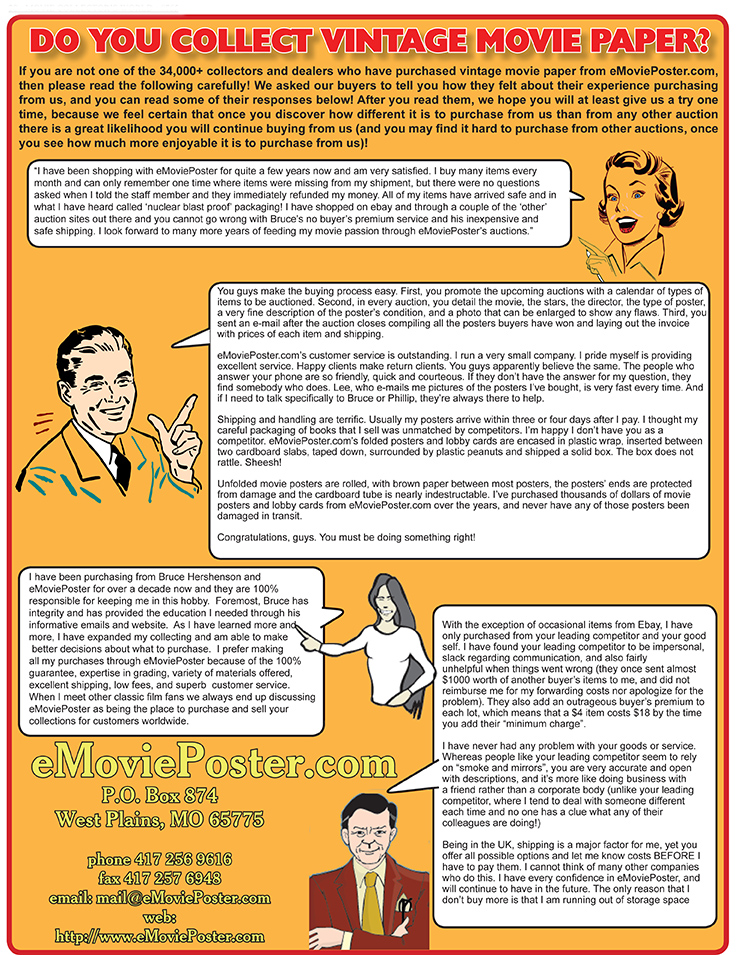
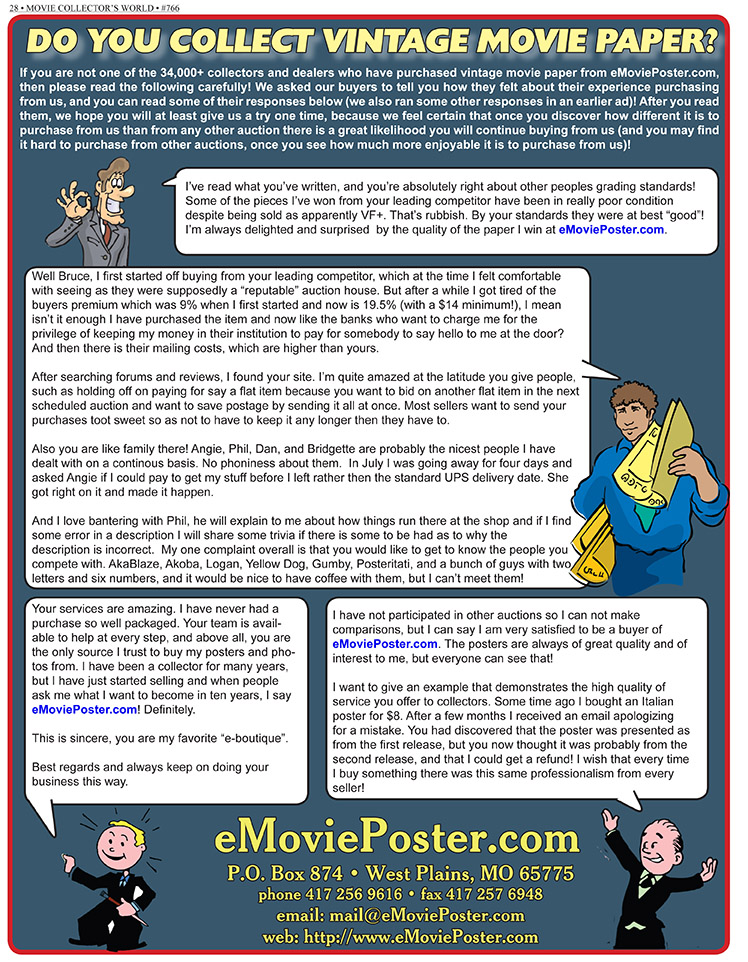
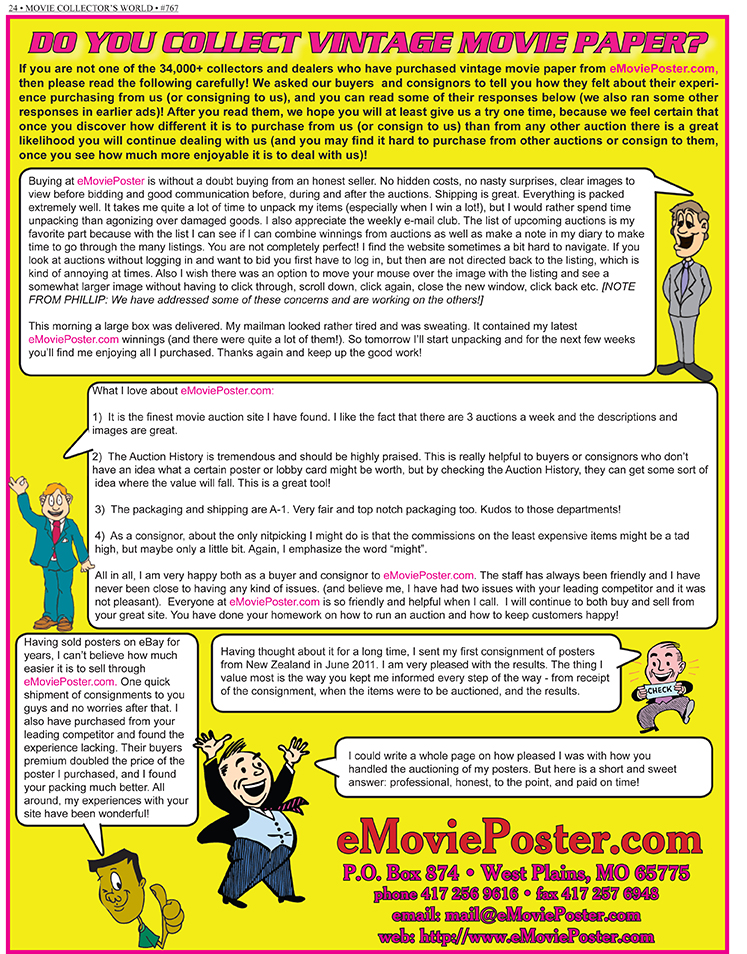
Also, please read the following three pages of in-depth* Customer Reviews *of
our company * - Page 1
<http://www.emovieposter.com/images/announcements/buyerreviews_page1.jpg>,
Page 2
<http://www.emovieposter.com/images/announcements/buyerreviews_page2.jpg>,
Page 3
<http://www.emovieposter.com/images/announcements/buyerreviews_page3.jpg>*,
which shows you in our customers' own words exactly what makes our company
and our auctions so very different from all others!

         Visit the MoPo Mailing List Web Site at www.filmfan.com
   ___________________________________________________________________
              How to UNSUBSCRIBE from the MoPo Mailing List

       Send a message addressed to: [email protected]
            In the BODY of your message type: SIGNOFF MOPO-L

    The author of this message is solely responsible for its content.