Hi Lundin,
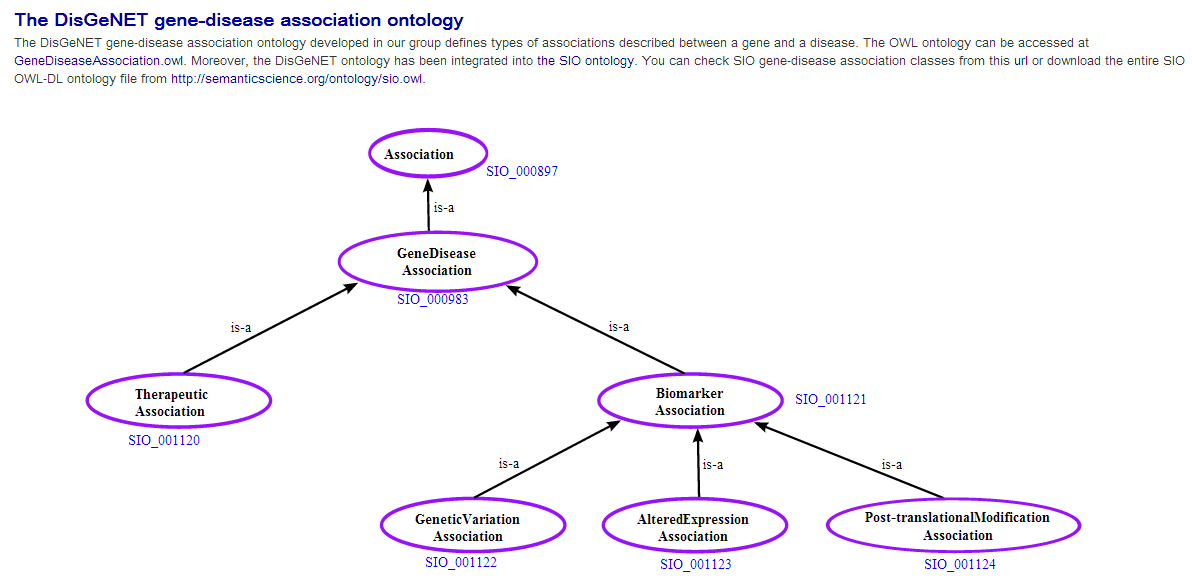
I found now an real-world example and maybe you can comment this. In this
gene-disease association ontology you have to connect nodes representing
genes with nodes representing diseases by their association type. Let's
suppose gene A has a GeneticVariationAssociation to disease B, then I have
to add 4 relationships (GeneticVariationAssociation, BiomarkerAssociation,
GeneDiseaseAssociation, Association) between A and B. Is it recommended to
do it this way or are there smarter possibilities?

<https://lh6.googleusercontent.com/-bPKb2sdcb4E/U8OXnr1U8eI/AAAAAAAAACQ/8P0IaychxT0/s1600/DisGeNET.png>


On Saturday, April 19, 2014 6:18:49 PM UTC+2, Lundin wrote:
>
> Hi Benny,
>
> In your examples, which seems to have an very finite numbers of
> relationships types, i would go for adding relationship vs properties. Thus
> the traversal can be done cheap rather than involve properties that would
> be needed in the look-up. This is the best design performance wise. But of
> course if your domain-model involves nodes that becomes dense with millions
> of outgoing relationship and the number of relationship cant so easily be
> forseen and you want query from that node i would think adding a properties
> make sense.
>
> Here is actually a good blog post on the topic:
> http://graphaware.com/neo4j/2013/10/24/neo4j-qualifying-relationships.html
>
> It is very hard without further insight to say exactly how to model your
> domain.
>
> And dont fortget that you can also limit the serach result by a type as
> well, as in
>
> (x)-[r]->(y) where type(r)="IS_DAUGHETR_OF"
>
> Mabey you could test some CSV data of a known domain, import it and try
> some models and find out ? I would be happy to read such a report.
>
> Den onsdagen den 16:e april 2014 kl. 14:09:48 UTC+2 skrev Benny Kneissl:
>>
>> Hi,
>>
>> as far as I know the smartest way to store hierarchies for node entities
>> is to use the new label feature. Lets's suppose an entity is of type B
>> where B is a subclass of A. Then the node is labeled by both A and B, right?
>>
>> But what about hierarchies for relationships? Should several
>> relationships be stored between two entities to model hierarchies for
>> relationships? Should the type of the relationship differ or is it more
>> meaningful to have the same type but different properties?
>>
>> A possible example is that "isDaughterOf", "isSonOf" are subtypes of
>> "isChildOf" when modeling a family tree. Or from biology when having a
>> BiochemicalReaction you might want to model "isParticipantOf", "isEductOf",
>> "isProductOf".
>>
>> In this simple hierarchy I think it is sufficient when asking for all
>> children to traverse both relationship types, but the hierarchy might
>> become more complex and then, it is likely that you forget one relationship
>> type in Cypher (  (x)-[r:IS_DAUGHTER_OF | IS_SON_OF]->(y)   ). If you use
>> only one type ((x)-[r:IS_CHILD_OF]->(y)) you have to add a property
>> daughter / son to ask only for daughter/son. So what is a good way
>> (performance, complexity in formulating a query) to do it in Neo4j? Adding
>> more relationships, or adding more properties?
>>
>> Currently I don't know what are the advantages for the different
>> approaches, in particular, with respect to formulate queries afterwards.
>>
>> Thank you for some ideas you have in mind,
>>
>> Benny
>>
>

--
You received this message because you are subscribed to the Google Groups
"Neo4j" group.
To unsubscribe from this group and stop receiving emails from it, send an email
to [email protected].
For more options, visit https://groups.google.com/d/optout.