This approach is fine as soon as you do not have some 20-30-50 millions of
phones in your database with say 3 millions of them has similar hardware
upgrade history of 2-3 steps. With the approach described, your model will
become overly heavy and overbloated with millions of (rarely used)
relationships.
When modelling, you always need to decide on The Tradeoff: what should be
modelled with relationship, and what with attribute.

As for me, I developed the following empiric rule for graph data modeling:
if you need more than 10000 relationships to a single node, consider
refactoring it into attribute.

In the case of phones, my solution will follow the following design pattern.

First, create and fill (and take care of updating at least monthly!) a
dictionary - set of nodes representing phone hardware models/revisions and
set of nodes for firmwares w/versions, with relationships between them
representing compatibility between hardware and firmware.

Now let's consider the phone lifecycle in the database, taking care of
firmware versions history and the fact that, quote: "The IMEISV drops the
Luhn check digit in favour of an additional two digits for the Software
Version Number (SVN), making the format
<http://en.wikipedia.org/wiki/International_Mobile_Station_Equipment_Identity#Structure_of_the_IMEI_and_IMEISV_.28IMEI_Software_Version.29>*AA-BBBBBB-CCCCCC-EE"

<http://en.wikipedia.org/wiki/International_Mobile_Station_Equipment_Identity#Structure_of_the_IMEI_and_IMEISV_.28IMEI_Software_Version.29>.
 *The
latter adds additional grain of salt to the model: the firmware maker MAY
obey this rule, if he wish, but 1) who may be 100% sure? 2) who knows in
advance, which 2 digits are chosen for what firmware version? So now we
understand, that IMEISV of the phone MAY change in time when the firmware
is updated. Or may not - who knows? The significant consequence is that *IMEISV
is not a static attribute of the device*, it can be changed (back and
forth) and MAY change in time.

Now, why on the Earth you consider *technical* phone firmware version to be
an attribute of relationship between phone and the network, which is a
*business* relationship by it's nature?

So, we start with a phone just unpacked and switched on for the very first
time. Or maybe not the first? We are not sure whether we have anything
already stored in database. The code below is just a sketch, I won't bet it
is executable 'as-is', no warranty:

MERGE (unit:Device)-[r:HAS_IMEISV]->(i0:IMEISV {IMEISV:
'99-123456-098765-72'})
ON CREATE SET i0.first_time = TIMESTAMP(),  r.first_time = TIMESTAMP(), unit
.first_time = TIMESTAMP() // Ok really we got this phone for the very first
time
WITH unit
MERGE (sim:SIMcard {IMSI: '1234560987654321'})
ON CREATE SET sim.first_time = TIMESTAMP()
WITH unit, sim
MERGE (unit)-[z:OPERATES_SIM]->(sim)
ON CREATE SET z.first_time = TIMESTAMP()
WITH unit, sim
MERGE (ph:PhoneNo {phone_no: '+380501234567', network: 'MTS'})
ON CREATE SET ph.first_time = TIMESTAMP()
WITH unit, ph
MERGE (man:Customer {name: 'A'})
ON CREATE SET man.first_time = TIMESTAMP()
WITH man, unit, ph
MERGE (unit)<-[ud:USES_DEVICE]-(man)-[un:USES_NUMBER]->(ph)
ON CREATE SET ud.first_time = TIMESTAMP(), un.first_time = TIMESTAMP()
RETURN man, unit, ph

Note that at this step we initially know nothing about firmware/revision
and hardware/revision, and we now have just the following model in the
graph:

<https://lh4.googleusercontent.com/-qWe0uw_nVYk/VGsfBVlD_7I/AAAAAAAABaQ/os4s6KN3SXo/s1600/IMEI_1.png>

But we want to model firmware updates history. Those may or may not affect
the value of IMEISV. Suppose we are not interested in the timescale of
events - when (and through which channel) did customer requested the
firmware update, when it was delivered to him, how much time did pass
between upgrade request and upgrade success or what was the percentage of
unsuccessful upgrade attempts. We just want to reflect the state of the
device with regard to it's firmware.

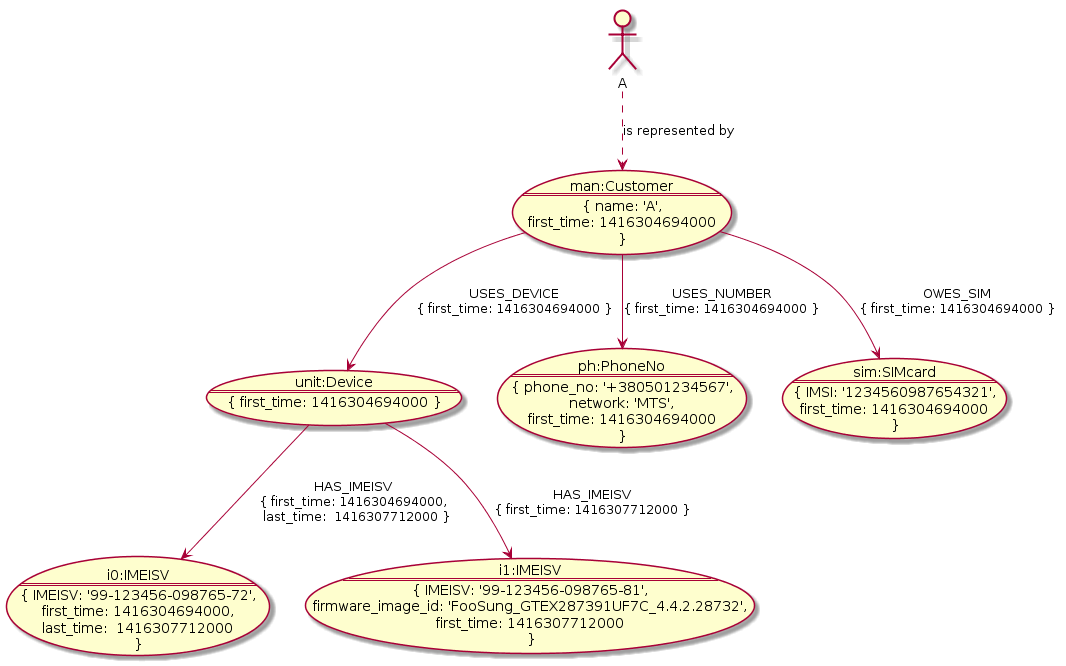
Suppose we somehow discovered, that the customer upgraded firmware to a
revision which has firmware_image_id: 'FooSung_GTEX287391UF7C_4.4.2.28732'
and this changed IMEISV to '99-123456-098765-*81*' so now we have:

<https://lh3.googleusercontent.com/-FbMkBJCUfnk/VGsmN9d0B7I/AAAAAAAABag/bkg_U1PF7SA/s1600/IMEI_2.png>


And note, there isn't a straightforward direct relationship to a node in
the dictionary of firmwares and this is correct - from business point of
view, when 2 devices have equal firmware version, this does not mean any
meaningful connection/relationship between them. And for convenient and
fast search and selection, you just need 2 indices both ON
:IMEISV(firmware_image_id) and ON :FirmwareDictionary(firmware_image_id)
and make sure that values of firmware_image_id are consistent.

WBR,
Andrii Stesin

On Sunday, November 16, 2014 11:28:45 AM UTC+2, Michael Hunger wrote:
>
> Mahesh, I like your model, it would be great  if the goal for this system
> is to track updates and changes to firmware in a clean way.
>
> But I think if you just need to occasionally check for upgrades per
> customer and see if they skipped something, and if it not the core-use-case
> of the system!!
>
> it might be easiest to just keep the relationship that edo had, update its
> properties and save the previous properties to an new relationship called
> ":PREVIOUS_VERSION"
>
> There might be some benefit to have a dedicated Firmware node per firmware
> version and then have phones relate to each of the firmwares, where only
> one :CURRENT relationship is allowed per phone. But again this depends on
> the model.
>
>

--
You received this message because you are subscribed to the Google Groups
"Neo4j" group.
To unsubscribe from this group and stop receiving emails from it, send an email
to [email protected].
For more options, visit https://groups.google.com/d/optout.