-- Thanks and Regards
   Mahesh Lal
On 18 November 2014 16:28, Andrii Stesin <[email protected]> wrote:
>
> When modelling, you always need to decide on The Tradeoff: what should be
> modelled with relationship, and what with attribute.
>
> As for me, I developed the following empiric rule for graph data modeling:
> if you need more than 10000 relationships to a single node, consider
> refactoring it into attribute.
>

This is really useful. Helps me understand things better. Thanks for
sharing this and the detailed solution.


> In the case of phones, my solution will follow the following design
> pattern.
>
> First, create and fill (and take care of updating at least monthly!) a
> dictionary - set of nodes representing phone hardware models/revisions and
> set of nodes for firmwares w/versions, with relationships between them
> representing compatibility between hardware and firmware.
>
> Now let's consider the phone lifecycle in the database, taking care of
> firmware versions history and the fact that, quote: "The IMEISV drops the
> Luhn check digit in favour of an additional two digits for the Software
> Version Number (SVN), making the format
> <http://en.wikipedia.org/wiki/International_Mobile_Station_Equipment_Identity#Structure_of_the_IMEI_and_IMEISV_.28IMEI_Software_Version.29>*AA-BBBBBB-CCCCCC-EE"
> <http://en.wikipedia.org/wiki/International_Mobile_Station_Equipment_Identity#Structure_of_the_IMEI_and_IMEISV_.28IMEI_Software_Version.29>.
>  *The
> latter adds additional grain of salt to the model: the firmware maker MAY
> obey this rule, if he wish, but 1) who may be 100% sure? 2) who knows in
> advance, which 2 digits are chosen for what firmware version? So now we
> understand, that IMEISV of the phone MAY change in time when the firmware
> is updated. Or may not - who knows? The significant consequence is that
> *IMEISV
> is not a static attribute of the device*, it can be changed (back and
> forth) and MAY change in time.
>
> Now, why on the Earth you consider *technical* phone firmware version to
> be an attribute of relationship between phone and the network, which is a
> *business* relationship by it's nature?
>
> So, we start with a phone just unpacked and switched on for the very first
> time. Or maybe not the first? We are not sure whether we have anything
> already stored in database. The code below is just a sketch, I won't bet it
> is executable 'as-is', no warranty:
>
> MERGE (unit:Device)-[r:HAS_IMEISV]->(i0:IMEISV {IMEISV:
> '99-123456-098765-72'})
> ON CREATE SET i0.first_time = TIMESTAMP(),  r.first_time = TIMESTAMP(),
> unit.first_time = TIMESTAMP() // Ok really we got this phone for the very
> first time
> WITH unit
> MERGE (sim:SIMcard {IMSI: '1234560987654321'})
> ON CREATE SET sim.first_time = TIMESTAMP()
> WITH unit, sim
> MERGE (unit)-[z:OPERATES_SIM]->(sim)
> ON CREATE SET z.first_time = TIMESTAMP()
> WITH unit, sim
> MERGE (ph:PhoneNo {phone_no: '+380501234567', network: 'MTS'})
> ON CREATE SET ph.first_time = TIMESTAMP()
> WITH unit, ph
> MERGE (man:Customer {name: 'A'})
> ON CREATE SET man.first_time = TIMESTAMP()
> WITH man, unit, ph
> MERGE (unit)<-[ud:USES_DEVICE]-(man)-[un:USES_NUMBER]->(ph)
> ON CREATE SET ud.first_time = TIMESTAMP(), un.first_time = TIMESTAMP()
> RETURN man, unit, ph
>
> Note that at this step we initially know nothing about firmware/revision
> and hardware/revision, and we now have just the following model in the
> graph:
>
>
> <https://lh4.googleusercontent.com/-qWe0uw_nVYk/VGsfBVlD_7I/AAAAAAAABaQ/os4s6KN3SXo/s1600/IMEI_1.png>
>
> But we want to model firmware updates history. Those may or may not affect
> the value of IMEISV. Suppose we are not interested in the timescale of
> events - when (and through which channel) did customer requested the
> firmware update, when it was delivered to him, how much time did pass
> between upgrade request and upgrade success or what was the percentage of
> unsuccessful upgrade attempts. We just want to reflect the state of the
> device with regard to it's firmware.
>
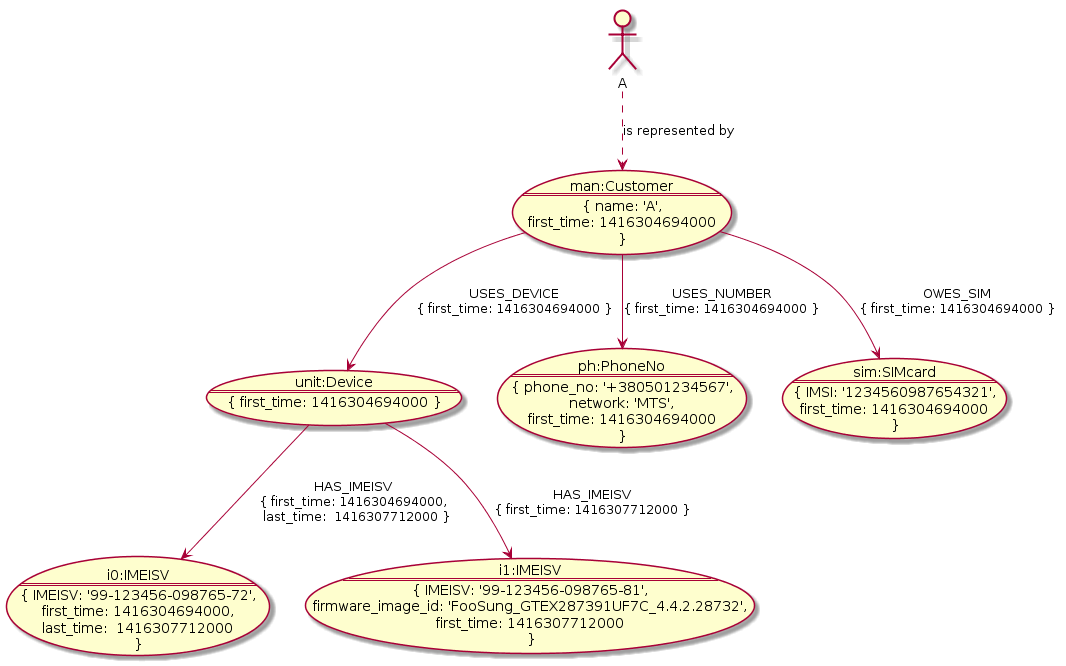
> Suppose we somehow discovered, that the customer upgraded firmware to a
> revision which has firmware_image_id: 'FooSung_GTEX287391UF7C_4.4.2.28732'
> and this changed IMEISV to '99-123456-098765-*81*' so now we have:
>
>
> <https://lh3.googleusercontent.com/-FbMkBJCUfnk/VGsmN9d0B7I/AAAAAAAABag/bkg_U1PF7SA/s1600/IMEI_2.png>
>
>
> And note, there isn't a straightforward direct relationship to a node in
> the dictionary of firmwares and this is correct - from business point of
> view, when 2 devices have equal firmware version, this does not mean any
> meaningful connection/relationship between them. And for convenient and
> fast search and selection, you just need 2 indices both ON
> :IMEISV(firmware_image_id) and ON :FirmwareDictionary(firmware_image_id)
> and make sure that values of firmware_image_id are consistent.
>
> WBR,
> Andrii Stesin
>
> On Sunday, November 16, 2014 11:28:45 AM UTC+2, Michael Hunger wrote:
>>
>> Mahesh, I like your model, it would be great  if the goal for this system
>> is to track updates and changes to firmware in a clean way.
>>
>> But I think if you just need to occasionally check for upgrades per
>> customer and see if they skipped something, and if it not the core-use-case
>> of the system!!
>>
>> it might be easiest to just keep the relationship that edo had, update
>> its properties and save the previous properties to an new relationship
>> called ":PREVIOUS_VERSION"
>>
>> There might be some benefit to have a dedicated Firmware node per
>> firmware version and then have phones relate to each of the firmwares,
>> where only one :CURRENT relationship is allowed per phone. But again this
>> depends on the model.
>>
>>  --
> You received this message because you are subscribed to the Google Groups
> "Neo4j" group.
> To unsubscribe from this group and stop receiving emails from it, send an
> email to [email protected].
> For more options, visit https://groups.google.com/d/optout.
>

--
You received this message because you are subscribed to the Google Groups
"Neo4j" group.
To unsubscribe from this group and stop receiving emails from it, send an email
to [email protected].
For more options, visit https://groups.google.com/d/optout.