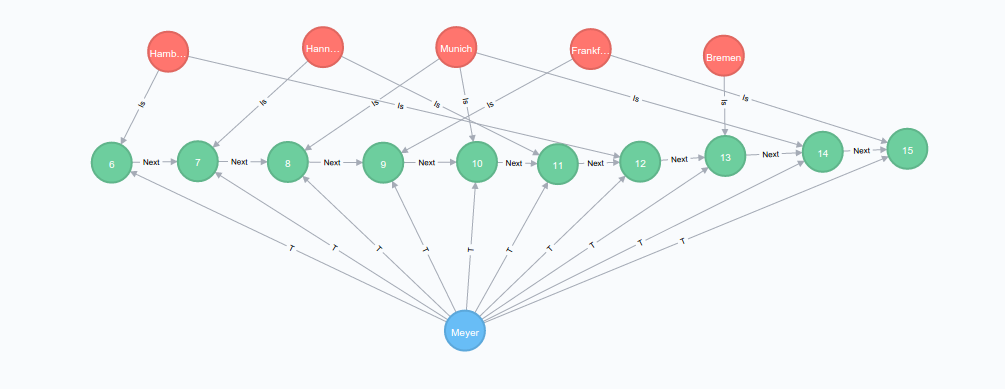
I have modeled the problem in alternative way, like suggested by Michael.
This are trips for the Truck 'Meyer'.
<https://lh4.googleusercontent.com/-3BfcmM4zfnY/VO2wAI6aMwI/AAAAAAAAAAM/jmEwZ68TbfU/s1600/alternative_graph.png>

How ever while playing with it, I am facing some problems:

I want to know all trips from Hamburg to Munich. And I want to get the
sequence of city names for these trips. And I want only direct  trips (ever
stop should occur only once).

I did not mange to 'join in' the city names so I stored the city names as
properties on the sequence nodes. With that I ended up with this query:
match (:City {name:'Hamburg'})-[:Is]->(s1:Stop)
match (:City {name:'Munich'})-[:Is]->(s2:Stop)
match path = (s1)-[:Next*1..2]->(s2)
WHERE ALL (n IN extract(x IN nodes(path)| x.name)
           WHERE 1=length(filter(m IN extract(x IN nodes(path)| x.name)
                                 WHERE m=n)))
return extract( n in nodes(path)| n.name);

However performance wise, I do not get big advantages above my optimized
other approach.

Any tips?

Here is the a link to the console populated with the test
graph: http://console.neo4j.org/r/yv6ex1


On Wednesday, February 18, 2015 at 5:07:20 PM UTC+1, Michael Hunger wrote:
>
> 50k trucks are not an issue
> Rel-indexes are legacy and only used when you really need them
>
> The tricks is not to use more indexes but a graph model that supports your
> queries
>
> M
>
> Von meinem iPhone gesendet
>
> Am 18.02.2015 um 11:02 schrieb [email protected] <javascript:>
> :
>
> Thanks, Michael.
>
> I will end up with 50.000 trucks.
>
> Here is my Expander:
>
> public Iterable expand(Path path, BranchState state) {
>     // for the start node return all outgoing connections
>     if (path.length() < 1){
>         return path.endNode().getRelationships(Direction.OUTGOING);
>     } else {
>         // for all consecutive nodes only return relations with same ID
> and with the next sequence number
>
>         // get previuos sequence
>         Integer seq =
> (Integer)path.lastRelationship().getProperty(SEQUENCE);
>         // increase the sequence by one to find the next sequence
>         Integer nextSeq = seq+1;
>
>         // get ID
>         Object lastID = path.lastRelationship().getProperty(ID);
>
>         ArrayList<Relationship> result = new ArrayList<>();
>
>         // get all outgoing rleationsships for end node
>         Iterable<Relationship> trips =
> path.endNode().getRelationships(Direction.OUTGOING, TRIP);
>         for (Relationship trip : trips) {
>             // only return is ID is equal and sequence is the next sequence
>             if (lastID.equals(rel.getProperty(ID, null))){
>                 if (nextSeq.equals((Integer)rel.getProperty(SEQUENCE,
> null))){
>                     result.add(rel);
>                 }
>         }
>
>         return result;
>
>     }
> }
>
> The while loop over all relations is definitely sub-optimal. Just
> yesterday I discovered the legacy indexes for relations. I am going to give
> them a try. They seem to be a perfect fit. Can I query the index with
> multiple fields?
> I have also already been using the ID as relationship type with great
> improvements.
>
> I have also thought ow would this be
>
> Thanks for the option 2. Might be worth a try!
>
> Is Cypher in general behaving better than Java code? Or is the trick in
> using as much indexes as possible?
>
> Patrick
>
>
>
> On Wednesday, February 18, 2015 at 10:07:59 AM UTC+1, Michael Hunger wrote:
>>
>> Perhaps you can share some of your Expander code?
>>
>> Not really sure between what your edges are?
>>
>>
>> Two ideas:
>>
>> 1) How many trucks do you have? Perhaps it makes sense to encode the
>> truck-id as relationship-type? So you have fewer rels to check and can
>> benefit from the separated storage by rel-type and direction.
>> 2) Model the trip as a node connected to a truck, and all locations it
>> visited (perhaps/optionally even encode the location-id as rel-id but that
>> might be overkill) so you can quickly find all that started at "A" and then
>> check if the trip has a rel to "B"
>>
>> 3) Another more verbose approach be to model each trip as a sequence of
>> nodes (which are shadow nodes of the locations), connect the start-node of
>> the trip to the truck (optionally all trip-nodes of the trip to the truck).
>> And then have a relationship to each stop of the trip.
>>
>> I'd probably go with model #2
>>
>> HTH Michael
>>
>>
>> Am 16.02.2015 um 12:54 schrieb [email protected]:
>>
>> I need some modelling advice.
>>
>> We want to store and analyse movement patterns. Think of trucks moving
>> through a logistic's networks.
>> We want to ask which truck has ever moved from location A to location B
>> and what was the sequence of intermediate stops they made to get there.
>>
>> In a later stage we also want to be able to ask this question if there is
>> no truck that has stopped at location A and B. Which trucks and which
>> sequence of stops would we have needed to get from A to B.
>>
>> Right now we modeled all locations as nodes and every trip a truck has
>> ever made as a separate edge. The edges are attributed with a truck ID and
>> a sequence number.
>> We wrote our custom expander class to be used with the traversal
>> framework and to take care of the sequence numbers and truck IDs to only
>> get complete sequences for individual trucks.
>>
>> However, this performs very badly.
>> Right now we have 300 locations/nodes and 300.000 trips/edges. Some stops
>> have 20.000 outgoing trips that we are checking for truck ID and sequence
>> number (for every outgoing relationship, get attributes and check) .
>> This performs too badly. 13 seconds for 900 sequences.
>>
>> Finally, we want to try to scale it to 3000 locations and 20.000.000
>> trips.
>>
>>
>> Do you have any alternative modelling ideas?
>>
>> Thanks a lot already.
>>
>>
>> ps: I was thinking of storing every trucks list  as a long linear
>> sequence of stops/nodes. The nodes are additionally linked to some
>> identifier Node through a type of is relation: "stop x is location A".
>>
>> --
>> You received this message because you are subscribed to the Google Groups
>> "Neo4j" group.
>> To unsubscribe from this group and stop receiving emails from it, send an
>> email to [email protected].
>> For more options, visit https://groups.google.com/d/optout.
>>
>>
>>  --
> You received this message because you are subscribed to the Google Groups
> "Neo4j" group.
> To unsubscribe from this group and stop receiving emails from it, send an
> email to [email protected] <javascript:>.
> For more options, visit https://groups.google.com/d/optout.
>
>

--
You received this message because you are subscribed to the Google Groups
"Neo4j" group.
To unsubscribe from this group and stop receiving emails from it, send an email
to [email protected].
For more options, visit https://groups.google.com/d/optout.