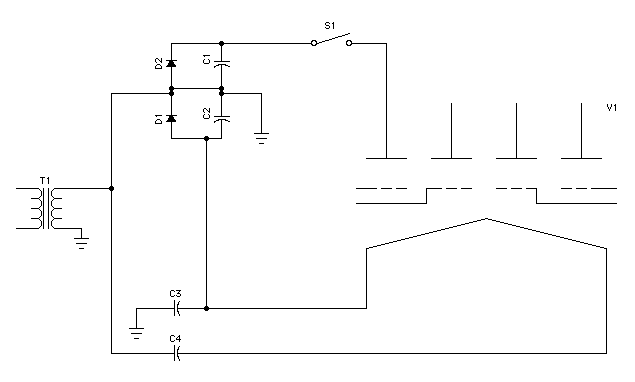
> The nice thing about the circuit is that if the input pulses stop the
> filament will not be overloaded because only one charge cycle's worth
> of energy is stored in the cap at any time, not enough to take out a
> filament on it's own. A shorted capacitor would be fatal to the
> heater, unless the heater circuit can operate at full supply voltage.
There are three ways to guard against that.  One is to use two capacitors:

http://www.vitriol.com/images/tech/vfdps1.gif

Then they'd both have to short in order to directly hook the power supply to
the filament.  If one shorted, your series reactance would be halved.  The
drawback is it takes two capacitors instead of one, and they're both twice as
large.

Another approach is to use a Y rated capacitor, which is designed not to fail
to a short circuit.

What I'd do is just add a zener clamp and probably a fuse, limiting the voltage
that can be applied to the filament.  This can be tricky when driving the
filament with narrow, high voltage pulses.

> If the same pulse
> train or switching currents could also be used to switch an inductor
> in circuit, or pass through diodes and caps as if in a voltage
> multiplier, perhaps a complete supply could be constructed this way ?

Quite.

This is illustrated on the LM9022 data sheet:

http://docs-europe.electrocomponents.com/webdocs/08da/0900766b808daabb.pdf

- John

--
You received this message because you are subscribed to the Google Groups
"neonixie-l" group.
To post to this group, send an email to [email protected].
To unsubscribe from this group, send email to
[email protected].
For more options, visit this group at
http://groups.google.com/group/neonixie-l?hl=en-GB.