Hi - It's been recognized for a long time that code itself can be a work
of art in all sorts of ways - the book Critical Code Studies covers some
of that I think; there was also a whole movement early on of Perl poetry
that was simultaneously literature and runnable programs; there have also
been productions and studies of untoward languages, including ones that
were invisible early on - and now that area has developed tremendously. I
used to have the urls for those but don't at the moment unfortunately. The
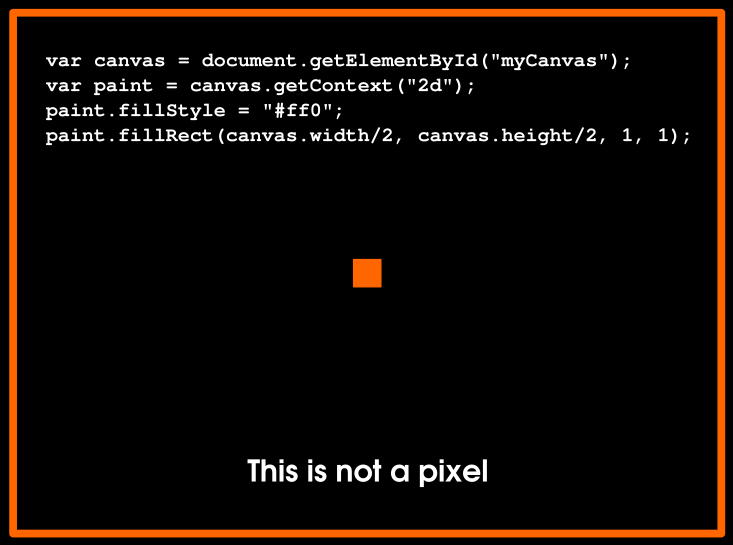
production of the pixel is an interpretation; it would also run of course
without a screen at all. Not that it matters, but I did a lot of
programming with a TI59 programmable calculator years ago; some of them
were short and were taken to be works of art such as a steady state which
had the command 'return' and nothing else. There's also codework, which
I've emphasized that I meant runnable code that intersected/interfered
with its surface production, a kind of grit. So I'm not sure what
distinction you're making here? And thanks, Alan - really interesting
discussion -
On Thu, 24 Sep 2020, Pall Thayer via NetBehaviour wrote:
Hi Bruno. Didn't you and I share a hotel room in Bergen, NO many years ago?
I think I get your point. Yes, programming code is like a blueprint in a
way. That blueprint then gets interpreted by a computer or software and then
turns into an action. A movie or play script is also a blueprint but one
that gets interpreted by humans. Obviously, a human "interpretation" of
something is going to be a lot more flexible than a computer's
interpretation of code. Therein lies the main difference between those two
schematics. What I'm proposing is a bit of a hybrid. If I feel that my own
(human) interpretation of a piece of code is going to make the outcome
somehow better (or just different, if people prefer), then I'm going to do
so from the perspective of a human who knows full well how the code will
perform when interpreted by the computer. So it's still grounded in a more
restrictive outcome than a movie or play script. If I allow myself too much
freedom in my interpretation, then I might as well abandon the programming
code part and we're basically back to 60s conceptualism. I'm looking for
something similar but different.

I do believe that the text of programming code can stand on its own as works
of art and have pursued that angle for several years in my Microcodes
(http://pallthayer.dyndns.org/microcodes/) and Object Oriented Art Code
(http://pallthayer.dyndns.org/stealthiscodeart/). I see the ideas that I'm
pitching here as my "logical next step".

Best r.
Pall

On Thu, Sep 24, 2020 at 2:53 AM Bruno Vianna via NetBehaviour
<[email protected]> wrote:
      hi Pall

      I don't know if I'm playing devil's advocate or standing for
      your
      point, but it comes to my mind the idea of a blueprint, which is
      not
      exclusive to code. Wouldn't a script for a movie, the  lines of
      a
      play, be also forms of laying out a final shape? And these codes
      (text) are also self-standing pieces of art? I could go even
      further
      and think of the frames of a movie compared to the screened
      result in
      a session.

      In case, the argument is very interesting.

      Bruno

      On Tue, Sep 22, 2020 at 7:13 PM Pall Thayer via NetBehaviour
      <[email protected]> wrote:
      >
      > As some on this list know, for many years, I've been pushing
      the notion that programming code should be viewed as an artistic
      medium when it's used to create art. The artist molds it into
      shape, as they would with a lump of clay, until it takes its
      final form. When I've discussed these ideas, I've always gotten
      a lot of pushback. People will say that programming code is a
      tool, like a paintbrush, not the medium, like paint. I don't
      agree. This notion has piqued my interest again in the wake of a
      rising trend where artists are creating graphic images by only
      using HTML/CSS (e.g. https://a.singlediv.com/ ,
      https://diana-adrianne.com/purecss-francine/ ).
      >
      > The problem with computer programmed art, however, is that it
      requires a computer. In my mind, there really hasn't been any
      justifiable reason to display computer programmed art on
      anything other than a computer... unless it adds something
      significant to the work. And this is something interesting that
      has recently occurred to me. I came up with this really simply
      piece:
      >
      > http://pallthayer.dyndns.org/notApixel/
      >
      > And have decided that this piece, although based entirely on
      computer programming code, will work better when divorced from
      the computer and the browser's interpretation of the code. On my
      4k screen, it's practically impossible to see the red pixel in
      the center. If I remove the work from the environment that
      interprets the code, I'm free to determine the size of a single
      pixel:
      >
      > http://pallthayer.dyndns.org/notApixel/notApixel.png
      >
      > And I could choose to produce that piece in any physical
      material I want. It could be a block of wood glued to a panel of
      wood. What determines the size of a pixel of wood? What
      determines the result of a hexadecimal color code when it's been
      removed from the computer? If the code is to be interpreted in
      wood, what does #f00 mean?
      >
      > My main point is that with the example shown above, the piece
      can be made to work better at a conceptual level than it would
      if it were not removed from the browser environment.
      >
      > I'd love to hear other people's ideas on this. I did just
      write this all off the top of my head, so if I'm rambling and
      things don't make sense, just ask and I'll do my best to
      clarify.
      >
      > Pall Thayer
      >
      > --
      > *****************************
      > Pall Thayer
      > artist
      > http://pallthayer.dyndns.org
      > *****************************
      > _______________________________________________
      > NetBehaviour mailing list
      > [email protected]
      > https://lists.netbehaviour.org/mailman/listinfo/netbehaviour
      _______________________________________________
      NetBehaviour mailing list
      [email protected]
      https://lists.netbehaviour.org/mailman/listinfo/netbehaviour


--
*****************************
Pall Thayer
artist
http://pallthayer.dyndns.org
*****************************
web http://www.alansondheim.org/index.html cell 347-383-8552
current text http://www.alansondheim.org/xn.txt
_______________________________________________
NetBehaviour mailing list
[email protected]
https://lists.netbehaviour.org/mailman/listinfo/netbehaviour