War in the Caucasus: Towards a Broader Russia-US Military Confrontation?


By Michel Chossudovsky


Global Research
<http://rs6.net/tn.jsp?e=001biiDl_o2b5y508v4no66PZ5B9WIccf3kRvtJ4FXs5RTDRV4e
d3Q9OhTH-lYzLvJiIonroMTtqzmYR-TEHKqNY2A_2F5uEKHCc7jMtCKbQb4OBqGA4cF7JQ==> ,
August 10, 2008


During the night of August 7, coinciding with the opening ceremony of the
Beijing Olympics, Georgia's president Saakashvili ordered an all-out
military attack on Tskhinvali, the capital of South Ossetia.

The aerial bombardments and ground attacks were largely directed against
civilian targets including residential areas, hospitals and the university.
The provincial capital Tskhinvali was destroyed. The attacks resulted in
some 1500 civilian deaths, according to both Russian and Western sources.
"The air and artillery bombardment left the provincial capital without
water, food, electricity and gas. Horrified civilians crawled out of the
basements into the streets as fighting eased, looking for supplies." (AP,
August 9, 2008). According to reports, some 34,000 people from South Ossetia
have fled to Russia. (Deseret Morning News, Salt Lake City, August 10, 2008)


The importance and timing of this military operation must be carefully
analyzed. It has far-reaching implications.

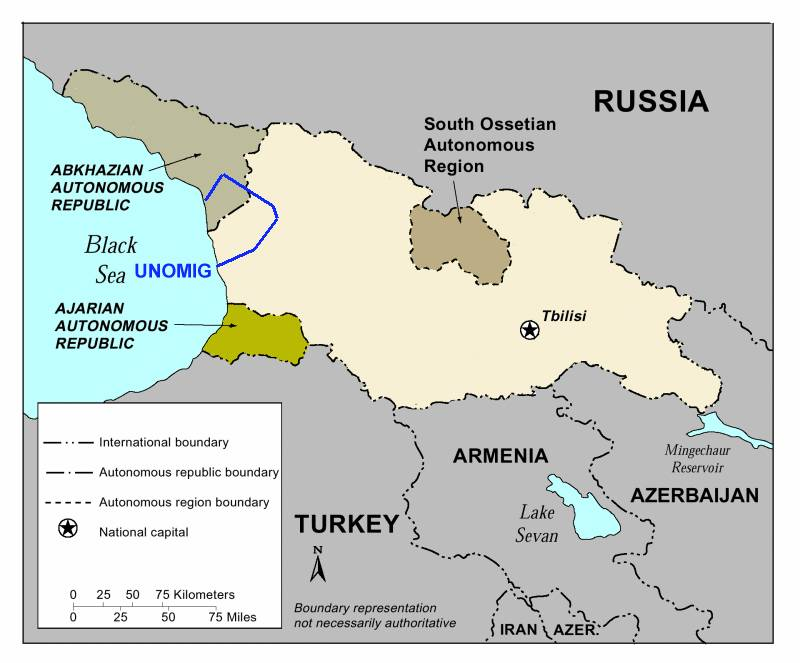
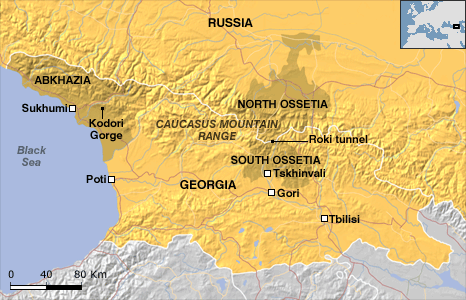
Georgia is an outpost of US and NATO forces, on the immediate border of the
Russian Federation and within proximity of the Middle East Central Asian war
theater. South Ossetia is also at the crossroads of strategic oil and gas
pipeline routes.

  <http://www.globalresearch.ca/articlePictures/georgiamap22.bmp>

  <http://www.globalresearch.ca/articlePictures/georgiamap2.gif>


Georgia does not act militarily without the assent of Washington. The
Georgian head of State is a US proxy and Georgia is a de facto US
protectorate.

Who is behind this military agenda? What interests are being served? What is
the purpose of the military operation.

There is evidence that the attacks were carefully coordinated by the US
military and NATO.

Moscow has accused NATO of "encouraging Georgia". Russia's Foreign Minister
Sergey Lavrov underscored the destabilizing impacts of "foreign" military
aid to Georgia: .

"It all confirms our numerous warnings addressed to the international
community that it is necessary to pay attention to massive arms purchasing
by Georgia during several years. Now we see how these arms and Georgian
special troops who had been trained by foreign specialists are used," he
said.(Moscow accuses NATO of having
<http://rs6.net/tn.jsp?e=001biiDl_o2b5yOiPkI6nFI9j4t69pQhz4S9GQ1gOCwExXIWDfK
GGHbdEr7yMKFHuG0Y6vhk3gvRjPiKN5Q6EdYrNDH8LGtzCKRp90ifu0tUaAFy5dRsBqfkzv9luDK
39khfLb8c771Q5i5-g2Q0T-x0AZuy2unisRycps0-uuNMP8=> "encouraged Georgia" to
attack South Ossetia, Russia Today, August 9, 2008)

Moscow's envoy to NATO, Dmitry Rogozin, sent an official note to the
representatives of all NATO member countries:

"Russia has already begun consultations with the ambassadors of the NATO
countries and consultations with NATO military representatives will be held
tomorrow," Rogozin said. "We will caution them against continuing to further
support of Saakashvili."

"It is an undisguised aggression accompanied by a mass propaganda war," he
said.

(See Moscow accuses NATO of having
<http://rs6.net/tn.jsp?e=001biiDl_o2b5yOiPkI6nFI9j4t69pQhz4S9GQ1gOCwExXIWDfK
GGHbdEr7yMKFHuG0Y6vhk3gvRjPiKN5Q6EdYrNDH8LGtzCKRp90ifu0tUaAFy5dRsBqfkzv9luDK
39khfLb8c771Q5i5-g2Q0T-x0AZuy2unisRycps0-uuNMP8=> "encouraged Georgia" to
attack South Ossetia, Russia Today, August 9, 2008)

According to Rogozin, Georgia had initially planned to:

"start military action against Abkhazia, however, 'the Abkhaz fortified
region turned out to be unassailable for Georgian armed formations,
therefore a different tactic was chosen aimed against South Ossetia', which
is more accessible territorially. The envoy has no doubts that Mikheil
Saakashvili had agreed his actions with "sponsors", "those with whom he is
negotiating Georgia's accession to NATO ". (RIA Novosti, August 8, 2008)

Contrary to what was conveyed by Western media reports, the attacks were
anticipated by Moscow. The attacks were timed to coincide with the opening
of the Olympics, largely with a view to avoiding frontpage media coverage of
the Georgian military operation.

On August 7, Russian forces were in an advanced state readiness. The
counterattack was swiftly carried out.

Russian paratroopers were sent in from Russia's Ivanovo, Moscow and Pskov
airborne divisions. Tanks, armored vehicles and several thousand ground
troops have been deployed. Russian air strikes have largely targeted
military facilities inside Georgia including the Gori military base.

The Georgian military attack was repealed with a massive show of strength on
the part of the Russian military.


  <http://www.globalresearch.ca/articlePictures/ossetiarussia.jpg>

In this image made from television, Russian military vehicles are seen
moving towards the capital of South Ossetia, Tskhinvali, on Friday, Aug. 8,
2008. (AP / APTN)

Act of Provocation?

US-NATO military and intelligence planners invariably examine various
"scenarios" of a proposed military operation-- i.e. in this case, a limited
Georgian attack largely directed against civilian targets, with a view to
inflicting civilian casualties.

The examination of scenarios is a routine practice. With limited military
capabilities, a Georgian victory and occupation of Tskhinvali, was an
impossibility from the outset. And this was known and understood to US-NATO
military planners.

A humanitarian disaster rather than a military victory was an integral part
of the scenario. The objective was to destroy the provincial capital, while
also inflicting a significant loss of human life.

If the objective were to restore Georgian political control over the
provincial government, the operation would have been undertaken in a very
different fashion, with Special Forces occupying key public buildings,
communications networks and provincial institutions, rather than waging an
all out bombing raid on residential areas, hospitals, not to mention
Tskhinvali's University.


<http://www.globalresearch.ca/articlePictures/UniversiteTskhinvali_Osseti.jp
g>
Tskhinvali's University before the bombing

The Russian response was entirely predictable.

Georgia was "encouraged" by NATO and the US. Both Washington and NATO
headquarters in Brussels were acutely aware of what would happen in the case
of a Russian counterattack.

The question is: was this a deliberate provocation intended to trigger a
Russian military response and suck the Russians into a broader military
confrontation with Georgia (and allied forces) which could potentially
escalate into an all out war?

Georgia has the third largest contingent of coalition forces in Iraq after
the US and the UK, with some 2000 troops.  According to reports, Georgian
troops in Iraq are now being repatriated in US military planes, to fight
Russian forces. (See Debka.com, August 10, 2008)
<http://rs6.net/tn.jsp?e=001biiDl_o2b5wdeilefERxOU7d8f89dm2wytHAFKsH71OcWyG7
4FTOCl3ZAg-tNuZ4i3ecppP7ORdIcSJhDoPZrzrGWV1W_eDci4TX-RB4ABlg6ZNG-FHLRyw82MH4
h52e>

This US decision to repatriate Georgian servicemen suggests that Washington
is intent upon an escalation of the conflict, where Georgian troops are to
be used as cannon fodder against a massive deployment of Russian forces.

US-NATO and Israel Involved in the Planning of the Attacks

In mid-July, Georgian and U.S. troops held a joint military exercise
entitled "Immediate Response" involving respectively 1,200 US and 800
Georgian troops.

The announcement by the Georgian Ministry of Defense on July 12 stated that
they US and Georgian troops were to "train for three weeks at the Vaziani
military base" near the Georgian capital, Tbilisi. (AP, July 15, 2008
<http://rs6.net/tn.jsp?e=001biiDl_o2b5ykR7r7BJ0WYmJrl5chGIx8tp1c5R8-WgmTZE9M
Wo3zE-JOSuBnaBeV09TxYq83EPxVsI11mEPnM7jRqpT1CNNoPwHFWzt0-ACXaeWo-ed4kt_7hLkt
q_lcIn7eU3O1cA5ThvEqSZlBNELMfHb3n5lLsAFUKmz7xlG2s3_TQtP90A==> ). These
exercises, which were completed barely a week before the August 7 attacks,
were an obvious dress rehearsal of a military operation, which, in all
likelihood, had been planned in close cooperation with the Pentagon.

The war on Southern Ossetia was not meant to be won, leading to the
restoration of Georgian sovereignty over South Ossetia. It was intended to
destabilize the region while also triggering a US-NATO confrontation with
Russia.

On July 12, coinciding with the outset of the Georgia-US war games, the
Russian Defense Ministry started its own military maneuvers in the North
Caucasus region. The usual disclaimer by both Tblisi and Moscow: the
military exercises have "nothing to do" with the situation in South Ossetia.
(Ibid)

Let us be under no illusions. This is not a civil war. The attacks are an
integral part of the broader Middle East Central Asian war, including
US-NATO-Israeli war preparations in relation to Iran.

The Role of Israeli Military Advisers

While NATO and US military advisers did not partake in the military
operation per se, they were actively involved in the planning and logistics
of the attacks. According to Israeli sources (Debka.com, August 8, 2008
<http://rs6.net/tn.jsp?e=001biiDl_o2b5y9LNn9yefigdO9m8DXD1q8zbYSL6H0YP2JZuxe
FknyBjh5mULDgYmIeJfpcIDWlvaxyRaalc5LuUAEgrUw1ELVcKTv3OXSbsg7a9YESigoQOJhtlvf
hiXBE_MxYM2j9uiJrvvrgmmdzQ==> ), the ground assault on August 7-8, using
tanks and artillery was "aided by Israeli military advisers". Israel also
supplied Georgia with Hermes-450 and Skylark unmanned aerial vehicles, which
were used in the weeks leading up to the August 7 attacks.

Georgia has also acquired, according to a report in Rezonansi (August 6, in
Georgian, BBC translation) "some powerful weapons through the upgrade of
Su-25 planes and artillery systems in Israel". According to Haaretz (August
10, 2008), Israelis are active in military manufacturing and security
consulting in Georgia.

Russian forces are now directly fighting a NATO-US trained Georgian army
integrated by US and Israeli advisers. And Russian warplanes have attacked
the military jet factory on the outskirts of Tbilisi, which produces the
upgraded Su-25 fighter jet, with technical support from Israel. (CTV.ca,
August 10, 2008)

When viewed in the broader context of the Middle East war, the crisis in
Southern Ossetia could lead to escalation, including a direct confrontation
between Russian and NATO forces. If this were to occur, we would be facing
the most serious crisis in US-Russian relations since the Cuban Missile
crisis in October 1962.

Georgia: NATO-US Outpost

Georgia is part of a NATO military alliance (GUAM) signed in April 1999 at
the very outset of the war on Yugoslavia. It also has a bilateral military
cooperation agreement with the US. These underlying military agreements have
served to protect Anglo-American oil interests in the Caspian sea basin as
well as pipeline routes.

Both the US and NATO have a military presence in Georgia and are working
closely with the Georgian Armed Forces. Since the signing of the 1999 GUAM
agreement, Georgia has been the recipient of extensive US military aid.

Barely a few months ago, in early May, the Russian Ministry of Defense
accused Washington, "claiming that [US as well as NATO and Israeli] military
assistance to Georgia is destabilizing the region." (Russia Claims Georgia
in Arms Buildup, Wired News, May 19,
<http://rs6.net/tn.jsp?e=001biiDl_o2b5xuOgZvOjVM8JzYlT9BDjZWlHrT9MBH5hP8UOGj
hKty0mq5r2TJku0ovI-rJ_JZ-YDTQ4svzGoyrm7rkvKD2YECyANAXOt6SR-ziJMsLT5L79G5CIIU
8790BYDGEoV15KE2dFxDhK3XumxtRB48Qhe0sr4q_L0HWsI=>  2008). According to the
Russian Defense Ministry

"Georgia has received 206 tanks, of which 175 units were supplied by NATO
states, 186 armored vehicles (126 - from NATO) , 79 guns (67 - from NATO) ,
25 helicopters (12 - from NATO) , 70 mortars, ten surface-to-air missile
systems, eight Israeli-made unmanned aircraft, and other weapons. In
addition, NATO countries have supplied four combat aircraft to Georgia. The
Russian Defense Ministry said there were plans to deliver to Georgia 145
armored vehicles, 262 guns and mortars, 14 combat aircraft including four
Mirazh-2000 destroyers, 25 combat helicopters, 15 American Black Hawk
aircraft, six surface-to-air missile systems and other arms." (Interfax News
Agency, Moscow, in Russian, Aug 7, 2008)

NATO-US-Israeli assistance under formal military cooperation agreements
involves a steady flow of advanced military equipment as well as training
and consulting services.

According to US military sources (spokesman for US European Command), the US
has more than 100 "military trainers" in Georgia. A Pentagon spokesman Bryan
Whitman "said there were no plans to redeploy the estimated 130 US troops
and civilian contractors, who he said were stationed in the area around
Tblisi" (AFP, 9 August 2008). In fact, US-NATO military presence in Georgia
is on a larger scale to that acknowledged in official statements. The number
of NATO personnel in Georgia acting as trainers and military advisers has
not been confirmed.

Although not officially a member of NATO, Georgia's military is full
integrated into NATO procedures.  In 2005, Georgian president proudly
announced the inauguration of the first military base, which "fully meets
NATO standards". Immediately following the inauguration of the Senakskaya
base in west Georgia, Tblisi announced the opening of a second military base
at Gori which would  also "comply with NATO regulations in terms of military
requirements as well as social conditions." (Ria Novosti, 26 May 2006
<http://rs6.net/tn.jsp?e=001biiDl_o2b5yeUHO7MhN2BvrVbgd4XIMYlMvgXbMaGTIsrXK8
PPG0Irlg-WqBMW_J62q3bjZUL4Fm7TmRL3fMqmBVE87rmuS9QcM3OlzzE0nlvxMwjOHa3CS33xo4
pRXlByseumI_ZjDgPLNJeFMi2VPXRGHyda3k-zSMKTGWmMBHCrL5OEsE-0hjMtRijtQsZNcaaora
6DL8eLntF0n4dw==> ).

The Gori base has been used to train Georgian troops dispatched to fight
under US command in the Iraq war theater.

It is worth noting that under a March 31, 2006, agreement between Tblisi and
Moscow, Russia's two Soviet-era military bases in Georgia - Akhalkalaki and
Batumi have been closed down. (Ibid)  The pullout at Batumi commenced in May
of last year, 2007. The last remaining Russian troops left the Batumi
military facility in early July 2008, barely a week before the commencement
of the US-Georgia war games and barely a month prior to the attacks on South
Ossetia.

The Israel Connection

Israel is now part of the Anglo-American military axis, which serves the
interests of the Western oil giants in the Middle East and Central Asia.

Israel is a partner in the Baku-Tblisi- Ceyhan pipeline which brings oil and
gas to the Eastern Mediterranean. More than 20 percent of Israeli oil is
imported from Azerbaijan, of which a large share transits through the BTC
pipeline. Controlled by British Petroleum, the BTC pipeline has dramatically
changed the geopolitics of the Eastern Mediterranean and the Caucusus:

"[The BTC pipeline] considerably changes the status of the region's
countries and cements a new pro-West alliance. Having taken the pipeline to
the Mediterranean, Washington has practically set up a new bloc with
Azerbaijan, Georgia, Turkey and Israel, " (Komerzant, Moscow, 14 July 2006)

  <http://www.hinduonnet.com/fline/fl2213/images/20050701000805902.jpg>

While the official reports state that the BTC pipeline will "channel oil to
Western markets", what is rarely acknowledged is that part of the oil from
the Caspian sea would be directly channeled towards Israel, via Georgia. In
this regard, a Israeli-Turkish pipeline project has also been envisaged
which would link Ceyhan to the Israeli port of Ashkelon and from there
through Israel's main pipeline system, to the Red Sea.

The objective of Israel is not only to acquire Caspian sea oil for its own
consumption needs but also to play a key role in re-exporting Caspian sea
oil back to the Asian markets through the Red Sea port of Eilat. The
strategic implications of this re-routing of Caspian sea oil are
far-reaching. (For further details see Michel Chossudovsky, The War on
Lebanon and the Battle for Oil
<http://rs6.net/tn.jsp?e=001biiDl_o2b5z0EqXM4v4Y9WaudG7tcZq53BHB9WJ7BMQjJxW-
0QeC5cQzroE8VAIyLm3NNK0uYaixMm9BSAhqeuksI7XBelr2iR6zTxJi48818YvKh4ofb5FG8YNN
Oui16sXd38q1Oiv6riIsebN8TK8YLcx4U0eArh0LReYd5jNF4nS2MQ0X9X5C_vDMBrswrmMtd5Pe
zmdR7FXJ63GyOebtCKeIlk2s> , Global Research, July 2006)

What is envisaged is to link the BTC pipeline to the Trans-Israel
Eilat-Ashkelon pipeline
<http://rs6.net/tn.jsp?e=001biiDl_o2b5ym4dBFJkA8oCRgt8_-4x2Qnwg3zD7vUEu000FS
BdJsgAOKZO22y5sPEZhZ8UX25u-RTpI2Jl-Fja5UPZl-R4tY-3p3mo2IKwL358ju9GOQOkIvQvVD
8blJ> , also known as Israel's Tipline, from Ceyhan to the Israeli port of
Ashkelon.

"Turkey and Israel are negotiating the construction of a
multi-million-dollar energy and water project that will transport water,
electricity, natural gas and oil by pipelines to Israel, with the oil to be
sent onward from Israel to the Far East,

The new Turkish-Israeli proposal under discussion would see the transfer of
water, electricity, natural gas and oil to Israel via four underwater
pipelines.

http://www.jpost.com/servlet/Satellite?cid=1145961328841
<http://rs6.net/tn.jsp?e=001biiDl_o2b5wR_TZlftScn-4Vl9jaEaKJcJkb6bCQw-AG46uL
-UtGdEYKmRdG2vcG0oqnWcUdUzJ_7Kc-wPYoQHMvK4qyNssci6QVv7dgsRQJrRpOB_ekKSV_umP2
zrk6sMEsykoILsaIfDycCJa4Uy-9BYhf4SXsBUN6IIb3IbJWf4KsrX8yXrjd5Qdfsj5T6Tc2FSZj
HXbb9LRh4eDInVpgqLd0_bZk> &pagename=JPost%2FJPArticle%2FShowFull

"Baku oil can be transported to Ashkelon via this new pipeline and to India
and the Far East.[via the Red sea]"

"Ceyhan and the Mediterranean port of Ashkelon are situated only 400 km
apart. Oil can be transported to the city in tankers or via specially
constructed under-water pipeline. From Ashkelon the oil can be pumped
through already existing pipeline to the port of Eilat at the Red Sea; and
from there it can be transported to India and other Asian countries in
tankers. (
<http://rs6.net/tn.jsp?e=001biiDl_o2b5xCK93ptn6fs556y4Pfj37HXMaj1um_amT-IYWH
gtiZYrVgqIXvCRR8IIIXTdk0W69yvRuiWysIsUigCbaPgO9BrsgjvrVQ00TDXdDtp6_79ySrbt3q
fJY_> REGNUM)

In this regard, Israel is slated to play a major strategic role in
"protecting" the Eastern Mediterranean transport and pipeline corridors out
of Ceyhan. Concurrently, it also involved in channeling military aid and
training to both Georgia and Azerbaijan.

A far-reaching 1999 bilateral military cooperation agreement between Tblisi
and Tel Aviv was reached barely a month before the NATO sponsored GUUAM
agreement. It was signed in Tbilisi by President Shevardnadze and Israel's
Prime Minister Binyamin Netanyu. These various military cooperation
arrangements are ultimately intended to undermine Russia's presence and
influence in the Caucasus and Central Asia.

In a pro forma declaration, Tel Aviv committed itself, following bilateral
discussions with Moscow, on August 5, 2008, to cut back military assistance
to Georgia.

Russia's Response

In response to the attacks, Russian forces intervened with conventional
ground troops. Tanks and armored vehicles were sent in. The Russian air
force was also involved in aerial counter-attacks on Georgian military
positions including the military base of Gori.

The Western media has portrayed the Russian as solely responsible for the
deaths of civilians, yet at the same time the Western media has acknowledged
(confirmed by the BBC) that most of the civilian casualties at the outset
were the result of the Georgian ground and air attacks.

Based on Russian and Western sources, the initial death toll in South
Ossetia was at least 1,400 (BBC) mostly civilians.  "Georgian casualty
figures ranged from 82 dead, including 37 civilians, to a figure of around
130 dead.... A Russian air strike on Gori, a Georgian town near South
Ossetia, left 60 people dead, many of them civilians, Georgia says." (BBC,
August 9, 2008). Russian sources place the number of civilian deaths on
South Ossetia at 2000.

A process of escalation and confrontation between Russia and America is
unfolding, reminiscent of the Cold War era.

Are we dealing with an act of provocation, with a view to triggering a
broader conflict?  Supported by media propaganda, the Western military
alliance is intent on using this incident to confront Russia, as evidenced
by recent NATO statements.


  _____


© Copyright Michel Chossudovsky, Global Research, 2008

The url address of this article is:
www.globalresearch.ca/index.php?context=va
<http://rs6.net/tn.jsp?e=001biiDl_o2b5xIQ9lwPdwt23Dc1qlFsxsaljVPHf3pcq6AiRBb
pm3W4IOG3XWlVJ4ZT-NlNQeIc_HyEFzzrPvVyjAkAutQzp1-Bbbr0P6eTTXgYnR0OviEafCSixgP
Z2qRMQUpNe1PiaFyKX10S_2xBN63sQ8zW83r1iU9DdxJut0=> &aid=9788


  _____


 <http://www.constantcontact.com/index.jsp?cc=custom01> Email Marketing by

 <http://www.constantcontact.com/index.jsp?cc=custom01>


GlobalResearch.ca | v | montreal | Canada